


Spending on domain-specific language models and specialized generative AI grew 210% in a single year, from $1.58B to $4.91B, according to Gartner's forecast of the worldwide AI platforms and models market. This number roughly doubles the growth rate of foundation model spending in the same period, within a total market that climbed from $39B to $64B, and the money is moving toward narrower models, and it is moving fast.
General-purpose models have made intelligence cheap and abundant, meaning intelligence alone no longer differentiates a product. Today, the specific layer where differentiation lives is domain specific AI: it encodes the vocabulary, the edge cases, the regulatory constraints, and the workflow logic that exist only within a particular industry or company.
Domain AI has already earned its place on the roadmap, so the strategic question has narrowed to which paths get teams to their goal, and what each one costs in capital, time, and optionality. Building a domain specific LLM from scratch, buying a vertical AI product, and adapting a general model with your own data are three different bets, each with its own failure mode, and most teams commit to one before an honest operating model assessment.
What is Domain AI vs a General-Purpose LLM?
Domain AI is artificial intelligence trained, tuned, or constrained to operate within a specific field of knowledge, industry, or business function rather than across general human language. Furthermore, a domain specific language model is the concrete artifact, the language model whose training data, vocabulary, evaluation criteria, and guardrails are narrowed to one domain, such as clinical documentation, insurance claims adjudication, semiconductor process engineering, or contract review.
The difference from a general-purpose LLM is architectural in intent. A general model optimizes for breadth, so it performs acceptably on almost any prompt and exceptionally on none of the ones that matter to your business; a domain specific LLM trades it for precision inside a bounded task space, which is exactly the trade a product team wants when the task is repetitive, high-volume, and expensive to get wrong.
A genuine domain AI differs from a general model in three ways:
- Vocabulary fidelity: The model treats domain terms as first-class concepts, so "material weakness" in an audit context does not drift toward a structural engineering meaning.
- Constrained output space: The model is bounded to produce outputs your downstream systems can actually consume, which turns generation into a reliable interface.
- Domain-calibrated evaluation: Success is measured against expert judgment inside the domain. A model that scores well on Massive Multitask Language Understanding (MMLU) tells you nothing about whether it can code a claim correctly.
The related family of Small Language Models (SLMs) overlaps heavily with this category. NVIDIA researchers led by Peter Belcak argue that SLMs are the appropriate default for agentic systems precisely because agents perform "a small number of specialized tasks repetitively and with little variation." Gartner reached a compatible conclusion, predicting that by 2027 organizations will use small, task-specific models at three times the volume of general-purpose LLMs.

Why Are Enterprises Moving Budget Toward Domain Specific Language Models?
Enterprises are shifting budget toward domain-specific language models because general models fail in areas such as narrow vocabulary, auditable decisions, and unit economics that must withstand millions of calls per month. Thousands of companies ran a general-model pilot and could not justify its cost per outcome, because response accuracy in general-purpose LLMs declines when tasks require specific business-domain context; domain-specific AI recovers that accuracy by narrowing what the model is asked to know.
There's also the economic driver: smaller task-specific models return answers faster with less compute, reducing both inference costs and the operational overhead of running the system. When a feature is called on every record rather than on every demo, the difference between a frontier model and a tuned small model is the difference between a viable gross margin and a subsidized one.
Furthermore, there's the accountability driver. ISACA Chief Global Strategy Officer Chris Dimitriadis notes that Domain-Specific Language Model (DSLMs) can maintain audit trails and cite regulatory sources, and points to Gartner projections that 40% of enterprise applications will feature task-specific AI agents by the end of 2026, up from under 5% in 2025, while more than 50% of enterprise generative AI models will be industry or function-specific by 2027, against roughly 1% in 2023.
There's a counterweight of failure rate, with Gartner also predicting that over 40% of agentic AI projects will be canceled by the end of 2027 due to escalating costs, unclear business value, or inadequate risk controls, and that only 19% of the 3,412 organizations it polled had made significant agentic investments. The budget is moving toward vertical AI and specialization, yet a large share of the projects consuming that budget still get killed, which is a strong argument for choosing your path deliberately.
When To Build, Buy, or Adapt a Domain Specific LLM?
The choice among building, buying, and adapting a domain specific LLM comes down to three variables: how proprietary your domain data is, how central the AI capability is to your product's value proposition, and how much of your operating model you can realistically rebuild around it.
Building a Domain Specific Model
Building means pretraining or heavily post-training your own model on a corpus you control, which makes sense in a narrow set of conditions: you hold a proprietary dataset that no competitor can license, the domain vocabulary exceeds general models, and the AI capability is the reason customers buy. The cost profile is capital-intensive and the time to first production value is measured in quarters, so this path suits companies where model quality is the moat and the balance sheet can absorb a research function. The honest disqualifier is data volume and labeling discipline. Most Series A through C companies hold interesting data rather than sufficient data, and discovering that after committing a year of engineering is the expensive way to learn it.
Buying a Vertical AI Model
Buying means licensing a vertical AI product or a pre-trained industry model and integrating it, and can be the right call when the capability is table stakes, when a credible vendor already has domain depth you would take years to accumulate, or when your competitive pressure is measured in months. The tradeoff is strategic dependency, since your roadmap now contains a component you do not control, priced by someone whose incentives diverge from yours, and switching costs compound quietly. Buying also concentrates risk in vendor viability. Gartner counts only about 130 of the thousands of self-described agentic AI vendors as offering real capability, which makes diligence on the vendor's own durability part of the purchase decision rather than an afterthought.
Adapting a General AI Model
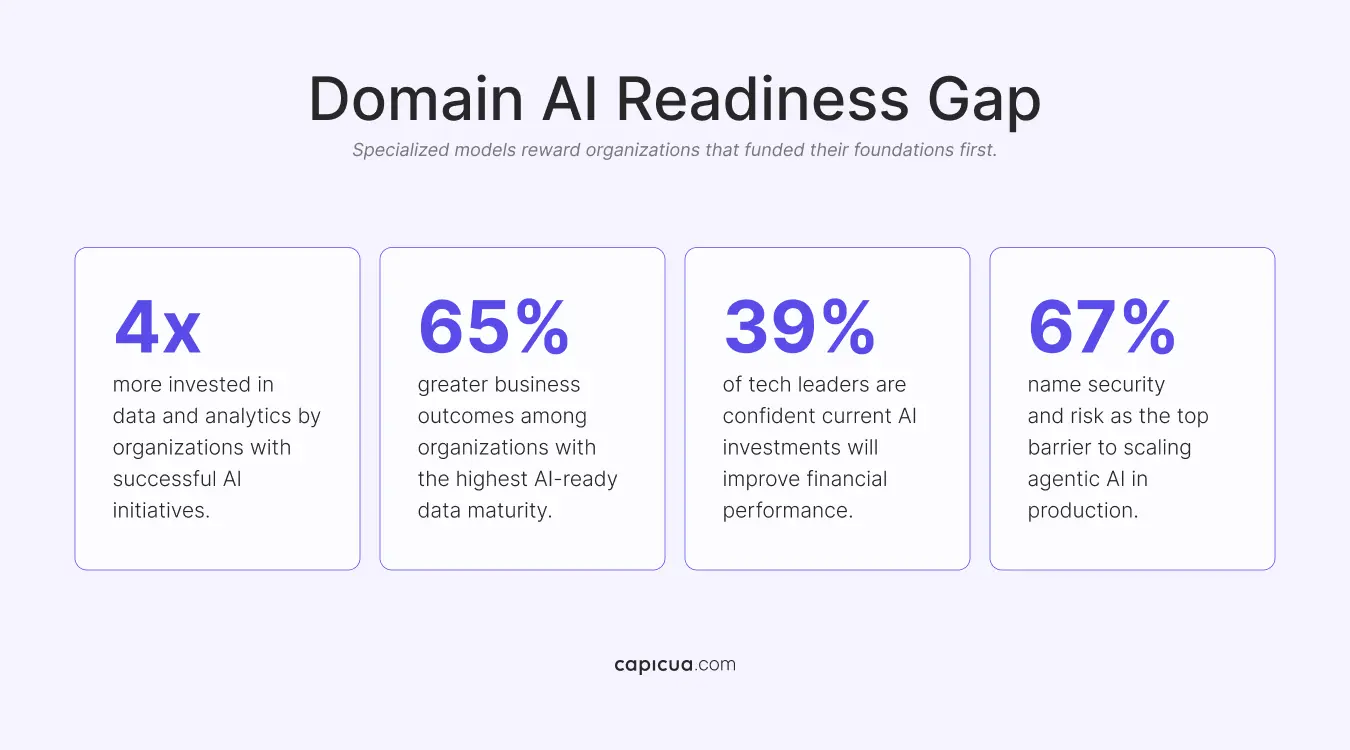
Adapting means taking a strong general model and specializing it through Retrieval-Augmented Generation (RAG), fine-tuning, context engineering, and domain-specific evaluation harnesses. For most post-PMF B2B software companies, this setup preserves optionality because the underlying model remains swappable, it turns your proprietary data into an advantage without requiring a research team, and it delivers measurable results in weeks rather than quarters. However, the path requires data readiness: Gartner reports that organizations with successful AI initiatives invest up to 4 times more of their revenue in foundational data and analytics capability, and most AI-ready data organizations achieve 65% greater business outcomes.
How To Turn a General Model Into Domain Specific AI?
Turning a general model into domain-specific AI is a sequence of narrowing decisions, with each stage reducing the cost of the next.
- Define the bounded task: Specify the exact decision the model makes, the inputs it receives, and the output schema your systems consume. A model with an unbounded job cannot be evaluated, and a capability that cannot be evaluated cannot be improved.
- Build the evaluation set: Assemble a few hundred expert-labeled examples that represent your real distribution, including the edge cases that generate support tickets, to be able to measure whether any later change helped.
- Engineer context: Retrieval, structured prompting, and tool access resolve a large share of domain gaps at a fraction of the cost of training, and they update the instant your underlying knowledge changes.
- Fine-tune for form, retrieve for fact: Use fine-tuning to teach the model the shape of your domain (tone, format, taxonomy, and reasoning pattern) and use RAG to supply facts that change. Reversing these produces a model that is confidently outdated.
- Constrain and instrument the output: Enforce schemas, add domain validators, and log every decision with its inputs so that wrong answers are diagnosable.
- Right-size the model last: Once accuracy holds, distill or substitute with a smaller model, then rerun the evaluation set. Inference cost falls by an order of magnitude without a corresponding drop in quality.
McKinsey's State of AI trust research found that roughly 67% of organizations cite security and risk as the top barrier to scaling agentic AI, that 74% flag inaccuracy as a material concern, and that organizations with clear accountability for responsible AI score 2.6 on maturity, compared with 1.8 for those without it. Organizations "can no longer concern themselves only with AI systems saying the wrong thing; they must contend with systems doing the wrong thing."

What Makes Domain Specific AI a Defensible Product Advantage?
Domain specific AI becomes defensible when the advantage compounds from something a competitor cannot buy, which, in practice, means proprietary data, an owned workflow, or accumulated expert judgment encoded into the evaluation.
There are three sources of durable advantage worth designing for:
- Data flywheel: To ensure every customer interaction improves your domain specific LLM and cannot be replicated elsewhere, design data capture into the product surface.
- Workflow ownership: When your product is where the work happens, your model sees context that a competitor querying the same foundation model never receives. Vertical AI wins on depth of workflow far more often than on model sophistication.
- Expert-calibrated evaluation: An evaluation suite built over years by domain specialists is the hardest asset to replicate, because it encodes judgment not documented elsewhere.
Products that wrap a general model in a thin interface inherit that model's roadmap and its pricing power, and they get absorbed the moment the underlying provider ships the same feature. Capicua's work on preserving product value in the AI era traces this pattern: throughput stops being the constraint, and the new constraint becomes knowing what must remain true about your product as models change beneath it.
Gartner's strategic predictions for 2026 project that by 2028, 90% of B2B buying will involve AI agents, routing over $15T in spend through agent-mediated exchanges. Products whose domain logic is legible to those agents will be selected, and products whose value is locked in an interface no agent can parse will not.

What Does Domain AI Require From Your Operating Model?
Domain AI requires an operating model where data quality, evaluation discipline, and decision ownership are standing functions. The latter is the requirement most teams underestimate, and it's why the strategy and organizational questions cannot be answered separately. Four capabilities distinguish organizations that ship domain specific language models successfully:
- Named owner: Someone whose job is the model's accuracy against business results, with authority to stop a release. Accountability maturity quantifies the value of this ownership.
- Continuous evaluation: Model quality degrades silently when data drift occurs, so evaluation belongs in CI rather than in a quarterly review.
- Funded data foundations: The 4x investment differential Gartner measured is the price of admission, and it is spent before the model produces value.
- A reversibility plan: Every model decision should have a documented path back, because the alternative is discovering your architecture is load-bearing after it fails.
Teams modernizing an existing platform face this most acutely, since the domain knowledge worth encoding is usually trapped in systems nobody wants to touch. Capicua's approach to AI-driven legacy modernization treats that extraction as the first deliverable.
The decision between building, buying, and adapting domain specific AI is a clarity problem, because each path commits your team to a different set of constraints for years. Shaped Clarity™ establishes what must remain true about your product before a model, a vendor, or a roadmap starts making decisions on your behalf. When the logic, data, and outcomes are explicit, choosing your path becomes an evidence question. Discover how to leverage Shaped Clarity here.
Conclusion
A segment growing 210% in a year is a clear verdict on where enterprises expect domain specific language models to pay off. What the market has not answered, and cannot answer for you, is which path fits your data, your product, and your organization's actual capacity to absorb change. The advantage over the next two years goes to product leaders who can defend their domain specific AI decisions with evidence from their own domain.
Make a confident decision about domain specific AI: contact us or book a call.