

Teams using vibe coding and adjacent AI tooling are shipping more software than ever while believing less of what they ship, and that's where the bill for vibe coding gets written. The first version arrives in an afternoon, but the invoice arrives at scale, in the form of production incidents, security remediation, duplicated logic no one can safely delete, and senior engineers spending their weeks on forensics instead of architecture.
According to Google Cloud's 2025 DORA report, 90% of devs now use AI at work, and 80% of them believe it has made them more productive. However, Stack Overflow's developer research found trust in AI tool accuracy has fallen to 29%, down eleven percentage points in a single year, even as adoption climbed to 84%.
Vibe coding AI has collapsed the cost of exploration, and any leader who dismisses that is arguing against the evidence. The harder truth is that the cost of generating software fell much faster than the cost of owning it, and the judgment to know what deserves to exist has not been automated at all. This piece looks at both halves honestly.

What is Vibe Coding?
Vibe coding is the practice of building software by describing the desired outcome in natural language and accepting the AI's output without reading or reasoning about most of the generated code. The term comes from Andrej Karpathy's February 2025 post, where he described a workflow in which you "fully give in to the vibes, embrace exponentials, and forget that the code even exists."
The answer to the questions "what's vibe coding?" and "how it differs from ordinary AI-assisted development?" should focus on comprehension. Engineer Simon Willison drew the boundary clearly in his widely cited breakdown: reviewing, testing, and understanding AI output is AI-assisted programming; shipping code you have not read is vibe coding. Both use the same vibe coding platforms, but only one of them transfers ownership of the result.
Gartner expects 40% of new enterprise production software to be built using vibe coding techniques by 2028, and predicts that doing so without governance will drive a 2,500% increase in defects over the same period. Meanwhile, 63% of people using these tools have never worked as developers: organizations are absorbing a new production input authored largely by people who cannot evaluate its output.
Three uses of "vibe code" now circulate, and conflating them causes bad decisions:
- Disposable vibe coding: Internal scripts, one-off dashboards, throwaway prototypes with lifespan measured in weeks and correctly zero-governance.
- Exploratory vibe coding: Clickable prototypes and spike solutions built to test a hypothesis before committing engineering capacity, both genuinely valuable and genuinely meant to be thrown away.
- Production vibe coding: Customer-facing systems handling real data, real money, and real compliance obligations, assembled by prompt and shipped without full review.

Why Do Vibe Coding Platforms Win the First Ninety Days?
Vibe coding platforms win early because prototyping rewards speed over durability, and AI has compressed the distance between an idea and something a stakeholder can click. McKinsey's research on AI-native development reports 20% to 50% productivity improvements across development tasks and 16% to 30% gains in delivery time and team productivity where AI is treated as foundational rather than bolted on.
Median task completion time for building new features drops by 20%-45% with AI assistance, per Forbes' analysis of the vibe coding productivity paradox. Vibe coding software delivers its most defensible return in greenfield work, unfamiliar frameworks, boilerplate, glue code, and throwaway internal tooling.
The market has priced this in. Lovable reached $100 million in annual recurring revenue within eight months of launch with 180,000 paying subscribers, and Cursor hit a $29.3 billion valuation at roughly $1 billion in annualized revenue. Demand for vibe coding AI is real, and the tools deliver on the promise they actually make: getting to a working artifact fast.
However, there are two nuances to consider before allocating budget. The first nuance concerns unevenly distributed gains: senior developers with 10 or more years of experience report productivity gains of around 81%, while junior developers show no measurable improvement in output. The second nuance is that self-reported gains often overstate reality: METR's randomized controlled trial and its February 2026 follow-up found that experienced open-source developers were roughly 20% slower on real tasks when using AI tools, while estimating afterward that AI had made them 20% faster.
What Does Vibe Coding Cost at Scale?
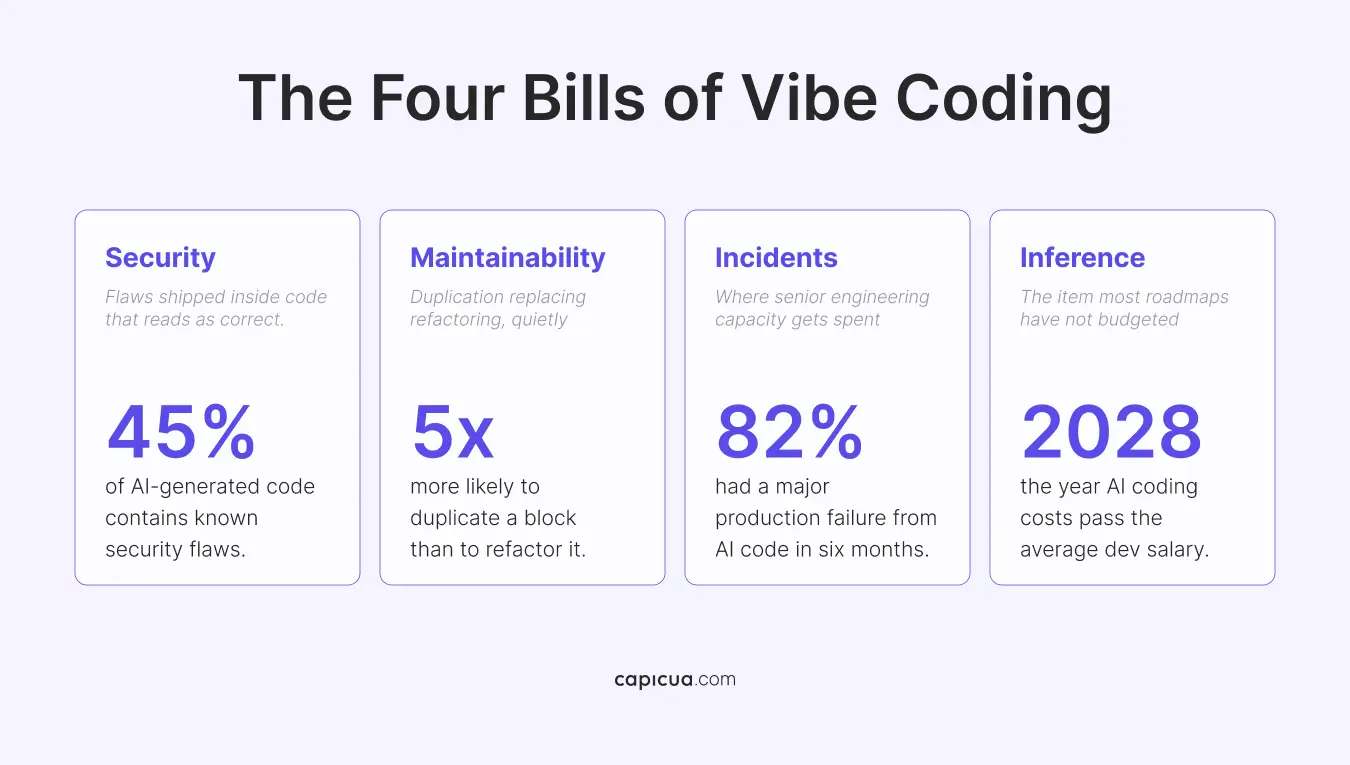
Vibe coding costs compound across four bills that arrive after launch: security remediation, maintainability decay, production incidents, and inference spend. Each is measurable and documented in current research, yet none appears in the demo that convinced the team to adopt the tool.
Vibe Coding Security
Veracode's Spring 2026 GenAI Code Security update tested more than 150 models across 80 coding tasks and found that roughly 45% of AI-generated code contains known security flaws, with the overall security pass rate stalled near 55%. Java performed worst at a 29% pass rate. Cross-site scripting failed 85% of the time, and log injection 87%. Even reasoning-focused models topped out at 70%-72%. However, within AI code security vulnerabilities, syntax correctness exceeds 95%, which makes the code look correct.
Vibe Coding Maintainability
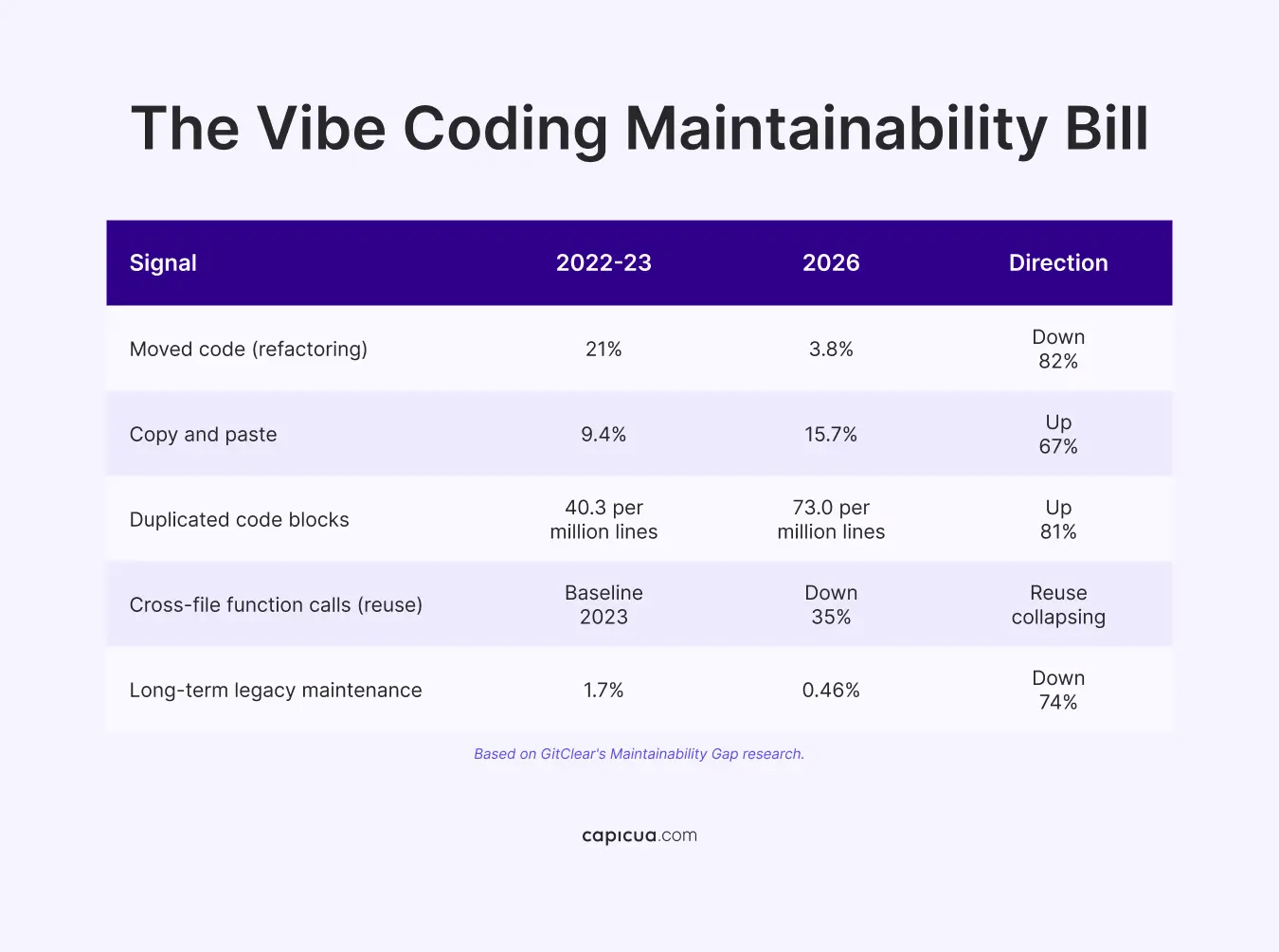
GitClear's Maintainability Gap research, published in January 2026, based on 623 million analyzed code changes spanning 2023 to 2026, documents the structural cost. Developers are now roughly five times more likely to duplicate a block than to refactor it. At scale, duplication becomes the mechanism by which a single fix turns into eleven fixes and a missed instance turns into an incident.
Vibe Coding Incidents
New Relic's State of AI Coding 2026 survey of 200 US technology decision-makers, published in June 2026, quantifies what happens when this reaches production. 78% of organizations report measurable spikes in production incidents directly tied to AI-generated code, and 82% suffered at least one major production failure caused by AI code in the preceding six months. AI-generated code introduced roughly 1.7 times as many critical runtime issues as peer-reviewed human code. 74% report that at least a quarter of AI-generated code required significant post-deployment rework.
Vibe Coding Inference
Gartner predicts that by 2028, AI coding costs will surpass the average developer's salary as token consumption rises and vendors shift to consumption-based pricing. Nitish Tyagi, Senior Principal Analyst at Gartner, notes that "token discipline will not emerge through developer choice alone, as developers tend to optimize for speed and convenience over cost efficiency." Budgets are being depleted earlier than expected, and most organizations lack the frameworks to measure cost against business impact.

Why Does Vibe Coding AI Break Down When Something Goes Wrong?
Vibe coding AI breaks down during incidents because debugging requires a mental model of the system, and unreviewed code was never loaded into anyone's head. Generation transfers artifacts. It does not transfer understanding.
Stack Overflow's 2025 Developer Survey, covering more than 49,000 developers, found 66% of developers now spend more time fixing "almost-right" AI-generated code. Code that is 90% correct is harder to repair than code that is obviously broken because the failure hides within a plausible structure: it's cheap to create yet expensive to locate.
Scale turns this from an annoyance into an operational risk. New Relic found that 86% of organizations report increased senior engineer firefighting and emergency intervention, with senior DevOps and SRE teams spending up to a third of their active workweeks triaging and refactoring machine-generated failures. Your most expensive and most strategically valuable people are being converted into an incident response function.
The review discipline that would catch this is thinning at exactly the wrong moment. According to New Relic, 62% of engineering leaders admit their teams often or always trust AI code enough to ship without line-by-line verification, and 41% of developers acknowledge pushing AI code to production without full review. Meanwhile, 94% of tech leaders rate AI-generated code as higher quality than human code during review, a confidence level that sits uncomfortably beside a 45% vulnerability rate.
Production failures cluster predictably, each affecting close to 30% of organizations:
- Integration failures: Generated code satisfies its local prompt while violating an assumption held somewhere else in the system.
- Compliance and governance gaps: Data handling, audit trails, and access control are rarely specified in a prompt, so they are rarely implemented.
- Data-integrity problems: Schema drift, silent type coercion, and missing constraints surface only after real users generate real volume.

How Does Vibe Coding Shift the Engineering Bottleneck?
Vibe coding moves the bottleneck from writing code to reviewing it, and most engineering organizations have not resized the second function to match the first. Generation capacity scaled by an order of magnitude, but review capacity stayed roughly constant because it's bounded by human attention and system knowledge.
According to the DORA research, AI adoption correlates positively with software delivery throughput and product performance, and it continues to correlate negatively with delivery stability. Teams ship more and break more, and that combination, survivable in a prototype, is corrosive in a platform that customers depend on.
Three structural pressures show up in scaling teams:
- Review throughput becomes the constraint: Pull request volume grows while reviewer hours do not, so reviews either slow delivery or degrade into rubber-stamping.
- Architectural coherence erodes quietly: With refactoring collapsed to 3.8% of changes and cross-file reuse down 35%, systems accumulate implementations of the same idea.
- Institutional knowledge stops accumulating: The fact that long-term legacy maintenance fell 74% describes a workforce that stopped tending the systems it depends on, which is precisely how a codebase becomes unmodifiable.
90% of organizations have adopted at least one internal platform, and there is a direct correlation between high-quality internal platforms and the ability to unlock AI value.
What Judgment Can Vibe Coding Software Never Replace?
Vibe coding software can generate any feature you can describe, so description quality becomes the binding constraint. The scarce input is judgment and deciding what deserves to exist, what evidence justifies building it, and what the product should refuse to do.
Engineering teams rework about 26% of their code before release, which can cost a mid-sized business upwards of $4.7 million a year, as covered in Capicua's analysis of how to reduce rework in software development. Cheap generation only increases the volume of decisions flowing through the same unchanged decision-making capacity, which is how teams end up rebuilding a product they only just launched.
McKinsey's framing of AI-native development captures the shift in which developers "no longer write exhaustive rules, but they shape the environment by defining boundaries, constraints, and objectives." Boundaries and objectives are judgment artifacts that arise from evidence about users, a defensible view of the market, and a willingness to say no.
There are four decisions teams can take to stay human:
- What to build: Model output is downstream of the prompt, and the prompt encodes a bet about user value. A wrong bet executed in one afternoon is still a wrong bet, now with a maintenance obligation attached.
- What evidence clears the bar: Deciding which signals justify committing engineering capacity is an organizational standard, not a capability a vibe coding platform provides.
- What the system must guarantee: Latency budgets, data boundaries, failure modes, and compliance obligations are architectural intents that prompts inherit when stated.
- What to delete: Deciding which parallel implementation survives requires knowing which one the business depends on. That knowledge lives with people, and preserving product value in the AI era depends on keeping it there.

How Can Teams Scale Vibe Coding Without Paying the Debt Tax?
Teams scale vibe coding safely by classifying work before generating it, then applying verification proportional to the blast radius. The goal is to keep the speed advantage where it compounds and to refuse it where it accumulates liability.
- Classify every artifact before the first prompt: Disposable, exploratory, or production. Only the third tier requires full review, test coverage, and architectural sign-off. Making the tier explicit prevents a prototype from drifting into the critical path by accident.
- Set a hard rule on unread code: No unreviewed AI output reaches a customer-facing path. With 45% of generated code carrying known flaws, review is a control.
- Fund review capacity alongside generation capacity: Treat reviewer hours as infrastructure. Budget them when adopting vibe coding platforms, and measure review latency as a first-class delivery metric.
- Automate the checks a human will skip: Static analysis, dependency scanning, and security testing in the pipeline catch the flaws that reviewers miss at volume, particularly cross-site scripting and injection, where models fail most often.
- Instrument before you accelerate: 96% of leaders rate observability as critical for AI-generated environments, and 78% now prompt for logging hooks and custom metrics in the initial output. What you cannot observe you cannot operate.
- Protect refactoring time as a standing commitment: With reuse down 35% and duplication up 81%, consolidation has to be scheduled work rather than hoped-for reach.
- Govern token spend like cloud spend: Attribute cost per team and per workflow now, before consumption-based pricing turns AI coding into a line item that rivals headcount.
- Keep discovery ahead of execution: Cheap building raises the value of knowing what to build, so evidence standards should tighten as generation costs fall, a discipline that shapes any SaaS roadmap built to survive scaling.
Shaped Clarity™ exists for the moment when generation capacity outruns decision capacity, and teams ship faster than they can tell whether shipping helped. It keeps evidence ahead of execution, so speed is spent on validated bets rather than on plausible ones. Products built this way leverage AI acceleration, because the judgment layer scales alongside the tooling rather than being replaced by it. Discover Shaped Clarity here.
Conclusion
Vibe coding has permanently lowered the cost of producing software, and that change is real, measurable, and worth using. The costs now live in security remediation, duplicated logic, production incidents, senior engineers on permanent call, and token bills projected to rival salaries. But look at the encouraging part: every one of those costs is a function of governance rather than of tooling. Generation is now abundant. Judgment about what deserves to exist is the scarce asset, and it compounds for those that invest in it.
Capture AI development speed without AI technical debt: contact us or book a call.