


There's a story often told in Silicon Valley boardrooms, pitch decks and product retrospectives: "the company that moved fastest won." Like most compelling narratives, it contains just enough truth to make it genuinely dangerous.
Speed maps neatly onto the urgency executives feel, the timelines investors impose and the anxiety that comes from watching a competitor ship features you haven't built yet. A seductive force, speed looks like progress, like momentum. And when someone presents a 90-day roadmap that promises a faster trajectory, your instinct may be to lean in.
But here's the counterintuitive reality: speed is not a proxy for progress. In digital products, moving fast without the right foundations mortgages growth rather than accelerating it. And that difference is what separates companies with durable, compounding growth from those that plateau, churn through customers or collapse under their own technical weight.
Speed may map neatly onto the urgency executives feel, but is no longer a proxy for progress.
This article is for decision-makers who sense that something is off in how their product is being built or grown. You may be watching impressive velocity but underwhelming retention, or your dozen features yet feel further from product-market fit than when you started.
If you're evaluating a product growth partner and trying to understand what separates a firm that will move quickly from one that will build something that lasts, what follows is a grounded, evidence-based case for why sustainable digital product growth demands that you reconsider speed as the primary metric.

The Allure of Speed
The "move fast and break things" doctrine, coined by Mark Zuckerberg as Facebook's internal motto, was born in an era of relatively open digital markets: distribution was cheap, venture capital was abundant and the first mover in a category could claim enormous, defensible territory before rivals could respond.
That era rewarded speed because the cost of getting to market slowly and losing the category to a faster competitor was often higher than the cost of building something imperfect. In that environment, speed really was a competitive advantage.
The cost of building something imperfect is no longer lower than the cost of getting to market slowly.
But today's digital product landscape looks nothing like it was in the early 2010s. Markets are more saturated, users are more sophisticated and more demanding, switching costs have dropped, and user patience has collapsed. In 2019, the Harvard Business Review called for a shift from "minimum viable products" to "minimum virtuous products," and even Zuckerberg changed the motto to "move fast with stable infrastructure."
The cost of a bad digital product stopped being a temporary setback and became a permanent loss of trust in an environment where competitors are one click away. Companies that treat speed as the primary signal of health are building on sand, and shipping fast often becomes synonymous with losing customers fast, even if leaders do not connect the dots.
Today's saturated markets, with discerning users and lower switching costs, lead to companies that prioritize speed alone to risk rapid customer loss.
The Debt Trap
The most concrete and measurable way speed undermines long-term growth is by accumulating technical debt. Every time a development team takes a shortcut (a quick fix, a workaround, a decision made for speed rather than durability), they create a liability that will cost more to resolve in the future than it would have cost to build correctly now.
That technical debt accounts for approximately 40% of IT balance sheets across companies, and companies in the 80th percentile for technical debt management had revenue growth 20% higher than those in the bottom 20th percentile and 10% higher than the average.
As speed becomes a tax on the future, decisions made in the name of moving fast have directly cost the company hundreds of millions of dollars in future growth.
More than 20% of technical budgets ostensibly dedicated to new products are actually diverted to resolving issues created by accumulated debt. Developers waste between 23% and 42% of their time because of technical debt.
Accenture's 2024 research found that organizations that balance speed with disciplined management of their technical debt achieve 60% higher revenue growth and 40% higher profits than their peers. Gartner also found that companies that effectively manage their technical debt can deliver services and solutions at least 50% faster over the long run.

The Vanity Metrics
Vanity metrics are the perfect, natural partner of speed when discussing misleading success. Metrics like downloads, page views, sign-ups, or feature launch velocity measure activity at the top of the funnel without indicating whether users find sustained value in what has been built, and can mask the dynamics that will eventually kill growth.
Vanity metrics measure activity but don't show if users find sustained value in what you've built.
Let's say a SaaS product onboards 500 new users per month—sounds exciting, doesn't it? Well, if 30% of those users churn within the first 90 days, you're burning acquisition spend to inflate a user base that isn't actually growing. You can be signing up new users daily, but if most leave after a month or two, your MRR stagnates or shrinks.
A monthly churn rate above 5% means annual retention falls below 50%, but a 5% improvement in retention can drive a 25% to 95% increase in profits over time. Acquiring a new customer costs 5 times as much as retaining an existing one, yet up to 65% of revenue comes from existing customers, not new ones. Retention is not a support metric but the primary engine of compounding growth.

The Transformation Rate
The gap between speed and sustainable outcomes is clear in digital transformation research, as studies show that over 70% of companies fail to capture value from DX efforts due to a lack of clear goals or strategy. Additionally, only 30% of transformations succeed due to a lack of focus on change management, and fewer than 20% of employees believe their company's digital reforms have enhanced productivity and are long-term sustainable.
Many of these transformations were well-funded and aggressively paced, but failed on their foundation and the choices made in the name of moving fast that compromised the durability of what was being built.
When speed becomes an organizational virtue and corners get cut on architecture, testing, and change management, the result is a platform that technically launches but fails to deliver the value it was designed to deliver. Those who succeed tend to treat pace as a variable to optimize outcomes and not a constraint to maximize at any cost.

The AI Paradox
A specific version of the speed trap is now playing out in AI-first product development. With AI tools for development, prototyping and feature generation proliferating, there's a strong temptation to interpret this acceleration—and its outcomes—as an unambiguous good.
Research shows that AI is being credited both as a driver of velocity and as a top contributor to new debt because rapid AI-assisted development's ability to produce code outpaces teams' auditing, understanding and maintenance. This complexity accumulates as a drag on future development and a liability that will eventually demand expensive remediation.
AI has the potential to enhance speed, but it's essential to balance it with a thorough understanding and maintenance for sustainable long-term growth.
AI startups launched in 2022 burned through $100M in three years, 2 times as fast as earlier generations, and approximately 90% of AI startups fail (versus the roughly 70% seen among traditional tech firms). The takeaway for product decision-makers is not to avoid AI-assisted development, but to ensure that what's being built delivers value, retains users and can be maintained sustainably as the product evolves.

The Success Indicators
If speed is not the right primary metric, what should decision-makers be optimizing for? Well, there's a set of indicators that measure the quality and compounding nature of growth rather than its pace alone.
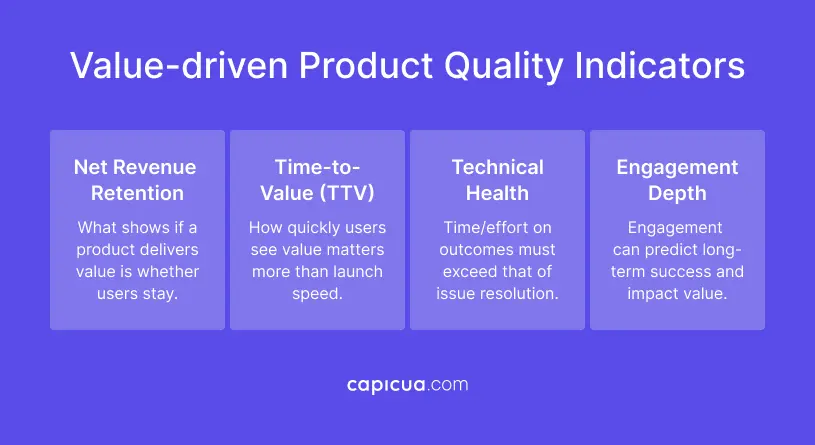
- Net Revenue Retention (NRR): The core indicator of whether a product is delivering value is whether customers stay (and whether they expand usage over time). Top-performing B2B SaaS companies push NRR past 120%, with top firms generating over 50% of new ARR. This growth is only achievable through product quality, thoughtful experience and genuine understanding of the problems the product solves.
- Time-to-Value (TTV): While time-to-market is a speed metric, time-to-value is a growth metric. Yes, a product can reach market in record time and still fail to help users achieve a meaningful outcome quickly enough to build the retention habit. The companies that grow most sustainably focus on the speed at which new users reach their first meaningful outcome and not on how quickly a feature gets shipped.
- Technical Health Indicators: Forward-thinking products have technical health as a core KPI, including engineering time spent on value-generating work vs. debt maintenance, reliability and uptime, and treating technical debt as a P&L consideration. These products thrive because their foundations don't buckle under the weight of growth.
- Activation and Engagement Depth: A product with 10,000 highly engaged users will outperform one with 100,000 passive ones because engagement signals are far more predictive of long-term retention than raw acquisition numbers. This tendency can be seen across all growth signals that matter, including lifetime value, expansion revenue, word-of-mouth referrals, and defensibility against competitive pressure.
Building with value at the core requires a willingness to slow feature development in order to build the scaffolding that converts new users into retained ones.
The Clarity Compound
Like any system, the longer clarity runs, the more it accelerates. Clarity begins with an explicit bet that creates a frame for the entire organization, such as "we believe users who complete three collaborations in their first week have 95% annual retention, so we're investing Q2 in reducing the friction of first collaboration to half an hour of user setup."
Organizations without explicit frames see their decisions cascade through thousands of small moments: a designer's choice about default settings, an engineer's choice about what edge case to optimize, a PM's choice about what to ship next. Each small choice made without reference to a larger bet drifts slightly, and that drift accumulates, because the product is being optimized for a dozen theories of value at the same time.
When the frame is clear, everyone moves in the same direction without constant middle management, eliminating drift.
In contrast, when a team operates within a clear bet frame, every choice snaps back to the core hypothesis. A designer makes an interface choice in the context of "we're reducing collaboration setup friction," and an engineer optimizes the code paths that affect time-to-first-collaboration.
This alignment accelerates decisions by eliminating false starts, and teams generate learnings, not as the failure of a bet but as signals in themselves. In this compounding capital allocation, each bet also generates qualitative learnings that make the next bet more accurate. When teams land bets and feedback loops inform the next decision, they stop debating what to build and start asking what they're learning.

The Financial Leverage
The compounding advantage that emerges from quality-driven growth extends to capital allocation itself. When teams slow down to make better bets (decisions informed by user research, architectural trade-offs and retention mechanics rather than just shipping velocity), they unlock leverage that compounds dramatically across the organization:
- Less rework: A feature shipped with clear hypotheses about user outcomes and retention requires far fewer subsequent corrections than one shipped as a minimum viable experiment and abandoned three-quarters later.
- Faster kill cycles: Not every bet will win, and the distinction between high-performing and struggling teams is the ability to identify bad decisions quickly and reallocate capital. As learning and execution have different speeds, teams that build with clarity can recognize failure much sooner.
- Faster scale: Products built with durable foundations and strong retention mechanics scale more efficiently because of the quality of the product experience. The financial model of a product that grows 100% year-over-year with 70% retention is weaker than one growing 40% with 95% retention, regardless of which looks faster on a dashboard.
- Concentrated capital: Every bad bet that consumes engineering resources also consumes decision-making capital, which is also the opportunity cost of leadership time spent on defending a decision that didn't compound value.
Teams that say "no" more often are the ones that move faster in the dimension that matters toward outcomes that retain users and generate revenue.
The bottleneck in digital product growth is not how fast code ships but how clearly teams understand what problems they're solving and for whom. It's a matter of judgment: every dollar and hour saved through better decision-making compounds through the quarters that follow. The companies with the most durable growth are often slow to bet, but fast to learn and to reallocate capital.

The Role of a Growth Partner
The right growth partners can slow you down in the moments when slowness creates long-term acceleration: architecture decisions, user research, retention analysis or technical debt remediation.
However, they're also able to move with genuine urgency in the moments where speed creates compounding value: validating product hypotheses, reducing time-to-value and establishing the feedback loops that allow you to learn faster than your competitors.
Teams that invest in getting the foundational decision right move faster because they're building on intentional architecture rather than patching yesterday's expedience.
When a growth partner measures success by the number of features shipped or the speed of delivery, they're optimizing for a metric that serves their internal processes rather than your long-term growth trajectory.
Ask any prospective growth partner how they think about technical debt and how they measure success at the 12-month horizon (not the 30-day one). Ask how they would approach a situation where slowing down development to address foundational issues would accelerate growth in the medium term, as well as what retention metrics they track and how those metrics inform prioritization. The answers will tell you whether they are building for your long-term value or for their short-term throughput.
In teams with clarity, execution feeds learning, which feeds the next round of execution. The feedback loop is tight, the learnings are sharp and the compounding advantage grows with every cycle.
Conclusion
Reckless speed and velocity without regard for foundations, user outcomes or the retention dynamics are the real enemies of growth. Decision-makers who build the most enduring digital products are the ones who ask harder questions: Are our users staying? Are they finding deeper value over time? Is our codebase getting more or less expensive to build on? Are we building the right things, or just building things fast?
These questions aim to grow correctly, and in markets with impatient users, intense competition and increased technical complexity, aiming correctly is the most important competitive advantage a digital product company can have.
Ready to build a digital product that grows with durability, not just velocity? The right growth partnership begins with honest questions about your foundations, your users, and the metrics that actually predict long-term success.