


A degree of not-knowing is unavoidable in product development. Still, there's a difference between the healthy uncertainty that fuels discovery and experimentation and the corrosive uncertainty that comes from a lack of strategic clarity.
When teams don't know what they're building toward, why they're building it or how to make confident decisions about priorities, costs compound quickly and run deep. This latter uncertainty rarely shows up in sprint budgets, quarterly reports or Profit and Loss statements, yet it shows up in missed deadlines, bloated backlogs and feature graveyards.
Understanding and actively managing this hidden tax is one of the highest-leverage investments you can make. This article will focus on making that invisible cost visible.

Uncertainty in Product Delivery
For product teams, uncertainty can be defined as the gap between what you need to know to make a decision and what you actually know when you must act. But before we dive in, it's important to distinguish between uncertainty and risk.
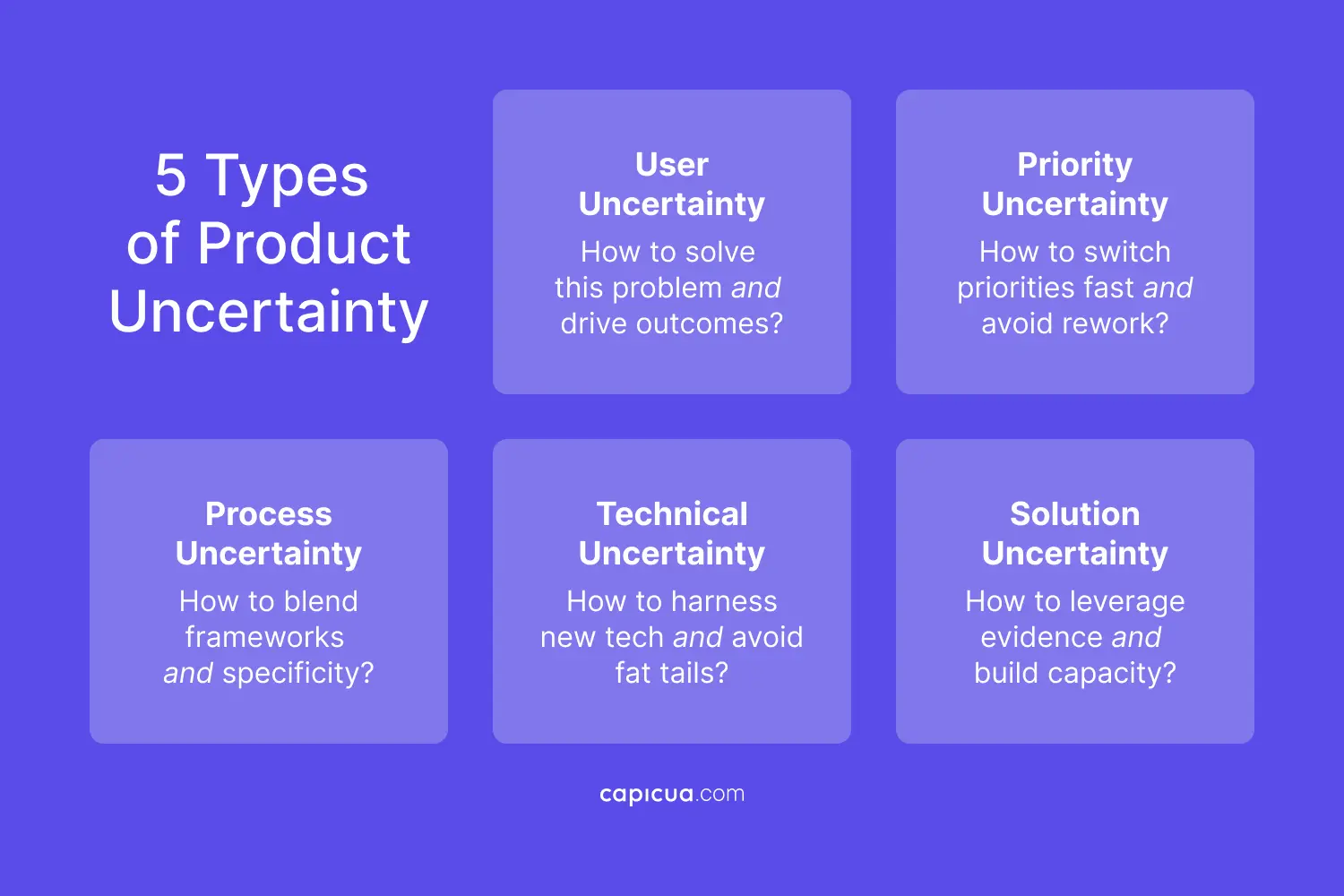
While product risk is often an identifiable event with assessable likelihood, uncertainty includes those "unknowns" that are harder to analyze until they materialize. In practice, uncertainty clusters into a few recurring categories:
- User Uncertainty: The first sign of uncertainty is not understanding the user problem well enough, and further, not knowing if solving it will drive outcomes. User focus tends to correlate with better organizational performance and job satisfaction. Uncertainty declines as the number of feedback loops with real users increases.
- Priority Uncertainty: Shifting priorities and decision rights lead to chronic switching, replanning, and work abandonment. DORA (DevOps Research and Assessment) reports show that instability in priorities can be harmful even when leadership and documentation seem otherwise strong or aligned.
- Process Uncertainty: While widely used, systematic procedures like Agile methods also have downsides that can lead to failure, such as a lack of customer involvement and delivery pressure, which increase uncertainty and downstream rework.
- Technical Uncertainty: New tech, legacy constraints, and interdependencies increase the chance of unexpected expansion, leading to fat-tailed behavior that's consistent with cascading failures across interdependent components.
- Solution Uncertainty: After centralizing the problem, uncertainty can remain about which intervention will work best in an evidence-based manner. That's why mechanisms like Amazon's Working Backwards explicitly force teams to clarify the user, the benefit, evidence and the experience before committing build capacity.
The Scale of Product Uncertainty
According to compiled research, roughly 80% of product features are rarely or never used after release, resulting in an estimated $29.5 billion in wasted R&D (Research and Development) spend each year. While it may sound like a technology failure, it's actually a clarity failure.
80% of software features are rarely or never used after release. This reality represents over $29B in annual R&D spend wasted.
Gartner reports that only 48% of projects fully meet or exceed their stated targets. Approximately 70% of projects end in partial or total failure, and over 85% of business transformations fail to achieve their original ambitions. These cons lead to an estimated annual global cost of $2.3T from failed digital transformation initiatives.
In terms of leadership, research shows that nearly 50% of product managers lack the time for strategic planning and roadmap development. This number comes alongside other concerning statistics, such as only 30% of organizations prioritizing rapid experimentation and iterative learning, and 84% of product teams worried they are building the wrong thing.
$2.3T estimated global annual cost of failed digital transformation initiatives.
At their root, most of these failures can be traced back to teams that were uncertain about what success looked like, whose problem they were solving and how to make fast, confident decisions when the evidence was incomplete.
The result? A vicious cycle: without a clear strategy, teams can't prioritize. Without clear prioritization, they can't move decisively. Without decisiveness, they lose speed and morale. And without speed and morale, they can't execute strategy even when it eventually arrives.
The Dimensions of Uncertainty Costs
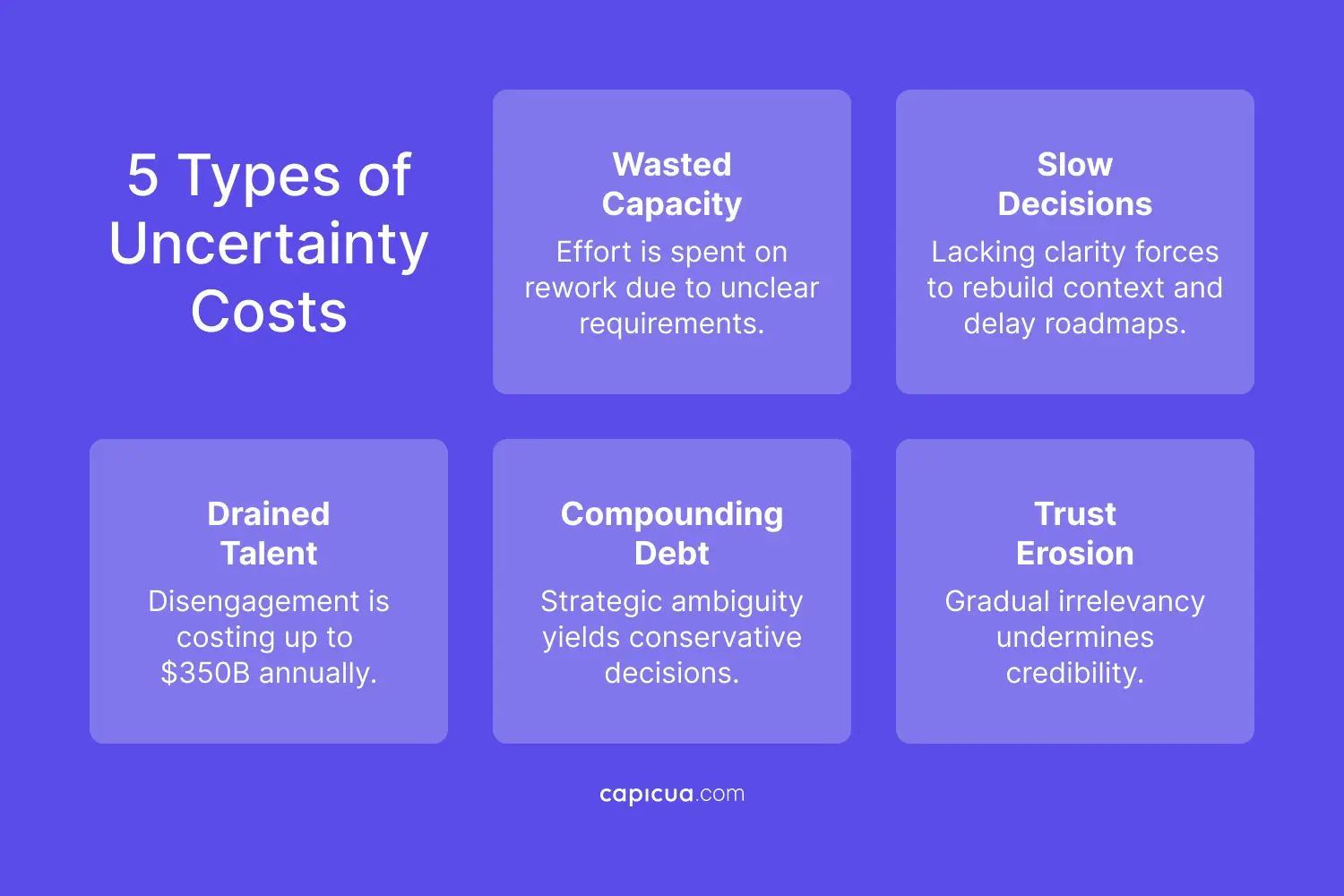
When leaders talk about the cost of uncertainty, they typically think about it as a single dimension: bad decisions. They think of a feature built for the wrong audience, a roadmap shaped without real user data or a pivot that came three months too late. But this framing is too narrow. The hidden cost of uncertainty operates across five distinct dimensions, and understanding each is essential to grasping the full financial and organizational toll.
1. Wasted Capacity
The costs of the most quantifiable dimension are staggering, as research shows that 30 to 50% of engineering effort is spent on avoidable rework caused by misaligned requirements. If a mid-market SaaS company with a 50-person engineering team averages $150,000 in loaded annual cost, this could translate into up to $2.25M in yearly wasted spend from rework alone.
When product teams are uncertain about the core problem they're solving, requirements get written loosely. When they're uncertain about user needs, designs get revised repeatedly. When they're uncertain about strategic priorities, scope creep becomes the norm. The root cause of most rework is insufficient clarity at the point of decision.
"37% of projects fail due to a lack of clear goals." — Project Management Institute.
According to a McKinsey study, IT projects, on average, exceed their budgets by 75%, overrun their schedules by 45% and generate up to 40% less value than originally predicted because the strategic context that should guide execution is missing.
ElectroIQ also states that, for every $1B invested in digital product development in the US, approximately $122M is wasted due to poor performance driven by unclear direction. That's a 12% tax applied before a single line of code is written!
2. Slow Decisions
When product cycles are measured in weeks and competitive windows open and close in months, the cost of delayed decisions is rarely zero, yet uncertainty consistently produces decision paralysis, which is endemic in the product industry.
According to ISACA's research on analysis paralysis in technology teams, indecision leads to missed market opportunities, frustrated stakeholders, and wasted resources as time that should be spent building and iterating is consumed by endless analysis loops. Moreover, 72% of business leaders report experiencing analysis paralysis due to data overload.
While this number may sound staggering, the root cause is well understood: when teams lack strategic clarity about what success looks like, every decision requires a complete rebuild of context from scratch. Meanwhile, competitors who move with greater clarity ship faster, capture user attention and establish switching costs.
72% of business leaders suffer from analysis paralysis caused by data overload.
The cost of indecision is not hypothetical; it is the sum of every sprint that circled back, every roadmap item that sat in the backlog for six months while the market moved and every feature built in the wrong direction because teams were too cautious to commit to a hypothesis and test it fast.

3. Drained Talent
Gallup's State of the Global Workplace report showed that global employee engagement dropped to just 21%. This rare decline signals a deepening crisis in workforce motivation, and disengaged employees can cost the economy up to $350B in lost productivity annually.
According to Gallup, companies with highly engaged teams experience 23% higher profitability and 51% less turnover. Uncertainty slows execution and also drives out the people you most need to retain.
Disengagement is driven when an unclear strategy sits at the top of the list. When teams don't understand how their work connects to a meaningful outcome, motivation erodes. When they watch features they built get ignored or deprecated without explanation, cynicism sets in. When they spend months building things that end up misaligned with user needs, the best talent starts looking elsewhere.
Employees who don't feel recognized are twice as likely to quit within a year, but those who stay don't feel motivated to celebrate shipping the wrong thing.
When recruiting, onboarding, and lost productivity are factored in, the financial cost of turnover in technical roles typically ranges from 90% to 200% of their annual salary, e.g, if a senior product manager earns $150K per year, their departure can cost from $135,000 to $300,000. Imagine the costs for a team experiencing chronic uncertainty.
This chronic uncertainty generates change fatigue even when the product itself isn't changing, because teams are constantly rebuilding their mental models of what matters, reversing decisions, and absorbing context that should have been established upfront.
4. Compounding Debt
Less visible but equally damaging is the architectural and experience debt that accumulates when teams build under uncertain strategic conditions. When the direction isn't clear, engineers make conservative choices that are easy to change, but often slow, expensive and difficult to scale. When user research hasn't established clear jobs-to-be-done, designers build interfaces that are internally logical but externally confusing.
Over time, this accumulation creates a product that is technically functional but strategically incoherent: companies launch a patchwork of features added by different teams, each pursuing a different interpretation of what the product should be. User experiences frustrate, codebases fight back against requirements and products cost significantly more to maintain than they should.
Without clarity, a product becomes a patchwork of internally logical but externally confusing features added by different teams, each pursuing a different interpretation that drives up costs.
5. Trust Erosion
There is a cost that is most difficult to quantify but most consequential: the erosion of customer trust and market position from product teams that ship features their users don't need, fail to ship features they do need and iterate without a clear thesis about value.
Digital product users have more choices than ever and lower switching costs than at any point in history. When a product visibly fails to improve in the ways that matter, customers begin exploring alternatives. Not loudly or immediately, but steadily.

The 5 Dimensions of Uncertainty Costs
- Wasted Capacity: Up to 50% of effort is spent on avoidable rework caused by unclear requirements, including vague problem definition, unclear needs and misaligned priorities.
- Slow Decisions: 72% of leaders report experiencing analysis paralysis due to data overload, and the lack of clarity forces teams to repeatedly rebuild context, delay roadmap commitments, and avoid testing hypotheses quickly.
- Drained Talent: Employee engagement has dropped to 21%, and disengaged employees cost up to $350B in lost productivity annually. Chronic uncertainty causes change fatigue, constant mental model rebuilding and decision reversals.
- Compounding Debt: Strategic ambiguity yields conservative technical decisions and misaligned interfaces, resulting in architectural and experience debt, as well as feature patchworks built around conflicting product visions.
- Trust Erosion: Gradually shipping irrelevant features undermines product credibility and prompts customers to explore alternatives. Trust erosion is hard to quantify yet highly consequential for long-term market position.
How Uncertainty Hides Itself
One of the most insidious properties of strategic uncertainty is its ability to disguise itself. Uncertainty rarely announces itself as such: it wears other costumes.
It looks like a backlog that never gets fully prioritized or roadmap planning sessions that end without consensus. Uncertainty manifests as OKRs that are technically defined but functionally ignored because no one is confident they're measuring the right things, or as product reviews that generate a lot of activity but can't demonstrate a clear business impact.
Uncertainty looks like a product manager who is excellent at execution but spends most of their time on coordination. In fact, Airtable states that "the average product leader spends more than 66% of their week on manual work."
Uncertainty often looks like busyness—high activity, long backlogs and packed sprint cycles can mask the absence of strategic clarity— until no one can explain how the work delivered measurable business value.
When strategy is unclear, every prioritization decision becomes a political negotiation. Engineering wants to reduce technical debt and sales wants the promised features to key accounts. Marketing wants to power the next campaign, and product sits at the center of the pressures without a shared framework. Every disagreement costs time, trust, and morale.
The teams most at risk are often the ones that appear most productive from the outside. They ship regularly, run sprints, hold retros and have a product roadmap. But if that roadmap is built on assumptions rather than validated insights, and those assumptions have never been stress-tested against a coherent strategy, the busyness conceals a deeply uncertain foundation.

Organizational Anti-Patterns That Perpetuate Uncertainty
Strategic uncertainty rarely emerges from a single failure point. Instead, it's typically the product of several compounding organizational patterns, each reinforcing the others.
1. Roadmaps Built on Outputs
The most common structural source of uncertainty is the feature-centric roadmap, a list of things to build with no clear articulation of why it will create value or how success will be measured. When teams operate from output-based roadmaps, every prioritization decision devolves into a debate about what to build rather than a structured analysis of which outcomes matter most and which bets are most likely to achieve them.
ProductPlan's State of PM 2025 survey found that only 31% of organizations prioritize rapid experimentation and iterative learning—the majority still operate under a build-and-ship model rather than a learn-and-adapt model. The difference in strategic clarity between these two operating modes is enormous.
Only 31% of organizations prioritize rapid experimentation and iterative learning.
2. Strategy-to-Execution Gaps
A common pattern is the strategy-to-execution gap: leadership has a clear strategic vision, but product teams lack the context, framework or decision rights to translate that vision into daily prioritization decisions.
Gartner found that 72% of leaders admit they don't know what employees need to do differently during change because of their disconnection from day-to-day work. But rather than merely a change-management problem, this structural clarity problem manifests in product teams as a constant re-negotiation of priorities.
Over 70% of leaders don't know what employees need to do differently because of their disconnection from day-to-day work.
Marty Cagan has also written extensively in his book, Inspired and Empowered, about the difference between "feature teams" and "product teams." While the former are expected to execute after being given only requirements, the latter are truly empowered to solve real-life problems with the most suitable, case-specific solutions. To summarize Cagan's approach, feature teams operate within high uncertainty because they lack the strategic context; product teams create clarity by owning outcomes rather than outputs.
Feature teams operate within high uncertainty because they lack the strategic context; product teams create clarity by owning outcomes rather than outputs.
3. Data Without Insight
While it may sound counterintuitive, having too much data without the analytical frameworks to turn it into insight can also perpetuate uncertainty. With analytics, session recording, testing frameworks, feedback systems and research repositories, product stacks have never been larger. However, almost half of the surveyed PMs report not having access to real-time project KPIs, suggesting that decision quality has not improved proportionately.
When product teams are drowning in dashboards but don't have a clear North Star metric tied to a clear strategic thesis, more data simply multiplies the number of things they could argue about. Data without interpretive frameworks generates more uncertainty, not less.
Almost 50% of PMs lack access to real-time project KPIs.
The 3 Anti-Patterns That Enhance Uncertainty
- Roadmaps Built on Outputs: Feature-centric roadmaps often lack clear value or success metrics, and the focus shifts from what to build to which outcomes matter most.
- Strategy-to-Execution Gaps: When leadership has a vision, but teams lack the context to implement it, companies end up in a constant state of priority re-negotiation.
- Data Without Insight: Data without frameworks leads to more uncertainty—without a clear North Star metric, more data can complicate decision-making.
What High-Performing Product Teams Do
Some things are inevitable, but there is a common ground for teams that ship features users actually adopt, retain their best talent and execute efficiently against commercial goals. Product companies that consistently build great digital products share a set of practices that directly address the sources of uncertainty described above.
1. Strategy as a Framework
In her book Escaping The Building Trap, Melissa Perri defines "product strategy" as a deployable decision-making framework, a coherent set of choices about what you're optimizing for, who you're serving, and what success looks like. All these choices must also be articulated clearly enough that any team member can use them to make daily prioritization decisions without needing to escalate.
High-performing product organizations embed strategy into the rituals of daily work: sprint planning, backlog grooming, design reviews and the questions they ask when evaluating new feature requests. When every decision is evaluated against a clear strategic framework, uncertainty drops dramatically, and so does the time wasted on misaligned work.

2. Discovery as an Investment
The identified $29.5B in wasted R&D spend doesn't come from building features slowly; it comes from confidently building the wrong features, and only the teams that invest heavily in product discovery escape this trap. This process encloses the structured practice of validating assumptions, testing hypotheses with real users and building evidence before committing engineering capacity.
In this context, Teresa Torres's continuous discovery model is the perfect representation of a core insight: the cost of discovery is almost always less than the cost of building and shipping something nobody uses. Product teams that dedicate meaningful time to discovery as an ongoing practice build less, ship faster, and create more value.
Product teams that dedicate meaningful time to discovery as an ongoing practice build less, ship faster, and create more value.
3. Decision Rights as a Design
A significant source of uncertainty is ambiguity about who has the authority to make which decisions. And when decision rights are unclear, every meaningful choice tends to require an alignment meeting. In the end, as meetings multiply and velocity drops, the teams that were supposed to move fast are moving slowly and spending most of their energy on internal politics.
At the team level, a well-known example of designing decision rights is Amazon's Type 1/Type 2 decision distinction, in which Type 1 decisions are high-stakes and require deep analysis and Type 2 decisions can be delegated and made quickly. Treating most decisions as Type 1, requiring full consensus and executive sign-off, is a primary driver of decision paralysis that makes uncertain teams even slower.
A rule of thumb is to make reversible product decisions when you have roughly 70% of the information you think you need. Waiting for 90% confidence often means waiting for the market to move on without you.
4. Outcomes as the North Star
While velocity, story points completed and features shipped are outputs, customer retention, activation rates, time-to-value and revenue per user are outcomes. While they may sound similar, output metrics can be maximized even when a team is building the wrong things. However, high-performing product teams resist the false comfort of activity metrics.
Teams that measure and report on outcome metrics create a self-correcting mechanism for strategic clarity. When a feature ships and the relevant outcome metric doesn't move, these teams quickly realize their hypothesis was wrong and are able to adjust without waiting for a quarterly review cycle to surface the issue. This tight feedback loop is the antidote to the long-cycle uncertainty that produces expensive rework and wasted capacity.

5. Unknowing as Safety
Product teams that normalize and celebrate intellectual honesty about what is unknown create the conditions for better decisions. This transparency enables them to invest in structured ways to make uncertainty explicit rather than glossing over it with confident-sounding roadmaps built on shaky foundations.
In an EPIC article, Spotify's research team identified the social pressure to express confidence even when genuine uncertainty exists, a counterintuitive dynamic in product teams. Teams that feel unsafe saying "we don't know" hide uncertainty rather than addressing it, and hidden uncertainty compounds.
These grounds underpin its agile structures, which have largely shaped—and continue to shape—productivity and user engagement. At the time of publication of this article, several sources, such as Atlassian, present the Spotify model as a pioneer in organizational structure and technological innovation.

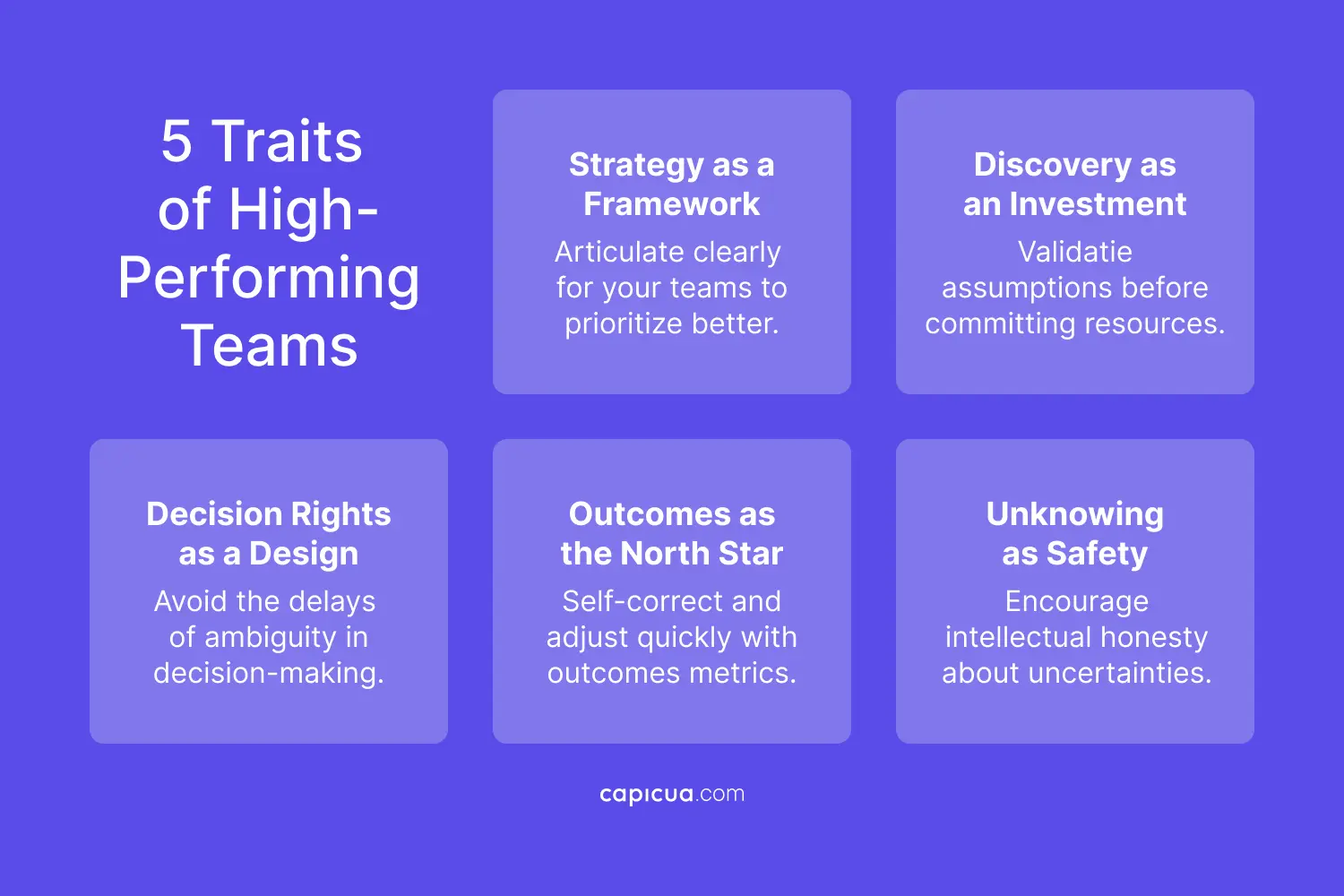
The 5 Differentiators of High-Performing Product Teams
- Strategy as a Framework: Product strategy is a decision-making framework that outlines optimization goals, target audience and success metrics, and a clear articulation of strategy allows team members to prioritize without escalation.
- Discovery as an Investment: Effective product discovery involves validating assumptions and testing hypotheses with users before committing resources. Continuous discovery leads to building less, shipping faster and delivering more value.
- Decision Rights as a Design: Ambiguity in decision-making authority causes delays and increases the number of meetings. Distinguishing between high-stakes and quick decisions enhances proactive decision-making and avoids decision paralysis.
- Outcomes as the North Star: High-performing teams focus on outcome metrics to self-correct and adjust strategies quickly, and tight feedback loops help address issues early, minimizing rework and capacity waste.
- Unknowing as Safety: Leaders have the responsibility to encourage intellectual honesty about uncertainties to foster better decision-making, as addressing unknowns openly prevents compounding hidden uncertainties.
What Should Leaders Do: Next Steps
For CPOs, VPs of Product and digital product CEOs reading this, the key insight is that uncertainty in your product teams is not a team-level problem, but a leadership-level problem that manifests at the team level.
If your teams are uncertain about priorities, it can be because the strategic framework for prioritization hasn't been communicated clearly enough, consistently enough or with sufficient specificity. If your teams are paralyzed by decision-making, it can be because decision rights haven't been explicitly designed, and the organizational culture hasn't made fast, reversible action feel safe. If your best product people are leaving, it can partly be because working in chronic ambiguity is exhausting, and your competitors who have resolved their strategic clarity are offering them a better place to do meaningful work.
The PwC 2025 Next in Consumer Markets Workforce report identifies declining employee morale, rising attrition, and eroding confidence as converging trends that pose deepening execution and strategy risks. Rather than upstreaming from it, these trends are downstream of leadership clarity.
The most high-leverage investments a product leader can make are in the unglamorous, often undervalued work of strategic clarity: defining a coherent product strategy that teams can actually use as a decision-making framework, designing the organizational structures and rituals that embed it into daily work, and building a culture that treats uncertainty as a problem to actively investigate rather than a condition to be managed around.
The highest-leverage investment a product leader can make isn't in faster execution, but in the strategic clarity that makes fast execution possible in the first place.
How To Estimate Product Team Uncertainty Tax
If you want to estimate the cost of uncertainty in your own organization, start with these diagnostic questions:
- What percentage of features shipped in the last year can be directly attributed to a measurable improvement in a user or business outcome? If you can't answer this confidently, uncertainty is already costing you.
- How much time does your average product manager spend per week on stakeholder alignment versus discovery and strategy? If it's more than 40% on alignment, you likely have a structural clarity problem.
- How quickly does your team make and commit to consequential product decisions? If the average time from data to decision exceeds two weeks for Type 2 decisions, decision paralysis is active.
- What is your rolling 12-month retention rate for senior product and engineering talent? If it's below 85%, dig into exit interview data: strategic uncertainty is almost always part of the story.
- If you asked five product team members to independently articulate the three most important outcomes the product is trying to deliver in the next six months, would you get consistent answers? Inconsistency is a direct signal of strategic uncertainty.
None of these questions requires elaborate benchmarking; they are simply diagnostic probes into the clarity of your product organization's strategic operating system—and they tend to surface the hidden costs of uncertainty remarkably quickly.
Uncertainty is not eliminated; it is managed. High-performing organizations invest in practices that (1) reduce uncertainty through evidence, (2) contain uncertainty through modularity and clear interfaces, and (3) absorb irreducible uncertainty via short feedback cycles and reversible decisions.
Conclusion
The digital product industry has spent the last decade optimizing for speed. And, as the window of competitive advantage in digital products is narrow, speed matters. Yet speed without clarity is an accelerated way to build the wrong things, exhaust your best people and burn through R&D budgets that should deliver compounding returns.
The hidden cost of uncertainty in product teams is not the cost of bad individual decisions, but the systemic cost of operating without the strategic clarity that turns a group of talented individuals into a high-performing product organization.
The good news is that clarity is one of the few strategic assets that compounds over time without additional capital investment. A product team that knows what it's optimizing for, trusts its decision-making frameworks and has leadership that consistently communicates strategic context performs better every quarter, as clarity compounds into institutional knowledge, trust, and executional excellence.
The most transformative thing a product organization can do right now is to honestly assess the cost of its existing uncertainty and commit to the difficult, unglamorous, high-leverage work of building the strategic clarity that makes everything else possible. If you'd like to start building with clarity, we'd love to start a conversation.