Most SaaS companies end up building the wrong thing, shipping it, watching it underperform, and rebuilding, and that loop repeats until it becomes the operating model. The problem is the structural gap between the moment a team decides what to build and the moment they understand why someone would use it.
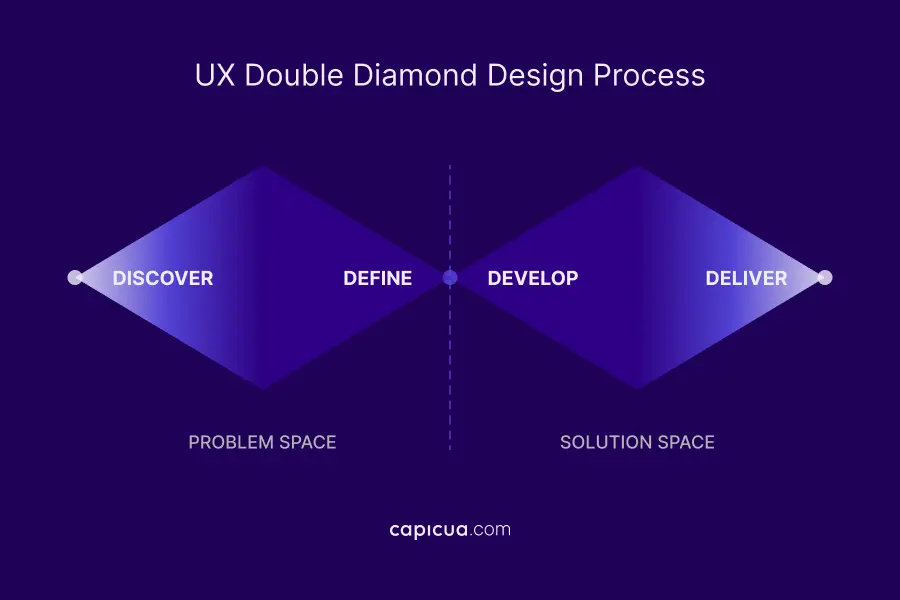
The double diamond design process, developed by the British Design Council in 2005, maps the design journey into four phases across two diamonds: Discover, Define, Develop, and Deliver, in which each diamond pairs divergent thinking (exploring broadly) with convergent thinking (narrowing to a decision). The result is a process that builds decisions on evidence rather than assumptions, and solutions on validated problems rather than guesswork.
This guide explains how the double diamond design process works, why its four phases are directly tied to sustainable SaaS growth, and how product leaders can apply it to reduce rework, improve retention, and make decisions their teams can execute with alignment.
What Is the Double Diamond Design Process?
The double diamond design process is a framework that structures product and UX work into four sequential phases, organized across two diamonds. Each diamond represents a cycle of divergent thinking followed by convergent thinking, and together they ensure that teams solve the right problem before investing in the right solution.
The first diamond belongs to the problem space. The Discover phase expands outward, with teams immersing themselves in user research, behavioral data, and contextual interviews to understand the full scope of a problem without filtering prematurely. The Define phase converges, and research findings are synthesized into a precise problem statement that the entire team can act on.
The second diamond belongs to the solution space. The Develop phase expands again, and teams ideate broadly, prototype multiple directions, and test with real users before committing. The Deliver phase converges on a validated approach that moves forward, refined through testing, and shipped with confidence.
In 2019, the Design Council updated the framework into its Framework for Innovation, adding four operating principles: put people first, communicate visually and inclusively, collaborate and co-create, and iterate constantly. These principles address the cultural conditions that make the process work, not just the mechanical steps.
"Design thinking is a human-centered approach to innovation that draws from the designer’s toolkit to integrate the needs of people, the possibilities of technology, and the requirements for business success." —Tim Brown, CEO of IDEO.
The Double Diamond Design Process Diagram
Understanding the double diamond design process diagram means understanding what each phase produces, not just what teams do during it. The output of each phase is a decision that either unlocks or blocks the next one.
Double Diamond Design Discover Phase
The Discover phase is about understanding the problem at scale before narrowing it. Teams conduct user interviews, observe workflows, analyze support tickets, review behavioral analytics, and map the competitive landscape. The goal is to accumulate evidence that challenges assumptions, and this phase answers the questions: "who is experiencing friction, where, and why?"
According to research, approximately 42% of SaaS startups fail because they build for a market need that does not exist. Discovery is the phase that prevents this, and teams that skip it simply pay the cost later, after engineering time has been spent and user expectations have been set.

Double Diamond Design Define Phase
The Define phase synthesizes everything gathered in Discover into a clear, shared problem statement. Teams move from symptoms to root causes, and from user frustrations to underlying needs. The output is a "How Might We" question or an equivalent brief that aligns product, design, and engineering before any design work begins.
This phase is where most product teams lose traction. Research findings are filed away, meetings produce vague direction, and teams move into Develop with different understandings of the problem. The Define phase exists precisely to prevent the misalignment that becomes rework in the solution space.
Double Diamond Design Develop Phase
With a validated problem statement, the Develop phase expands the solution space. Teams sketch multiple approaches, build low-fidelity prototypes, and test them with real users before committing to any single direction. The emphasis is on generating enough options to identify the most promising path, not on producing a polished design.
This is where the UX design process double diamond diverges from traditional product development. Instead of assigning a single designer to spec out a feature and hand it off to engineering, the Develop phase treats solution selection as a research activity. Prototypes are hypotheses. Testing is how you resolve them.

Double Diamond Design Deliver Phase
The Deliver phase narrows the options from multiple to one by refining it through more rigorous testing, resolving outstanding questions, and preparing for production. The goal is to ship something validated. Post-launch, delivery continues: teams monitor how the solution performs against the original problem definition and feed those signals back into the next Discover cycle.
The 4 Steps of the Double Diamond Design Process
- Discover: Understands the problem at scale before narrowing focus, gathering evidence to challenge assumptions and identifying friction points to prevent building for non-existent market needs and reduce future costs.
- Define: Synthesizes findings into a clear problem statement and moves from symptoms to root causes and user needs, creating a shared understanding to prevent misalignment that leads to rework in the solution space.
- Develop: Expands the solution space with a validated problem statement, treating prototypes as hypotheses and testing to refine solutions while emphasizing research and options over polished design.
- Deliver: Narrows down solutions through rigorous testing, ensuring a validated final product and monitoring post-launch performance against the problem definition to feed insights back into the next Discover cycle for continuous improvement.

Why Does the Double Diamond Reduce Rework
Research from both IBM and Forrester shows that fixing a product error post-launch can cost 100 times more than catching it during the design phase. Furthermore, DesignRush reports that development cycles are reduced by 33% when UX is prioritized up front.
Yet most SaaS teams continue to invest the bulk of their cycle time in development, where iteration is most expensive, rather than in discovery and definition, where it is nearly free. The double diamond flips this ratio: by concentrating uncertainty in the first two phases, where teams are working with sketches and interviews rather than production code, it reduces the probability that engineering capacity is spent on the wrong solution.
The margin protection also extends to team alignment. When product, design, and engineering teams enter the Develop phase with a shared, validated problem statement from the Define phase, the number of mid-sprint redirects, stakeholder misalignments, and scope creep incidents drops measurably.

Double Diamond and SaaS Growth Metrics
Product leaders operating in B2B SaaS environments are accountable to metrics that design process frameworks rarely address directly: net revenue retention, time-to-value, activation rates, and churn. The double diamond design process connects to all of them because each metric is downstream of a product decision that was either validated or not validated.
Net revenue retention, the clearest signal of sustainable SaaS growth, depends on whether users continue to find value in the product. According to McKinsey, top-quartile SaaS companies achieve an NRR of 113%, meaning they grow 13% without adding new customers. In the products that achieve this, every feature was built to address a problem users confirmed they had.
In terms of Time-to-value, when the Define phase produces a precise problem statement, the Deliver phase produces a solution that users can activate faster, because the product answers a question they were already asking. Onboarding that accelerates TTV is designed from a deep understanding of user needs, which is precisely what the Discover and Define phases produce.
Last but not least, regarding churn reduction, teams that apply the UX design process double diamond consistently ship features that users actually need. Furthermore, superior UX across the full product experience can increase conversion rates by up to 400%. In a SaaS context, it means expansion, renewal, and product-led growth.

The Double Diamond Design Process for SaaS Product Sprints
The practical challenge for most SaaS teams is integrating the double diamond design process into a sprint cadence that already has velocity targets and a backlog with 90 items. The framework should be treated as a decision-making structure that replaces the parts of product development that currently produce rework.
Here is how the double diamond design integration works in practice:
- Run a compressed Discover cycle before every significant feature. A set of user interviews, behavioral analytics review and support ticket themes can surface the evidence needed to challenge or confirm the assumption underlying the feature.
- Hold a Define session before creating the first wireframe. Bring product, design, and engineering together for a half-day working session to synthesize research into a written, shared problem statement.
- Treat the Develop phase as a testing cycle, with three low-fidelity prototypes of the most promising solution directions. Test each with five to eight users, and use what you learn to eliminate two and refine one.
- Instrument the Deliver phase with success metrics defined during Define. The metric that tells you whether the shipped feature solved the original problem should be identified before engineering begins.
Design frameworks like the double diamond work best when they are adapted to the team's context rather than followed rigidly. The principle matters more than the procedure: validate the problem before designing the solution, and validate the solution before building it.
Common Failure in the Double Diamond Design Process
Most teams that adopt the double diamond design process encounter one of three failure modes. Understanding them in advance is more valuable than any implementation checklist.
- Skipped Convergence: Teams run discovery, generate rich research, and then move directly into ideation without synthesizing their findings into a shared statement. Treating the Define phase as optional results in fragmented prototypes, prolonged reviews, and features that technically ship but do not clearly solve anything.
- Linear Sequence: Teams complete Discover, then Define, then Develop, then Deliver, and assume the cycle is done. In practice, the two diamonds are meant to be iterative, and insights from the Deliver phase feed back into the next Discover cycle.
- Conflated Speed: Teams under velocity pressure compress discovery and definition to meet sprint deadlines; as a result, the double diamond diagram becomes a retrospective artifact, with a steady increase in post-launch rework and a widening gap between features shipped and outcomes achieved.
A useful reference for understanding how these failure modes compound is Capicua's guide to human-centered design for sustainable business growth, which maps the cost of underfunding discovery across the full product development lifecycle.
Shaped Clarity™ operates at the intersection of what the double diamond surface is and what the business needs to act on. When teams apply the framework rigorously, they generate signals: validated problem definitions, tested hypotheses and user-confirmed outcomes. Turn signals into decisive product direction, so that every investment moves the organization toward sustainable growth. Learn more about Shaped Clarity here.
Conclusion
The double diamond design process is a decision-making structure for product organizations that have learned, through rework and churn, that moving fast without validated direction is more expensive than moving deliberately with it.
Its four phases map directly to the metrics that govern business viability: discovery protects against building for non-existent needs, definition protects against team misalignment, development protects engineering investment, and delivery protects post-launch retention.
Looking to apply the double diamond design process in your SaaS product? Get in touch with Capicua: contact us |send us an email |book a meeting.