Organizational debt is the sum of every structural shortcut, deferred decision, and inherited process that quietly drains your team's ability to ship. It shows up as meetings that produce no decisions, approval chains that outlive their purpose, and duplicated work across teams that don't realize they're solving the same problem.
Unlike technical debt, which lives in code and can be measured in sprint cycles, organizational debt lives in how people coordinate. It compounds silently, and according to McKinsey, two-thirds of senior leaders admit their organizations are too complex and inefficient to execute effectively.
This article breaks down what organizational debt actually is, where structural friction accumulates, what it costs in coordination overhead, and how product leaders can start reducing it before it stalls growth.
What is Organizational Debt?
Organizational debt is the accumulation of structural decisions, process shortcuts, and people compromises that leaders should have addressed but didn't. The term was coined by Steve Blank, who described it as "all the people and culture compromises made to 'just get it done' in the early stages of a startup." His conclusion was direct: failing to refactor organizational debt can kill a growing company.
"Organizational debt is like technical debt, but worse." Steve Blank
The concept of organizational debt mirrors technical debt, but operates at a higher altitude. Where technical debt lives in code, organizational debt lives in reporting lines, decision rights, hiring patterns, and the unwritten rules that govern how work actually moves through a company. It includes biased hiring processes, poorly defined roles, delayed performance conversations, and policies that were written for a 5-person team and never revisited.
In its compounding mechanism, each deferred structural decision makes the next one harder to address. A PLOS One research study found that organizational debt functions as a direct roadblock to agility in software engineering, creating interest payments in the form of reduced productivity, innovation lag, and increasing resistance to change.
Organizational debt lives in all the unwritten rules that govern how work actually moves through a company.
- What is organizational debt? Organizational debt is the structural equivalent of technical debt: deferred decisions in people, processes, and culture that compound over time and erode a team's ability to execute.

How Structural Friction Erodes Velocity
Structural friction is what organizational debt feels like in practice. It's the drag that teams experience when layers of approval, unclear ownership, and legacy processes slow down every initiative. And it rarely arrives all at once; it accumulates through a pattern that Scrum.org researchers call "decision debt," the calcification of ad-hoc decisions into a permanent process.
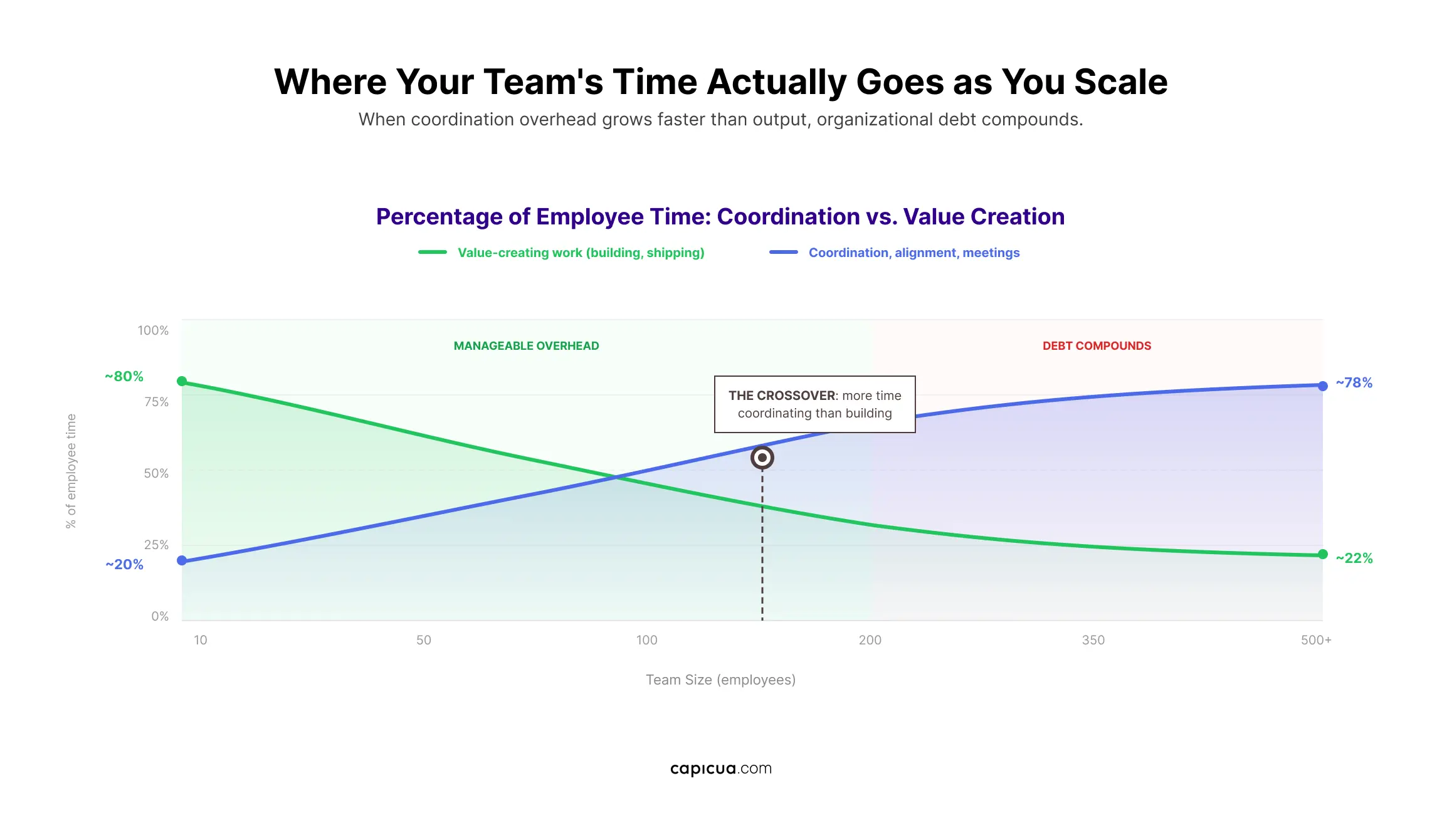
Employees are now spending 80-85% of their time on meetings, email, and alignment work, and only 35-40% of their week on work that creates new value.
Consider what happens as a company moves from 20 to 200 employees. The founder who once approved product decisions in a hallway conversation is now three reporting layers away from the team building the feature. What was a 5-minute decision becomes a two-week approval cycle involving stakeholders who may lack the context to evaluate the trade-off.
According to research on collaboration overload, time spent in collaborative activities has increased by over 50% in the past two decades, with many employees now spending 80-85% of their time on meetings, email, and alignment work. As nearly three out of every five days are consumed by coordination, the average employee spends only 35-40% of their week on work that creates new value.
- What is structural friction? Structural friction builds through accumulated decision debt. Every workaround, extra approval layer, and ad-hoc process adds drag that compounds as teams grow.

The Coordination Costs of Scaling Teams
Coordination costs are the tax every growing organization pays for alignment. The question is whether the tax rate is manageable or whether it has quietly become the company's largest line item. To answer it, the numbers are striking.
According to Flowtrace's meeting research, a typical employee spends 392 hours per year in meetings, roughly 14.8 hours per week, which represents nearly two full working days. For managers, the burden is heavier: 13 hours per week in meetings alone, leaving limited time for deep work, strategy, or direct coaching.
Senior executives now spend nearly 23 hours per week in meetings, and engineering teams spend an average of 40% of their work hours in meetings.
The financial impact is equally tangible. Time spent in meetings costs employers an average of $29,000 per employee annually, factoring in preparation and follow-up time. For software teams specifically, research published in the Journal of Computer Science found that engineering teams spend 30 to 50% of their work hours in meetings, directly limiting time available for code development and architectural problem-solving.
At scale, these costs interact. More teams mean more interfaces, more interfaces mean more alignment meetings, and more alignment meetings mean less time building. According to McKinsey, 20 to 30% of operating expenses are lost each year to rework, miscommunication, and misaligned processes. For a mid-sized company, that translates to $250,000 to $600,000 in pure waste annually.
- What is the coordination cost of scaling teams? Coordination costs scale super-linearly with team size. A 100-person company doesn't have 5x the coordination cost of a 20-person company; it often has 10x or more.

Why Team Inefficiency Survives Reorganizations
Most companies respond to team inefficiency with structural reorganizations: new reporting lines, merged departments, and renamed teams. While the pattern is familiar, because it feels decisive, the problem is that reorganizations address the org chart while leaving the underlying debt intact.
As Julia Västrik writes, what worked for 20 people becomes dysfunctional at 200. Still, instead of redesigning the structure from first principles, organizations tend to add layers, create workarounds, and let informal networks fill the gaps. The result is a company that looks restructured on paper but operates with the same friction underneath.
What worked for 20 people becomes dysfunctional at 200. Companies end up looking restructured on paper, but operate with the same friction underneath.
One of the most common drivers of persistent team inefficiency is policy accretion. Every time an issue arises, the instinct is to create a new policy to prevent it from happening again. Over time, these policies stack into a regulatory layer that nobody fully understands, and everyone works around.
The deeper issue is that reorganizations target symptoms rather than root causes. Moving a team from one reporting line to another doesn't clarify decision rights. Merging two departments doesn't resolve the misaligned incentives that caused friction between them. The debt persists because the underlying structures, informal rules, approval habits, and communication defaults remain untouched.
- Why does inefficiency survive reorganizations? Reorganizations rearrange reporting lines but rarely address the accumulated structural debt underneath. Lasting change requires refactoring decision rights, policies, and coordination patterns.

Scaling Overhead: What Grows Faster Than Revenue
Scaling overhead is the operational drag that accumulates when a company's internal complexity grows faster than its output. In healthy organizations, adding people multiplies capacity, but for those carrying significant organizational debt, adding people multiplies coordination cost instead.
Senior executives now spend nearly 23 hours per week in meetings, up from less than 10 hours in the 1960s. As organizations add layers, each layer generates its own alignment requirements, and the total coordination tax balloons. The Quixy research on workflow debt frames this clearly: workflow debt can be more financially damaging than technical debt because it undermines the performance of entire teams. When processes calcify, every new hire inherits the full weight of those accumulated inefficiencies.
Every time an issue arises, instead of understanding its root cause, organizations rush to create a policy to prevent it from happening again.
At 20 people within a company, informal coordination works because everyone has context. At 200, those same informal patterns fragment into silos, and the company responds by adding more formal coordination mechanisms, which in turn add more overhead. Revenue per employee often declines in this window because structural costs are absorbing an increasing share of productive capacity.
- What is scaling overhead? Scaling overhead is the gap between growing headcount and growing output. When coordination costs outpace revenue per employee, the organization is paying compound interest on its structural debt.

How to Diagnose and Reduce Organizational Debt
Reducing organizational debt starts with making it visible. Most teams can feel the friction but lack a shared vocabulary to describe its origins. Hence, a structured diagnostic approach turns intuition into actionable insight.
- Map Decision Latency: Track how long it takes for a product decision to move from proposal to action. If the average decision cycle exceeds two weeks, that's a signal of structural friction. Identify which approval layers are adding time without adding clarity.
- Audit Coordination Load: Quantify how much of your team's week is spent on alignment work versus value creation. Benchmarks show that high-performing teams keep collaborative overhead below 35% of total time. If your teams are above that threshold, coordination is likely consuming capacity.
- Refactor Policies: Review each standing process to ensure continued relevance. Policies designed for a 30-person company often survive unexamined into the 300-person phase. Remove or simplify any process that no longer matches the actual operating context.
- Organization as a Product: The best product teams iterate based on user feedback, so apply the same signal-based approach to your organizational design: measure, learn, adjust. Decision rights, team boundaries, and communication flows should evolve as frequently as the product itself.
Conclusion
Organizational debt is the invisible operating cost of growth. Every company accumulates it, yet the ones that scale sustainably learn to see it, name it, and address it with the same rigor they apply to their product backlog. The companies that get this right can keep building better products, quarter after quarter, without drowning in their own complexity.
Looking to reduce organizational debt and scale your product team with clarity? Get in touch with Capicua or schedule a call on Calendly.