


Most companies talk about agility, yet the gap between strategic ideals and the reality of customer demands makes it hard for them to experience it in their day-to-day operations. The 2025 Business Agility Report shows that around 86% of companies report "large" benefits when they truly master it. But separates the talk from the results? This article breaks down what agility in business really is and how to architect an agile business model.

What is Business Agility
The term "business agility" refers to an organization's ability to adapt its strategy to external changes quickly. At its core, it's about the steps founders and leaders can take to create a culture and system that enables the company to be on top of user and market shifts.
Systems and frameworks must prompt decisive action in response to changes, whether they're evolving customer feedback or new market conditions, without being stuck in old habits or strict plans.
As stated in the Business Agility Report, organizations that became more agile from 2024 to 2025 experienced an average 10.3% increase in revenue per employee. That is opposed to 3.5% for those who decreased.
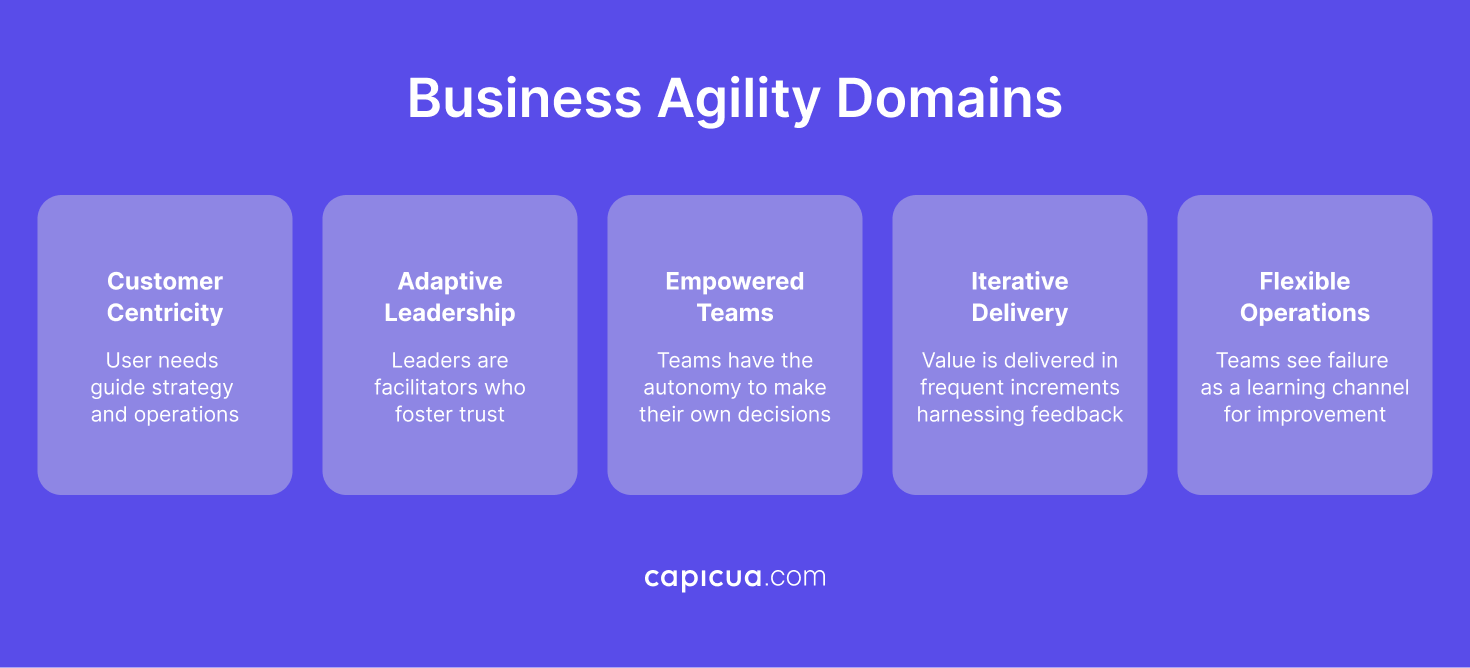
What are the Domains of Business Agility
- Customer-Centricity: Companies that operate under a business-agility culture should be "almost obsessed" with understanding and meeting customer demands. Their feedback can guide both strategic decisions and product building operations.
- Adaptive Leadership: Agile leadership shifts away from traditional command-and-control, and people-first leaders become both visionaries and facilitators. They lead change within their teams while fostering a culture of trust and safety.
- Empowered Teams: Small, self-organizing teams are given the autonomy to make decisions and manage their own work. This outcome accountability fosters the ownership and, as a consequence, boosts delivery.
- Iterative Delivery: Value is delivered in frequent increments rather than all at once, harnessing continuous feedback as a business strategy and ensuring the company is always working on the most important priorities.
- Flexible Operations: When leveraging business agility, teams embrace an engaged culture of experimentation and view failure as a learning opportunity, with a relentless focus on improvement across processes and people's skills.
Why Visionary Companies Need Agility in Business
As business agility can be the primary defense against market irrelevance, companies that embrace it can gain a significant advantage in several key areas. First, by fostering a learning culture, agile companies unlock the creative potential of team members and teams, helping drive ongoing, reliable optimization.
With optimized operations that quickly incorporate feedback and iterate, business-agile organizations are better equipped to satisfy dynamic demands. This ease of adaptation can lead to happier, more loyal customers over time.
How Does Business Agility Work
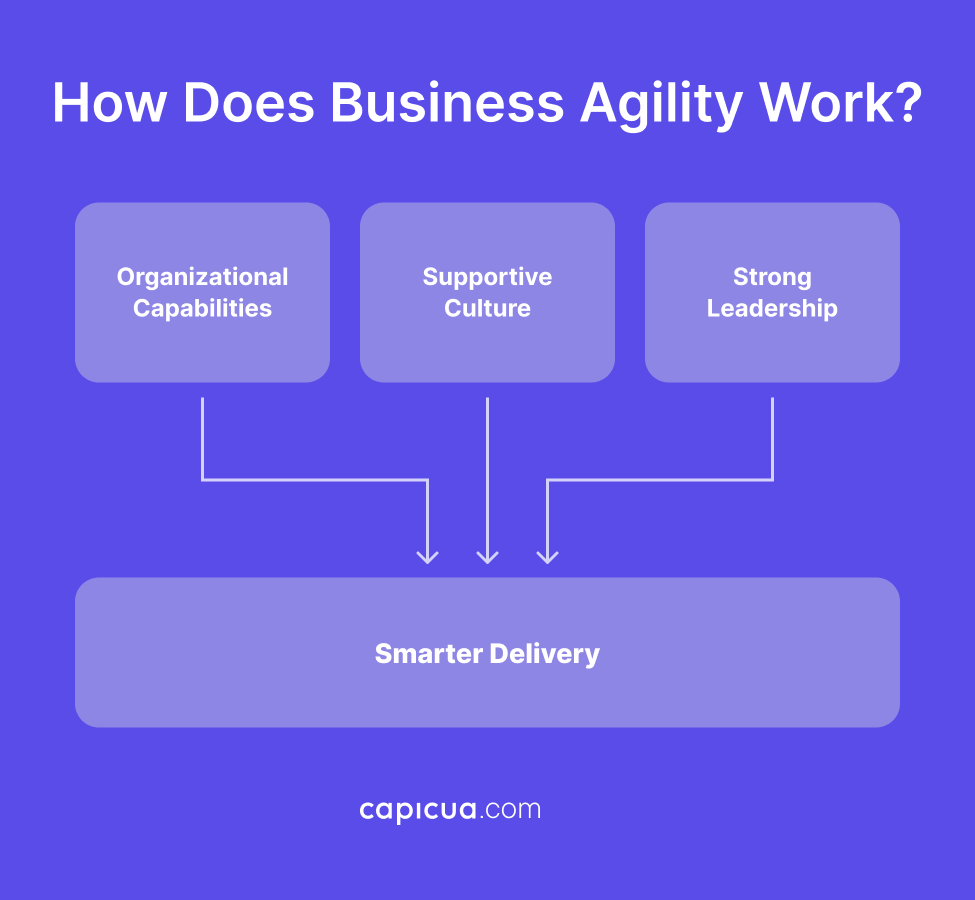
Business agility is a holistic system built upon several interlinked pillars that creates an environment where adaptability is the default operational state.
To do so, it first relies on organizational capabilities to ensure the entire company has the muscle to respond to change, focusing on strategic agility to sense market shifts and pivot accordingly. While operational agility emphasizes optimizing processes to enable swift execution, team agility allows teams to form and reform as new challenges arise.
Moreover, agility is powered by a supportive culture that prioritizes transparency and trust. When leaders trust their teams and team members trust each other, decision-making is decentralized, encouraging proactive problem-solving and experimentation.
Of course, strong leadership is a core element, as leaders can shape agile behaviors, remove the obstacles that often slow teams down and help teams focus on tasks, such as dedicated discovery or feedback loops, that inform next cycles of work.
All these elements merge to ensure smarter delivery, as iterative approaches and agile frameworks can help companies deliver value faster, more consistently and more reliably.
What is an Agile Business Model
An agile business model is an organizational design structured for flexibility and customer value streams, with a setup that reduces delays and speeds up information sharing and decision-making.
Instead of fixed plans, work is broken down into smaller increments with iterative cycles of planning, execution and learning that allow for regular course corrections based on results. Popular methodologies, such as Kanban or Scrum, often facilitate these operations, providing structure to processes and helping teams manage complex work.
Archetypes of Agile Business Models
The Team of Teams Model
This popular model breaks down large hierarchies into a network of small, interconnected teams. Here, each "team" operates with a high degree of autonomy while maintaining alignment with other teams and the overall organization through regular coordination.
However, the Team of Teams model goes beyond selecting people within an organization and simply telling them, "So, you're this team now." There must be a strong alignment in both hard skills, such as technology and experience knowledge and expertise, and soft skills, such as time management, problem solving and strategic collaboration.
A prime example of this model in action is Spotify's Squad Framework, which organized its workforce into small teams called "Squads." Each Squad handles a specific aspect of Spotify's services and is grouped into "Tribes" that meet regularly.
The Value Stream Model
Here, organizations are structured around the end-to-end value flow that serves a specific customer segment. Teams with diverse expertise work together to deliver a product from concept through maintenance to consistently and effectively meet their needs.
Consider a company that manufactures athletic footwear and organizes its operations into traditional teams (design, marketing, production). An example of Value Stream would be translating those to cater to the "athletes looking for training shoes" customer group.
The Platform Model
In this archetype, a stable "platform" of shared services supports an ecosystem of customer-facing teams, providing everything they need to innovate without reinventing core functions.
A great example of a Platform Model is Amazon with Amazon Web Services' (AWS) cloud-based services, including storage, computing power and ML capabilities, that form the backbone of Amazon's operations and serve numerous external businesses.
Agile Business Model vs Traditional Models
Traditional models are hierarchical and optimized for predictability in stable environments. These models rely on top-down decision-making and detailed long-term planning. Moreover, communication flows vertically, and work is passed between isolated departments.
Agile models, in contrast, are optimized for adaptability in volatile environments, featuring decentralized decision-making and a focus on cross-functional collaboration. Planning operations favors short cycles that enable rapid iteration, and the primary goal is effectiveness, delivering the right value to the customer at the right time.
Conclusion
Agility is about creating responsiveness in this rapidly changing market, and adopting agile business models can enhance the ability to deliver value to customers.
At Capicua, we're the Product Growth Partner that best suits your goals. Don't become stagnant, reach out today to grow!