


Your brain is always working; you are constantly processing information and planning your next steps. However, this process isn't always as rational as you might believe. Critical thinking is prone to systematic errors, known as cognitive biases—there are over 180 known biases that change how we see reality! This article examines some biases brands use in their marketing strategies. Let's read on!
What is a Cognitive Bias?
We like to think we are always logical. However, our brains often take shortcuts to make processing information easier, which can lead us to make judgments that aren't entirely accurate. In this context, a cognitive bias is a mental pattern in thinking that can influence how you perceive and make decisions. For instance, if you've ever heard the saying "first impressions last," it relates to a common bias called the "anchoring bias." Cognitive biases can affect everything from your opinions and beliefs to the choices you make in daily life.
The study of cognitive biases gained popularity with the work of psychologists Daniel Kahneman and Amos Tversky, which showed that human judgment often differs from what rational choice theory predicts. This research was so groundbreaking that it even won the 2002 Nobel Prize in Economic Sciences "for having integrated insights from psychological research into economic science (...) concerning human judgment and decision-making under uncertainty."
The duo demonstrated that individuals frequently rely on heuristic reasoning, which can be interpreted as mental shortcuts or "rules of thumb," to simplify problems and make decisions faster. These biases are fundamental to how the brain has evolved to process information under constraints. Yet, while these heuristics are often useful, they can also lead to errors in judgment, which we now call cognitive biases.

At this point, you may be asking yourself, "Why do we have biases?" Well, the existence of biases is deeply rooted in the evolutionary need for decision-making. Attention spam and cognitive resources are finite, yet our brains are constantly bombarded with an overwhelming amount of information.
To cope with this and the pressure to make rapid judgments, our minds have developed heuristic reasoning: mental shortcuts that help us act decisively and are important for survival in early environments.
For example, the availability heuristic allows us to make quick judgments based on information that is easily recalled, which can be faster than conducting a thorough analysis or using empirical evidence in contexts that demand fast decision-making.

Why Cognitive Biases Matter for Businesses
As data volumes from digital platforms increase, the cognitive analysis market is expected to reach over USD 50B by 2033. This growth also stems from the use of Artificial Intelligence (AI) and Machine Learning (ML) across industries, with key sectors including retail and IT.
The pervasive influence of cognitive biases makes them critical to any business: every decision within an organization is made by individuals susceptible to these mental shortcuts. Misunderstanding or ignoring these biases can lead to missed opportunities and significant financial losses.
The cognitive media market is set to reach over USD 45B in 2031, up from USD 18B in 2026 (19.40%), according to a 2020-2031 analysis. Moreover, as many as 80% of observed ads encouraged at least one cognitive bias. For example, while overconfidence bias can lead to poor investment decisions, confirmation bias may lead leaders to ignore important data that goes against their initial beliefs.

How Might Businesses Use Cognitive Biases to Their Advantage
Anchoring Bias
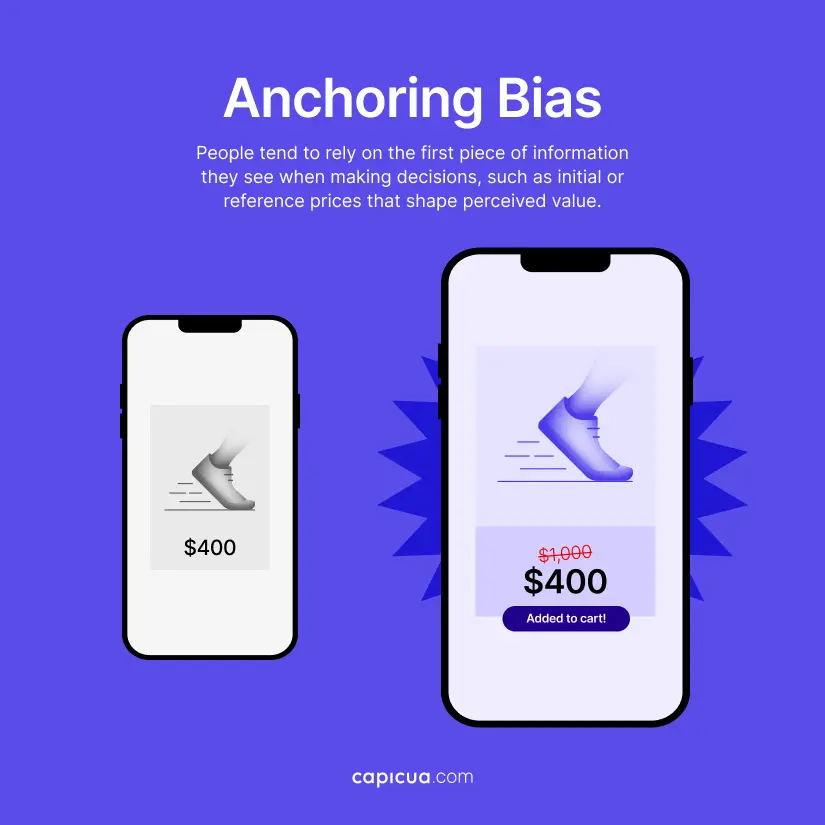
Anchoring bias occurs when users rely too heavily on the first piece of information offered when making decisions. In the context of business, the "anchoring effect" is frequently seen in pricing strategies. Over the years, several sources have found that common tactics for effective anchors include prices ending in ".99" or products initially priced at a high "original" price, even if inflated. "Charm pricing" or "Psychological pricing" can also fall under the umbrella of anchoring bias, as people are more likely to buy something priced at $19.99 than at $20. The 2010 book "Priceless: The Myth of Fair Value" found that charm pricing outperformed rounded pricing by about 24%.
Scarcity Bias
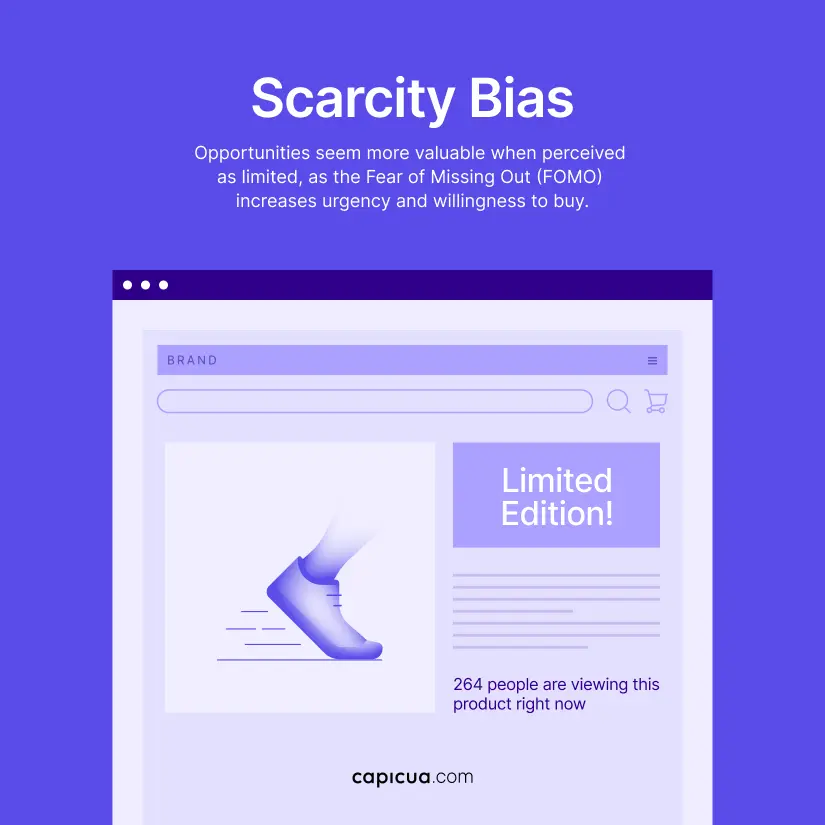
Scarcity bias is the tendency to place greater value on items or opportunities perceived as scarce or rare, making it a powerful motivator in marketing and sales. Companies can use it to create a sense of urgency, for example, by running flash sales with short durations or by highlighting low stock. The "exclusivity" and the fear of missing out (FOMO) increase a user's desire and willingness to buy. Think of e-commerce sites showing "Only X left!" or "X people have this in their cart" pop-ups on listings.
Social Proof
Also known as "status quo bias," Social Proof is a psychological trigger that prompts people to copy others' actions. Coupled with the bandwagon effect, the tendency to "follow the crowd", these biases are key in modern marketing.
In this context, businesses use customer experiences and visible popularity indicators ("most popular," "best-seller"). Known examples include showcasing customer ratings and opinions on products. When prospective buyers encounter product pages that fully endorse the item, it engages the principle of social validation.
Loss Aversion
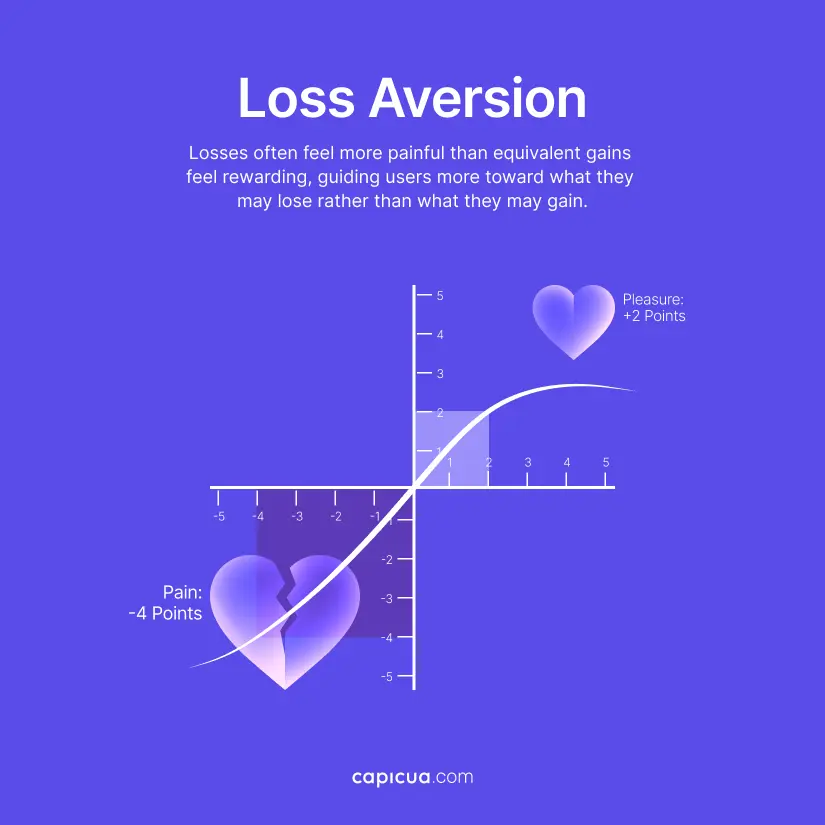
Loss aversion is the idea that losing something hurts about twice as much as gaining something of equal value feels good. In business operations, loss aversion can be used by strategically emphasizing what a customer might lose by choosing a competitor's offering.
For instance, free trials make customers averse to losing that access once the trial ends. Limited-time discounts can also be framed as a way to avoid the "loss" of savings. Even in the healthcare field, framing outcomes as survival vs mortality can highlight loss aversion. A treatment with a 90% survival rate is considered better than one with a 10% mortality rate, even if both treatments have the same statistical information.
Confirmation Bias
Confirmation bias is the tendency to favor information that confirms one's pre-existing beliefs. In business decisions, confirmation bias manifests in how marketing messages are targeted. Brands often create campaigns that resonate with their target audience's existing values, such as car brands that emphasize top-tier safety features to build confidence among drivers who prioritize safety.
Decoy Effect
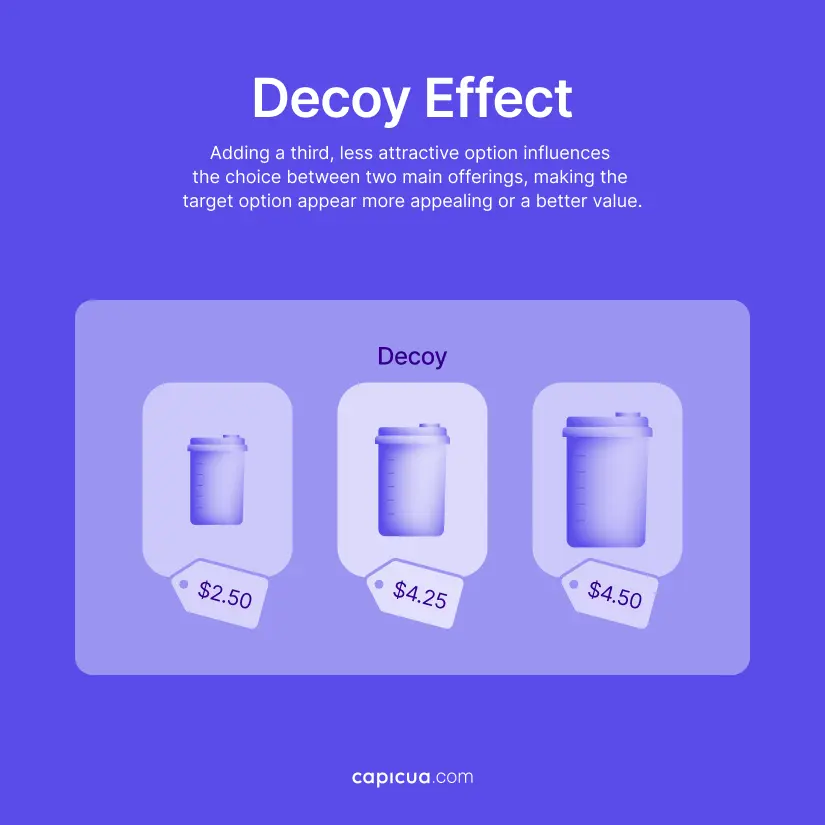
The decoy effect is a decision-making phenomenon that occurs when a third, less appealing option is added to alter a customer's choice between two other options. By providing a "decoy" that is weaker than one option but better than another, companies can lead consumers to the best choice.
If a small product is priced at $5 and a large one at $10, customers might be unsure which to choose. However, if a medium one is introduced at $9.50, the large option becomes more appealing. Classic examples of the decoy effect include coffee shops and cinema snacks.
Halo Effect
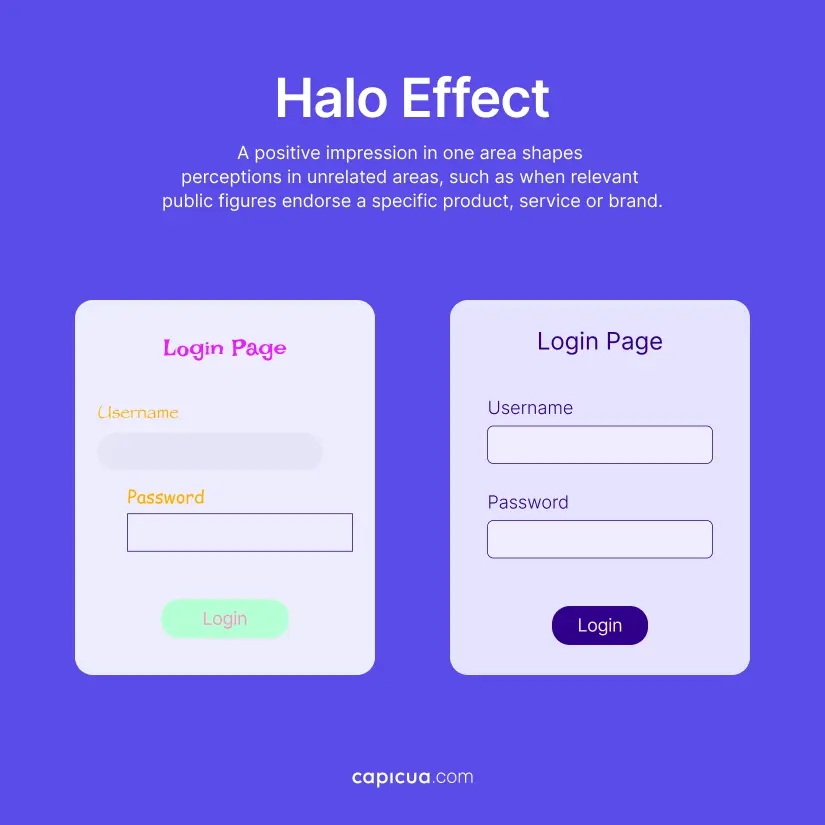
The halo effect occurs when our impression of something influences how we feel about its specific traits, even if those traits are unrelated to the first. In other words, the halo effect is the ability for an impression in one area to influence our perception in other areas.
Companies leverage the halo effect in marketing by highlighting single features that can make a product feel more valuable or desirable. If a brand has a strong positive reputation, consumers unconsciously attribute positive qualities to their products.
That is what happens with Apple: the sleek design and packaging imply a sense of high quality, and that impression extends to aspects such as User Experience and overall brand reliability. Another well-known example is influencer marketing, which associates a person we may already like with specific traits of an unrelated product or service.
In the context of digital products, The Decision Lab ran an experiment in which users were shown two versions of an app's login page. On the one hand, they were asked whether they liked the page's aesthetics; on the other, they were asked to rate the app's intuitiveness, reliability and security. The study showed that user who likes the login's look and feel also tended to rate the app higher across all three categories.
Framing Effect
The framing effect occurs when people make decisions based on how information is presented, rather than on the information itself. Also known as the "framing bias," it holds that the same problem can elicit different responses depending on how it is framed.
During the 1960s, Volkswagen positioned its compact vehicles as clever substitutes for large cars. The slogan "Think Small" helped reshape public perception of small-car ownership in a positive light. A more modern example could be the difference in perceptions a product labeled "90% fat-free" may evoke compared with one labeled "10% fat".

Availability Bias
Also known as "Availability heuristic," this bias leads people to overestimate the importance of events that are more vivid in their memory. Within this bias, people estimate probabilities based on examples that come to mind rather than objective facts. Think of the common fear of shark attacks. While these are incredibly uncommon, we tend to remember stories about them more vividly than those about more mundane risks.
In marketing, this bias translates to compelling stories or easily remembered slogans that have a greater impact. As familiarity breeds trust, the mere exposure effect can increase click probability by up to 70% after repeated exposure. A great example is lottery winners, who take over the news and increase the number of people who subsequently play, even when the chances of winning are quite low.
Common Cognitive Biases for Businesses
- Anchoring Bias: People tend to rely heavily on the first piece of information they see when making decisions, such as initial or reference prices that shape perceived value.
- Scarcity Bias: Opportunities seem more valuable when perceived as limited, as the fear of missing out (FOMO) increases urgency and willingness to buy.
- Social Proof: Popularity indicators such as ratings, reviews or labels like "best-seller" tend to increase trust and likelihood of purchase.
- Loss Aversion: Losses often feel more painful than equivalent gains feel rewarding, guiding users more toward what they may lose rather than what they may gain.
- Confirmation Bias: People favor information that confirms their existing beliefs, and reinforcing expectations can influence behavior and decision-making.
- Decoy Effect: Adding a third, less attractive option influences the choice between two main offerings, making the target option appear more appealing or a better value.
- Halo Effect: A positive impression in one area shapes perceptions in unrelated areas, such as when relevant public figures endorse a specific product, service or brand.
- Framing Effect: Decisions can depend on how information is presented rather than the facts alone, and different positioning can change the perception of the same data.
- Availability Bias: People judge importance based on what is easiest to recall; making memorable stories, repeated exposure or vivid examples increase perceived value.
Cognitive Biases and B2B Digital Product Companies
When building digital solutions, partners shape decisions, behaviors and perceptions beyond design and coding, and cognitive biases are at work with each decision. Ignoring biases only results in products and strategies being shaped without active management.
Every digital product teaches users what to do, what to value and what to ignore, but the same principle applies to decision-makers who choose to build a product in the first place. Everyone, from executives to end-users, relies on mental shortcuts to process information quickly. These shortcuts, or cognitive biases, help people make decisions under uncertainty, but they can also introduce predictable distortions.
For companies delivering digital products, these distortions can mean that requirements reflect assumptions rather than real needs, metrics are interpreted in ways that confirm existing beliefs, and roadmaps are influenced by opinions rather than evidence. Understanding these patterns can help companies manage risk more effectively.

Cognitive Bias and Product Development Stages
Cognitive biases appear long before a product reaches users:
- Discovery: During discovery, confirmation bias can lead teams to seek evidence that validates an initial idea rather than challenge it.
- Design: At the design stage, the Halo Effect can lead teams to assume users think the same way they do.
- Delivery: After delivery, the status quo bias can lead companies to keep investing in features that don't yield results.
- Measurement: Here, framing biases can distort learning by focusing only on successful use cases while ignoring silent failures.
In B2B environments, products rarely have a single decision-maker. Instead, there are sponsors, teams, stakeholders and end users who may interpret information differently. For instance, while executives may exhibit availability bias, operational teams may face status quo bias, which can make them resist change.
If a partner does not account for these dynamics, people interpret reality through different lenses, leading to greater misalignment. The stakes are higher when you consider that these biases compound across organizations: a single company's internal assumptions become another company's product decisions.

Cognitive Bias, End-User Experience and Growth
Ultimately, products succeed or fail based on how real users behave, and ot how teams expect them to behave. These biases can lead teams to overestimate motivations, underestimate friction or misinterpret signals. The result? Users simply disengage. From a growth perspective, reduced learning speed leads to slower iteration, weaker retention and higher acquisition costs.
On the other hand, companies that actively consider cognitive biases gain an important advantage by designing systems that reduce uncertainty rather than amplify it. This approach includes testing assumptions rather than defending them, designing experiments that challenge beliefs and structuring discovery to surface blind spots early. In practice, this structure improves decision quality, stakeholder alignment, product-market fit signals and long-term scalability.
In product delivery, success depends not only on technical execution but on clarity across organizations. A partner who understands cognitive bias helps clients separate signal from noise, prioritize outcomes over opinions and reduce costly rework, enabling them to learn faster than competitors.
Our operating lens, Shaped Clarity™, merges foresight with discipline to turn costly guesswork into measurable impact and give direction and momentum back to founders and leaders who want to lead the future with soul, through well-thought-out digital solutions.
Shaped Clarity™ helps visionary leaders protect their vision and cut the waste to scale with soul. Every decision is anchored to your purpose and sharpened by signals; signals surface in time to act before waste multiplies and budget erodes, and value remains intact to make growth both sustainable and rewarding. If you want to learn more about how Shaped Clarity™ can meet your specific requirements, get in touch with us!

Conclusion
Cognitive biases are key elements of how people think, yet in digital product environments, unexamined assumptions can be costly. Consumer behavior and experiences are heavily influenced by how a product or service is presented.
As a result, recognizing and designing around cognitive bias is essential to building products that work not only in theory but in reality. The real challenge is rarely writing code but understanding how people decide, learn and act. At Capicua, we can help you make the most out of it, as your Product Growth Partner. Reach out today!