


Rather than scrolling through results, users are now directly turning to AI to find answers to their questions. A great example of this shift is Adobe's recent study, which states that AI drove a 690% increase in traffic to retail sites during the 2025 holiday season.
Over the years, companies relied on search engines and their best practices to make their offerings as easy to find as possible. But recent changes in preferences led to new algorithms and new best practices to follow to comply.
These algorithms, which select which content is included in AI-generated answers, are a major factor in what's known as Generative Engine Optimization. But what is GEO? Is GEO here to stay? What are the differences between Generative Engine Optimization vs traditional SEO? Will GEO replace SEO? Let's find out.

What is Generative Engine Optimization (GEO)
The term Generative Engine Optimization describes actions to be taken in the context of Generative AI Search Engine Optimization. GEO was coined in 2023 as the result of a collaborative effort by researchers from Princeton University, Georgia Tech, The Allen Institute for AI and IIIT Delhi, and it focuses on how LLMs retrieve and present information in response to queries, as well as the actions to maintain a competitive edge.
In sum, GEO adapts digital content to match the inputs that Generative AI algorithms identify as matching a specific query. In short, GEO is what makes a content part of an AI answer. While it may seem like an unknown or distant concept, everyday examples of GEO include OpenAI's ChatGPT, Google's AI Overview and even Amazon's Alexa.
Search engines paved the way for these features a long time ago, including featured snippets that provided direct answers before common link-based results. With the rise of GenAI, engines began synthesizing answers from multiple sources to take it a step further.
With these constant changes and updates, search queries have become more conversational, which is valuable for both traditional SEO and the new AI-driven landscape. SEO practices focused on high-quality, user-centric content are also core to AI search, as they build the authority and clarity that generative models prioritize in citations.
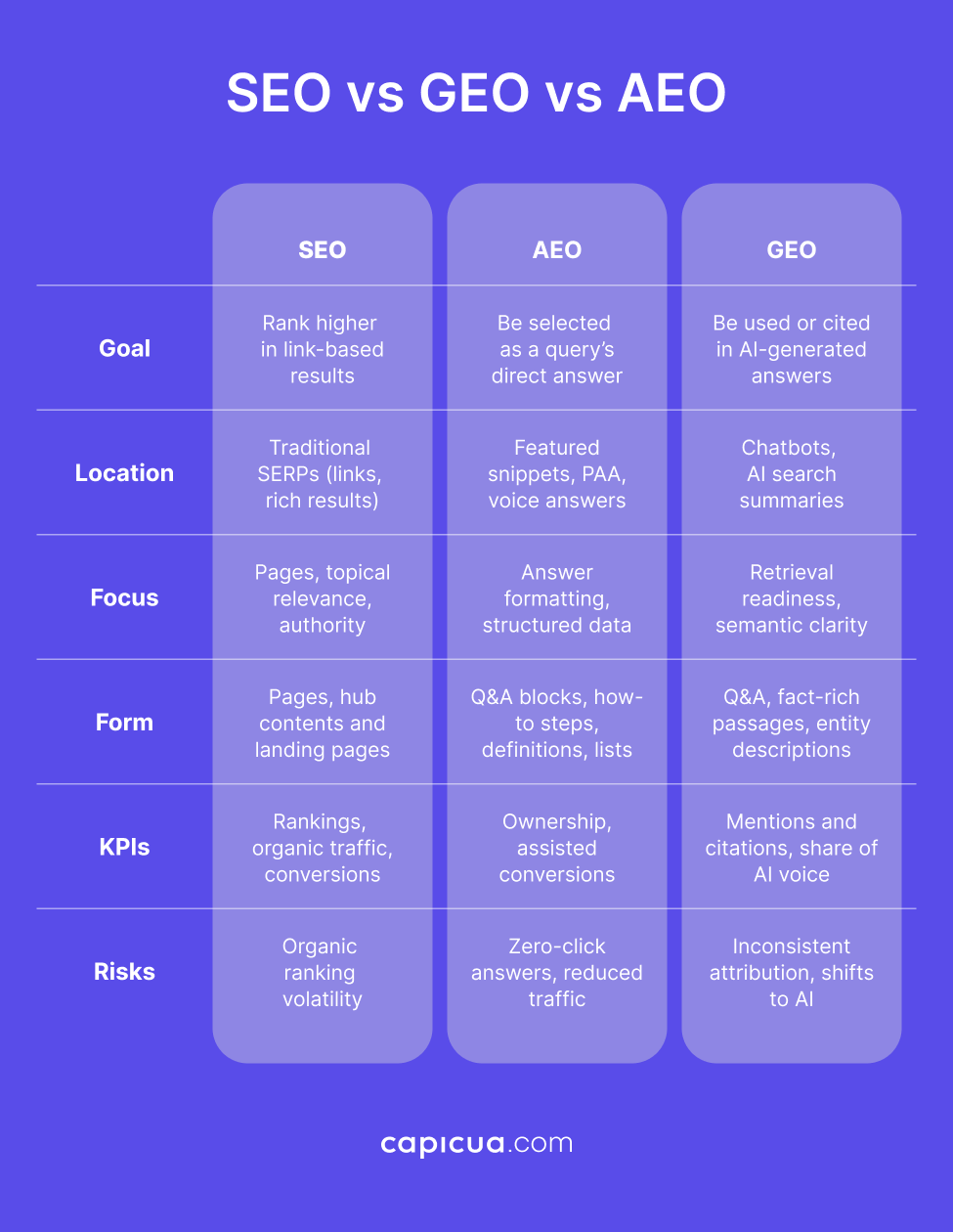
SEO focuses on earning a spot in the link-based results; GEO prioritizes being cited within the AI-generated answer itself. While they have distinct goals and measurement metrics, the most effective strategies blend both, using a strong SEO foundation to enhance content for AI visibility. The two methods are complementary, not mutually exclusive, and mastering both can provide a significant competitive advantage.

SEO vs GEO vs AEO: Search, Answer and Generative Optimization
- What is SEO? SEO focuses on optimizing a website to increase its visibility and traffic within traditional, link-based search engine results pages. The primary goal is to rank higher in the organic results, driving users to click through to a website.
- What is AEO? AEO specifically optimizes content to provide a direct answer on the search results page itself, minimizing the need for the user to click a link (a "zero-click" environment). This targets rich results such as featured snippets, "People Also Ask" sections and knowledge panels.
- What is GEO? GEO is an evolution of AEO that specifically targets content discoverability by AI-powered engines and chatbots. The goal is to structure content with clarity, context and authority so that Large Language Models (LLMs) can easily understand, process and ultimately cite content within their synthesized, conversational answers.
- What is the difference between AEO vs GEO? AEO is the strategy of optimizing for any "zero-click" answer format, while GEO is the specific methodology used to achieve AEO goals within the technical context of GenAI and Retrieval-Augmented Generation (RAG) systems. Both methods are built upon a strong SEO foundation.
What is Retrieval-Augmented Generation (RAG)
Traditional search uses a search index, a big database of which words appear on which pages, along with algorithms to rank relevancy. When users search, it matches queried keywords to its index to return relevant links. However, GEO is powered by Large Language Models (LLMs) trained to generate text.
LLMs can answer questions based on the data they were trained on, but relying solely on training data can lead to sharing outdated knowledge, ignoring niche or private information or even hallucinating to compensate for a lack of information in a specific field. For instance, if you ask an AI about the updates a digital product had in 2025, but the AI's training data only goes to 2020, it may hallucinate or fail to provide a relevant answer.
In this context, Retrieval-Augmented Generation (RAG) is a hybrid AI approach that combines information retrieval with text generation to craft more accurate, up-to-date answers from external sources. There are multiple RAG architectures designed for different purposes, ranging from simple retrieval-once-generate processes to more complex, multi-stage systems.
Retrieval-Augmented Generation (RAG) combines information retrieval with text generation to craft more accurate, up-to-date answers from external sources.
Since GEO is about being embedded in the AI's index while also being semantically relevant, understanding RAG helps clarify why GEO strategies matter. If you want to be in AI answers, you need to be both stored in vector databases and rank highly in similarity for relevant queries. In RAG, content must first be retrieved before it can be part of the answer.
It's important to note that semantic relevance differs significantly from simple keyword matching. AI search prioritizes content that is meaningfully related to the user's intent, even if it doesn't contain the exact query words. Content with clear, specific meaning and structured data is highly rewarded, while old tricks like keyword stuffing can actively harm visibility by reducing semantic clarity and triggering spam filters.

How Does Retrieval-Augmented Generation Work?
Retrieval-Augmented Generation is the result of interconnected algorithmic layers, each responsible for a specific stage of how the system finds, evaluates and generates answers.
1. RAG Indexing
RAG's process starts with data preparation: relevant external or proprietary data is collected and broken down into smaller, manageable pieces called "chunks." After chunking, an embedding model converts these text chunks into numerical representations, known as vectors, that capture their semantic meaning. Finally, vectors are stored and indexed in a specialized vector database to enable efficient later searches.
2. RAG Retrieving
When a user submits a question, the system converts the query into a vector using the same embedding model used for the documents. Once the query is transformed into this vector format, the system conducts a similarity search, comparing the query vector with the document vectors stored in the database. This comparison helps identify the most relevant chunks of information to address the user's question.
3. RAG Generation
The last phase, generation, begins with augmentation to integrate retrieved information and the original user query to deliver an "augmented" prompt that is rich in context. The augmented prompt is sent to the system's specific Large Language Model (LLM), which utilizes both its inherent knowledge and the additional context provided to generate a response that is accurate, relevant and factually grounded for the user.
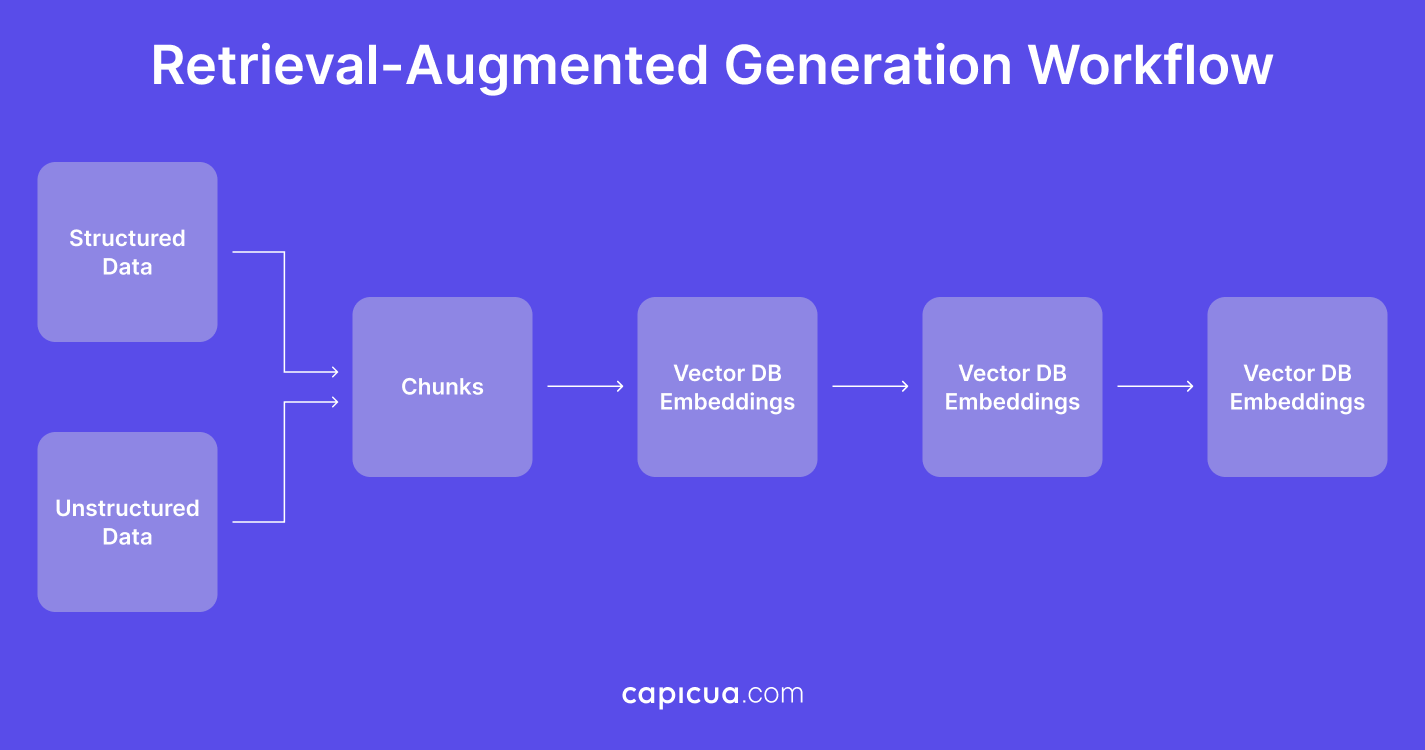
To summarize, RAG retrieves information before generating a response, which helps ground the LLM's output in specific facts and reduces "hallucinations".
What Digital Product Companies Must Know About GEO
Users move between platforms and discover products in diverse ways, including traditional search, AI assistants, and social media. If you keep focusing only on SEO, you might miss the market segment of users who prefer AI, but only focusing on GEO can cut you off from the still-massive volume of traditional search. It's key to maximize visibility across touch points.
Think of it as an iteration of known procedures. Teams can continue creating SEO-friendly content and documentation, but incorporate AI-friendly formats that make it easy for LLMs to index. It's key to monitor both search rankings and whether and how your brand is mentioned by AI. Platforms like Ahrefs and Semrush also track brand mentions in AI results and citation frequency for a comprehensive analysis of AI "share of voice."
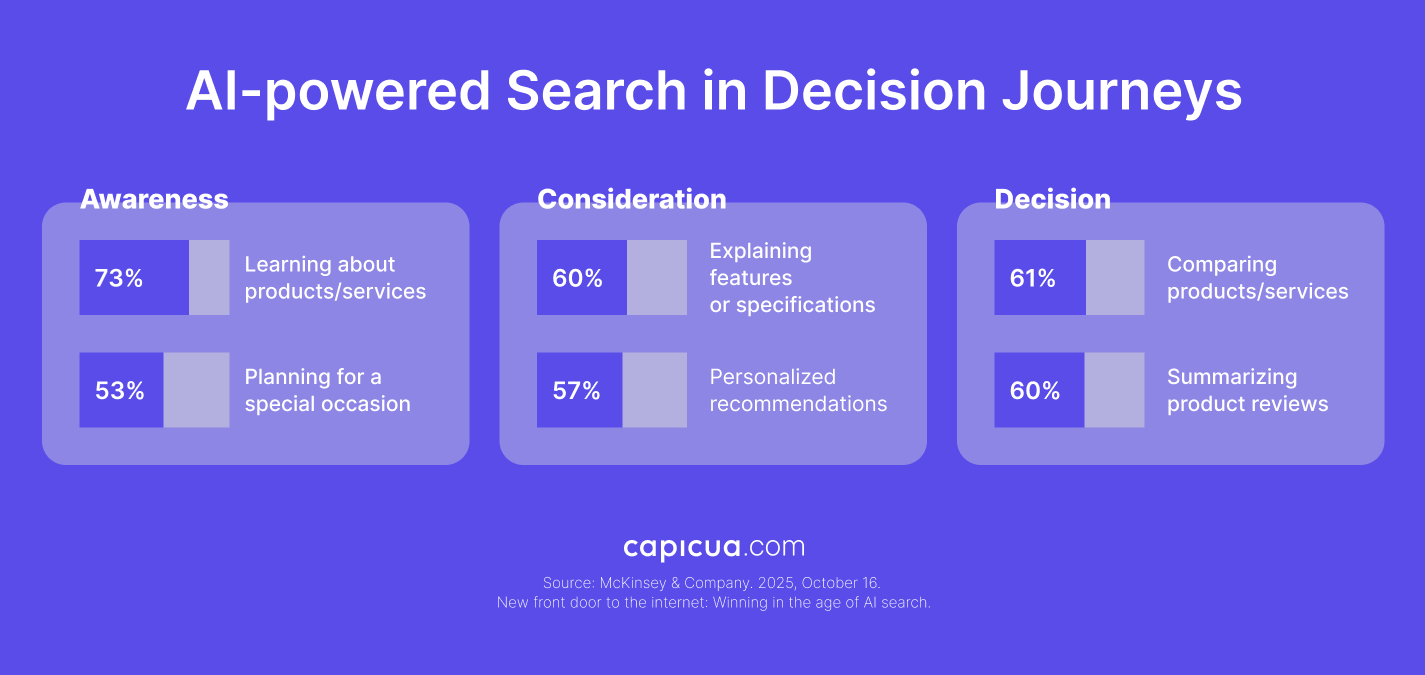
Being present in AI-generated answers can also significantly influence user perception. According to McKinsey, consumers are using AI-powered search "extensively" across decision journeys. In Awareness - Consideration - Decision funnels, users harness AI to both learn broadly about categories, brands, and services (Awareness), and to compare features or summarize review items for specific products (Decision). What's more, AI is widely used across sectors, from consumer electronics to wellness and health to financial services.
Generative search results are known to shortcut the often-called tedious aspects of research. The work of overcoming information gaps, weighing credible sources, and comparing contradictory perspectives is mostly done by AI rather than the user. Combined with its more conversational tone, being part of AI results can position your brand as both approachable and authoritative.
Seeking information is also a habit-driven; think of how "to google" became the equivalent of "to search" once Google established its authority as a game-changer. Today, there's a shift among Gen Zers of calling ChatGPT simply "chat." As linguistic shifts can also shape behavior, companies have much to gain by becoming go-to sources for answers.
As linguistic shifts can shape societies' behavior, companies have much to gain by becoming go-to sources for answers.
Beyond marketing, SEO and GEO considerations can influence the product itself, as well as customer support and experience. Many digital products now include AI chatbots or search functions within their apps, which is essentially an internal use of RAG. If you've invested in a well-structured knowledge hub, you can repurpose that for an in-app assistant.
Maintaining thorough FAQs, how-to guides and Q&As can boost both Google ranks and AI visibility, as well as equip companies to build smarter support and documentation. Good GEO content can double as training data for your own AI features and blend more easily with overall AI product strategies.
A strong GEO strategy can also be a hidden gem for product discovery. If you notice people searching for "Does [YourProduct] integrate with XYZ?", you can prioritize those integrations. If you see that AI answers compare you with a competitor, you can ensure the info it's using is favorable, publish a comparison page or improve content on overlapped topics.
What digital product companies must know is that GEO can offer greater discoverability, improved brand authority and insights that can drive product and content strategy. As a result, leaders can own the conversation in their domains regardless of where it happens.

Conclusion
Users are relying more and more on AI-powered interfaces to synthesize information and guide decisions, and Generative Engine Optimization is walking alongside this structural shift in how digital products and brands are discovered, evaluated and trusted.
As GEO can influence discovery, documentation, support, and even internal AI capabilities, companies that treat content as knowledge will be the ones to shape perceptions earlier in decision journeys and secure relevance wherever discovery occurs.