


Customers are the fuel of your business, and knowing how much each one contributes to your growth can determine how fast and how far you get. To make growth intentional, Customer Lifetime Value (CLV or CLTV) quantifies the revenue a customer generates over time. How to calculate CLV to make informed decisions throughout the customer journey?
What is Customer Lifetime Value
Customer Lifetime Value measures the total profit from a customer and reveals how much they contribute to business growth. In this context, a CLV calculation is key to gathering insight into how effectively a business acquires, retains and monetizes customers.
By assessing value, businesses can identify the most valuable retention segments and optimize acquisition spend by investing more in those who drive long-term revenue to strengthen high-impact relationships.
By regularly measuring their CLTV, companies know how much to invest in acquisition to better channel improvement initiatives and adapt strategies to customer behavior. This result also supports revenue forecasting by aligning strategy with customer profitability.

How to Calculate Customer Lifetime Value?
There are several Customer Lifetime Value formulas, so your decision as a decision-maker will depend on factors such as your business model and data maturity.
For instance, IBM measures CLV as CLTV = Customer Value * Average Customer Lifespan. Here, value is the revenue a customer generates over a given period (e.g., monthly or annually), and average customer lifespan is the time a customer spends with your business.
If a user generates $600 per year and the average customer remains with the company for 5 years, the calculation would be: CLV = $600 × 5 = $3,000. This means each customer is worth approximately $3,000 over their lifetime within your business operations.
Another customer lifetime value calculator involves average revenue per customer, gross margin and churn rate, with the formula: CLTV = (Average Revenue per User × Gross Margin) ÷ Churn Rate. This version is often seen as more accurate than simpler versions because it factors in the profitability of the revenue rather than just the top-line income.
Here, Average Revenue Per User (ARPU) refers to the average revenue generated per user or account over a specific period. Gross Margin defines the percentage of revenue remaining after subtracting the costs of sold goods or service delivery. Lastly, the Churn Rate is the percentage of customers who stop using the service within the same given period.
If a company has a monthly ARPU of $50, a gross margin of 80%, and a monthly churn rate of 10%, the calculation would be: CLTV = (50 × 0.80) ÷ 0.06 = $400. This formula shows that the average customer is expected to generate $400 in gross profit over a month.
What is a Good Customer Lifetime Value Score
Since the dollar value of CLV can vary by industry, a good Customer Lifetime Value is primarily defined by its relationship to acquisition costs, measured by the LTV:CAC ratio.
If the CLTV is lower than or close to CAC, growth becomes fragile and hard to sustain. A declining number usually points to issues such as misaligned pricing, weak customer onboarding or unmet expectations.
And while a rising CLTV indicates customers are staying longer, spending more or both, a ratio that is too high can also be interpreted as under-spending on growth, which can allow competitors to capture market share.
Different customer types, plans, regions or acquisition channels will naturally have different lifetime values, so it's also critical to interpret CLTV by customer segmentation. In this context, high-performing customer segments reveal where to double down.
A high-performing customer segment is a small group that drives the majority of a brand's long-term profitability and sustainable growth. Core characteristics of these groups, beyond revenue concentration, include higher retention, lower price sensitivity and brand advocacy.
By understanding how much value customers generate, your business can model growth, plan infrastructure and assess impact, making growth more predictable and giving leadership, product and customer service teams a shared language to build on.
Why is Customer Lifetime Value Important
By connecting customer behavior with revenue strategies, CLTV helps companies better cater to long-term customers. If CLV is clearly understood, acquisition costs are justified and profitability and capital efficiency are improved. When teams optimize for lifetime value, revenue growth becomes intentional, informing growth strategies' decisions.
How to Improve Customer Lifetime Value Score
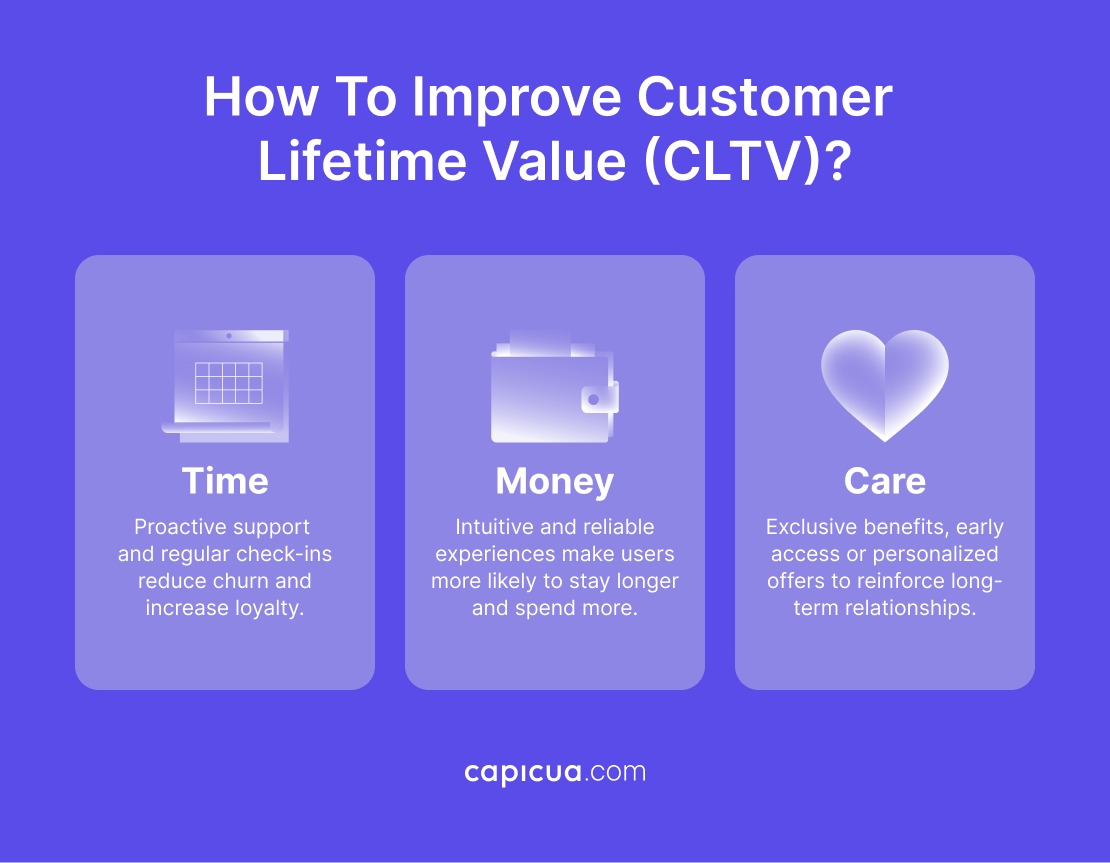
To improve Customer Lifetime Value, you need to increase three branches: how long customers stay, how much they spend and how consistently they choose you. Remember: when users get value and feel supported, retention and therefore value improve naturally.
To do so, you can start by assessing and iterating on customer success through strong onboarding, proactive support and regular check-ins to reduce churn and increase customer loyalty. Make sure every interaction, from usability to messaging, matters!
Experiences that feel intuitive and reliable make users more likely to stay longer and spend more. Loyalty programs with exclusive benefits, early access or personalized offers further reinforce long-term relationships.

Conclusion
When you understand what your customers are truly worth, you can make better decisions to support growth execution. At Capicua, we align clarity and execution to build products users love and keep coming back to. Let's build with purpose!