


Many businesses have discovered that, despite its capabilities, traditional AI still requires ongoing human oversight. But what if the AI could handle those steps itself? That is the model shift for Agentic AI, with projections placing its global market size at around $5-7.5 billion for the year and a compound annual growth rate of over 40%. What exactly defines this form of AI, and how does it have the ability to change industries completely? This article breaks down the core Agentic AI definition and more.
What is Agentic AI
While traditional AI is typically reactive and follows fixed rules, and generative AI primarily creates content based on prompts, agentic AI refers to autonomous systems that perceive their environment, reason through complex goals and take independent actions.
Rather than referring to a company or an Artificial Intelligence agency, the term "agency" in Agentic AI refers to the system's capacity for autonomous, goal-directed action. While a standard AI produces an output for a specific natural-language prompt, an agentic AI receives a high-level goal.
Agentic AI typically involves a combination of advanced ML algorithms, Large Language Models and Natural Language Processing, as well as autonomous decision-making processes and functionality. These operations are often designed to mimic aspects of human cognition, such as perception, reasoning and continuous learning.
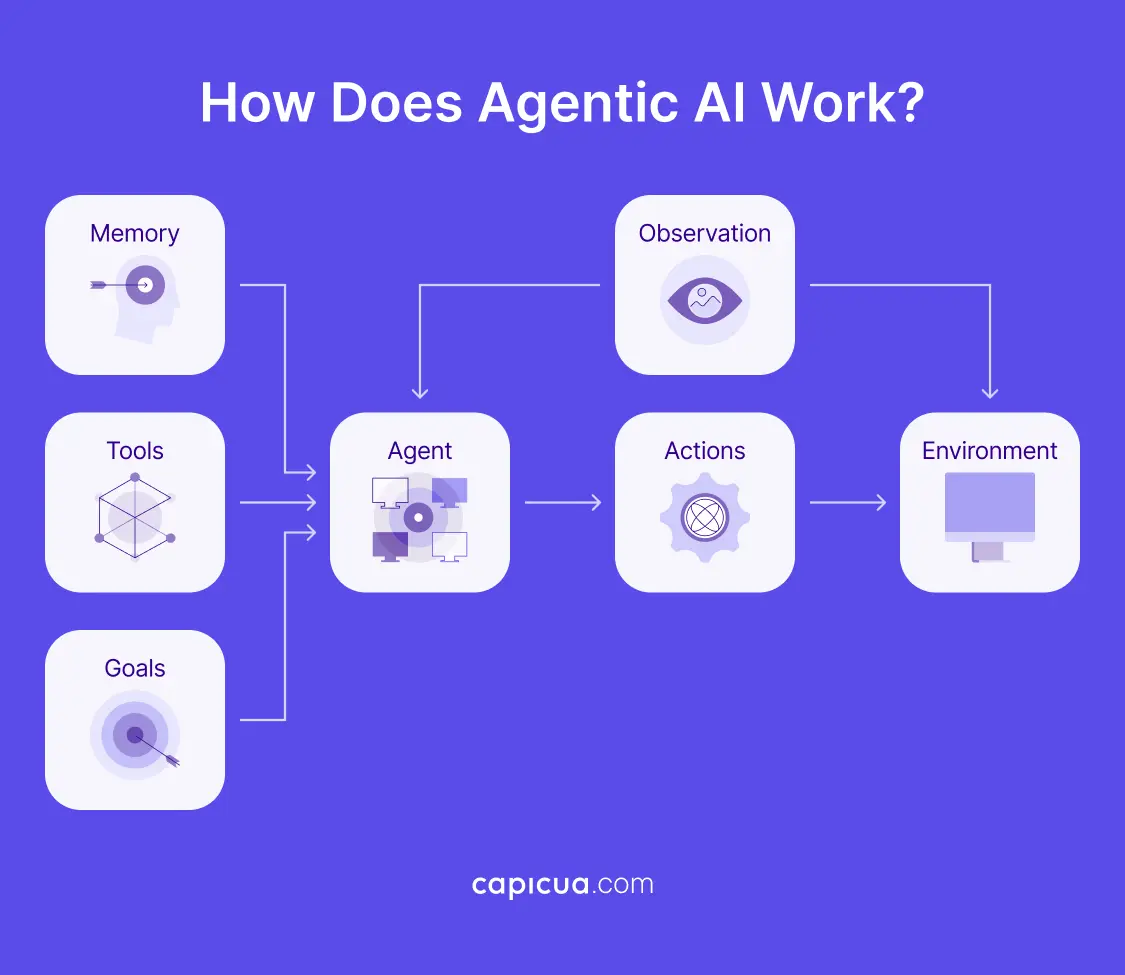
Elements of Agentic AI
- Pursuit: Intelligent agents work towards a defined objective without needing instruction for every step, doing so by breaking large goals into smaller subtasks. The agent starts working through a list of tasks, and if something doesn't work, it can simply backtrack and try a different approach. This structure creates cycles of action and feedback, and the agent keeps moving forward until the job is done or it gets stuck and needs help.
- Reasoning: These AI systems can 'think' ahead and devise action sequences by using internal reasoning frameworks (logic models or Bayesian networks) to evaluate paths. It can consider which resources are needed, what order makes sense and what potential blocks could arise, harnessing Reinforcement Learning and self-improvement techniques to keep track of what it has already tried and what it has learned.
- Interactions: By accessing specific tools, such as software APIs, agentic AIs can actively use other software and data sources to accomplish tasks. When its plan calls for an action, such as fetching real-time data or creating a chart, it doesn't just describe the task. It can generate the exact code or API call needed to command the external tool directly, which turns sequences into action-driven workflows.
- Learning: AI agents operate in a continuous loop of learning from experience and refining actions. These decision-making capabilities ensure that if an action leads to a dead end, the system uses that failure as information to rule out one option and try another.
What is an Agent Ecosystem
An agent ecosystem is a network of interacting intelligent agents that collaborate to perform tasks across various domains, such as software programs, AI algorithms, digital assistants and robotic systems. Each of these is designed to execute specific functions or to work collaboratively to achieve a common goal, powered by interconnectedness and the integration of specific technologies.
- Single Agent Systems: A single-agent agentic system is an AI entity that performs multi-step tasks for a single user or purpose, using a single core model to decide which tools to use to achieve its goals. Examples of single-agent systems include personal calendar assistants, internal helpdesk bots and AI trading bots.
- Multi-agent Systems: Multi-agent collaboration involves multiple specialized AI agents, with divided labor and ongoing communication to perform more complex tasks. This labor division can encompass areas like software development or enterprise systems, and examples include smart assistants, supply chain management and logistics optimization.
Agentic AI vs Generative AI
First, Agentic Artificial Intelligence systems leverage Computer Vision in interactive settings to observe their environment, analyze data and make decisions based on findings. Examples of Agentic AI include autonomous vehicles, robotic process automation, and sophisticated chatbots to enhance the customer experience.
On the other hand, Generative AI focuses on learning patterns from existing data to create new content, using models that analyze the data they're fed to generate outputs that resemble it. The most well-known examples include content and image generation models.
While Agentic AI is designed for action and interaction with the environment, Generative AI focuses on data-driven content output. Both are powerful yet designed for distinct roles within the scope of Artificial Intelligence technologies.
Why Agentic AI Matters
The core benefit of agentic AI for businesses is its ability to take operations from basic automation to true operational autonomy, as it can independently plan, reason and act to achieve complex business goals. That's why, according to a recent study, over 85% of surveyed CIOs see Agentic AI as a strategic priority.
By delegating heavy, high-volume processes to autonomous agents, companies can reduce operational costs by 25% to 40% and accelerate process cycle times by 30% to 50%. This shift allows team members to focus on high-value strategic innovation and customer-centric tasks, while reducing the time spent supervising AI workflows.
These systems can predict market trends and customer preferences to proactively tailor strategies. Agentic AI can also extract actionable insights from large volumes of data, greatly improving operations' optimization and organizational responsiveness.
AI Agents in customer service can also handle common inquiries to deliver personalized, responsive experiences. Virtual assistants can offer instant support with tailored recommendations based on customers' preferences and interactions. These systems can perform repetitive tasks consistently and precisely, reducing errors and increasing output.
Conclusion
There are many areas where Agentic AI can help you take your company to the next growth stage, especially so you (the human reading this) can focus on what truly matters. We are committed to guiding visionary teams along this journey, so get in touch!