

Understanding how users interact with your product to accomplish their goals is key to providing an optimal User Experience (UX). That's why your design teams must carefully consider and define every step users take to uncover friction, identify opportunities and create meaningful experiences.
At an internal level, your teams must also be able to easily share their knowledge with other teams and partners to inform decisions and ensure alignment. One of the best and proven approaches to support these processes is a customer journey map.
Let's explore what a digital product customer journey map is and why it's so important for leaders and decision-makers to create products that users love with an evidence-based, clarity-driven approach.
What is a Customer Journey Map for a Digital Product
At its core, a customer journey map is a detailed visual representation of all the interactions users have with a product. Think of it as a diagram that walks you through all the steps users take to achieve a goal, such as purchasing an item in an online store.
Unlike sales funnels, customer journey maps are highly user-centric, showing the experience from the user's perspective at every touchpoint and covering everything from discovering a brand to post-purchase interactions.
These journey maps can also include detailed user personas with their specific goals, motivations, behaviors and pain points to help teams put themselves in users' shoes. With a well-made customer journey map, companies leverage a visual, empathy-driven representation of how users interact with their product and brand.
Stages of the Customer Journey Mapping
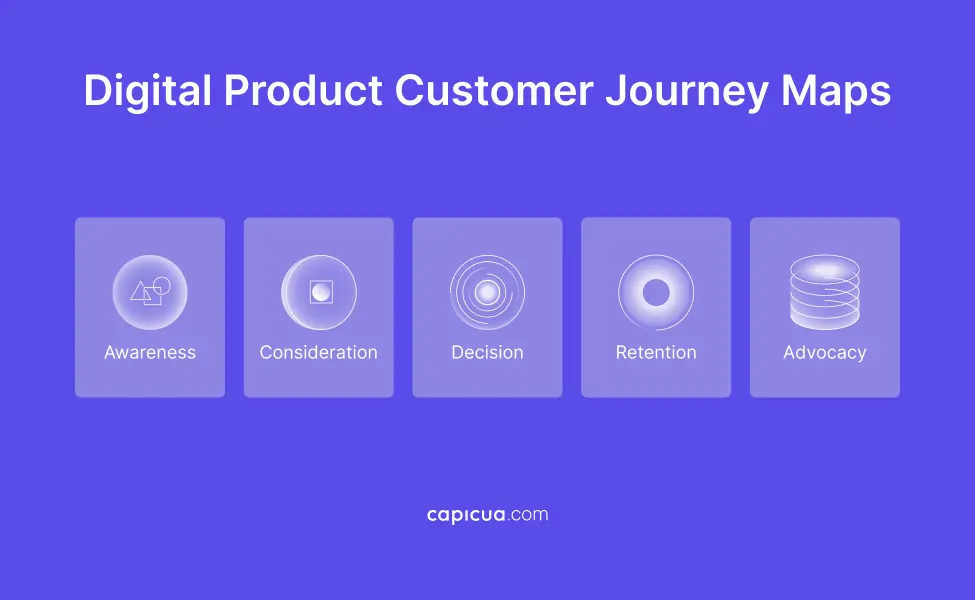
Most customer journey maps have five key stages that illustrate the steps users take when interacting with your brand to create engaging experiences and drive successful outcomes.
- Awareness: The first step in the loop, awareness represents the moment your ICP discovers your brand and its potential to solve problems, which is essential for users to move through the next stages. Instances of awareness practices include blog posts, thought leadership and targeted ads.
- Consideration: The consideration stage begins when users realize there may be a match between your company's solutions and ways to fix the problems they're facing. Ways to differentiate your company and show its offerings during the consideration stage include interactive tools and retargeting ads.
- Decision: Users weigh the pros and cons of available options and, after selecting your company as the best fit to solve their problem, they're ready to sign a contract. At this point, approaches to gain trust include intuitive demos with transparent pricing and customer testimonials that address potential objections.
- Retention: While acquiring new customers can be harder and more expensive than retaining them, you must also nurture relationships with current customers so they do not erode or make them feel neglected. Well-known examples of retention strategies include proactive support, personalized offers and reward programs.
- Advocacy: Satisfied customers are far more likely to recommend your brand, significantly driving growth. Simply put, the advocacy stage means that the happy customers you've retained promote your brand to their networks. You can show advocacy with social proof, content collaboration and community building.

How to Create A Customer Journey Map
- Goals: The process of creating a successful customer journey map begins with defining clear, measurable goals, often using the SMART framework (Specific, Measurable, Achievable, Relevant, Time-bound). Examples of clear goals include improving customer satisfaction or increasing loyalty and retention. Yet, after selecting a broad goal, narrow it down to something much more specific and concrete.
Example: Reduce the average sales cycle from 9 months to 6 months by removing friction points during the Technical Validation and Legal Review stages.
- Data: With clear goals, the next step is to collect data, which can be done through analytics tools, surveys, CRM systems and social media interactions, among others. This stage involves qualitative and quantitative insights from both general audiences and specific customer journeys. At this stage, user sentiment metrics, such as Net Promoter Score (NPS) and the Customer Effort Score (CES), are also key.
Example: CRM data shows that 60% of leads stall after the demo (quantitative), and interviews reveal they find our ROI calculators too generic for their industry (qualitative).
- Personas: While including demographic data, personas must also highlight interests, pain points, behavioral traits, goals and motivations. To create them effectively, teams can use existing customer data and data-driven insights, yet, since they may have different goals, each user persona will be a segment with a unique journey. With these user personas, teams will be better able to focus on real customer needs, motivations and expectations.
Example: Ryan, the CISO technical validator, cares about integration and compliance. Meanwhile, Emma, the CFO economic buyer, cares about ROI and total cost of ownership.
- Touchpoints: At this step, teams list every point of interaction customers have with the brand and product, from initial discovery to post-purchase interactions. Detailed touchpoints in customer journey maps help teams understand all the steps users take to accomplish their specific, persona-based goals. Leaders must consider both digital and physical touchpoints, informed by real customer behavior and data insight.
Example: Awareness: Downloading a report. / Consideration: 1-on-1 personalized technical demo for the IT team. / Decision: Master Service Agreement with the legal department. / Post-Purchase: Quarterly business reviews with a dedicated manager.
- Visualization: Making things both visual and structured begins after blending both personas and product touchpoints. At this stage, teams organize and align actions and touchpoints across a timeline to show how customers move toward their goals. Each touchpoint must have its respective pain points and improvement actions clearly defined.
Example: A grid showing that the "Initial Trial" stage can leave both the end user excited and the manager frustrated by the lack of transparent pricing documentation.
- Improvement: It's unlikely your customer journey map will be perfect from the start, so your teams must review and test it carefully to identify gaps and opportunities. Regular iteration, testing and feedback ensure the map stays accurate, actionable and relevant, based on feasibility and impact, as user needs and touchpoints evolve.
Example: After implementing an industry-specific ROI calculator to help Emma, you revisit the map and discover the bottleneck has moved to the "Onboarding" stage, hence needing a new map focused on implementation speed.

Why are Customer Journey Maps Important?
Customer journey maps give your teams and company a better understanding of your target audience while encouraging a user-centric culture, helping optimize messaging and deliver seamless experiences across different channels.
With these much more effective initiatives, customer journey maps can also have a huge impact on Return On Investment (ROI). In fact, over 75% of companies surveyed say strategic journey mapping helped them increase the ROI of business investments. Moreover, sites with well-designed user journeys can achieve up to 200% higher visit-to-order conversion rates, while visit-to-lead rates can be more than 400% higher.
Rather than just a cute, aesthetic way to visualize intricate operations, a customer journey map is a powerful tool for teams to understand users through a shared reality.
Conclusion
Customer journey maps are great for teams to understand users better and tailor product decisions to their needs while promoting a user-focused culture that drives growth and engagement.
As a design-driven Growth Partner, at Capicua we know firsthand the powerful role journey maps play in building digital products that resonate with real people. If you want to bring your wildest ideas to life while ensuring alignment with users, get in touch!