
Go Back

What To Know About Product Experience Debt

Updated:
2/26/26
Original:
2/26/2026
min read
Build With Clarity

Speed can often be seen as the metric that matters most, but beneath the surface, unseen liabilities accumulate, slowing progress, increasing risk and quietly eroding scalability. And while Operations leaders who use technical debt management methods will report 50% fewer obsolete systems by 2028, technical debt is not the only risk. Product and experience debt can also compromise customer experience and competitive advantage. Where can debt accumulate? What can leaders do about it?

What is Technical Debt?

Imagine fixing a leaking roof with duct tape. It may work in that moment, but every storm will worsen the situation, making repairs more expensive, and eventually, you'll deal with structural damage. That's what happens with technical debt: software development teams trade long-term system health for short-term delivery. 

To meet deadlines, developers may skip tests, accept low code quality, rely on workarounds or postpone upgrades. These decisions aren't careless and are often the result of pressure, but even with good intentions, there's still a long-term debt burden.

The longer the debt is ignored, the more effort is required just to keep the product running. The highest-impact debt is the accumulation of postponed quality work.

What is Product Debt?

If technical debt is a leaking roof, product debt is a construction that made sense at the time, but was built without a plan. Product debt accumulates when uncertainty turns into confidence, for example, when an idea starts as a hypothesis and becomes a requirement. An example of this situation could be if a deadline approaches and the feature is built without evidence to support it, simply because time passed. 

Unlike tech debt, product debt can arise from adding features without evidence or validated learning, and from features that once solved a real problem becoming irrelevant as the product derails from its original vision. This debt burdens teams and users alike, as interfaces become cluttered, value propositions blur and onboarding becomes harder.

What Causes Product Debt?

Product debt is caused primarily by how product decisions are made, justified and left unchallenged over time. Ideas become unvalidated requirements, such as building features without enough customer input. 

Internal opinions, sales urgency or stakeholder requests may seem reasonable when shared, but they may not align with the product's mission. Once built, these features can also become expensive to remove, even when their value is questionable.

Product debt also grows when teams prioritize short-term wins. "Low-hanging fruit" decisions often focus on what's easy to build or what delivers immediate results, but accumulate complexity. Commitments made years ago, legacy customers or stakeholder expectations also make it difficult to question whether a feature still belongs. 

While it may sound counterintuitive, product debt can also thrive in mature products with expert teams and long-term users. Familiarity can hide complexity, and what feels intuitive to insiders can be overwhelming to new users, allowing debt to grow unnoticed.

Over time, product debt shapes products through the accumulation of historical decisions rather than validated, vision-grounded goals.

How to Fix Product Debt?

Product debt can't be resolved by building more or faster—it's solved with value. Businesses need to treat product decisions as hypotheses that can expire and not permanent commitments, questioning what already exists and whether it's still needed. 

Similarly, new features need to be objectively justified based on actual user research and evidence. Features should earn their place in the product through demonstrated impact, not assumptions, internal opinions or historical pressure. 

Addressing product debt also requires shifting the definition of progress. Speed and delivery are easy to measure; focus and clarity are not. Teams need to account for the long-term cost of every addition. Fewer, more meaningful features almost always outperform broader, more complex products.

Retiring features, consolidating flows and reducing options are not signs of regression in themselves; they can be acts of product maturity. When removal is thought out, interfaces become clearer, onboarding improves and the product regains strategic focus.

Finally, teams must actively challenge familiarity. Expert users and seasoned product teams are often blind to complexity because they've learned to navigate it. Bringing an outer perspective from a Product Growth Partner, such as Capicua, can help teams cut through the noise and realign the product with user needs. 

Capicua Product Growth Partner
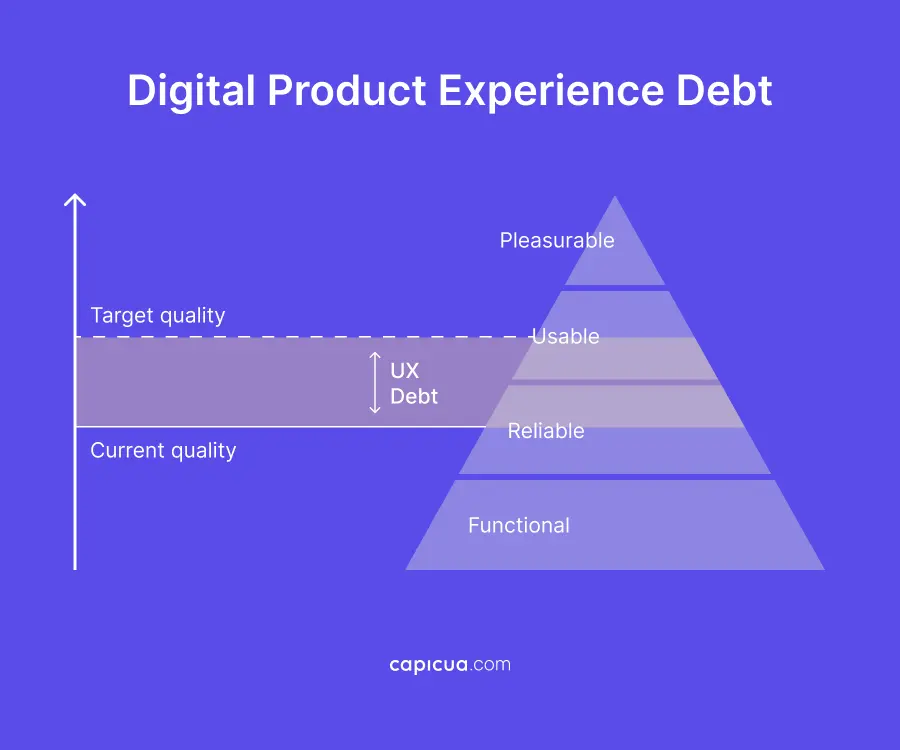
Experience Debt - Source: Capicua

What is User Experience Debt?

User experience debt is the accumulation of friction, confusion and inconsistency within a product, and it builds when users' experience (how they navigate, understand and feel) falls short of what the product is meant to deliver.

When interfaces become cluttered, flows grow longer, interactions feel unintuitive and visual and behavioral patterns lose consistency. Individually, these quality issues may seem small, but together they require more effort, attention and patience from users. These types of debt accumulate throughout the customer journey, including first impressions and onboarding, increasing errors and discouraging continued use. 

UX debt occurs when usability issues are tolerated rather than resolved.

What Causes User Experience Debt?

Experience debt emerges as products evolve faster than the experience that holds them together. As new features, flows, and entry points are added, existing interactions are left untouched, leading to fragmentation and inconsistencies. Also, designing for internal logic rather than user behavior can make users feel the product wasn't meant for them.

When design decisions are made in isolation, such as small changes introduced by different teams, the lack of communication and the consequent lack of feedback further accelerate this problem. When teams rely on assumptions, user requests, historical usage or expert users, they can miss how the product feels to newcomers. 

How to Fix User Experience Debt?

Working on UX / design debt starts with acknowledging that friction is real. Confusing flows, repeated user errors, support tickets, drop-offs and workarounds are all symptoms of an experience that doesn't align with actual use. 

The first step is to treat that friction as a product input, not as a background annoyance. Progress comes from stepping back and looking at the experience as a whole, not as isolated screens or features. Teams need to reconnect user journeys end-to-end and ask simple questions: What are users trying to achieve? Where do they hesitate? Where do they lose confidence? 

UX debt is reduced when decisions are guided by real behavior, and improvements don't require redesigning everything at once. The most effective approach is incremental, where teams simplify interactions one at a time, reduce steps in common tasks, clarify language and remove visual noise. Make space for ongoing validation, such as regular usability testing, feedback loops and exposure to real users. 

UX debt is reduced when decisions are guided by real behavior, not assumptions or legacy flows.

Conclusion

Debt in products rarely shows up all at once; it accumulates quietly since initial development. The real challenge with debt is knowing which risk you're taking on, why it exists and whether it still serves the product's mission.  

This article was written for decision-makers in the digital product industry. If you are interested in avoiding debt and ensuring incremental growth for your digital solution, we'd love to start a conversation!

About
We turn costly guesswork into signal-based direction for visionary leaders to regain control losing value.

With Shaped Clarity™, we anchor decisions to purpose for sustainable and rewarding growth.
Shaped Clarity
discover
Shaped
Clarity™
Shaped Clarity
discover
Shaped
Clarity™

Scalable Product Evolution

The Palindrome - Capicua's Blog
Make The Difference
This image showcasts different concepts related with the article topic.
Summarize:
Summarize with ChatGPTSummarize with PerplexitySummarize with Claude

Speed can often be seen as the metric that matters most, but beneath the surface, unseen liabilities accumulate, slowing progress, increasing risk and quietly eroding scalability. And while Operations leaders who use technical debt management methods will report 50% fewer obsolete systems by 2028, technical debt is not the only risk. Product and experience debt can also compromise customer experience and competitive advantage. Where can debt accumulate? What can leaders do about it?

What is Technical Debt?

Imagine fixing a leaking roof with duct tape. It may work in that moment, but every storm will worsen the situation, making repairs more expensive, and eventually, you'll deal with structural damage. That's what happens with technical debt: software development teams trade long-term system health for short-term delivery. 

To meet deadlines, developers may skip tests, accept low code quality, rely on workarounds or postpone upgrades. These decisions aren't careless and are often the result of pressure, but even with good intentions, there's still a long-term debt burden.

The longer the debt is ignored, the more effort is required just to keep the product running. The highest-impact debt is the accumulation of postponed quality work.

What is Product Debt?

If technical debt is a leaking roof, product debt is a construction that made sense at the time, but was built without a plan. Product debt accumulates when uncertainty turns into confidence, for example, when an idea starts as a hypothesis and becomes a requirement. An example of this situation could be if a deadline approaches and the feature is built without evidence to support it, simply because time passed. 

Unlike tech debt, product debt can arise from adding features without evidence or validated learning, and from features that once solved a real problem becoming irrelevant as the product derails from its original vision. This debt burdens teams and users alike, as interfaces become cluttered, value propositions blur and onboarding becomes harder.

What Causes Product Debt?

Product debt is caused primarily by how product decisions are made, justified and left unchallenged over time. Ideas become unvalidated requirements, such as building features without enough customer input. 

Internal opinions, sales urgency or stakeholder requests may seem reasonable when shared, but they may not align with the product's mission. Once built, these features can also become expensive to remove, even when their value is questionable.

Product debt also grows when teams prioritize short-term wins. "Low-hanging fruit" decisions often focus on what's easy to build or what delivers immediate results, but accumulate complexity. Commitments made years ago, legacy customers or stakeholder expectations also make it difficult to question whether a feature still belongs. 

While it may sound counterintuitive, product debt can also thrive in mature products with expert teams and long-term users. Familiarity can hide complexity, and what feels intuitive to insiders can be overwhelming to new users, allowing debt to grow unnoticed.

Over time, product debt shapes products through the accumulation of historical decisions rather than validated, vision-grounded goals.

How to Fix Product Debt?

Product debt can't be resolved by building more or faster—it's solved with value. Businesses need to treat product decisions as hypotheses that can expire and not permanent commitments, questioning what already exists and whether it's still needed. 

Similarly, new features need to be objectively justified based on actual user research and evidence. Features should earn their place in the product through demonstrated impact, not assumptions, internal opinions or historical pressure. 

Addressing product debt also requires shifting the definition of progress. Speed and delivery are easy to measure; focus and clarity are not. Teams need to account for the long-term cost of every addition. Fewer, more meaningful features almost always outperform broader, more complex products.

Retiring features, consolidating flows and reducing options are not signs of regression in themselves; they can be acts of product maturity. When removal is thought out, interfaces become clearer, onboarding improves and the product regains strategic focus.

Finally, teams must actively challenge familiarity. Expert users and seasoned product teams are often blind to complexity because they've learned to navigate it. Bringing an outer perspective from a Product Growth Partner, such as Capicua, can help teams cut through the noise and realign the product with user needs. 


Capicua Product Growth Partner
Experience Debt - Source: Capicua

What is User Experience Debt?

User experience debt is the accumulation of friction, confusion and inconsistency within a product, and it builds when users' experience (how they navigate, understand and feel) falls short of what the product is meant to deliver.

When interfaces become cluttered, flows grow longer, interactions feel unintuitive and visual and behavioral patterns lose consistency. Individually, these quality issues may seem small, but together they require more effort, attention and patience from users. These types of debt accumulate throughout the customer journey, including first impressions and onboarding, increasing errors and discouraging continued use. 

UX debt occurs when usability issues are tolerated rather than resolved.

What Causes User Experience Debt?

Experience debt emerges as products evolve faster than the experience that holds them together. As new features, flows, and entry points are added, existing interactions are left untouched, leading to fragmentation and inconsistencies. Also, designing for internal logic rather than user behavior can make users feel the product wasn't meant for them.

When design decisions are made in isolation, such as small changes introduced by different teams, the lack of communication and the consequent lack of feedback further accelerate this problem. When teams rely on assumptions, user requests, historical usage or expert users, they can miss how the product feels to newcomers. 

How to Fix User Experience Debt?

Working on UX / design debt starts with acknowledging that friction is real. Confusing flows, repeated user errors, support tickets, drop-offs and workarounds are all symptoms of an experience that doesn't align with actual use. 

The first step is to treat that friction as a product input, not as a background annoyance. Progress comes from stepping back and looking at the experience as a whole, not as isolated screens or features. Teams need to reconnect user journeys end-to-end and ask simple questions: What are users trying to achieve? Where do they hesitate? Where do they lose confidence? 

UX debt is reduced when decisions are guided by real behavior, and improvements don't require redesigning everything at once. The most effective approach is incremental, where teams simplify interactions one at a time, reduce steps in common tasks, clarify language and remove visual noise. Make space for ongoing validation, such as regular usability testing, feedback loops and exposure to real users. 

UX debt is reduced when decisions are guided by real behavior, not assumptions or legacy flows.

Conclusion

Debt in products rarely shows up all at once; it accumulates quietly since initial development. The real challenge with debt is knowing which risk you're taking on, why it exists and whether it still serves the product's mission.  

This article was written for decision-makers in the digital product industry. If you are interested in avoiding debt and ensuring incremental growth for your digital solution, we'd love to start a conversation!