


Search engines are undergoing a shift as GenAI rises. For years, Search Engine Optimization (SEO) has been the go-to strategy for getting products discovered in search engines. But Generative Engine Optimization (GEO) has emerged as the counterpart that optimizes content to appear in AI-generated answers from chatbots and AI search tools.
Rather than scrolling through results, users are now turning to AI chatbots (like ChatGPT or Google's AI-powered results) for direct answers. A recent Adobe study found that GenAI drove a 690% increase in traffic to retail sites during the 2025 holiday season. Furthermore, sources like Wired state that the GEO industry is expected to be worth nearly USD 850M.
Companies relied on SEO practices to master search engine results and put their products and services at the forefront of results and, as a consequence, people's minds. Yet, as users started preferring conversational chatbots to form opinions and select products and services, brands had to rethink their digital product growth strategies.
In this article, we'll explain Generative Engine Optimization vs traditional SEO, outline their technical underpinnings and discuss the business impacts of each. For decision-makers in the product development industry, we'll share how a combined SEO+GEO approach can position products for maximum visibility.
What is SEO (Search Engine Optimization)
At its core, traditional search engines crawl sites, index content and use algorithms to determine which pages best answer users' queries. While it may seem like a new concept, search engines began adjusting their algorithms to prevent ranking manipulation as early as 1997, as captured in archived sites on the Wayback Machine.
In this context, Search Engine Optimization (SEO) encompasses the strategies for tailoring content to rank higher in search engines such as Google and Bing. The process includes keyword optimization, backlink management and technical site improvements, as well as UX factors like page speed and mobile friendliness.
The result of a well-executed SEO strategy is often a higher ranking for relevant keywords or concepts, which translates into qualified traffic, leads and conversions that meet specific business requirements. Since half of website traffic still comes from organic search, SEO is a cornerstone of digital marketing that companies cannot afford to ignore.
What is GEO (Generative Engine Optimization)
Unlike its search counterpart, Generative Engine Optimization (GEO) has emerged alongside AI-driven search and chatbot assistants. Introduced in 2023, the term was first used by researchers at Princeton University to describe strategies for influencing how Large Language Models retrieve and present information in response to user queries.
GEO can be defined as the practice of adapting digital content and online presence to improve the visibility of specific content in answers produced by Generative AI rather than items in blue link listings. Examples include Google's Search Generative Experiences (known as AI Overview), OpenAI's ChatGPT and Amazon's Alexa.
Let's say you ask Google, "What project management apps integrate better with Slack?" SEO results would show you ten website links with lists of apps, yet its AI may generate a simple answer such as, "Management apps X, Y and Z integrate with Slack and offer these features(...)." The role of GEO is to make your content or product part of that answer.
GEO best practices encompass content formatting (concise answers, bullet points, Q&A), factual accuracy (AI values current, authoritative data), and clear, trustworthy signals (citing sources or using schema markup). The main goal is for your content to be among the sources the AI retrieves, draws upon and cites when assembling its response.
A key driver is that AI search engines work differently, so known SEO tricks such as keyword stuffing won't help. While it’s a debatable aspect of the SEO vs GEO battle, some studies even claim that traditional keyword stuffing can actually decrease content visibility in AI-generated results, as AI focuses on value or outcome to understand the context of a piece of content.
Search queries are becoming more conversational, with longer, question-like queries, yet half of web traffic comes from organic search. This combination shows that, rather than abandoning SEO, GEO serves as a complementary tool to help users discover brands and products through both methods.
Differences Between GEO vs SEO
Both Search and Generative Engine Optimization share the goal of connecting users with relevant content, yet they operate in different arenas and reward different tactics. Let's compare some key aspects of SEO vs GEO.
- Style and Length: Traditional SEO queries tend to be shorter (e.g., "restaurants near me"), while a GEO query might be more conversational (e.g., "What is the best restaurant to eat sushi in New York?"). As users engage in longer dialogues, queries are more context-rich, with AI-based search prompts being almost six times longer than traditional searches.
- Results Format: With each query, SEO delivers a list of around ten link results, and users pick the ones that look promising and click through. On the other hand, GEO provides a single, comprehensive answer with references, meaning the AI, and not the user, does the work of aggregating information from multiple sources into a single answer.
- Content Requirements: Format differences lead to some differences in what succeeds in each approach. While SEO favors comprehensive pages that thoroughly cover a topic, Generative AI favors structured and information-dense content. In other words, AI needs facts, definitions and clearly labeled sections to pull from, and these edges are not as aligned with repeating "best project management software" as traditional SEO.
- Structure Requirements: Following the last point, bullet points and FAQs are great examples of formatting that can help GEO extract the data it needs, as they might be more digestible to an AI than a long essay. Yes, keywords still matter for context, but semantic relevance and clarity matter more.
- Ranking Factors: SEO leverages factors such as backlinks, keywords, metadata and engagement metrics, whereas GEO focuses more directly on content quality, structure and source credibility. Being a "reputable source" isn't so much about the number of sites that link to a website as about being presented as an authoritative voice by others.
- User Engagement: SEO often focuses on whether users click a link on the results page, but because users might feel no need to click through citations in an AI answer, GEO removes clicks from the equation. Andreessen Horowitz calls this phenomenon the shift from "click-through rates to reference rates," focusing on relevance over rankings.
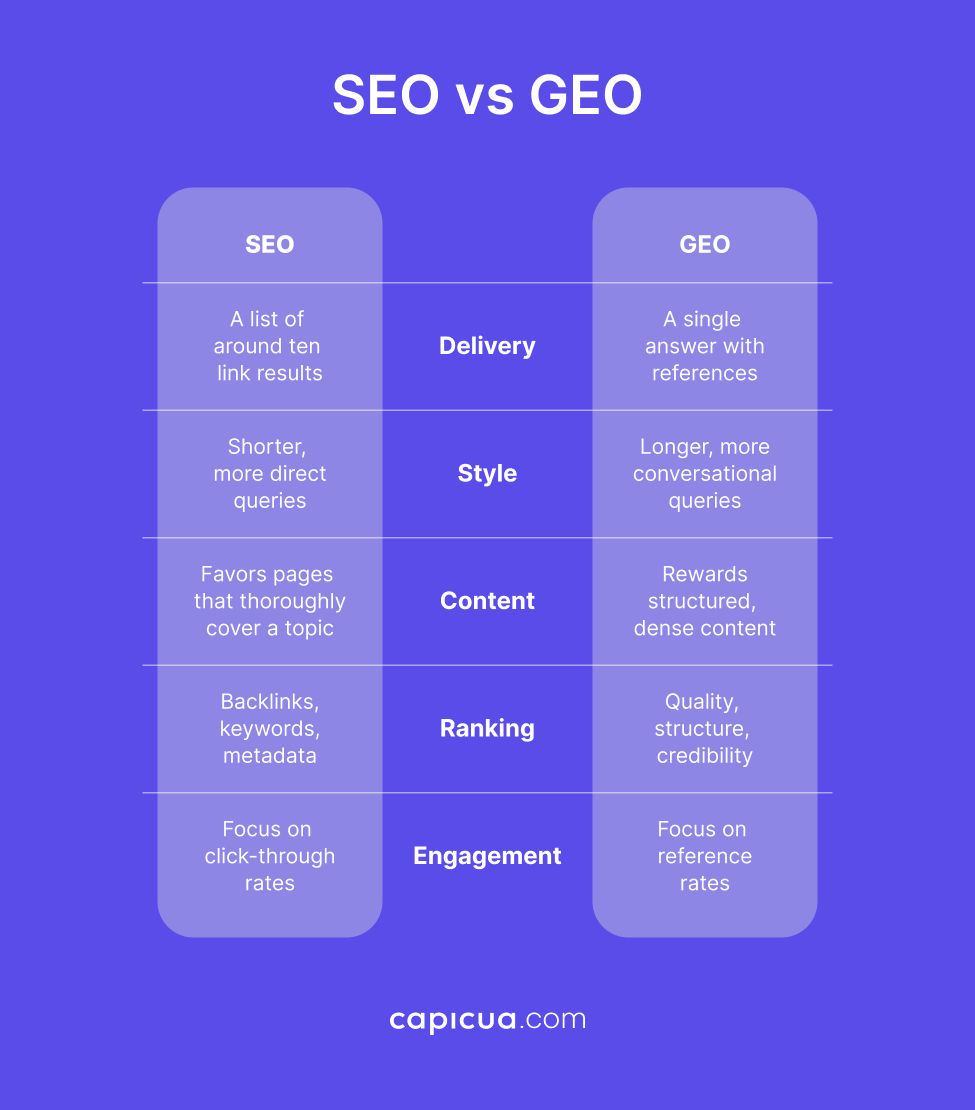
Let's say you have a blog about UX, and someone is searching for "user onboarding best practices." SEO would focus on getting them to click your "10 Best Practices for User Onboarding" post, and GEO would aim to have your content included in its summary: "According to YourWebsite's blog, onboarding best practices include tutorials and messages(...)." Both scenarios are valuable, but they require different preparation.
While they are part of the tactics to achieve the same goal, SEO and GEO differ in query styles, result formats, optimization techniques and success metrics. Traditional SEO is about earning one of those top 10 spots on a page; GEO is about earning a spot in the answer itself.
What is AEO (Answer Engine Optimization)
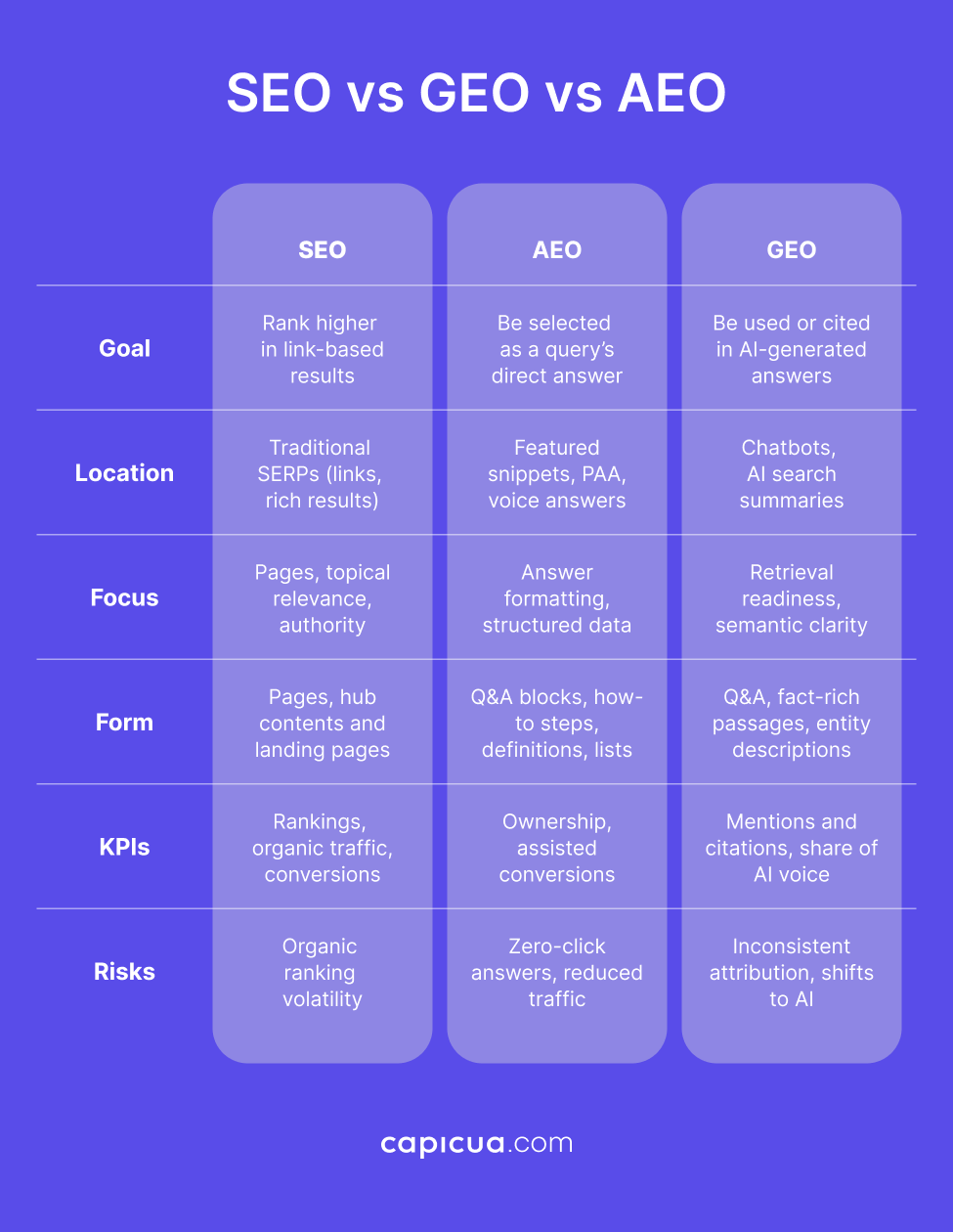
It's often referred to as the bridge between SEO and GEO, but what is Answer Engine Optimization? AEO optimizes content for "answer-first" interfaces and search experiences that prioritize instant responses over link lists, including featured snippets, People Also Ask, knowledge panels and voice assistants.
But how does AEO Answer Engine Optimization work? In plain terms, answer engines look for content that can be parsed quickly and matched to explicit questions. Algorithms tend to favor clear headings, short paragraphs and bullet lists, while also highlighting the who, what, how, why or when of a specific topic.
The output is usually a single snippet, a voice response or a compact answer block that may or may not drive clicks. To achieve successful AOE, it's important to use schema markup such as FAQPage, HowTo, Product or Organization, depending on the content.
SEO vs GEO vs AEO
While differing in formats and KPIs, there's a practical relationship among SEO, AEO, and GEO. SEO builds the foundation in authority, crawlability and discoverability, and while AEO can be leveraged as a format advantage, GEO works as the AI distribution strategy.
How To Master SEO and GEO
There are some high-level strategies and best practices for succeeding in both traditional search engines and generative AI platforms. The goal is to create a synergistic approach where efforts in one also benefit the other.
- Technical SEO Hygiene: As AI systems often rely on the same web content, SEO basics, such as speed, crawlability and mobile friendliness, also help GEO. Adding schema markup for different sections can also make your content more digestible for AI crawlers. If your content isn't crawlable, it won't be included in either Google's index or AI snippets.
- AI-Friendly Formats: You might maintain long-form articles for depth (SEO likes thorough expertise) but also provide summaries, bullet-point lists and a robust FAQ page or knowledge base within them. Blend comprehensive content with concise answers to create layered knowledge packaging for different consumption modes.
- Platform–based RAG: Consider RAG-based search within your product, such as a chatbot that uses your content to answer user queries, naturally optimizing your content for retrieval and quickly discovering which content chunks are useful. If your own AI support bot can't find good answers from your content, ChatGPT likely won't either.
- Adaptable Monitoring: Manually query ChatGPT or Perplexity with relevant questions to track your presence in AI results. Is your content not cited? Who takes that place? What are they doing differently? Also, keep an eye on analytics. If you see a dip in organic search clicks on certain informational queries, is it because an AI result gave the answer?
- Ethical Considerations: It might be cheap to have an AI spit out dozens of new stuffed articles, but AI engines will likely be trained on similar AI output, and it could create a spiral of mediocre content. Don't be tempted to game the system with low-quality AI-generated content; focus on real expertise and unique insights.
- Team Alignment: Good SEO writing already covers many GEO fundamentals, but ensure that your content writers, SEO specialists and product marketers are all aware of GEO principles. Update your content regularly if possible, as AI systems love "fresh" information for questions about the latest stuff.
These strategies can create a virtuous cycle: SEO brings users to in-depth content on your site, and GEO ensures your content permeates AI-driven conversations elsewhere. Strong SEO performance often correlates with being included in AI results, and insights from AI queries can reveal new SEO content opportunities.

Why SEO and GEO Matter for Digital Product Development
The rise of GEO presents both challenges and opportunities, but what real-world impact do both SEO and GEO have on a company's business edge?
- Maximized Visibility: Users discover products in various ways, whether through Google search, asking AI assistants or chatbots, voice on smart speakers or searching across social media platforms. The search journey is becoming more diversified, and users move between sources. That's why smart businesses enforce unified visibility across channels.
- Trust and Authority: Being part of AI-generated answers can influence user perception. Having an AI assistant consistently cite your company's white paper or include your product in its recommended solutions subtly builds trust and credibility. Appearing here can position your brand as helpful in a more conversational and intimate way.
- Success Metrics: SEO's value is direct, measured in organic search-based visitors, sign-ups or purchases. GEO's value is a bit more indirect, as it might drive some referral traffic, but often its goal is to influence people upstream of a click or conversion. Thriving companies understand and adapt how they measure and attribute success.
- Customer Experience: Good SEO/GEO content can double as training data for your own AI features. Internal AI chatbots or search functions can not only boost Google rank and AI visibility, but also equip companies to build smarter support bots and search tools. The same optimization that gets you in ChatGPT's answers can also power your own chatbot.
- User Feedback: Mastering SEO and GEO can also guide what features to build. If you notice that people search for "Does [YourApp] integrate with XYZ?", you might prioritize building that integration. The insights from search and AI queries can inform product decisions and messaging, and align roadmaps and positioning accordingly.
- Competitive Advantage: Early adopters of GEO are starting to stand out in AI-driven contexts. If no one in your space has structured their content for AI, you can adjust content for AI visibility and become the go-to source that the AI chooses because it finds your content easiest to parse and most relevant.
In summary, the business impact of combining SEO and GEO is greater and more resilient discoverability, improved brand authority and insights that can drive product and content strategy. Companies that excel in both will effectively own the conversation in their domain, whether that conversation happens on a search results page or in an AI chat window.
SEO vs GEO Q&A and Key Takeaways
- What is the difference between SEO and GEO? Search Engine Optimization (SEO) focuses on improving rankings in search engine results by strategically leveraging keywords, backlinks and metadata. Generative Engine Optimization (GEO) optimizes content so it's included directly in AI-generated answers.
- Why is GEO becoming important for digital products? Users are increasingly asking conversational AI for answers rather than clicking through search results. GEO helps digital products get cited inside AI responses, which can increase visibility even if users don't click through to your website.
- Do SEO and GEO compete with each other? No! SEO and GEO are complementary. While SEO still drives organic traffic and helps users discover content, GEO ensures content appears in answers in AI-powered search experiences.
- What are the requirements for SEO vs GEO? Comprehensive content optimized around keywords and backlinks performs well for SEO. For GEO, structured, concise, information-dense content (e.g., bullet lists or FAQs) is more likely to be used by AI systems when synthesizing responses.
- What does success look like for SEO vs GEO? For SEO, success is traditionally measured by higher rankings and increased organic traffic. Meanwhile, GEO measures success by how often your content is referenced or incorporated into AI responses. This difference shows a shift from click-through rates to reference rates.
- Should I abandon SEO for GEO? Please don't! SEO remains foundational, and GEO builds on it to capture visibility in the new AI-driven search landscape. A combined approach yields the best results.
Conclusion
We are witnessing a shift from the "web of links" to the "web of language." Search engines and AI assistants provide answers synthesized from myriad sources, making both SEO and GEO indispensable for digital product companies.
With a solid understanding of both edges, businesses can avoid the pitfall of tunnel vision. The technical nuances may differ, but ultimately, both efforts align with the goal of providing valuable information to the right audience and staying top of mind with customers.
Investing in GEO does not mean throwing out the SEO playbook. It means recognizing that your knowledge strategy is now as important as your product features. Those who will win in this new era are those who effectively productize their knowledge for both human searchers and AI algorithms.