
Go Back

Accelerate Artificial Intelligence Adoption

Technology
Updated:
1/6/26
min read
Build With Clarity

As of the time of publishing this article, over 85% of decision-makers state that they use Artificial Intelligence in at least one business edge. But the harsh reality is that getting value from AI is a different story. Actually capturing value from AI requires moving beyond standalone initiatives toward a strategy that encompasses every part of your business. This article outlines a plan to accelerate your AI adoption, from data management to responsible use. Let's read on!

What is AI Adoption?

At its core, AI adoption involves integrating Artificial Intelligence (AI) technologies into the functional processes of an organization. A successful adoption results in the development of a new force within the organization, but that requires weaving AI into three critical layers.

There's the data layer, which curates and structures information, and the process layer, which restructures workflows to leverage AI-driven insights and automation. But there's also the people layer, and business leaders must ensure teams are equipped with the skills and tools they need to succeed in the long run.

Related
Technology Consulting for Product Business Growth

What is an AI Adoption Strategy? 

An AI adoption strategy is the plan that helps a company move from experimenting with AI to fully adopting it. Strong adoption strategies align AI efforts with business goals, from improving customer service to speeding up operations.

Pillars of AI Adoption Strategy 

  • Strategic Alignment. Alignment ensures that every AI initiative is closely tied to a clear business objective, moving beyond generic tactics to company-specific digital transformation.  According to industry analysis, top companies use AI to prioritize impactful use cases and unlock new revenue streams.
  • AI Governance. In the context of AI, governance ensures ethical deployment and creates the structure for responsible AI. Notable frameworks include the European Union's Ethics Guidelines for Trustworthy AI (2019), the OECD AI Principles and the Technology (NIST) AI Risk Management Framework.
  • Data Management. This pillar represents a big core of AI itself, data. Everything in AI begins and ends with data, and you cannot have effective Artificial Intelligence without well-managed data. Data management establishes protocols for collecting and handling the high-quality data that AI systems depend on.
  • Human Power. Technology alone cannot drive adoption, so this pillar addresses the crucial human with a dual approach. You can build or hire specialized AI talent, such as Data Scientists and Machine Learning Engineers, but you should also train the wider workforce to ensure everyone understands how to use AI tools in their daily work.

Related
AI-powered SecOps for Business Security

Artificial Intelligence in Data Analytics

Let's start with the basic question: What is Data Analytics? Data Analytics is the science of examining raw data to draw conclusions,  applying algorithmic or mechanical processes to derive insights and, progressively, predict future events. This powerful tool is great for transforming your often chaotic data collection into clear findings.

In this context, Artificial Intelligence enhances Data Analytics by transforming it from describing data to predicting actions. While traditional analytics can tell what already happened and why, AI technologies, particularly Machine Learning, can also automate the analytical process and even forecast what will happen next. 

Examples of AI in Data Analytics start with pattern recognition to detect intricate patterns and relationships within vast datasets, and predictive modeling to build models that increasingly accurately predict events. AI can also leverage NLP to analyze unstructured data, particularly helpful for uncovering meaningful insights in areas such as customer reports and social media content.

How to Accelerate Artificial Intelligence Adoption

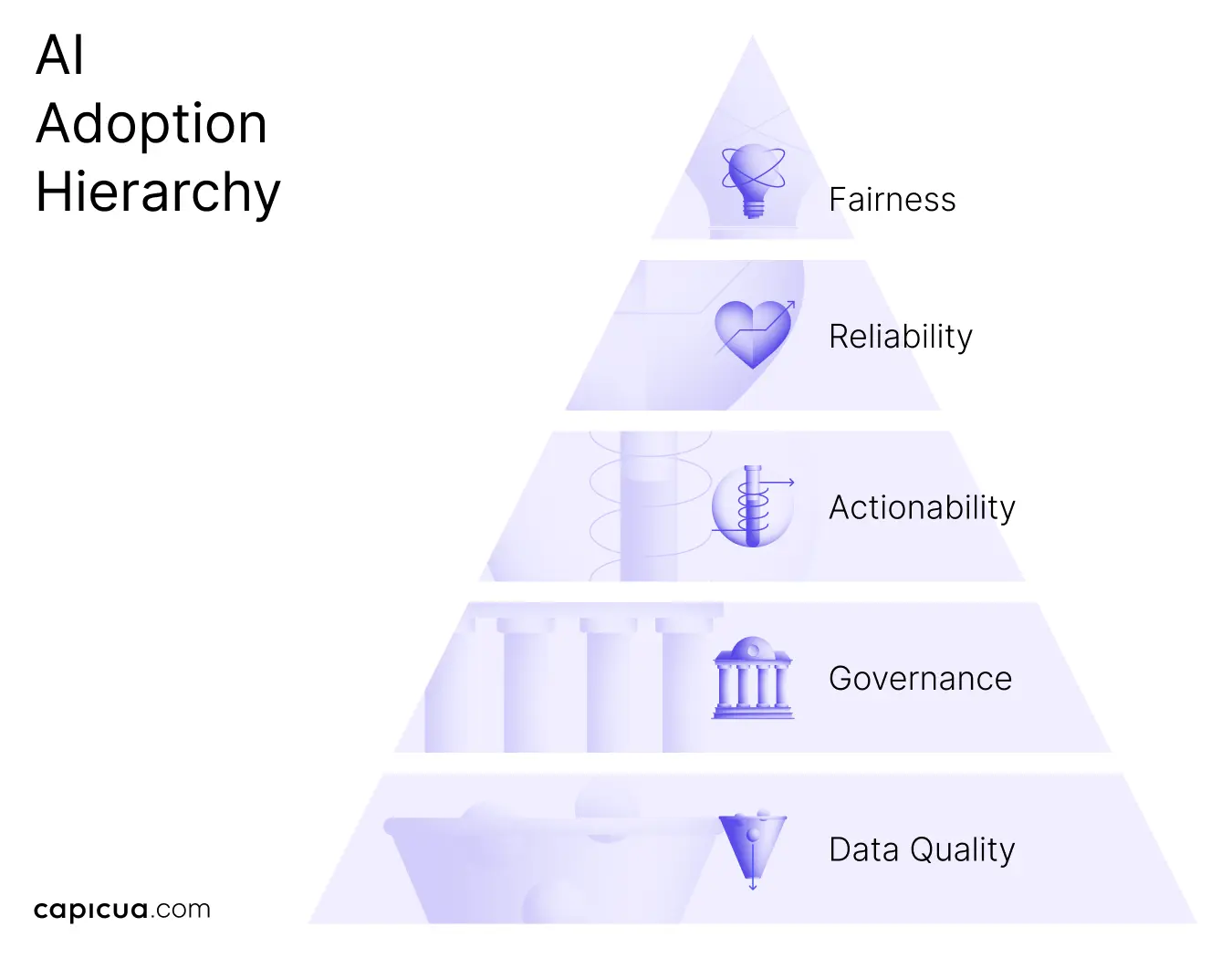
Accelerating AI adoption requires a foundational approach: building an organizational ecosystem that enables AI to thrive. The Department of Defense's strategy provides an excellent model for this, built around the AI Hierarchy of Needs.

This framework organizes the essential components into a logical progression, so each layer needs to be solid before the next is built. You can use this hierarchy as a roadmap to accelerate your own AI journey within data analytics and beyond!

Capicua Product Growth Partner, Creator or Shaped Clarity

AI Hierarchy of Needs

  • Foundational Layer: 45% of companies cite data accuracy concerns as a major challenge to adoption. Quality data is extremely important, so start by focusing on robust data management practices. Establish clear ownership and implement data catalogs to enable easy discovery and a trusted source of truth that can reliably fuel your AI use and models.
  • Second Layer. With a data foundation in place, the next layer is a governance framework that defines the rules for deploying AI systems. Integrate security from the outset to protect both data and AI models from manipulation, ensuring that AI development is not a free-for-all.
  • Third Layer. Once you have high-quality data governed by proper rules, you can begin generating analytics-based insights to transform data into actionable intelligence. To achieve adoption, it's key to define KPIs to measure the impact of insights, such as accuracy, precision, recall, and F1-score for model performance. Success is not just about building a model, but about whether that model improves a business outcome.
  • Fourth Layer: For AI to be fully adopted, users must trust that AI systems are reliable and safe. Users should have a basic understanding of how an AI system arrives at its conclusions. To do so, this process involves rigorous testing of AI models to ensure they perform as expected and ongoing monitoring to prevent unexpected or harmful behavior.
  • Top Layer: At the pinnacle of the hierarchy is responsible AI: fairness, transparency and accountability ensure AI systems align with societal and business values and address potential biases. Set clear lines of accountability for effective AI implementation to achieve sustainable AI adoption and safety while boosting brand reputation.

Why is a Clear AI Adoption Strategy Important

A clear AI adoption strategy is the difference between succeeding with Artificial Intelligence and falling into pilot purgatory, where promising projects never scale or deliver real value. Without a coherent strategy, your business risks scattered investments and redundant efforts that don't solve actual problems. 

Conversely, these strategies provide direction and a framework for assessing success. Responsible Artificial Intelligence strategies also instill confidence, with 58% of those investing in AI and GenAI reporting gaining a proper ROI. In fact, the Pentagon, through its Chief Digital and AI Office (CDAO), recognized this imperative with its 2023 DoD Data, Analytics, and Artificial Intelligence Adoption Strategy.

It was created to unify efforts and accelerate capabilities "from the boardroom to the battlefield." As Deputy Secretary of Defense Kathleen Hicks stated, the goal is to secure a decision advantage to help leaders make more informed decisions. As of Jan 2026, the Trump administration is also moving toward a "National Policy Framework for Artificial Intelligence" for state-independent innovation. This decision aims to simplify processes amidst state-by-state regulations that "create a patchwork of 50 different regulatory regimes that make compliance more challenging."

These efforts regarding AI architecture highlight the relevance of Artificial Intelligence strategies not only at the business level but also within governmental institutions. These strategies are also a key indicator of how much AI is—and will be—part of our daily lives.

Conclusion

Today's market is fueled by the ability to transform data into action, which is essential for sustainable growth. AI provides a vital edge, empowering businesses to understand today to lead tomorrow. At Capicua, we architect strategies that turn AI and data analytics into drivers of results. Ready to build that future? Reach out today!

About
We turn costly guesswork into signal-based direction for visionary leaders to regain control losing value.

With Shaped Clarity™, we anchor decisions to purpose for sustainable and rewarding growth.
Shaped Clarity
discover
Shaped
Clarity™
Shaped Clarity
discover
Shaped
Clarity™

Scalable Product Evolution

The Palindrome - Capicua's Blog
Make The Difference
This image showcasts different concepts related with the article topic.
Summarize:
Summarize with ChatGPTSummarize with PerplexitySummarize with Claude

As of the time of publishing this article, over 85% of decision-makers state that they use Artificial Intelligence in at least one business edge. But the harsh reality is that getting value from AI is a different story. Actually capturing value from AI requires moving beyond standalone initiatives toward a strategy that encompasses every part of your business. This article outlines a plan to accelerate your AI adoption, from data management to responsible use. Let's read on!

What is AI Adoption?

At its core, AI adoption involves integrating Artificial Intelligence (AI) technologies into the functional processes of an organization. A successful adoption results in the development of a new force within the organization, but that requires weaving AI into three critical layers.

There's the data layer, which curates and structures information, and the process layer, which restructures workflows to leverage AI-driven insights and automation. But there's also the people layer, and business leaders must ensure teams are equipped with the skills and tools they need to succeed in the long run.

Related
Technology Consulting for Product Business Growth

What is an AI Adoption Strategy? 

An AI adoption strategy is the plan that helps a company move from experimenting with AI to fully adopting it. Strong adoption strategies align AI efforts with business goals, from improving customer service to speeding up operations.

Pillars of AI Adoption Strategy 

  • Strategic Alignment. Alignment ensures that every AI initiative is closely tied to a clear business objective, moving beyond generic tactics to company-specific digital transformation.  According to industry analysis, top companies use AI to prioritize impactful use cases and unlock new revenue streams.
  • AI Governance. In the context of AI, governance ensures ethical deployment and creates the structure for responsible AI. Notable frameworks include the European Union's Ethics Guidelines for Trustworthy AI (2019), the OECD AI Principles and the Technology (NIST) AI Risk Management Framework.
  • Data Management. This pillar represents a big core of AI itself, data. Everything in AI begins and ends with data, and you cannot have effective Artificial Intelligence without well-managed data. Data management establishes protocols for collecting and handling the high-quality data that AI systems depend on.
  • Human Power. Technology alone cannot drive adoption, so this pillar addresses the crucial human with a dual approach. You can build or hire specialized AI talent, such as Data Scientists and Machine Learning Engineers, but you should also train the wider workforce to ensure everyone understands how to use AI tools in their daily work.
Related
AI-powered SecOps for Business Security

Artificial Intelligence in Data Analytics

Let's start with the basic question: What is Data Analytics? Data Analytics is the science of examining raw data to draw conclusions,  applying algorithmic or mechanical processes to derive insights and, progressively, predict future events. This powerful tool is great for transforming your often chaotic data collection into clear findings.

In this context, Artificial Intelligence enhances Data Analytics by transforming it from describing data to predicting actions. While traditional analytics can tell what already happened and why, AI technologies, particularly Machine Learning, can also automate the analytical process and even forecast what will happen next. 

Examples of AI in Data Analytics start with pattern recognition to detect intricate patterns and relationships within vast datasets, and predictive modeling to build models that increasingly accurately predict events. AI can also leverage NLP to analyze unstructured data, particularly helpful for uncovering meaningful insights in areas such as customer reports and social media content.

How to Accelerate Artificial Intelligence Adoption

Accelerating AI adoption requires a foundational approach: building an organizational ecosystem that enables AI to thrive. The Department of Defense's strategy provides an excellent model for this, built around the AI Hierarchy of Needs.

This framework organizes the essential components into a logical progression, so each layer needs to be solid before the next is built. You can use this hierarchy as a roadmap to accelerate your own AI journey within data analytics and beyond!


Capicua Product Growth Partner, Creator or Shaped Clarity

AI Hierarchy of Needs

  • Foundational Layer: 45% of companies cite data accuracy concerns as a major challenge to adoption. Quality data is extremely important, so start by focusing on robust data management practices. Establish clear ownership and implement data catalogs to enable easy discovery and a trusted source of truth that can reliably fuel your AI use and models.
  • Second Layer. With a data foundation in place, the next layer is a governance framework that defines the rules for deploying AI systems. Integrate security from the outset to protect both data and AI models from manipulation, ensuring that AI development is not a free-for-all.
  • Third Layer. Once you have high-quality data governed by proper rules, you can begin generating analytics-based insights to transform data into actionable intelligence. To achieve adoption, it's key to define KPIs to measure the impact of insights, such as accuracy, precision, recall, and F1-score for model performance. Success is not just about building a model, but about whether that model improves a business outcome.
  • Fourth Layer: For AI to be fully adopted, users must trust that AI systems are reliable and safe. Users should have a basic understanding of how an AI system arrives at its conclusions. To do so, this process involves rigorous testing of AI models to ensure they perform as expected and ongoing monitoring to prevent unexpected or harmful behavior.
  • Top Layer: At the pinnacle of the hierarchy is responsible AI: fairness, transparency and accountability ensure AI systems align with societal and business values and address potential biases. Set clear lines of accountability for effective AI implementation to achieve sustainable AI adoption and safety while boosting brand reputation.

Why is a Clear AI Adoption Strategy Important

A clear AI adoption strategy is the difference between succeeding with Artificial Intelligence and falling into pilot purgatory, where promising projects never scale or deliver real value. Without a coherent strategy, your business risks scattered investments and redundant efforts that don't solve actual problems. 

Conversely, these strategies provide direction and a framework for assessing success. Responsible Artificial Intelligence strategies also instill confidence, with 58% of those investing in AI and GenAI reporting gaining a proper ROI. In fact, the Pentagon, through its Chief Digital and AI Office (CDAO), recognized this imperative with its 2023 DoD Data, Analytics, and Artificial Intelligence Adoption Strategy.

It was created to unify efforts and accelerate capabilities "from the boardroom to the battlefield." As Deputy Secretary of Defense Kathleen Hicks stated, the goal is to secure a decision advantage to help leaders make more informed decisions. As of Jan 2026, the Trump administration is also moving toward a "National Policy Framework for Artificial Intelligence" for state-independent innovation. This decision aims to simplify processes amidst state-by-state regulations that "create a patchwork of 50 different regulatory regimes that make compliance more challenging."

These efforts regarding AI architecture highlight the relevance of Artificial Intelligence strategies not only at the business level but also within governmental institutions. These strategies are also a key indicator of how much AI is—and will be—part of our daily lives.

Conclusion

Today's market is fueled by the ability to transform data into action, which is essential for sustainable growth. AI provides a vital edge, empowering businesses to understand today to lead tomorrow. At Capicua, we architect strategies that turn AI and data analytics into drivers of results. Ready to build that future? Reach out today!