


While most B2B organizations believe they're doing UX right, something keeps feeling off. Feedback loops slow down, teams debate assumptions for weeks, and customers churn without explanation. Here's what's actually happening: they're confusing having UX with being mature in UX. These are two different things, and this gap separates organizations that lead markets from those that merely participate in them.
The UX Maturity Model
The Nielsen Norman Group's six-stage UX maturity model is a widely validated framework in the field, built from over two decades of research and thousands of client engagements. Here, organizations are mapped from Stage 1 (Absent: UX doesn't exist or is actively misunderstood) to Stage 6 (User-Driven: user insight shapes strategic direction across the company). The 6 stages of NN/G UX maturity are:
- Absent: No UX practice, no shared vocabulary, no investment.
- Limited: UX exists in pockets, but is inconsistent and unsupported.
- Emergent: Processes and awareness are growing, but unevenly across teams.
- Structured: UX is standardized, with defined roles and repeatable methods.
- Integrated: UX is embedded in strategy and cross-functional execution.
- User-Driven: User understanding drives innovation at the organizational level.
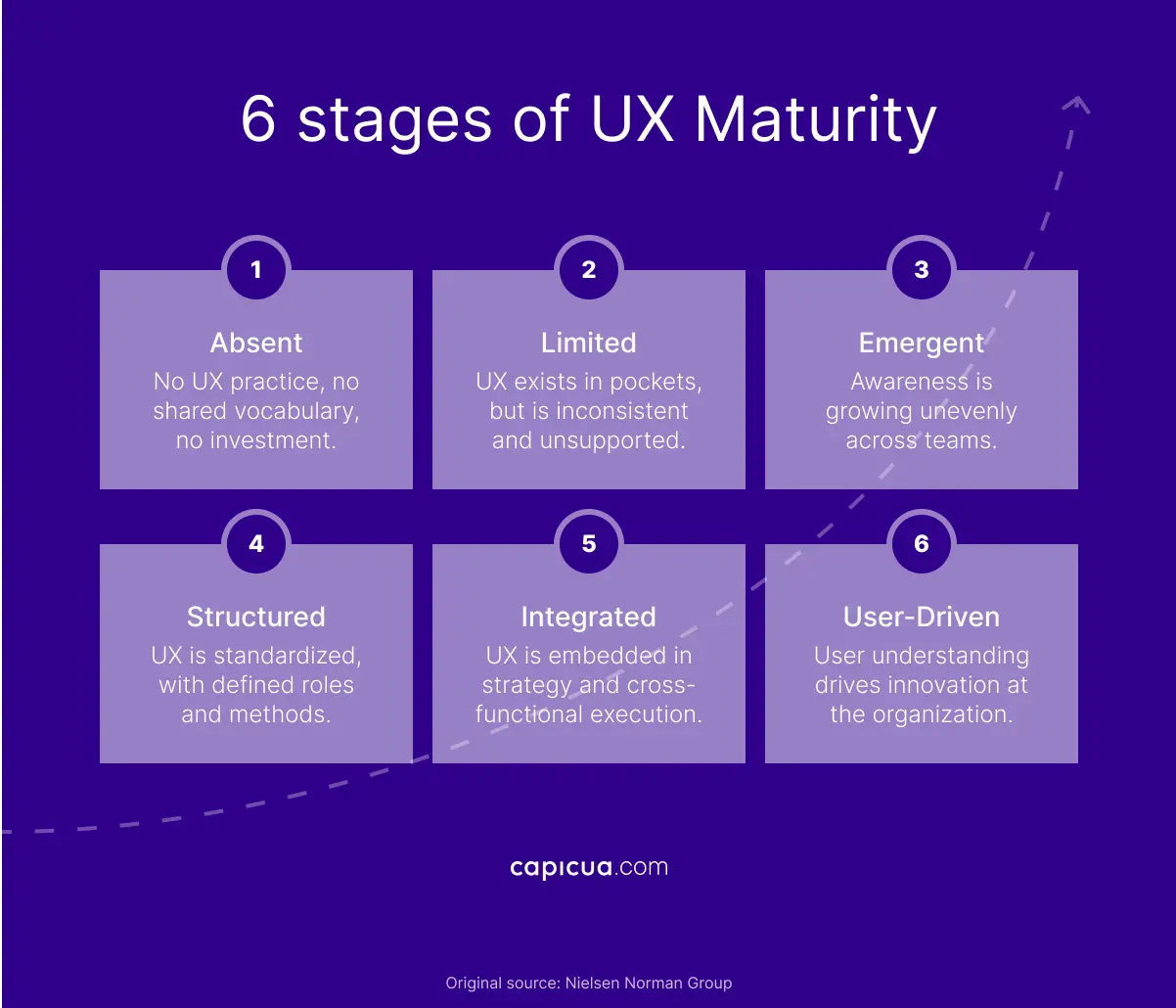
While this scale sounds easily understandable on paper, according to NNG itself, nearly half of UX professionals rate their own company at Emergent (Stage 3). Only 4% operate at Stage 5, and fewer than 0.1% reach Stage 6.
Most B2B product organizations, including those that are well-funded, growing, and proud of their design investment, are operating at roughly the same level as organizations that just figured out they should hire a UX designer. And this structural reality explains a lot.

Why is B2B UX Still Emergent
There's a particular trap in B2B: the user, the customer, and the buyer aren't always the same person. Enterprise deals close on features and integrations, not on flow and delight, which allows usability debt to accumulate silently until the renewal conversation. This fact creates a dangerous form of organizational UX that appears to be progress but isn't.
While leadership nods at "user-centricity" in presentations, design maturity signals get misread, and UX capability growth stalls when it's not treated as an organizational property. Talented design teams end up buried inside a product org with no research budget, no seat at the roadmap table, and no shared language with sales, customer success, or executives: operating in a silo, and not driving maturity.
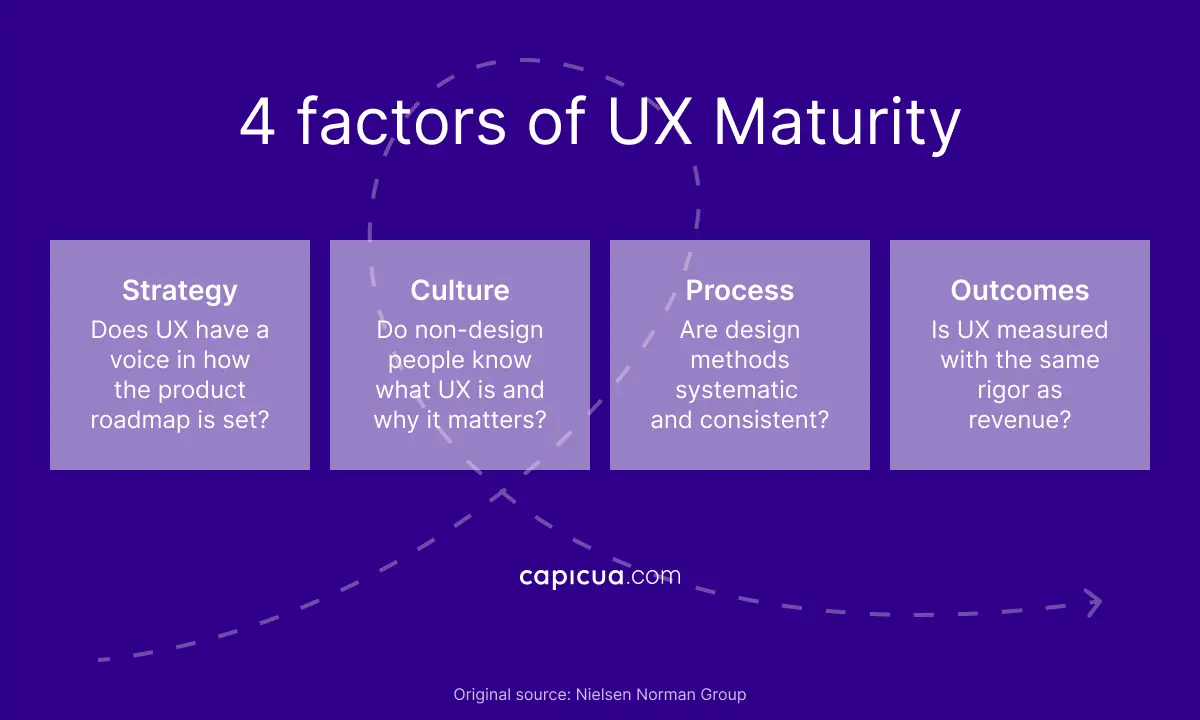
In this context, the NN/G model evaluates four factors in UX maturity models:
- Strategy: Does UX have a voice in how the product roadmap is set?
- Culture: Do non-design people know what UX is and why it matters?
- Process: Are UX research and design methods systematic and consistent, or ad hoc?
- Outcomes: Is the impact of UX measured with the same rigor as revenue and retention?
If you answer "not really" to any of these questions, you're at an Emergent stage, regardless of what your org chart says.
The UX Mistake B2B Organizations are Making
McKinsey's Design Index tracked the financial performance of 300 publicly listed companies over five years and found that organizations in the top quartile of design practice achieved 32% higher revenue growth and 56% higher total returns to shareholders than their peers across medtech, consumer goods, and retail banking. That's financial performance data, audited across industries, beyond a UX echo chamber.
Moreover, Maze's Research Maturity Report surveyed over 500 design, research, and product professionals across 66 countries, and found that the dimension most strongly linked to business outcomes was impact, or whether research actually reaches decision-makers and influences what gets built.
The uncomfortable rethink for most B2B organizations is that the question is no longer "are we doing enough research?" but "is our research reaching the people with the power to act on it, and fast enough to matter?" While low-maturity organizations run research in parallel with decisions, high-maturity organizations research as the basis for decisions.

How Can B2B Organizations Improve UX Maturity
Design maturity isn't always something you can accelerate by hiring more designers, buying better tools, or running a design sprint. NN/G's research concluded that it can take up to 20 years for organizations to complete all stages, which can be seen as a clarifying insight disguised as a pessimistic warning. Progress through UX maturity models requires:
- Sponsorship: Leaders at high-maturity organizations must go beyond "support design" and treat performance metrics with the same rigor as financial KPIs. Actions include funding research, attending usability reviews, and especially delaying roadmap decisions when the evidence isn't there yet.
- Literacy: Symptoms of low maturity include sales teams that dismiss research findings, engineers who push back on accessibility requirements, and PMs who equate delivery speed with product quality. UX capability growth requires building a shared vocabulary and investment in outcomes across every team that touches the customer experience.
- Documentation: Organizations at higher stages thoroughly document their design processes rather than relying on a single senior designer to hold institutional knowledge in their head. Your UX isn't structural if two people leaving would make it collapse.
- Measurement: "Users liked it" is not a business outcome. Retention rate, time-to-value, support ticket volume, feature adoption, and NPS segmented by persona are the metrics that make UX legible to leadership and move it from a cost center to a strategic function.

The Lens That Enhances B2B UX Maturity
There's a reason so many B2B product organizations plateau at Emergent despite genuine effort: running separate tracks for discovery and delivery, for design and strategy, for learning and building. When UX maturity is treated as a design responsibility and business outcomes as a product responsibility, massive amounts of value quietly leak away.
Those who break through treat user understanding as an ongoing system that shapes every decision, at every level, continuously, which is what Shaped Clarity™ formalizes as a product lens that treats discovery and delivery as two expressions of the same learning system.
Shaped Clarity's Map → Bet → Play → Merge loop describes how a mature organization thinks: charting uncertainty before committing, making hypothesis-backed bets rather than assumption-driven roadmaps, running the fastest possible experiments to generate the deepest learning, and feeding that learning back into the system continuously.
What makes this a maturity lens is that it collapses the gap between what teams know and what they decide. In low-maturity organizations, those two things are often months apart: with Shaped Clarity™, they're the same conversation.
Conclusion
UX maturity is the practice of progressive clarity, sharpened through structure, sustained through culture, and made legible through outcomes. The organizations that treat it that way stop asking whether design is worth investing in, because they've already seen the answer in their revenue. The question for B2B leaders is whether their organization is built to leverage what it knows.
If you're ready to continuously learn to discover and deliver products that always make users' lives better and easier, let's start a conversation.