Human-Centered Design for Business Growth

Updated:
5/5/26
Posted:
5/5/26

What separates the digital products that compound in value over time from the ones that quietly accumulate rework, churn, and mounting technical debt? The answer is not a better sprint cadence or a larger engineering budget: it's whether the people building the product understood the people using it before they started building.

Human-centered design is the discipline of orienting every decision around the actual humans at the end of the experience. In a B2B SaaS context, that means designing for the outcomes your users are trying to achieve and the pressures your buyers are trying to resolve. When done with rigor, it transforms product development from a cycle of assumptions and corrections into a system of validated decisions and compounding returns.

The UX design market itself is projected to reach $13.06 billion in 2026, growing at a 14.49% CAGR through 2031. Furthermore, McKinsey's Design Index tracked 300 publicly listed companies over five years and found that top-quartile design performers delivered 32% points higher revenue growth and 56% points higher total shareholder returns than their industry peers. The signal is clear: design is a growth lever.

Human-centered design is a decision-making filter, and teams that apply it consistently reduce rework costs, eliminate unused features, and build products that compound in user and business value.

What Human-Centered Design Means for Product Teams

Human-centered design (HCD) is the practice of building products by continuously involving real users in the research, ideation, and testing process, so that what ships reflects actual human needs rather than internal assumptions. It's a methodology rooted in empathy, structured around evidence, and measured by outcomes.

For product teams, the phrase surfaces alongside 'design thinking' or 'user research' and gets filed under process improvement. But at its most effective, HCD is a filter applied to every decision: who is this for, what are they actually trying to do, and how do we know?

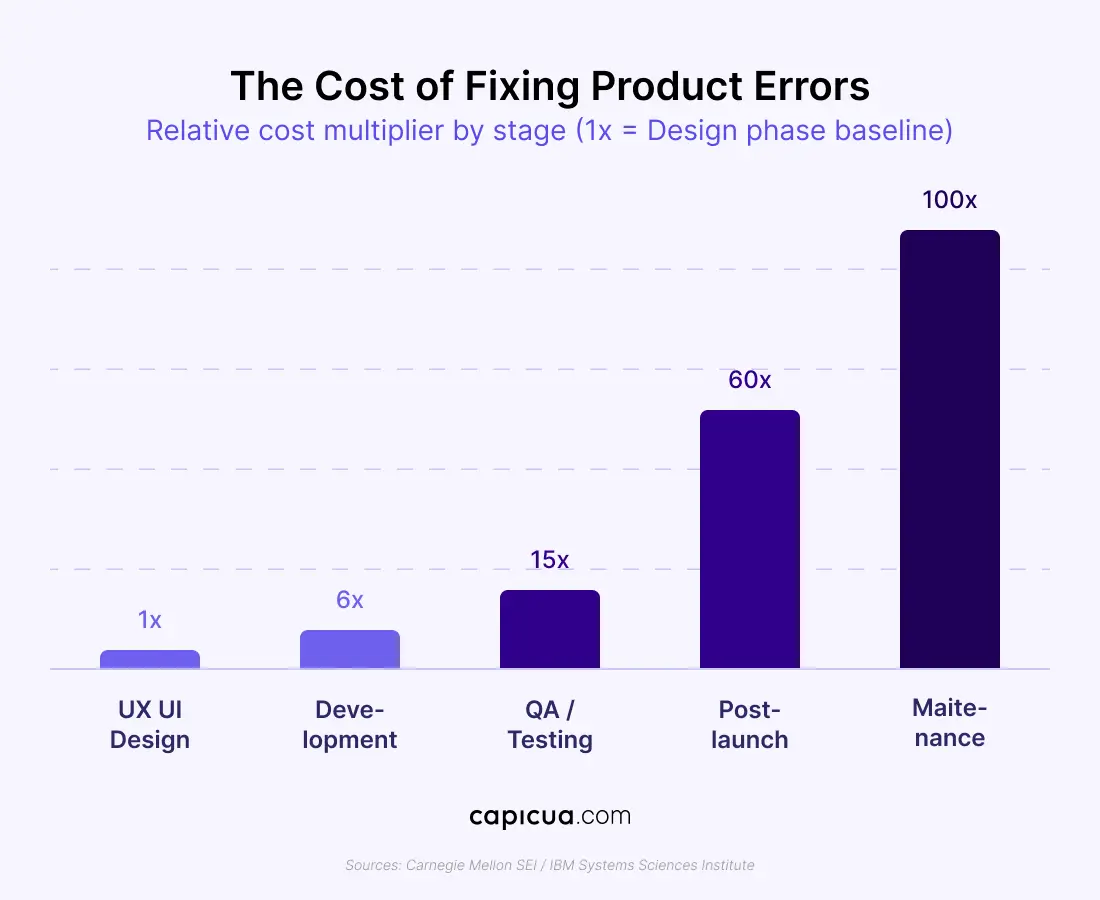
Assumptions are expensive. Research shows that the cost of correcting a product error after launch is four to five times higher than fixing it during the design phase, and up to 100 times more expensive if discovered during maintenance. What's more, most software features are rarely or never used, pointing to the cost of building without sufficient user understanding.

Human-centered design intercepts this problem at the source. Front-loading discovery and testing eliminates the structural conditions that produce unused features, misaligned roadmaps, and expensive rebuilds.
The Four Pillars of Human-Centered Design

Effective human-centered design in a product context operates across four disciplines that reinforce each other:

  • User research: how real users think, behave, and struggle with your product, as a continuous, systematic discovery and not a one-time kickoff activity.
  • Iterative prototyping: building low-fidelity versions of ideas to test assumptions before they become code.
  • Signal-based roadmapping: letting validated user insights shape prioritization, rather than internal intuition or competitive mimicry.
  • Cross-functional alignment: ensuring design, product, and engineering share a unified understanding of the user, so decisions compound rather than conflict.
Capicua Product Growth Partner
The Escalating Cost of Fixing Product Errors

How Human Design Types Shape Team Performance

In organizational behavior, "human design types" often refers to the Human Design system. The framework, brought together in 1987 by Alan Robert Krakower under the name of Ra Uru Hu, describes five core energy archetypes: Generators, Manifesting Generators, Projectors, Manifestors, and Reflectors. 

  • Generators: Also called "builders," they deliver consistent energy to build, master skills, and bring vision to life; following a "to respond" philosophy based on satisfaction.
  • Manifestors: These natural trailblazers initiate action and create change without needing to wait for others, while grounded on a "to inform" strategy.
  • Manifesting Generators: A mix of Generator and Manifestor traits, they are highly efficient, multi-passionate, and fast-paced, also following a "to respond" approach.
  • Projectors: Designed to act as guides, they work best by directing the energy of others with a "to wait for the invitation" philosophy.
  • Reflectors: The rarest type, they have no defined centers, making them highly sensitive to their environment and to the energy of others.

Whether or not you engage with the framing, the practical insight embedded in this typology states that different people on your team are wired to contribute differently, and forcing uniform processes onto a diverse team produces friction that bleeds into the product.

In product design, however, human design types describe the user categories your product serves: behavioral profiles, mental models, and usage patterns that define how different segments interact with your system. Getting this wrong is where rework originates.

User Typologies And Design Decisions

Sometimes called personas, user typologies are more accurately behavioral archetypes grounded in research. When product teams invest in it, they gain a shared vocabulary. Features decision stops being a subjective debate and becomes a question with a referent: does this serve our core user type, or are we building for an edge case?

According to McKinsey's research on design maturity, companies with robust UX measurement frameworks are 3.5 times more likely to report that design has a significant business impact than those without formal metrics. The discipline of mapping human design types into product decisions is one of the clearest paths to measurable impact.

User Typologies and Organizational Diversity

From a team-level perspective, when product organizations fail to account for the diversity of thinking styles and working modes across their teams, they build products that reflect only the loudest voice in the room. A 2025 World Economic Forum study found that organizations that invest in empathy as a structural competency achieve higher customer loyalty, lower churn, and measurable brand affinity. Empathy became a system property, built into team structure, research operations, and decision-making.
Why Human-Centered Design Reduces Rework and Protects Margins

A 2025 Carnegie Mellon Software Engineering Institute analysis found that 60 to 80% of software costs are attributable to features built incorrectly, requirements that didn't reflect actual needs, or interfaces that failed usability testing after engineering had already invested weeks of work. 

The math compounds quickly. A typical mid-stage SaaS product team spending 35% of engineering capacity on non-coding tasks, such as requirement clarification, late-stage redesigns, and post-launch patches, is leaving recoverable margin on the table. 

Human-centered design concentrates uncertainty at the front of the process, where iteration is inexpensive, rather than at the back, where it is catastrophic. For a product leader managing velocity, budget, and a roadmap under pressure, the strongest argument for human-centered design is financial.
Human-Centered Design For Early Validation

Teams that run structured UX research and iterative testing before major engineering commitments build better products and a sustainable capability. The ability to validate ideas cheaply and quickly becomes a compounding advantage, and competitors who skip this step ship faster in the short term and rebuild more expensively over time.

Forrester research consistently identifies user research investment as one of the highest-leverage activities in product development, with the UserTesting Human Insight Platform TEI study showing a 4x return on investment from structured user research programs.

Human-Centered Design For Conversion and Retention

The business case extends beyond cost reduction. According to DesignRush, a well-executed UI can boost conversion rates by up to 200%. In comparison, superior UX across the full product experience can increase them by up to 400%. A modest 10% increase in UX investment has been shown to drive conversion rate improvements of up to 83%.

For B2B SaaS businesses where revenue depends on activation, expansion, and retention, these numbers translate directly to net revenue retention. A product that users understand and value does not require constant re-engagement campaigns or high-cost customer success interventions to survive renewal conversations.

How Human-Centered Is Your Product Development?

Answer 6 questions to assess your team's HCD maturity.

Question 1 of 6
Score Level What it means

How to Embed Human-Centered Design in Product Development

Understanding the value of human-centered design is not the same as knowing how to operationalize it within a team under roadmap pressure, engineering constraints, and quarterly targets. The following is a framework for making HCD a structural property of how your product team operates, rather than a workshop exercise that fades after sprint review.

  1. Discover: Continuous discovery requires consistency throughout the product lifecycle to reduce uncertainty about value, impact, and feasibility. Rather than a dedicated research team, leadership must treat speaking to users as non-negotiable.
  2. Measure: Human-centered design generates qualitative richness that must also be translated into quantitative indicators, such as activation rates, time-to-value, support ticket volume and feature adoption curves.
  3. Align: HCD treats design and engineering as a shared system. When engineers participate in research sessions and designers understand implementation constraints, the gap between what is designed and what is built narrows significantly.
  4. Own: When human-centered design becomes an organizational property rather than a team-specific or leadership-based function, products become more coherent, and teams make better autonomous decisions.
The Business Case for Human-Centered Design Investment

If you are a founder or product executive presenting a budget case for deeper design investment, data may be on your side, but the framing still matters. The conversation is about design as an operating system for reducing waste and compounding returns.

McKinsey's Design Index found that design-driven companies outperformed the S&P 500 by 228% over ten years. DesignRush's data also shows that design-centered organizations experience 32% faster revenue growth and 56% higher returns than typical companies. Every $1 invested in UX yields returns ranging from $2 to $100 in revenue.

Human-Centered Design And Executive Metrics

Beyond the improvements that HCD brings from a "better UX" perspective, human-centered design also offers significant benefits for business leaders:

  • Reduced churn: users who understand and value a product renew without friction. 
  • Higher net revenue retention: products that map to user workflows reduce friction that drives expansion and contraction. 
  • Faster time-to-value: when users reach their 'aha moment' faster, activation metrics improve, and sales cycles shorten.
  • Lower customer acquisition cost: products that generate referrals and a strong category reputation reduce dependence on paid acquisition.

Human-Centered Design And Not Investing In Design

NNGroup's State of UX 2026 report identifies design depth as the primary differentiator between products that sustain competitive advantage and those that compete on price. For B2B SaaS leaders who have outgrown build-fast-fix-later, the investment case for HCD is not a design argument. It is a business durability argument.

The risks of underfunding human-centered design are asymmetric. Teams that skip user research ship faster, but only to end up rebuilding. Products that ignore usability achieve some level of user adoption, but only until they churn. Roadmaps built on assumptions scale, but only until they need to be restructured. The cost of these corrections is organizational, and teams that repeatedly rebuild lose the confidence to ship.

Human-centered design is a multiplier on every growth metric that matters to executives: retention, expansion revenue, time-to-value, and competitive differentiation.

When product teams turn user signals into decisive direction, every design investment compounds rather than dissipates. Shaped Clarity helps teams and organizations close the gap between what they learn from users and what they actually build. Human-centered design becomes the engine of growth strategy, not just late-sprint quality assurance.

Conclusion

Human-centered design is a decision-making discipline that any product organization can operationalize and deliver measurable returns at every stage of scale. Product leaders understand their users deeply enough to ship the right ones. They instrument processes to catch misalignments before rework, measure design with the same rigor they apply to revenue, and they treat user empathy as a structural competency.


Capicua helps leaders embed human-centered design into their processes so every decision compounds toward growth. Build products your users won't want to leave: contact us | send us an email | book a meetingCONTENT

With Shaped Clarity™, we turn costly guesswork into signal-based direction for those who want to lead the future with soul.
Discover Shaped Clarity
Renowned by
Financial TimesTechreviewerGoodfirmsClutch
Make The Difference
Go Back

Human-Centered Design for Business Growth

Updated:
5/5/26
Original:
5/5/2026
min read
Build With Clarity

What separates the digital products that compound in value over time from the ones that quietly accumulate rework, churn, and mounting technical debt? The answer is not a better sprint cadence or a larger engineering budget: it's whether the people building the product understood the people using it before they started building.

Human-centered design is the discipline of orienting every decision around the actual humans at the end of the experience. In a B2B SaaS context, that means designing for the outcomes your users are trying to achieve and the pressures your buyers are trying to resolve. When done with rigor, it transforms product development from a cycle of assumptions and corrections into a system of validated decisions and compounding returns.

The UX design market itself is projected to reach $13.06 billion in 2026, growing at a 14.49% CAGR through 2031. Furthermore, McKinsey's Design Index tracked 300 publicly listed companies over five years and found that top-quartile design performers delivered 32% points higher revenue growth and 56% points higher total shareholder returns than their industry peers. The signal is clear: design is a growth lever.

Human-centered design is a decision-making filter, and teams that apply it consistently reduce rework costs, eliminate unused features, and build products that compound in user and business value.

What Human-Centered Design Means for Product Teams

Human-centered design (HCD) is the practice of building products by continuously involving real users in the research, ideation, and testing process, so that what ships reflects actual human needs rather than internal assumptions. It's a methodology rooted in empathy, structured around evidence, and measured by outcomes.

For product teams, the phrase surfaces alongside 'design thinking' or 'user research' and gets filed under process improvement. But at its most effective, HCD is a filter applied to every decision: who is this for, what are they actually trying to do, and how do we know?

Assumptions are expensive. Research shows that the cost of correcting a product error after launch is four to five times higher than fixing it during the design phase, and up to 100 times more expensive if discovered during maintenance. What's more, most software features are rarely or never used, pointing to the cost of building without sufficient user understanding.

Human-centered design intercepts this problem at the source. Front-loading discovery and testing eliminates the structural conditions that produce unused features, misaligned roadmaps, and expensive rebuilds.

The Four Pillars of Human-Centered Design

Effective human-centered design in a product context operates across four disciplines that reinforce each other:

  • User research: how real users think, behave, and struggle with your product, as a continuous, systematic discovery and not a one-time kickoff activity.
  • Iterative prototyping: building low-fidelity versions of ideas to test assumptions before they become code.
  • Signal-based roadmapping: letting validated user insights shape prioritization, rather than internal intuition or competitive mimicry.
  • Cross-functional alignment: ensuring design, product, and engineering share a unified understanding of the user, so decisions compound rather than conflict.

Capicua Product Growth Partner
The Escalating Cost of Fixing Product Errors

How Human Design Types Shape Team Performance

In organizational behavior, "human design types" often refers to the Human Design system. The framework, brought together in 1987 by Alan Robert Krakower under the name of Ra Uru Hu, describes five core energy archetypes: Generators, Manifesting Generators, Projectors, Manifestors, and Reflectors. 

  • Generators: Also called "builders," they deliver consistent energy to build, master skills, and bring vision to life; following a "to respond" philosophy based on satisfaction.
  • Manifestors: These natural trailblazers initiate action and create change without needing to wait for others, while grounded on a "to inform" strategy.
  • Manifesting Generators: A mix of Generator and Manifestor traits, they are highly efficient, multi-passionate, and fast-paced, also following a "to respond" approach.
  • Projectors: Designed to act as guides, they work best by directing the energy of others with a "to wait for the invitation" philosophy.
  • Reflectors: The rarest type, they have no defined centers, making them highly sensitive to their environment and to the energy of others.

Whether or not you engage with the framing, the practical insight embedded in this typology states that different people on your team are wired to contribute differently, and forcing uniform processes onto a diverse team produces friction that bleeds into the product.

In product design, however, human design types describe the user categories your product serves: behavioral profiles, mental models, and usage patterns that define how different segments interact with your system. Getting this wrong is where rework originates.

User Typologies And Design Decisions

Sometimes called personas, user typologies are more accurately behavioral archetypes grounded in research. When product teams invest in it, they gain a shared vocabulary. Features decision stops being a subjective debate and becomes a question with a referent: does this serve our core user type, or are we building for an edge case?

According to McKinsey's research on design maturity, companies with robust UX measurement frameworks are 3.5 times more likely to report that design has a significant business impact than those without formal metrics. The discipline of mapping human design types into product decisions is one of the clearest paths to measurable impact.

User Typologies and Organizational Diversity

From a team-level perspective, when product organizations fail to account for the diversity of thinking styles and working modes across their teams, they build products that reflect only the loudest voice in the room. A 2025 World Economic Forum study found that organizations that invest in empathy as a structural competency achieve higher customer loyalty, lower churn, and measurable brand affinity. Empathy became a system property, built into team structure, research operations, and decision-making.

Why Human-Centered Design Reduces Rework and Protects Margins

A 2025 Carnegie Mellon Software Engineering Institute analysis found that 60 to 80% of software costs are attributable to features built incorrectly, requirements that didn't reflect actual needs, or interfaces that failed usability testing after engineering had already invested weeks of work. 

The math compounds quickly. A typical mid-stage SaaS product team spending 35% of engineering capacity on non-coding tasks, such as requirement clarification, late-stage redesigns, and post-launch patches, is leaving recoverable margin on the table. 

Human-centered design concentrates uncertainty at the front of the process, where iteration is inexpensive, rather than at the back, where it is catastrophic. For a product leader managing velocity, budget, and a roadmap under pressure, the strongest argument for human-centered design is financial.

Human-Centered Design For Early Validation

Teams that run structured UX research and iterative testing before major engineering commitments build better products and a sustainable capability. The ability to validate ideas cheaply and quickly becomes a compounding advantage, and competitors who skip this step ship faster in the short term and rebuild more expensively over time.

Forrester research consistently identifies user research investment as one of the highest-leverage activities in product development, with the UserTesting Human Insight Platform TEI study showing a 4x return on investment from structured user research programs.

Human-Centered Design For Conversion and Retention

The business case extends beyond cost reduction. According to DesignRush, a well-executed UI can boost conversion rates by up to 200%. In comparison, superior UX across the full product experience can increase them by up to 400%. A modest 10% increase in UX investment has been shown to drive conversion rate improvements of up to 83%.

For B2B SaaS businesses where revenue depends on activation, expansion, and retention, these numbers translate directly to net revenue retention. A product that users understand and value does not require constant re-engagement campaigns or high-cost customer success interventions to survive renewal conversations.

How Human-Centered Is Your Product Development?

Answer 6 questions to assess your team's HCD maturity.

Question 1 of 6
Score Level What it means

How to Embed Human-Centered Design in Product Development

Understanding the value of human-centered design is not the same as knowing how to operationalize it within a team under roadmap pressure, engineering constraints, and quarterly targets. The following is a framework for making HCD a structural property of how your product team operates, rather than a workshop exercise that fades after sprint review.

  1. Discover: Continuous discovery requires consistency throughout the product lifecycle to reduce uncertainty about value, impact, and feasibility. Rather than a dedicated research team, leadership must treat speaking to users as non-negotiable.
  2. Measure: Human-centered design generates qualitative richness that must also be translated into quantitative indicators, such as activation rates, time-to-value, support ticket volume and feature adoption curves.
  3. Align: HCD treats design and engineering as a shared system. When engineers participate in research sessions and designers understand implementation constraints, the gap between what is designed and what is built narrows significantly.
  4. Own: When human-centered design becomes an organizational property rather than a team-specific or leadership-based function, products become more coherent, and teams make better autonomous decisions.

The Business Case for Human-Centered Design Investment

If you are a founder or product executive presenting a budget case for deeper design investment, data may be on your side, but the framing still matters. The conversation is about design as an operating system for reducing waste and compounding returns.

McKinsey's Design Index found that design-driven companies outperformed the S&P 500 by 228% over ten years. DesignRush's data also shows that design-centered organizations experience 32% faster revenue growth and 56% higher returns than typical companies. Every $1 invested in UX yields returns ranging from $2 to $100 in revenue.

Human-Centered Design And Executive Metrics

Beyond the improvements that HCD brings from a "better UX" perspective, human-centered design also offers significant benefits for business leaders:

  • Reduced churn: users who understand and value a product renew without friction. 
  • Higher net revenue retention: products that map to user workflows reduce friction that drives expansion and contraction. 
  • Faster time-to-value: when users reach their 'aha moment' faster, activation metrics improve, and sales cycles shorten.
  • Lower customer acquisition cost: products that generate referrals and a strong category reputation reduce dependence on paid acquisition.

Human-Centered Design And Not Investing In Design

NNGroup's State of UX 2026 report identifies design depth as the primary differentiator between products that sustain competitive advantage and those that compete on price. For B2B SaaS leaders who have outgrown build-fast-fix-later, the investment case for HCD is not a design argument. It is a business durability argument.

The risks of underfunding human-centered design are asymmetric. Teams that skip user research ship faster, but only to end up rebuilding. Products that ignore usability achieve some level of user adoption, but only until they churn. Roadmaps built on assumptions scale, but only until they need to be restructured. The cost of these corrections is organizational, and teams that repeatedly rebuild lose the confidence to ship.

Human-centered design is a multiplier on every growth metric that matters to executives: retention, expansion revenue, time-to-value, and competitive differentiation.

When product teams turn user signals into decisive direction, every design investment compounds rather than dissipates. Shaped Clarity helps teams and organizations close the gap between what they learn from users and what they actually build. Human-centered design becomes the engine of growth strategy, not just late-sprint quality assurance.

Conclusion

Human-centered design is a decision-making discipline that any product organization can operationalize and deliver measurable returns at every stage of scale. Product leaders understand their users deeply enough to ship the right ones. They instrument processes to catch misalignments before rework, measure design with the same rigor they apply to revenue, and they treat user empathy as a structural competency.


Capicua helps leaders embed human-centered design into their processes so every decision compounds toward growth. Build products your users won't want to leave: contact us | send us an email | book a meetingCONTENT

About
We turn costly guesswork into signal-based direction for visionary leaders to regain control losing value.

With Shaped Clarity™, we anchor decisions to purpose for sustainable and rewarding growth.
Shaped Clarity
discover
Shaped
Clarity™
Shaped Clarity
discover
Shaped
Clarity™

Scalable Product Evolution

The Palindrome - Capicua's Blog
Make The Difference