


Ambiguity is not a minor inconvenience: it's a compounding cost. Every layer of confusion multiplies downstream when engineers don't know which features matter most, when designers and product managers operate from different definitions of success or when stakeholders receive conflicting signals about priorities. By the time a product reaches the market, the original vision has been quietly diluted by a dozen misaligned interpretations.
According to an analysis of workplace collaboration, a lack of clarity in communication is a significant stressor: 80% of employees report stress due to unclear instructions, and 46% spend up to 40 minutes daily resolving confusion. Meanwhile, the Harvard Business Review states that 75% of cross-functional teams fail to meet at least three of five key performance criteria (staying on budget, on schedule, adhering to specifications, meeting user/customer expectations and maintaining strategic alignment).
These are not (or should not be) abstract statistics for decision-makers, as they represent wasted sprints, missed launches and the slow erosion of team morale. The solution, however, is not a better tool, a new framework or another all-hands meeting: it's leadership. Not the inspirational-poster variety, but the specific, behavioral kind: leaders who make it their job to translate vision into unambiguous action for every layer of their organization. This article explores how leadership directly shapes the conditions for clarity, why teams struggle to achieve it and what it looks like when leaders get it right for digital products.

The Clarity Crisis in Digital Product Teams
Product teams operate at the intersection of extreme speed and extreme complexity. They manage multiple product lines, serve diverse user segments, navigate shifting market conditions and coordinate across engineering, design, data, marketing and sales teams often simultaneously. In this environment, even small alignment gaps have outsized consequences.
Consider communications alone. According to Microsoft, the average worker receives 153 Teams messages per weekday. Another Microsoft report states that two in three people struggle to find the time and energy to do their jobs, making them less likely to innovate and think strategically. What's more, studies show that two in three leaders (60%) are concerned that a lack of innovation on their teams is impacting business outcomes.
The root cause of most of this dysfunction? Structural ambiguity: the absence of clear goals, ownership and decision-making authority. Low-performing teams are five times more likely to lack central access to work details, and 80% of those teams still struggle with busywork due to a lack of automation and unclear process ownership.
In digital product companies specifically, studies show that more than 60% of design leaders felt unsupported by their C-suite partners due to unclear expectations and limited strategic involvement. Moreover, over half of product teams reported delays due to misalignment between design and development functions.
These friction points are systemic failures in how leadership communicates and codifies strategic intent, and this failure is the core of the clarity crisis.
What Clarity Actually Means in a Leadership Context
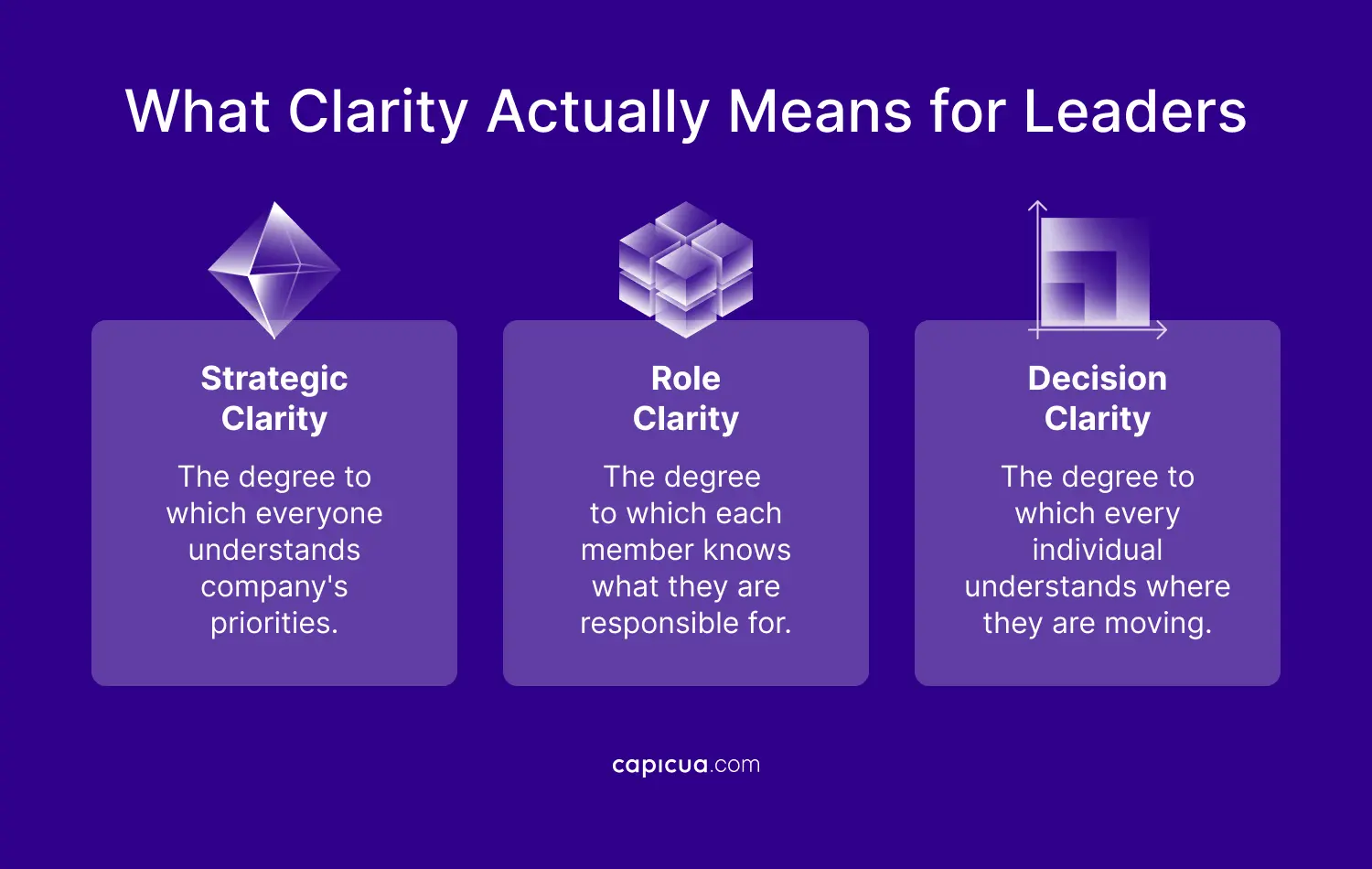
Clarity is often misunderstood as simply "good communication"—being articulate in emails or running well-run meetings. However, while not wrong, that understanding is also too narrow. In an organizational context, clarity operates on three distinct levels: strategic clarity, role clarity and decision clarity. Leaders must attend to all three.
- Strategic Clarity: the degree to which every person in an organization understands the company's priorities, why those priorities were chosen and how their work connects to them. When strategy is handed down rather than built collaboratively, middle layers fill in the blanks with their own divergent interpretations.
- Role Clarity: the degree to which each member knows what they are responsible for, what authority they hold and where their accountability ends and someone else's begins. Research consistently shows that this clarity promotes team function, while the absence of explicit role contracts tends to create friction and duplication.
- Decision Clarity: the degree to which every individual knows who is empowered to make which decisions, at what threshold those decisions need to be escalated and how fast they can move without seeking approval. The absence of decision clarity creates a hidden tax on time spent waiting for sign-off, seeking alignment or second-guessing.
When leaders deliver on all three dimensions of clarity, the effects are measurable. Research shows that when employees collaborate with clarity, they work 15% faster, produce 73% better work, are 60% more innovative and feel 56% more satisfied.
The Leadership Behaviors That Create Clarity
Leaders can actively generate clarity through specific, repeatable behaviors. Here are the most consequential.
1. Visibilizing Strategy
One of the most common failures in digital product organizations is that strategies exist at the executive level but degrade as they move down the organizational hierarchy. VP-level leaders may have an excellent strategic understanding; team leads often have a partial picture; individual contributors frequently have almost none.
Gallup states that only 19% of employees strongly agree with the statement "My manager explains how my organization's cultural values influence our work." This number means that for the vast majority of teams, there is a critical interpretive gap between organizational intent and daily execution. But closing this gap requires more than announcing strategies.
Leaders must translate strategies and regularly and explicitly explain what the team is doing, why it's the highest priority right now, how it connects to the organization's broader goals and what success looks like in concrete, measurable terms. The best leaders weave the thread between individual tasks and company objectives.
Leaders who make strategy visible both improve clarity and build culture.
2. Communicating Context
Informing and creating understanding are two different things, and most leaders are reasonably good at the former and underinvest in the latter. Informing is telling teams about a decision; creating understanding means explaining the reasoning, the trade-offs considered and the implications for the team's work.
In digital product contexts, contextual communication is especially important because product decisions carry downstream design, engineering and go-to-market implications. Research from Gallup's Workplace Study reinforces that leaders who commit to explaining the why behind decisions build trust and engagement that directly impact productivity.
When a leader says "we're deprioritizing feature X," the engineering team needs to understand whether this is a temporary deferral or a permanent cut, whether the underlying problem remains on the roadmap and whether their current work is affected. Without context, teams over-communicate to compensate, creating meeting overhead and coordination drag that cost organizations hours of productivity per person per week.
In digital product contexts, contextual communication is especially important because product decisions carry downstream design, engineering, and go-to-market implications.
3. Designing Roles
Role clarity has to be engineered deliberately at the outset of projects and revisited as work evolves. Leadership requires the ability to design, clarify and recalibrate role relationships throughout a project's life cycle. Every member must have role clarity as the project evolves to ensure the team functions as a cohesive whole.
Practical frameworks like RACI (Responsible, Accountable, Consulted, Informed) are useful starting points, but the more powerful practice is simply making role conversations explicit and recurring. This practice means clearly defining who makes the final call on product decisions, who owns the definition of done, who is accountable for what and who has authority to negotiate scope. These conversations can feel administrative, but their absence generates coordination drag and duplicated effort.
Leaders must define who makes the final call on product decisions, who owns the definition of done, who is accountable for what and who has authority to negotiate scope.
4. Cultivating Safety
Clarity and psychological safety are complementary values, and a safe team will ask clarifying questions rather than operating on uncertain assumptions, surface concerns before they become blockers and flag conflicting priorities.
Research shows that leaders who reset organizational priorities and foster psychological safety drive human performance, and that human-centered leadership remains a defining trend. Product leaders must create the conditions where a junior engineer can ask why a decision was made, where a product manager can push back on a roadmap item and where a designer can advocate for a user need that seems to conflict with a business metric.
If teams don't have conversations about decisions, roadmaps and metrics, because they fear the social cost of questioning leadership, assumptions calcify into bad decisions.
5. Creating Rhythms
One of the most effective tools in a leader's toolkit is the operating rhythm: the predictable cadence of meetings, check-ins, reviews and communications that collectively ensure alignment is maintained over time. Employee engagement lags at 31% globally, but leaders can improve engagement through small, repeatable habits. Weekly priority clarity and regular recognition often matter more than one-time initiatives.
Workers report having "meeting hangovers" after 28% of their meetings, and individual contributors' unproductive meeting load jumped to 3.7 hours per week. The problem is not meeting frequency per se; it's meeting design, and the goal is not more meetings; it's fewer, better-structured touchpoints that systematically prevent ambiguity from accumulating.
Leaders who invest in structuring their operating rhythms can communicate more clearly in fewer, shorter interactions.
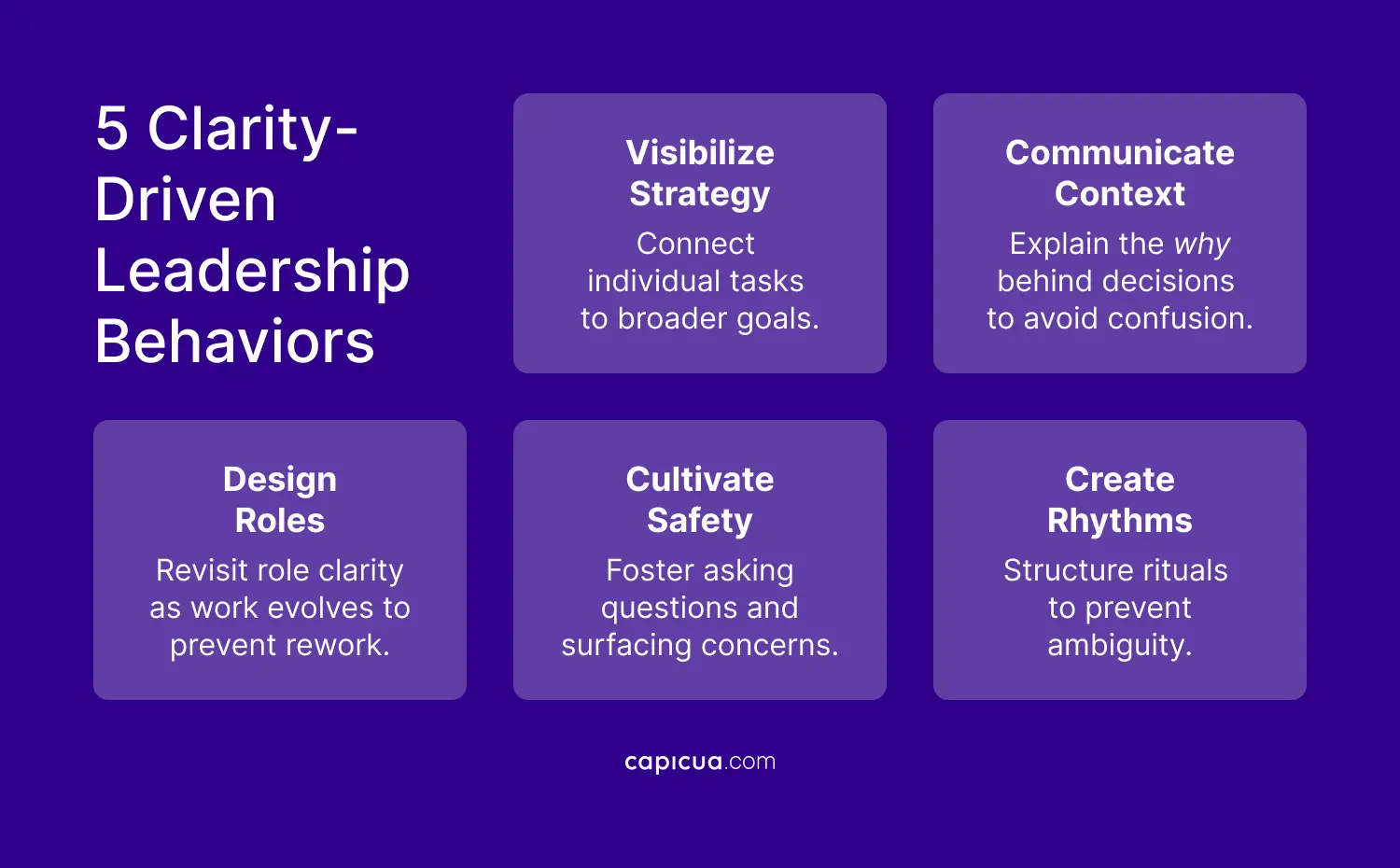
5 Clarity-Driven Leadership Behaviors
- Visibilizing Strategy: Strategies often degrade as they move down the hierarchy. Leaders should regularly translate strategies and connect individual tasks to broader goals to improve clarity and build culture.
- Communicating Context: Contextual communication is essential in digital product environments for avoiding confusion and inefficiencies. Trust and engagement are built when leaders explain the reasoning behind decisions.
- Designing Roles: Role clarity must be engineered and revisited as work evolves. Explicit and recurring conversations about roles prevent coordination drag and duplicated efforts.
- Cultivating Safety: Clarity and psychological safety go hand in hand, and safe teams ask questions and surface concerns to avoid blockers. Leaders must foster environments where team members feel comfortable challenging decisions.
- Creating Rhythms: Employees often experience "meeting hangovers" caused by poor meeting design. Leaders' focus should be on fewer, better-structured meetings to prevent ambiguity, as operating rhythms help maintain alignment over time.
Why Middle Leadership Is the Most Critical Layer
When organizations talk about leadership and clarity, the conversation often focuses on the C-suite. But in digital product organizations, the most critical clarity-generating work happens in the middle: a VP, a Director, a Team Lead. They translate executive strategy into day-to-day priorities, and tend to represent the point at which clarity breaks down.
When the C-suite and the extended leadership team operate as a connected, strategically capable system, organizations execute more coherently, adapt more quickly and build stronger momentum. However, when the extended leadership tier is treated as a recipient of strategy rather than an architect, even strategies that look coherent in the boardroom fail at the next level down and beyond.
Middle leaders are often evaluated on delivery metrics, such as shipping features, hitting quarterly OKRs and managing team capacity, without being explicitly accountable for strategic clarity within their teams. They may be brilliant operators but inconsistent communicators of organizational intent. They may understand the "why" behind decisions but fail to translate it into the language their teams need to act.
The solution is to make clarity-building an explicit and measurable part of middle leadership accountability. Companies that evaluate leaders on what was shipped and on how clearly their teams understood what and why they were building a specific item consistently outperform those that don't.

The Costs of Being The Wrong Type of Leader
Leadership clarity is not just about productivity. Ambiguity has a direct line to attrition, and attrition is one of the most expensive challenges any product company faces. In fact, according to Gallup, when employees feel connected to their purpose, their team, and their leader, they are significantly more engaged and productive.
Yet the inverse is equally true: marketing employees who experience high levels of collaboration drag are 15x more likely to feel burned out and 9x more likely to plan to leave the company within the next year. In product organizations, where experienced engineers, designers, and product managers are among the most in-demand and difficult-to-replace professionals, that attrition risk is an existential product risk.
Ambiguity also has a direct cost in execution quality. While active communication within teams can boost productivity by 25%, inefficient processes account for a 20 to 30% loss in productivity. For a product organization, that gap can represent the difference between iterating on user feedback and missing the market window entirely.

What Strong Leadership Clarity Looks Like
Clarity can be both easy to describe in the abstract and genuinely difficult to execute in the noise of a real product organization. At the strategic level, it looks like a leadership team that meets regularly to align on what is being built, the reasoning behind trade-offs, the metrics that define success and the criteria for deprioritization.
At a role level, it looks like project kick-offs where the first thirty minutes are spent not on deliverables and timelines, but on decision rights and accountability structures. Clarity looks like a leader who proactively resolves ownership ambiguity before it creates conflict, like design and management leads who have had explicit conversations about where one role ends and the other begins.
Moreover, at the decision level, it looks like teams that know which decisions they can make autonomously, which should be flagged before making them, and which require formal sign-off. It looks like leaders who resist the temptation to be consulted on everything. Paradoxically, over-consultation can create as much ambiguity as under-communication, as it teaches teams they don't have genuine authority over their own scope.
Effective leadership fundamentally stems from strong leader-follower relationships and clarity-building behaviors. Moreover, organizations that focus on these behaviors reduce complexity, improve outcomes and foster more inclusive and resilient workplaces.

A Framework for Leaders Who Want to Build Clarity
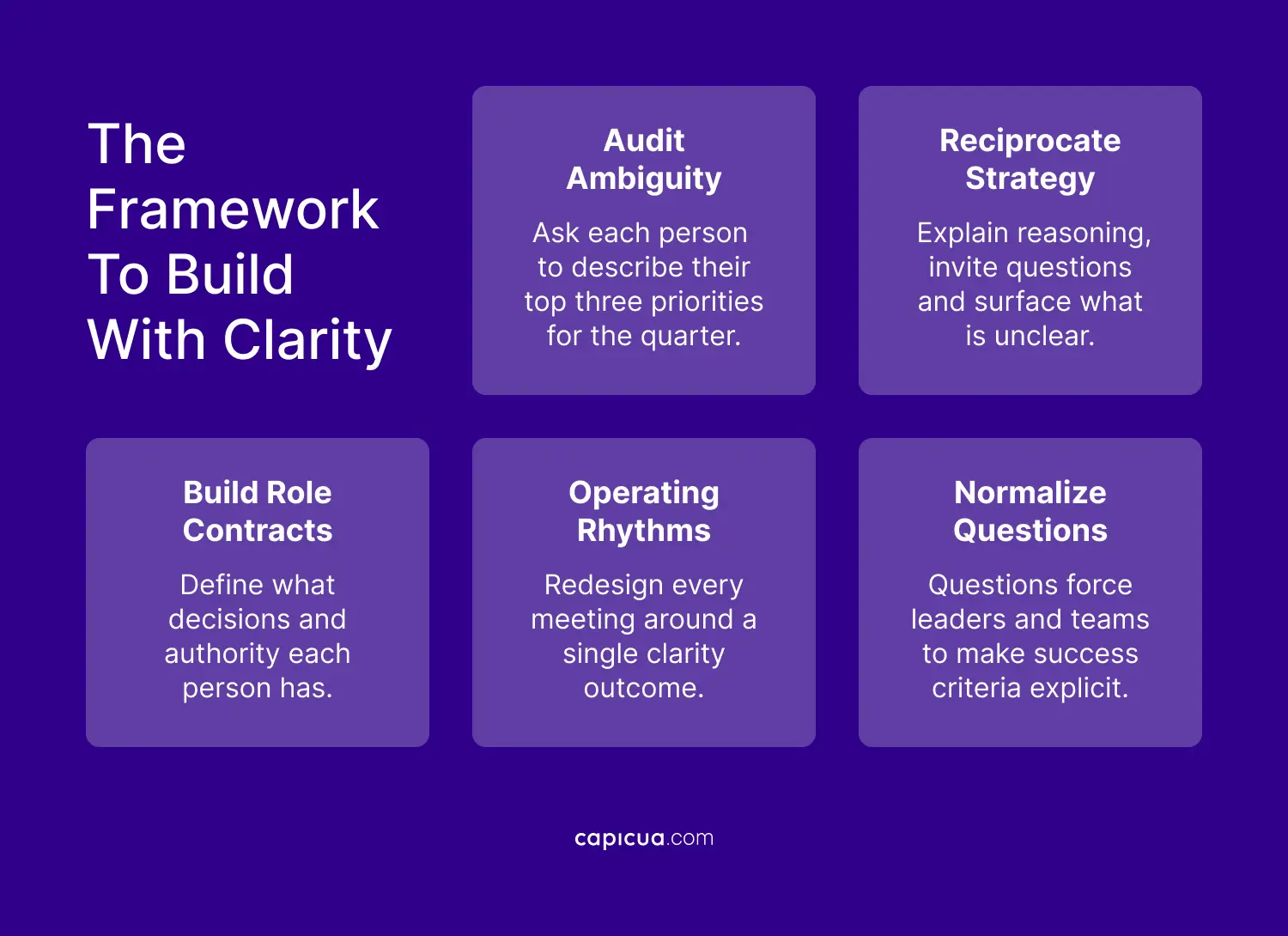
For leaders who want to close the gap between where their teams are and where they need to be, the following framework offers a practical starting point:
- Auditing Ambiguity. Ask each person on your team to describe their top three priorities for the quarter and how those connect to the company's goals. If the answers diverge significantly from what you intended, you have a clarity gap.
- Reciprocating Strategy. Strategy is a shared mental model to build, and the most effective leaders involve their teams in interpreting and applying strategy, not just receiving it. Rather than consensus-based decision-making, this approach focuses on explaining reasoning, inviting questions and surfacing what is unclear before work begins.
- Building Role Contracts. A role contract defines what each person is specifically accountable for, what decisions they own, and what authority they have to act. They're not bureaucratic overhead, but the infrastructure of speed.
- Operating Rhythms. Map your current meeting cadence and ask: which of these meetings exist to create clarity, and which have become rituals? Cut the latter, invest in the former, and redesign every remaining meeting around a single clarity outcome.
- Normalizing Questions. "What does good look like?" This simple question is one of the most effective tools for surfacing misalignment before it becomes costly, as it forces both leaders and team members to make success criteria explicit.
Conclusion
Competitive advantage is usually discussed in terms of technology, data, user experience or go-to-market speed. But the organizations that consistently outperform their peers tend to share a less visible advantage: their teams know exactly what they are trying to accomplish, why it matters and what role each person plays in making it happen.
That is the result of leaders who have made clarity a discipline and treat reducing ambiguity as a core responsibility rather than a secondary concern. Communication is a leadership strategy, and clear, consistent, and authentic communication became the foundation for trust, alignment, and measurable performance.
For decision-makers, the question is not whether clarity matters, but whether your organization is treating it with the structural seriousness it deserves. The organizations that win in product development are those where talented people consistently know what they are supposed to do and trust that the direction they've been given is worth following. That is what clarity-driven leadership creates. And it starts at the top.
This article was written for decision-makers in the digital product industry. If you are interested in how organizational clarity connects to product growth strategy, we'd love to start a conversation.