

The most expensive line in your product budget never appears in a single invoice. It hides inside the features you ship and your users quietly ignore. Across U.S. software alone, poor-quality, rework-heavy software was estimated at $2.41T a year by CISQ, and a meaningful share can be traced back to one avoidable mistake: building before validating.
A prototype example is the cheapest insurance you can buy against it. This working model of an idea is built to be tested and discarded, not shipped, and it exists to answer one question before code does: is this accurate, functional, and intuitive enough to bet on?
The cost of answering late is steep, as fixing a flaw in production can cost up to 100 times as much as fixing it at the design stage, according to the IBM Systems Sciences Institute. This article walks through concrete prototype examples across fidelity levels, from a paper prototype example sketched in minutes to Figma prototype examples that simulate the real interface. The goal is to show how each one protects accuracy, functionality, and intuitiveness in the digital product development process.

What is a Prototype? A Working Example Defined
A prototype is an early, testable model of a product or feature that lets a team learn whether an idea works before committing engineering resources. The clearest example of a prototype is a clickable mockup of a checkout flow that looks and behaves enough like the real thing for users to attempt a purchase.
However, nothing is built: the team watches where users hesitate and changes the design, not the codebase. Prototypes vary by fidelity, meaning how closely they resemble the finished product. Teams generally move through three levels:
- Low-fidelity prototypes: paper sketches or rough wireframes that test structure and flow.
- Mid-fidelity prototypes: digital wireframes with basic interactions, layouts and logic.
- High-fidelity prototypes: polished, interactive mockups that simulate real experiences.
In this context, validation through experimentation correlates with outcomes. In Figma's research, 60% of teams that succeeded multiple design or technical approaches, compared with only 39% of those that failed. Prototypes are how that exploration happens cheaply.

Paper Prototype Example: The Fastest Way to Test an Idea
A paper prototype is a hand-drawn representation of a screen or flow, used to test concepts before any tool is opened. A typical paper prototype example involves sketching each screen of an onboarding flow on index cards. A teammate acts as the "computer," swapping cards as a test user "taps" buttons drawn in pen.
For leaders, the value of a paper prototype is speed and candor. Because it looks unfinished, stakeholders critique the idea rather than the pixels, and the team avoids what Tim Brown calls becoming too complex too early. Early prototyping like this is one reason rapid prototyping approaches can cut development costs by up to 30% and TTM by around 50%.
A paper prototype example earns its keep when you need to compare two or three flow structures before investing in design, align a cross-functional team on scope in a single working session, or test a feature's logic with users without signaling that anything is final.

Figma Prototype Examples: Simulating the Real Experience
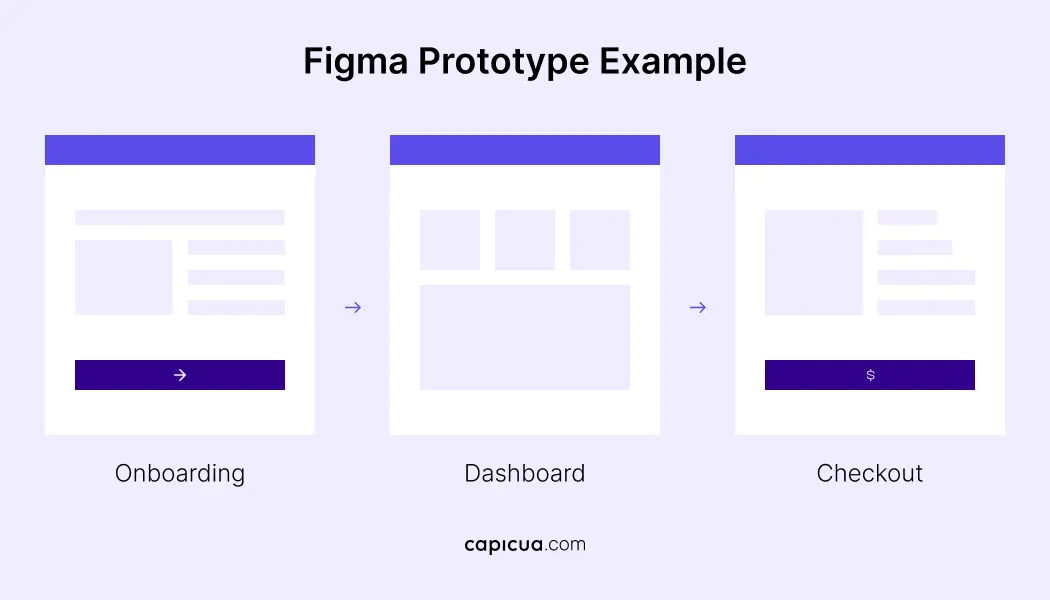
Figma prototypes are interactive, high-fidelity mockups that link real screens with transitions, states, and clickable components, allowing users to move through a product as if it were live. Figma has become the default environment for this, with 13M monthly active users and roughly 40% of the collaborative design market, which means a Figma prototype example is also the artifact your designers, PMs, and engineers can all read.
The Figma prototype examples that recur in B2B SaaS work include:
- Onboarding walkthrough: a clickable first-run experience tested with new users to measure time-to-value before engineering builds it.
- Dashboard redesign: interactive states (loading, empty, populated, error) that prove the layout holds up under real data conditions.
- Pricing and checkout flow: a simulated path from plan selection to confirmation, used to catch drop-off points before a line of payment code is written.
The strategic payoff is a cleaner design-to-development handoff. A validated Figma prototype serves as the source of truth that engineers build against, which is part of why software prototyping is estimated to reduce project rework by around 30% in fast-moving industries like fintech and healthcare IT.
How Prototype Examples Ensure Accuracy and Intuitiveness
A prototype protects three things every product leader is ultimately accountable for: accuracy (the product solves the real problem), functionality (the flows actually work), and intuitiveness (users succeed without help). Each maps to a stage of testing:
- Accuracy is validated when you put a prototype in front of real users and watch whether it addresses their actual job-to-be-done. Here, teams catch the most expensive error of all: building the wrong thing well.
- Functionality is validated through interactive prototypes that expose broken logic, dead ends, and missing states before they become defects. Moving that discovery left on the timeline is exactly where cost multipliers are avoided.
- Intuitiveness is validated through usability testing, where success is measured by task completion without intervention. A prototype that needs explanation is feedback.
Done together, these checks compound. Integrating prototyping into agile workflows has been associated with 27% faster product validation than traditional build-first models, because the team spends its expensive cycles on a validated direction.
With Shaped Clarity, every prototype example is read as a signal: what users tap, where they hesitate, what they ignore; those signals become a shared operating reality the whole team can act on. Learn more about how Shaped Clarity turns sketches into decisions here.
Conclusion
A paper prototype example, a clickable mockup, a set of Figma prototype examples: each is a structured bet placed before the expensive chips are on the table. As products grow more complex and AI raises the bar on experience quality, prototypes close gaps one tested assumption at a time.
Validate your next product bet before you build it: contact us | send us an email | book a call.