


Here's an unpleasant truth: the reason your last three features underperformed had nothing to do with how they were built; it's grounded in the question your team was set out to answer. While most teams are excellent at generating solutions, they're surprisingly careless about framing the problem those solutions are meant to solve. And this issue is further supported by the fact that ~60% of PMs admit to shipping features customers don't use.
But worry not! The "How Might We" template is the design-thinking artifact that closes the gap. A How Might We (HMW) question reframes a validated insight into an open, solvable challenge for cross-functional teams to explore the right problem before anyone commits engineering time. Popularized through companies such as IDEO, Google, and Facebook, the three-word phrase has become a fixture of product discovery, ideation workshops, and whiteboard sessions in tools like Miro.
This guide covers the design thinking How Might We template end to end: what it is and where it came from, how to write HMW questions that are neither too broad nor too narrow, how to run the How Might We template in Miro with a real team, and how sharper framing translates directly into less product rework. You'll also get an interactive question builder, worked How Might We examples, and a checklist of the traps that quietly derail ideation.

What is the How Might We Template in Design Thinking?
The How Might We template is a problem-framing tool that converts a research insight into a short, open-ended question in the form: How might we [action] for [user] so that [outcome]? And while it may seem like a random name, each word does its work deliberately. "How" assumes a solution exists; "might" keeps the space open to many possibilities rather than a single right answer; and "we" frames the challenge as a collective effort.
The technique was introduced at Procter & Gamble (P&G) in the 1970s, later adopted by IDEO as a core design thinking practice, and spread through Google and Facebook into mainstream product culture. Today, relevant sources such as the Interaction Design Foundation describe HMW as the bridge between the "define" and "ideate" stages of design thinking. The Nielsen Norman Group also states that well-constructed HMW questions generate creative solutions while keeping teams focused on the right problems to solve.
In practice, the template sits at a specific point in the product and UX discovery process. You start from a point of view or need statement grounded in research, then reframe it as one or more HMW questions to brainstorm against. A strong HMW keeps the solution open, giving a frame wide enough to invite bold ideas and narrow enough to stay tied to real evidence.

How to Write How Might We Questions
The hardest part of the How Might We template is calibration, and the NN/G identifies two failure modes that quietly ruin a session. The first is questions that are too broad or vague, like "How might we improve the UX of the product?"Since the phrasing isn't tied to anything learned, it produces ideas that miss the root problem. The second is embedding a solution in the question itself, which restricts the pool of possibilities before ideation even begins.
A reliable way to hit the middle is to build every HMW from a research insight using a three-part structure. Anchor it to a specific segment, name the change you want, and leave the mechanism open:
- Name the action: Use a solution-agnostic verb phrase ("help," "reduce friction for," "make it easier to") rather than a feature ("add a dashboard").
- Name the user: Point at a specific segment ("mid-market onboarding leads"), not a generic "users."
- Name the outcome: State the behavior or value change ("activate before the trial ends"), never the interface.
To better understand the difference, let's review two How Might We examples. A weak version would be: "How might we add onboarding tooltips?" It embeds the solution and skips the user and outcome entirely. A calibrated version, "How might we help first-time admins reach their first successful workflow so that they activate before the trial ends?", is specific about who and why, and open about how. Remember: if a question feels too big, break it into a set of narrower HMWs; if it feels trivially answerable, it's probably embedding a solution.

How to Run the How Might We Template in Miro
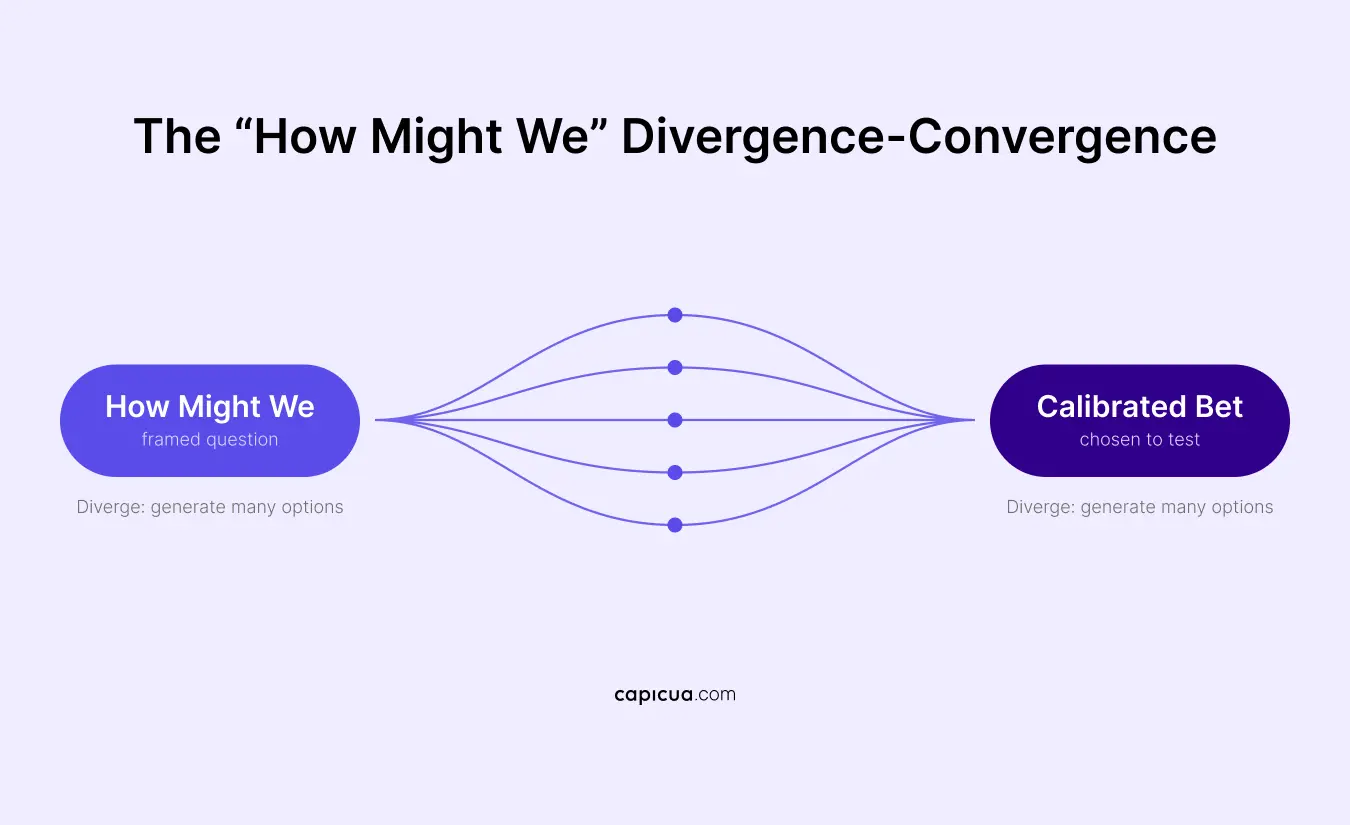
Creating a How Might We template in Miro turns a solo framing exercise into a cross-functional ideation workshop. Miro offers a dedicated How Might We template that works because HMW sessions follow the divergence-convergence principle: first, widen the field to gather as many ideas as possible, then narrow toward the ones worth betting on.
A practical HMW workshop runs in five steps:
- Frame from insight: Post 2-4 validated research findings on the board so every HMW traces back to evidence, not opinion.
- Draft HMW questions: Have each participant write HMW questions on sticky notes in silence for five minutes, using the action/user/outcome structure.
- Cluster and select: Group similar questions, then dot-vote to choose two or three to ideate against as the first convergence point.
- Diverge into ideas: Brainstorm solutions under each chosen HMW, keeping quantity over quality and deferring judgment.
- Converge into bets: Cluster the ideas, prioritize by impact and feasibility, and carry the strongest forward as testable hypotheses.
"How Might We" Template To Reduce Product Rework
The How Might We template works as a rework-prevention control, and as most founders know, rework is a high, recurring cost. The Standish Group's CHAOS research shows that fewer than 35% of projects are delivered on time, on budget, and within scope. At the same time, McKinsey found that up to 40% of engineering capacity is consumed by rework.
Much of that waste traces back to teams solving a problem they never framed correctly, yet poor framing is also a knowledge problem. A PMI study found that organizations with weak knowledge-sharing practices waste an average of $110M for every $1B spent on projects.
An HMW session forces a team to make its assumptions explicit and shared before committing, which is exactly where drift begins. As Capicua has written, rework and misalignment compound quietly when teams mistake speed for direction. The upside of framing before building is measurable: a 2025 Boston Consulting Group analysis of product operating models found that companies with formal assumption-testing practices reduced rework cycles by an average of 47% compared with peers without such practices.
To summarize, the How Might We template converts a vague directive into a shared, testable question the whole team can rally around, which is the foundation of good design thinking and product management.

5 Mistakes When Working With The "How Might We" Framing
Even experienced teams are at risk of misusing the How Might We template, and a few recurring mistakes account for most disappointing sessions, including:
- Framing without research: HMW questions written from opinion rather than a discovery insight produce confident answers to unvalidated problems.
- Going too broad: "How might we improve retention?" is a strategy, not a workshop prompt. Anchor it to a specific moment and segment.
- Embedding the solution: If the question names a feature, the team will only generate variations of that feature.
- Skipping convergence: Generating fifty ideas and never prioritizing leaves a board full of sticky notes and no decision.
- Treating HMW as a one-off: The best teams revisit and re-scope HMW questions as evidence accumulates, keeping framing and learning in sync.
The through-line is that the template is only as good as the thinking behind it. Used well, it is a forcing function for shared understanding; used carelessly, it produces the illusion of alignment while the real disagreement stays buried.
"Shaped Clarity is the craft of turning ambiguity into direction, direction into action, and action into value." – Ismael Larrosa, CEO at Capicua.
A How Might We question is a small act of clarity: it externalizes an assumption, names the user and outcome, and turns a vague directive into a shared, testable frame. Shaped Clarity™, Capicua's proprietary product operating lens, scales that same move across the whole organization, so teams keep framing ahead of execution cost and turn product signals into decisive business breakthroughs. Learn more about Shaped Clarity here!
Conclusion
The How Might We template endures because it solves a problem that never goes away: teams are wired to jump to solutions before they've agreed on what they're solving. Three words slow that reflex down just enough to point everyone at the same, well-scoped challenge. Execution keeps getting cheaper and faster, so the scarce advantage moves upstream to the quality of the questions a team chooses to answer. The design thinking How Might We template is a simple, durable way to raise that quality, one problem at a time.
Frame the right problem before building: contact us or book a call with us.