


Some products earn daily loyalty, while others are deleted within a week, and contrary to popular belief, it's not so much about specific features as about the user needs each meets. While a "good" retention rate heavily depends on the industry, products retain only around 35% of users one month after their first visit and lose roughly 70% of them within three months. That attrition tends to start with unmet basic needs at the bottom of the pyramid.
A great way to diagnose the problem is to apply Maslow's hierarchy of needs to digital products. Borrowed from Abraham Maslow's 1943 model of human motivation, this five-tier pyramid runs from physiological survival to self-actualization. Higher needs only matter once the ones beneath them are satisfied: a mission statement cannot feed a hungry person, just as a beautiful interface cannot rescue an app that crashes.
This guide walks through the full UX hierarchy of needs, navigating how each tier of Maslow's model translates into concrete product decisions, from load times and data security to community, personalization, and delight, and how leaders can use the digital product pyramid as a product prioritization framework.
What is Maslow's Hierarchy of Needs?
Maslow's hierarchy of needs in product design is a layered model that ranks user requirements from the most fundamental to the most aspirational, with each level having to be satisfied before the next becomes meaningful. It adapts the psychologist Abraham Maslow's original theory of human motivation, which arranged needs into five tiers: physiological, safety, love and belonging, esteem, and self-actualization.
In a design framework, those tiers get correlated with the UX hierarchy of needs, described by the Interaction Design Foundation as a digital product pyramid with five ascending levels: functionality, reliability, usability, proficiency, and delight. A product has to be functional before anyone cares whether it is reliable, and reliable before usability earns attention.
This model forces order onto competing priorities. When every stakeholder wants their feature shipped first, the pyramid provides shared logic for what comes next and what waits, answering the question product leaders ask in every roadmap review: "given finite time, which user needs move the product forward, and which are premature?"
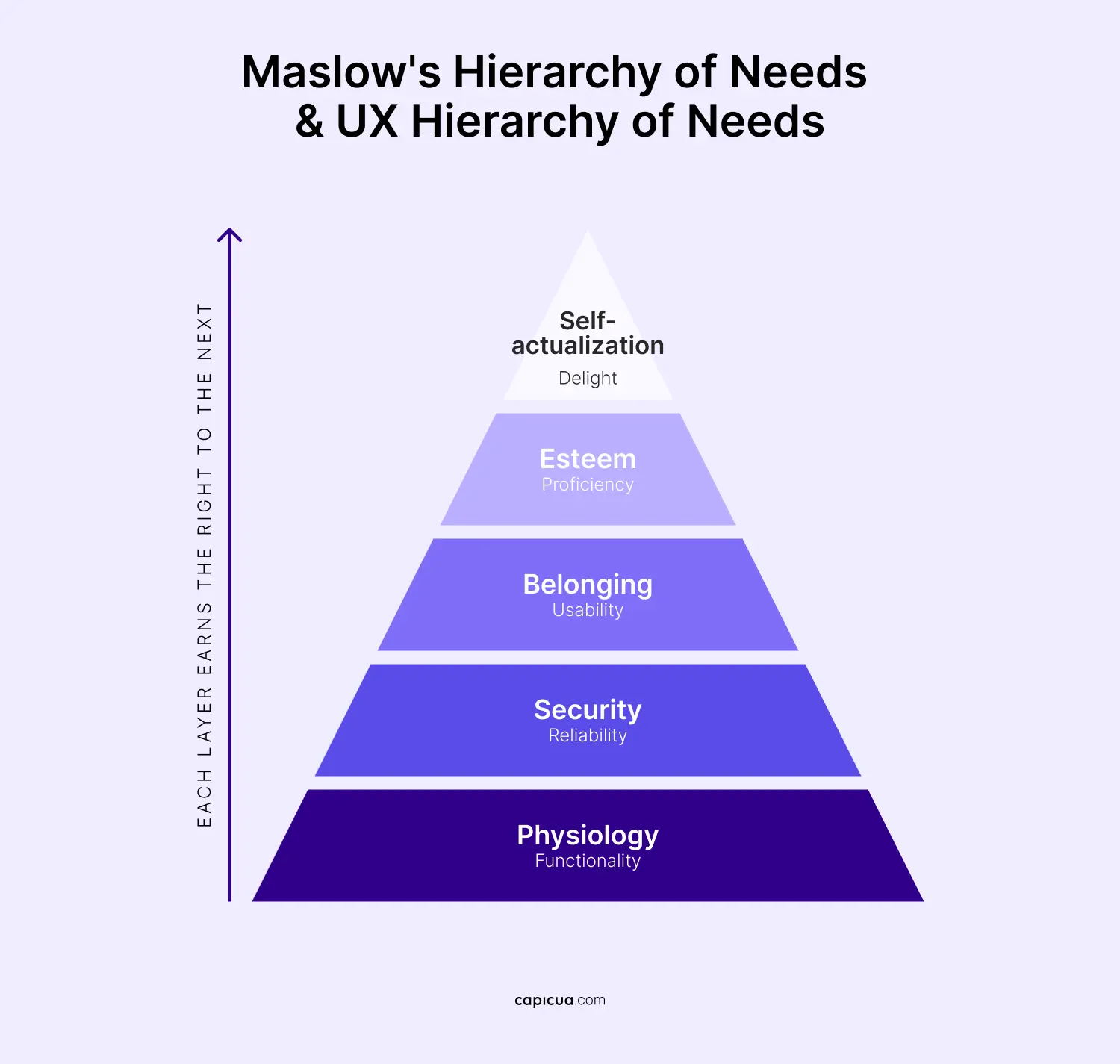
Physiology and Functionality
Before a product can be secure, social, or delightful, it has to do the core job it promised: the page loads, the button works, the search returns results; yet when this layer fails, nothing above it registers. Think of UX functionality sitting at the base of the digital product pyramid, the equivalent of Maslow's physiological needs.
The clearest expression comes to speed, because users experience a slow product as a broken one. According to Google AdSense Help, 53% of visitors abandon mobile pages that take longer than 3 seconds to load; therefore, a product that stalls at the physiological layer never has a chance to compete on anything else.
For product teams, there are 3 concrete design functionality takeaways:
- Instrument core flows and treat time-to-value as a first-class metric.
- Fix performance and reliability regressions before adding features.
- Define "functional" from the user's job, not the spec sheet. Technically shipping but not completing the intended task still fails the physiological test.

Security and Reliability
According to a 2025 Digital Trust Index survey of more than 14,000 consumers, 82% have stopped using a brand because of how they perceive their data is handled, and 86% reported expecting a high level of data privacy from the companies they interact with online.
Once a product works, the next need is safety, expressed in software as UX reliability, data security, and trust. Trust is a decisive factor in purchase and retention, so users need to feel that their data is protected and that the system will behave predictably. But beyond security, there's the aspect of reliability: a product that works today but fails intermittently keeps users in a state of low-grade anxiety that does not deepen engagement. Meeting safety needs means designing for graceful failure, transparent data practices, predictable uptime, and clear communication when something breaks.

Belonging and Usability
The third tier, love and belonging, is where digital products stop being tools and start becoming places. In Maslow's model, this step highlights the need for connection, membership, and relationship. In digital products, it shows up as community features, collaboration and shared spaces that tell a user they are among people like them.
Belonging is what turns individual usage into a network, so products that let users collaborate, share progress, or see others succeeding create switching costs that no single feature can match: leaving means leaving people, not just software. That's why collaboration tools, community forums, and social feeds are so durable: because the user needs they meet are relational and compounding. The UX hierarchy of needs positions this layer as the bridge between a product that functions and one that matters to someone.
For B2B SaaS teams, belonging often looks like team workspaces, shared dashboards, and peer benchmarking. Yet the mechanism is identical: give users a reason to feel part of something, and engagement no longer depends on any one person's willpower. The design questions become "Who does this user want to be seen by?" "What does progress look like when it is shared?" "Where does the product create a sense of ‘we’?"

Esteem and Personalization
Above belonging sits esteem, the need to feel competent, recognized, and valued. In digital products, this stage translates into personalization, mastery, status, and progress. Users at this level want the product to reflect them and to acknowledge how far they have come, through customizable profiles, tailored recommendations, achievement systems, and visible signals of expertise. The most direct tool for meeting esteem needs could be gamification, with a market value estimated to reach USD 112.32B by 2031 at a CAGR of 25.24%.
However, while well-designed gamification measurably increases mobile app engagement, the effect ultimately depends on its fit with the user's actual goals. The other caution at this tier is that esteem features fail when bolted onto an unmet base: a leaderboard on a product that loads slowly or leaks trust reads as noise. Personalization earns its keep when it makes users more capable, when recommendations shorten tasks, when dashboards surface what a specific role cares about, and when progress markers show real mastery.

Self-Actualization and Delight
At the top of the pyramid, self-actualization, a product helps users become the version of themselves they aspire to be. This layer is Maslow's peak need translated into delight, meaning, and identity. A product at this level is part of how the user sees themselves; think of a writing app that makes someone feel like a writer, or a fitness platform that makes them feel like an athlete.
Reaching this tier is worth the climb, since delight is the layer that turns satisfied users into advocates, with the cheapest advocacy and most durable growth channel a product can have, compounding precisely because it sits on top of everything below it. The discipline here is sequence: self-actualization cannot be manufactured on a weak foundation, and teams that reach for delight before function tend to produce novelty that fades.
"Good design is actually a lot harder to notice than poor design, in part because good designs fit our needs so well that the design is invisible, serving us without drawing attention to itself. Bad design, on the other hand, screams out its inadequacies, making itself very noticeable." ― Donald A. Norman, The Design of Everyday Things.
Reading a product against Maslow's hierarchy is a diagnostic act that tells you which unmet need is capping your growth before you spend a quarter building the wrong layer. And turning scattered product signals into a clear read on where users actually are on the pyramid is what Shaped Clarity™ does best. Learn more about how Shaped Clarity turns hierarchies into roadmaps.
Conclusion
For digital products, Maslow's hierarchy of needs shifts from theory to a tool for explaining why fast, reliable, trustworthy products earn the right to build community, why community earns the right to personalize, and why personalization earns the right to delight. The pyramid will keep mattering as products get more crowded and users get less patient. Map your product against the hierarchy, find the lowest unmet need, and build there; that's where the next unit of growth is hiding.
Find the lowest unmet need capping your growth with Capicua: contact us or book a call.