


Some products turn first-time users into daily habits, while others, with comparable features, quietly bleed them away. What is the actual difference, you may ask? It often comes down to motivation design, and the discipline founders use to engineer it has a name.
Gamification is the practice of applying game mechanics, such as progress, rewards, and challenge, to non-game products to drive specific behaviors. When done well, it turns passive usage into committed engagement, yet if done carelessly, it becomes an exhausting layer of points nobody asked for.
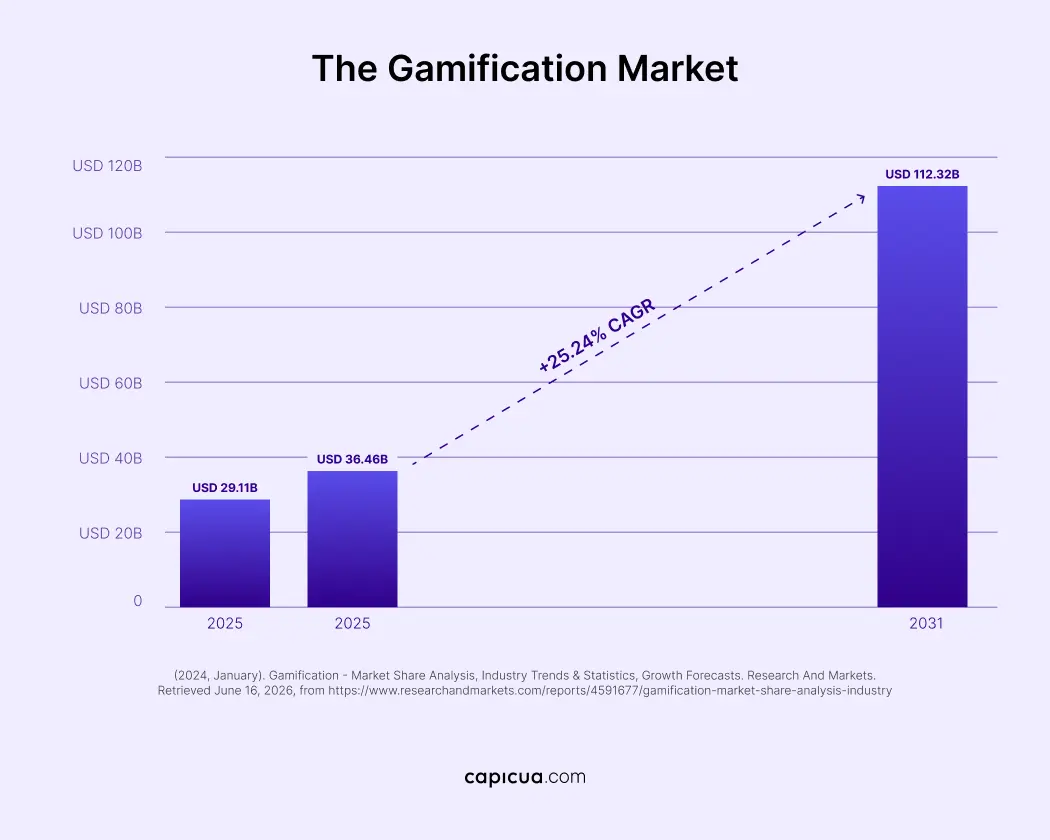
With a gamification global market valued at USD 29.11B in 2025 and estimated to reach USD 112.32B by 2031 at a CAGR of 25.24%, gamification signals a shift in which engagement mechanics have moved from consumer novelty to core retention infrastructure.
This guide answers what is gamification in the context of digital product ideation, building, and scale, and how to evaluate gamification solutions and gamification apps without bolting motivation onto a product that has not earned it yet, with everything in between. Let's play!
Gamification in Digital Product Design
At its core, gamification harnesses game design elements to motivate specific user behaviors, including well-known yet field-specific processes such as points, levels, streaks, challenges, and rewards. Every gamification mechanic maps to an action the business needs, whether it's completing onboarding, finishing a workflow or returning daily.
Most mechanics generally fall into a few gamification families:
- Progression: levels, bars, and meters that show users how far they have come.
- Achievement: badges, milestones, and streaks that reward consistency.
- Social: leaderboards, teams, and shared challenges that use belonging to drive activity.
- Reward: points, tiers, and unlockable perks that attach tangible value to repeated engagement.
However, in the realm of gamification, there's a huge, underestimated difference between surface mechanics and motivation design. During design stages, adding a badge is much easier than understanding why a user would care about it and what behavior it reinforces.
While Gartner predicted in 2014 that "80% of current gamified applications will fail to meet business objectives, primarily due to poor design", more recent studies also back up the fact that gamification may be failing, in fact, John Barau Dah's[1] "Gamification is not Working: Why?" paper expands on this idea and finds four (4) main aspects that explain it:
- Shallowess: The superficial application of game elements to a system or activity can still not change its fundamental experience.
- Overjustification: The excessive and arbitrary use of rewards can undermine intrinsic motivation.
- BPL Triad: The excessive reliance on basic game elements, such as badges, points, and leaderboards.
- Overreliance: The use of narrow models or theories to explain or design gamified experiences.

Gamification Examples That Drive Retention
Let's think of gamification examples where mechanics produced measurable business outcomes. These are consumer-facing cases, but the underlying mechanics of reward loops tied to repeated behavior carry over directly to B2B.
- Duolingo: The shift from chores to habits enabled the language-learning platform Duolingo to report USD 811.2M in revenue and 39% growth in early 2025, with streak-based mechanics highly credited with its retention curve.
- Starbucks: The tier-based star program is so central to behavior that Starbucks attributes roughly 60% of U.S. company-operated revenue to its gamified rewards model.
- First United Bank: With its gamified Personalized Financial Guidance (PFG) approach in its mobile app, the Oklahoma bank achieved a more than 50% higher user adoption rate and a 20-fold increase in savings account openings.
The common ground among these gamification examples is that these mechanics reward a behavior the user already had reason to do while also reducing the friction of doing it again. On the other hand, gamification apps that invent artificial reasons for users to return can spike, yes, but they'll most likely end up fading. The key is to focus on the behaviors most closely aligned with your value when in doubt about whether to gamify your product.
How to Choose Gamification Software
There's a key difference to consider before starting: gamification software refers to tools that provide mechanics, such as point systems, leaderboards, and reward logic, while a gamification platform is the broader system that manages rules, analytics, and integrations across your product.
The market has matured to the point where most teams no longer build these from scratch, with low-code platforms being able to trim gamification development spend by up to 70% and cloud-based deployments now capturing 67.62% of market revenue. This shift means that decisions are now jumping from engineering capacity to design judgment.
When evaluating gamification solutions, founders should weigh:
- Behavior: Does the platform support the specific mechanic our value loop needs?
- Analysis: Can we measure whether a mechanic changes behavior?
- Integration: Does it connect cleanly to our existing data, identity, and CRM stack?
- Compliance: Can it provide audit trails and consent management in regulated verticals?
Since the U.S. Federal Trade Commission levied USD 7.8 million in penalties on a health app for data violations, the compliance question serves as a reminder that engagement mechanics that touch sensitive data carry real liability.
The failure rate of gamified applications is most likely a clarity-driven consequence of teams instrumenting behaviors before they understand which behaviors carry their product's value. Shaped Clarity™ turns user signals into decisive bets, so gamification reinforces the loop that drives retention rather than decorating one that does not. Learn more about Shaped Clarity here!
Conclusion
Gamification has become a measurable lever for retention and revenue, yet only for those who treat it as motivation design disciplined by evidence. The next wave, AI-driven personalization of challenges and rewards, will widen the gap, and the advantage will belong exclusively to those who know which behavior they are reinforcing and why it matters to the business.
To turn mechanics into durable retention, get in touch, send us an email, or book a call.