

Football (also called soccer, depending on where you're from) prided itself for most of its history on its simplicity: a ball, two goals, and a set of laws that fit on a single page. Yet technology has quietly and then loudly reshaped the sport. Each advance solved a problem of its day and, in doing so, changed how the game was played, officiated, coached, and consumed.
This football and technology article traces the most consequential technological milestones in association football, from Victorian goal nets to the present day.
The Football Foundations
The Goal Net: 1878 - 1891
The earliest applied technology was about making the game possible to play and adjudicate. While experiments with electric floodlighting to allow matches and training to continue after sunset began as early as 1878 in Sheffield, the first sport-based invention, the goal net, was patented by Liverpool engineer John Brodie in 1891. Before then, goals were often a matter of dispute between players and referees; the net turned the goal into incontrovertible physical evidence.
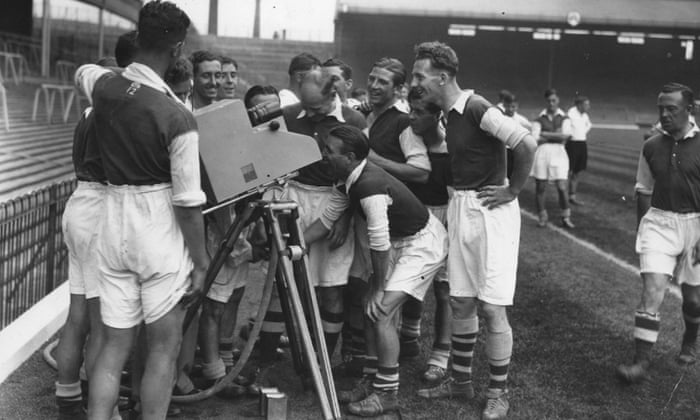
The Televised Match: 1937
The BBC broadcast a specially arranged practice match between Arsenal and Arsenal Reserves at Highbury. On Sep 16, 1937, it became the first footbal/soccer ever shown on television. While the audience was tiny and mostly London-based, the moment marked the beginning of the transformation from a gate-money spectacle into a broadcast product. Every subsequent innovation in cameras, replay, and graphics descends from this experiment and continues to shape the sport's economics today.
The Football Equipment
The Miracle of Bern: 1954
Football boots began as heavy, high-topped leather work boots, primarily designed for protection, and that was the case until the decisive leap came at the 1954 World Cup final in Switzerland. It was then that Adi Dassler equipped the West German team with boots fitted with exchangeable screw-in studs that could be lengthened for the rain-soaked Bern pitch.
West Germany's shock 3–2 victory over Hungary, the so-called Miracle of Bern, was widely attributed in part to their surer footing, and the match became the founding myth of football as an equipment sport. Of course, it's worth noting that Rudolf Dassler, Adi's estranged brother and founder of Puma, disputed the claim to have invented the screw-in stud. Regardless of who came up with it, boot design from this point on shifted decisively from protection toward performance, lightness, and control.

The Adidas Telstar: 1970
The 1970 World Cup in Mexico was the first to be broadcast live and internationally, and the Adidas Telstar ball was explicitly designed for that medium. Its 32-panel truncated icosahedron design, with twelve black pentagons and twenty white hexagons, made the ball stand out clearly on the black-and-white television sets most viewers owned.
The black-and-white pattern was not strictly new, but Telstar fixed it in the global imagination so completely that it remains the default image most people draw when asked to picture a football. It's the clearest case in the sport's history of broadcast technology dictating the design of playing equipment.
The Synthetic Era: 2006
Leather balls absorbed water and grew heavier as the match wore on, distorting their flight and increasing the risk of injury. The structural revolution arrived in 2006 with the Adidas +Teamgeist, which reduced the ball to fourteen thermally bonded panels rather than stitched seams. This shift led to a rounder, near-waterproof surface with far more consistent flight, and thermal bonding has been the standard for top-level match balls ever since
The pursuit of ever-smoother aerodynamics did not always go smoothly: the eight-panel Jabulani of the 2010 World Cup was widely criticized by goalkeepers and outfield players for unpredictable movement, and a NASA Ames study confirmed it produced an erratic "knuckleball" effect at high speed, highlighting the role of physics in sports.

The Playing Surface
The Floodlit League Football: 1956
Eighty years after the first experiments, floodlighting finally became practical. On 22 February 1956, Portsmouth hosted Newcastle United at Fratton Park in the first Football League match played under floodlights, which Newcastle won 2–0 before a crowd of 15,831. Floodlights detached football from daylight, enabling midweek evening fixtures, higher attendances, and even today's prime-time television scheduling.
The Synthetic Surfaces: 1958
Keeping a pitch playable became its own technical discipline. Everton's Goodison Park installed England's first undersoil heating in 1958, sharply reducing the postponements that once plagued the winter calendar.
In the 1980s, clubs such as Queens Park Rangers and Luton Town experimented with fully artificial pitches, but the hard, high-bounce surfaces drew complaints about injuries and distorted play and were effectively banned in the English top flight by the end of the decade.
The lasting solution was the hybrid pitch, with natural grass reinforced with synthetic fibers and pioneered by systems such as Desso GrassMaster, which combined the feel of grass with far greater durability and is now standard at elite stadiums worldwide.

The Data Revolution in Sports
The Manual Notation: 1950s
Football's analytics tradition is older than the computers that now power it. From 1950, RAF wing commander Charles Reep recorded matches by hand, tallying passes and shot sequences. His data led him to conclude that most goals came from moves of three passes or fewer, underpinning the "long-ball" theory and shaping English coaching for decades.
His conclusions are heavily contested: the historian Jonathan Wilson and statistician Richard Pollard have argued that his own data did not support the inferences he drew from it. Whatever its merits, Reep's work established the idea that football could be measured.
The Broadcast Statistics: 1996
Manual notation became an industry with the founding of Opta, which since 1996 has supplied the detailed, standardized event data that have made granular statistics a routine part of how fans watch, and clubs recruit. Its 2006 move to real-time data collection meant numbers could now flow during a match, embedding analytics permanently.

The GPS and Wearables: 2000
Companies such as Catapult Sports introduced GPS vests for training, measuring distance, acceleration, and physical load to manage workload and reduce injury risk. The pivotal regulatory moment came around 2015, when the laws were amended to permit Electronic Performance and Tracking Systems (EPTS) to be worn both in training grounds and in competitive matches.
The Expected Goals (xG): 2012
No metric has reshaped the football conversation more than expected goals, which assigns each shot a probability of going in based on factors such as distance, angle, and pressure.
The term appears in a 1993 statistical paper, and models resembling modern xG were published in 2004. Still, the inflection point for popularization was Sam Green's 2012 article for Opta, while the 2017 launch of StatsBomb carried xG into the mainstream. By measuring chance quality rather than mere outcomes, xG changed how players are recruited, how performances are judged, and how matches are narrated.

The Officiating Technology
The Goal-Line Technology: 2010
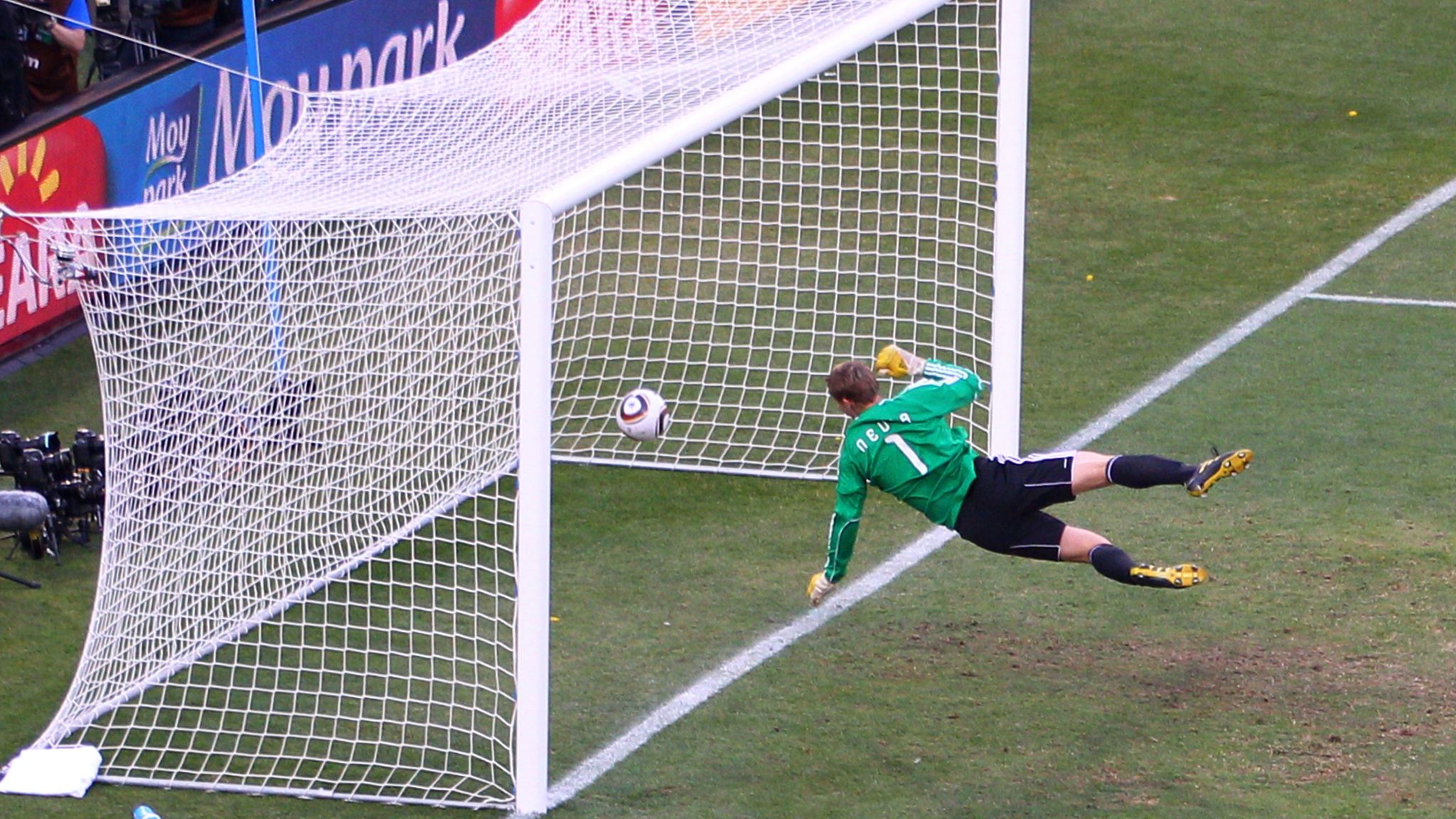
On 27 June 2010, Frank Lampard's shot for England against Germany struck the bar and bounced clear over the line, only for the goal to be waved away. This "ghost goal" shifted FIFA's long-standing opposition to technology, and on 5 July 2012, the IFAB allowed goal-line technology, approving both the camera-based Hawk-Eye and magnetic-field GoalRef.
The Premier League became the first competition to deploy it across a full season, using Hawk-Eye from August 2013, and the 2014 World Cup in Brazil became the first World Cup to use it. For the first time, the game accepted that a machine could settle a question of fact more reliably than an official.
The Vanishing Spray: 2014
A humbler innovation also debuted at the 2014 World Cup: vanishing spray, a water-based foam that referees use to mark the ten-yard distance at free kicks, which evaporates within a minute. Vanishing spray solved the petty but persistent problem of defensive walls creeping forward and showed that not every useful technology needs to be high-tech.
The Video Assistant Referee: 2016
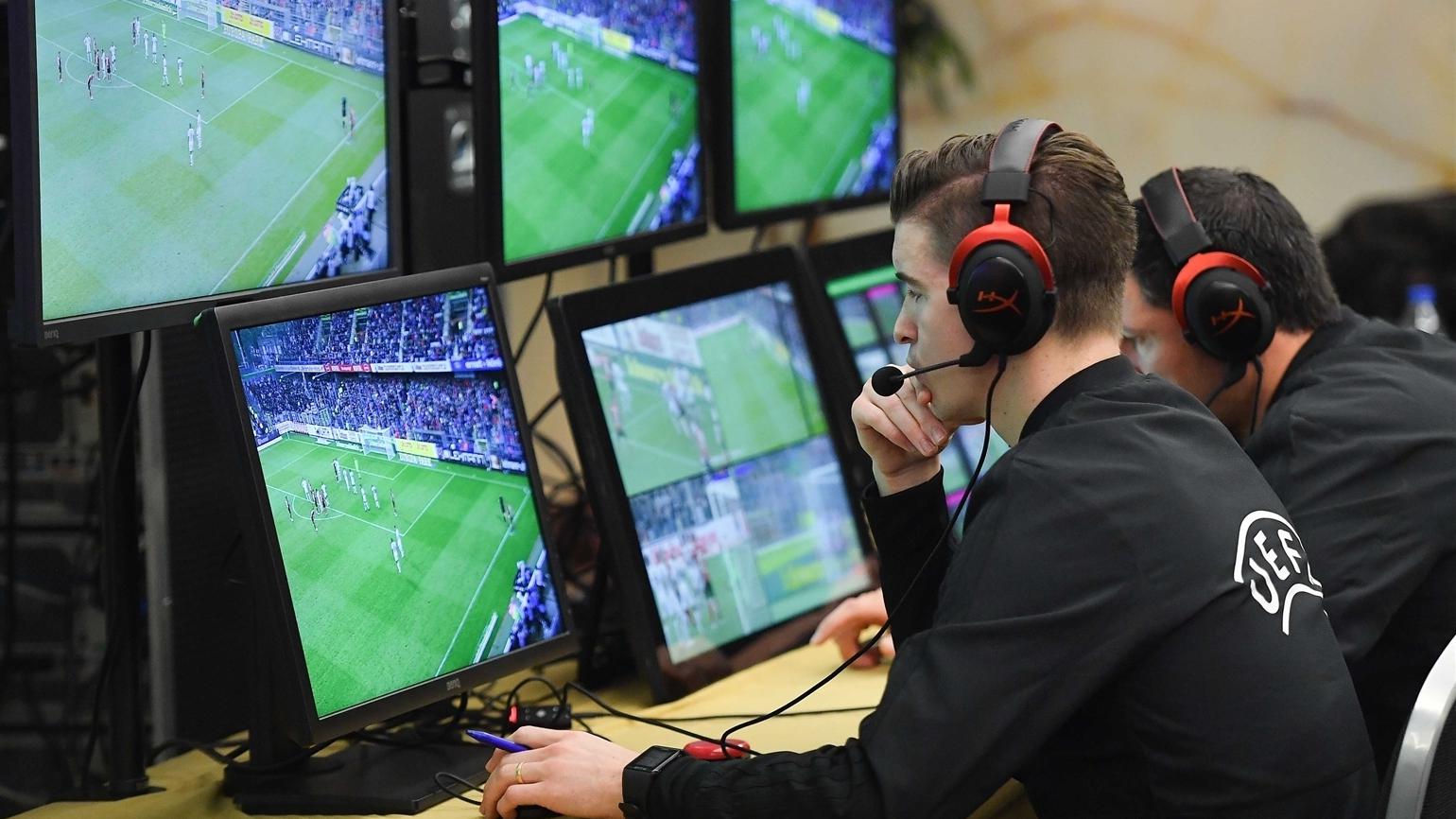
And that's how we reach one of the most contested technologies in modern football: the Video Assistant Referee (VAR). After live trials beginning in 2016 and a first major-tournament outing at the 2017 Confederations Cup, the IFAB wrote VAR into the Laws of the Game in March 2018, and the 2018 World Cup in Russia became the first to use it.
VAR allows on-field decisions to be reviewed for four match-changing categories (goals, penalties, direct red cards, and mistaken identity) under a principle of "minimal interference, maximum benefit." Today, while it has clearly reduced errors, it also ignites a debate about delay, subjectivity, and the emotional cost of the celebrated-then-canceled goal.
The Semi-Automated Offside: 2022
The state of the art arrived at the 2022 World Cup in Qatar with semi-automated offside technology. Twelve dedicated cameras tracked up to twenty-nine points on each player's body fifty times per second, and an inertial sensor inside the Adidas Al Rihla match ball reported the ball's position 500 times per second.
An algorithm combines the two feeds to flag offside automatically and generates a 3D animation for broadcast. By fusing the connected ball, optical tracking, and AI, the first time a connected ball played an officiating role at a World Cup points toward a future in which equipment, data, and officiating are a single integrated system.
Conclusion
The arc from the goal net to the semi-automated offside calls is a single continuous story: each technology entered the game to settle a question the unaided human could not. The net proved the goal; the Telstar made the ball visible; floodlights freed it from daylight; data made it measurable; and cameras and sensors made split-second decisions reviewable.
Football's laws have remained remarkably stable, but the tools surrounding them have transformed the experience of playing, judging, and watching the sport. What can we expect from it next? What would be a must-have for the next editions, in your opinion? Let's chat!