

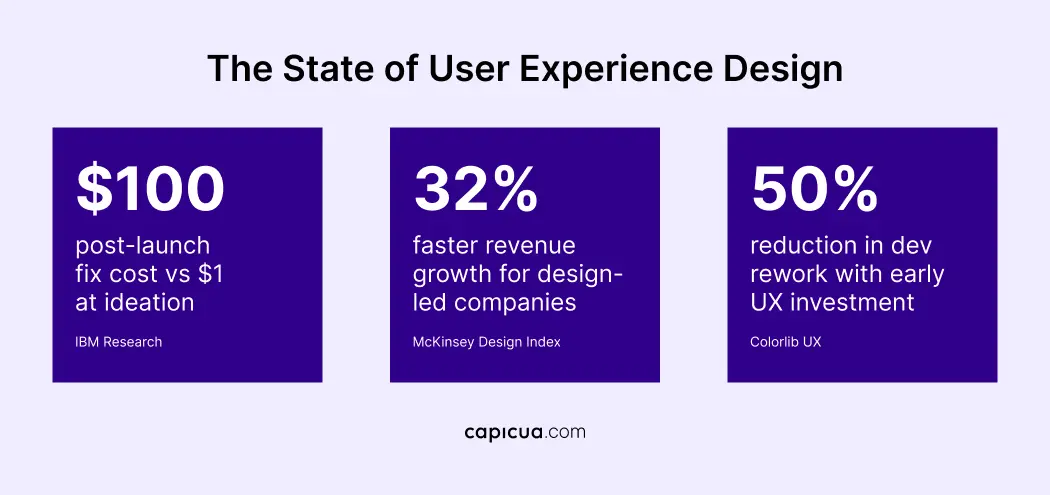
User experience design ideation is the product stage in which teams set direction, test assumptions cheaply, and lay down the trust architecture. And, while it may sound like a nice-to-have, according to IBM Research, fixing a usability problem after a product launches can cost 100 times more than addressing it during ideation.
At post-PMF, you're not experimenting anymore. You have a customer base, a roadmap, and a team looking for direction. The credibility of your process directly shapes the credibility of your product, your team, and your organization. This article breaks down how to run ideation in user experience that serves as the foundation for a trustworthy, scalable product culture.
What is User Experience Design Ideation
User experience design ideation is the structured phase of product development where cross-functional teams generate, evaluate, and prioritize design directions before committing resources to execution. In the design thinking process, it sits between user research and prototyping, at the highest-leverage moment in the entire lifecycle.
But contrary to popular belief, ideation is not a free-for-all brainstorm. When done well, it is a disciplined creative divergence in which teams use research-backed signals to frame problems, generate a wide range of solutions, and converge on the most viable directions with evidence. Each technique, from Design Sprints to the SCAMPER framework, pushes teams past their first instinct, which is rarely the most user-centered.
Why does this matter more now than it did five years ago? Because the User Experience Design market was valued at $11.41B in 2025 and is growing at 14.49% annually, product complexity has outpaced team capacity at most scaling companies.
Founders who once held product intuition at the center now manage teams that make hundreds of micro-decisions per sprint. Without a credible ideation process to anchor those decisions to user signals, drift is inevitable. Features get built for the wrong reasons. Roadmaps get shaped by internal politics rather than market reality. Ideation in user experience is the corrective mechanism that forces the right questions to be asked early.
How To Build UX Design Credibility at the Ideation Stage
Credibility in UX design is a process problem that starts at ideation. When product teams generate ideas without grounding them in user research, designs reflect team assumptions rather than user mental models, stakeholder reviews become debates about personal preference rather than evidence-based evaluation, and engineering effort is spent on solutions that feel unintuitive to the final user.
When a product underperforms, no one can trace the failure back to a specific decision because decisions were not justified. The credibility gap is the distance between what a design team believes about its users and what those users actually need. And that gap widens every time ideation runs on opinion rather than signal.
Building UX credibility at the ideation stage requires three things:
- Problem framing: Ideation sessions should open with a synthesis of recent user research. The "How Might We" question that frames the session should come from an observed user behavior or stated pain, not an internal hypothesis.
- Documented rationale: Every idea that advances from ideation to prototyping needs a one-sentence justification tied to a user signal. This step creates an audit trail that makes design decisions defensible to engineers, executives, and customers.
- Cross-functional visibility: When stakeholders outside the design team can see the ideation process and not just the outputs, trust accumulates. Transparency converts skeptics into advocates.
Treat every ideation session as a trust-building event. The process is the credibility.

UX Ideation Frameworks For Scaling Product Teams
Not all ideation methods are created equal, and the right choice depends on where your product is in its lifecycle. If you're a founder running Series A or B companies, the most useful frameworks for you share a common property: they generate diverse ideas quickly and force evaluation against real user criteria.
Design Sprints Framework
Google Ventures' Design Sprint method compresses weeks of ideation into five structured days. Each day has a specific output, and the team commits to a prototype by day four. If you lose weeks to alignment meetings, the Sprint is a forcing function for decision clarity that replaces debate with a shared prototype that can be tested with real users.
How Might We Framework
How We Might (HMW) questions convert user pain points into generative design prompts. "Users struggle to find X feature" becomes "How might we make X visible without cluttering the navigation?" This practice opens the solution space rather than pointing at a single fix. Teams that practice HMW framing consistently generate more varied ideas and avoid the confirmation bias that leads them to jump to their first obvious solution.
Crazy 8s Framework
Crazy 8s is an eight-idea sketching exercise completed in eight minutes that prevents overthinking and forces teams to exhaust their most obvious ideas quickly so that less obvious ones can emerge. If you tend toward analysis paralysis, Crazy 8s is a reset mechanism that produces raw outputs but ideas that often seed the best solution.
Top 3 User Experience Ideation Frameworks
- Design Sprints: Condense weeks of ideation into five structured days, with each day focusing on a specific output as a forcing function for decision clarity.
- How Might We: Convert user pain points into generative design prompts to encourage exploration of multiple solutions and avoid confirmation bias.
- Crazy 8s: Prevent overthinking by pushing teams to quickly exhaust obvious ideas with an eight-idea sketching exercise completed in eight minutes.
Each of these methods is supported by current research on design thinking, which consistently shows that structured creative divergence produces better-validated solutions than open-ended brainstorming. Frame the problem from user research, generate widely, and evaluate against user criteria before committing.
How to Build UX Credibility with Stakeholders and Executives
Building UX credibility inside a scaling organization requires making the design process legible to people who do not speak design. Executives and boards evaluate decisions through the business lens of revenue impact, customer retention, operational cost, and competitive position. Designers who present ideation as finished visuals can end up losing the argument before it starts. Yet, those who bring ideation outputs as a story, from user signal to design direction to measurable hypothesis, can win alignment and resources.
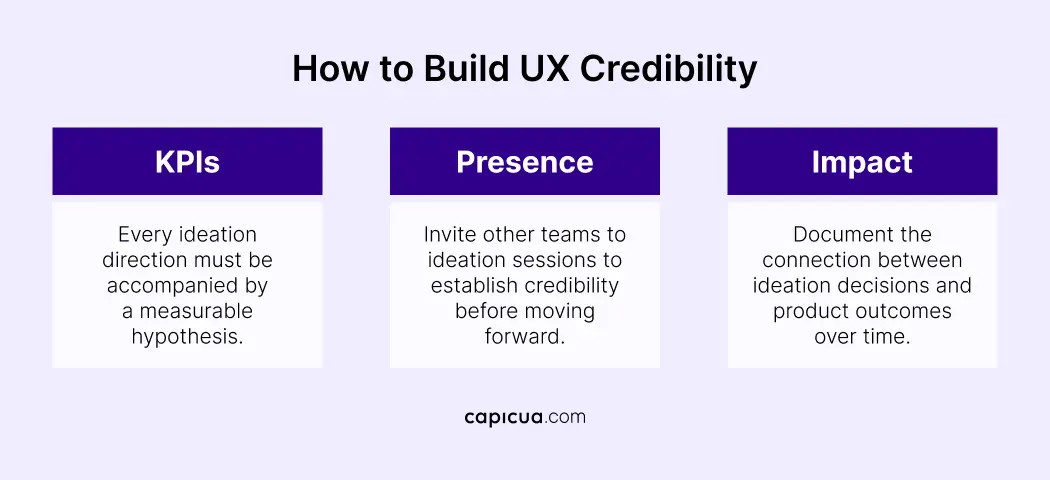
There are three practices that can accelerate UX credibility with non-design stakeholders:
- UX to KPIs: Every ideation direction should be accompanied by a measurable hypothesis. "If we restructure onboarding around this concept, we expect to reduce time-to-value by 20%" is a straighter forward statement than "We think this is a cleaner experience" is not.
- Stakeholders in sessions: Observers become advocates. When a Head of Sales watches the UX team run an ideation session grounded in customer interview data, credibility is established before the prototype is created.
- Post-launch impact: UX credibility compounds over time when teams document the connection between ideation decisions and product outcomes. A library of validated bets is the most powerful argument for continued UX investment.
According to McKinsey's Design Index research, design-led companies achieve 32% faster revenue growth and 56% higher returns to shareholders. Design-forward companies have made UX credibility a systemic practice.

Why UX Credibility is a Growth Lever
Forrester reports that every $1 invested in UX can return up to $100; IBM's Design Thinking reports reducing development and testing time by 33% and improving customer satisfaction; and Maze reports that 88% of users who have a poor experience will not return.
Most product leaders understand that bad UX hurts retention, but fewer recognize that high-credibility UX is a proactive driver of growth. In a SaaS context, these are churn signals built directly into the product design. UX credibility, built through rigorous ideation practice, creates compounding returns:
- Faster iteration: Teams that ideate rigorously need fewer revision rounds because the direction is validated before execution begins.
- Lower costs: Products that are immediately intuitive convert better and generate more organic referrals, and credible UX reduces the friction that kills word of mouth.
- Higher velocity: Enterprise buyers evaluate ease of adoption as a risk factor; hence, a product that demonstrates a rigorous process wins deals that a technically equivalent but poorly designed competitor loses.
- Reduced debt: Every UX decision made without rigor creates technical and experiential debt. Teams that invest in ideation spend less time firefighting legacy problems.
The State of UX research from UX Design Institute confirms that research, critical thinking, and strategic problem-solving are the most differentiating capabilities for design teams. Credible UX, anchored in serious ideation, is a business capability with measurable ROI.

How To Integrate UX Ideation into Your Product Operating Model
Running a great ideation session once is a skill; building it into your organization's rhythm is an advantage. If you're scaling from product-market fit toward Series B and beyond, you must know that the intuitive design practices that worked when the team was five people now need to become a repeatable process that works when the team is fifty. This shift means establishing:
Research-to-Ideation Pipelines
Events, not dates, should trigger ideation sessions. A round of user interviews revealing a new friction pattern should trigger an ideation session. A cohort analysis unexpectedly showing churn at a specific touchpoint should trigger a framing exercise. Connecting research outputs to ideation inputs creates an organization that can quickly respond to real issues rather than to internal roadmap pressure.

Cross-Functional Ideation Teams
The best ideation sessions include engineers, product managers, and customer success representatives alongside designers. This cross-functional composition surfaces constraints that purely design-led ideation misses and creates joint ownership of the direction, which speeds up subsequent development. When the engineer who attended the ideation session builds the prototype, alignment cost drops to near zero.
Ideation Documentation and Decision Logs
Ideation sessions should produce a short list of ideas with their rationale, and a "not now" list of ideas that were considered but deferred. This documentation rhythm turns ideation into an institutional asset that new team members can read to understand the product and that investors can use to see how the product team thinks. Reducing friction and enhancing satisfaction fastest requires making UX decisions visible across the organization.
Rigorous ideation is one of the clearest expressions of the Shaped Clarity™ framework in action. When ideation is grounded in real user signals, documented with honest rationale, and visible to the full organization, it creates the organizational clarity that turns product decisions into durable competitive advantages. Read more about our proprietary lens here.
Conclusion
User experience design ideation is the practice that defines the quality of everything that follows and whether credibility is earned or squandered. The frameworks are available, the research on ROI is unambiguous, and the patterns that make ideation repeatable are well understood. In the end, the product that earns user trust in six months of development is the one that spent the first three weeks asking better questions.
Ready to build a more credible UX? Get in touch with Capicua: contact us | send us an email | book a meeting.