


What happens when a sector with not so much structural change becomes one of the most actively disrupted markets? That is the situation with education and technology right now. A convergence of Artificial Intelligence, adaptive systems, and shifting workforce demands is forcing a rethink of how knowledge is built, validated, and delivered across all age groups and levels of learning.
The global edtech market was valued at approx $214B in 2025 and is on track to surpass $400B by 2030. What is shifting is the underlying logic of how learning products get built, sold, and retained: the assumptions that worked five years ago are all up for renegotiation. This article maps the intersection of education and technology across age groups and institutional levels, and what founders building digital learning products need to understand as they make bets in this space.

New Tech in Education Across Age Groups
The conversation about new tech in education often collapses everything into a single frame: K-12 classrooms and chatbots. The reality is more layered and more consequential across every stage of the learning lifecycle.
K-12 and EdTech
In K-12, 82% of US school districts now have at least one ongoing AI initiative, including adaptive testing or virtual tutoring. Finland leads Europe with 91% of public schools using AI for personalization. The shift in 2025 and 2026 is from pilots to embedded practice: AI is moving from "we have an AI tool" to "AI informs how we teach every lesson." At the same time, 60% of teachers report using AI for work, with 32% doing so at least weekly.

Higher Education and EdTech
Universities face a harder challenge: teaching with technology while also teaching about technology in ways that prepare graduates for a workforce being actively reorganized by AI. While the 2026 EDUCAUSE Top 10 report identifies technology literacy as a top strategic priority for every institution, 95% of college faculty also report fear about student overreliance on AI and diminished critical thinking.
Workforce and EdTech
According to Rest of World, Post-PMF edtech investments are flowing toward AI-powered tools that help organizations hire, cut costs, and teach workers new skills at scale. The World Economic Forum's Future of Jobs data consistently identifies data analysis, AI literacy, and digital marketing as the most in-demand employer skills, making corporate learning an open opportunity for founders with expertise in B2B motion.

Pros and Cons of Personalized Learning Technology
A 2025 randomized controlled trial published in Scientific Reports found that AI tutoring outperformed in-class active learning, with an effect size ranging from 0.73 to 1.3 standard deviations. These results rival some of the strongest educational interventions ever studied.
By 2025, 61% of edtech platforms offered AI-driven personalization, and over 65% of leading adaptive platforms had integrated LLM UIs for Socratic-style dialogue. Adaptive learning systems now account for 38% of total online instructional time in US high schools.
However, while embedding technology in education is often seen as futuristic, there are also disadvantages that tech founders and leaders must consider from the outset to build educational technology that truly delivers a positive impact.
A known disadvantage of edtech is that digital environments also offer easy access to non-educational content, such as social media, games, and videos, which leads a significant portion of students to be distracted by their own devices during lessons.
Overreliance on software for spelling, calculations, and generative writing can also prevent students from developing core cognitive and problem-solving abilities independently.
EdTech is frequently targeted by cyberattacks and data breaches, as noted in a Stanford University report, and inequitable access to high-speed internet and updated devices can create a stark gap between students from different socioeconomic backgrounds.
To overcome these disadvantages and build a truly impactful edtech product, tech founders must move away from generic SaaS blueprints and adopt pedagogy-first design, strict data minimization, and frictionless classroom integration.

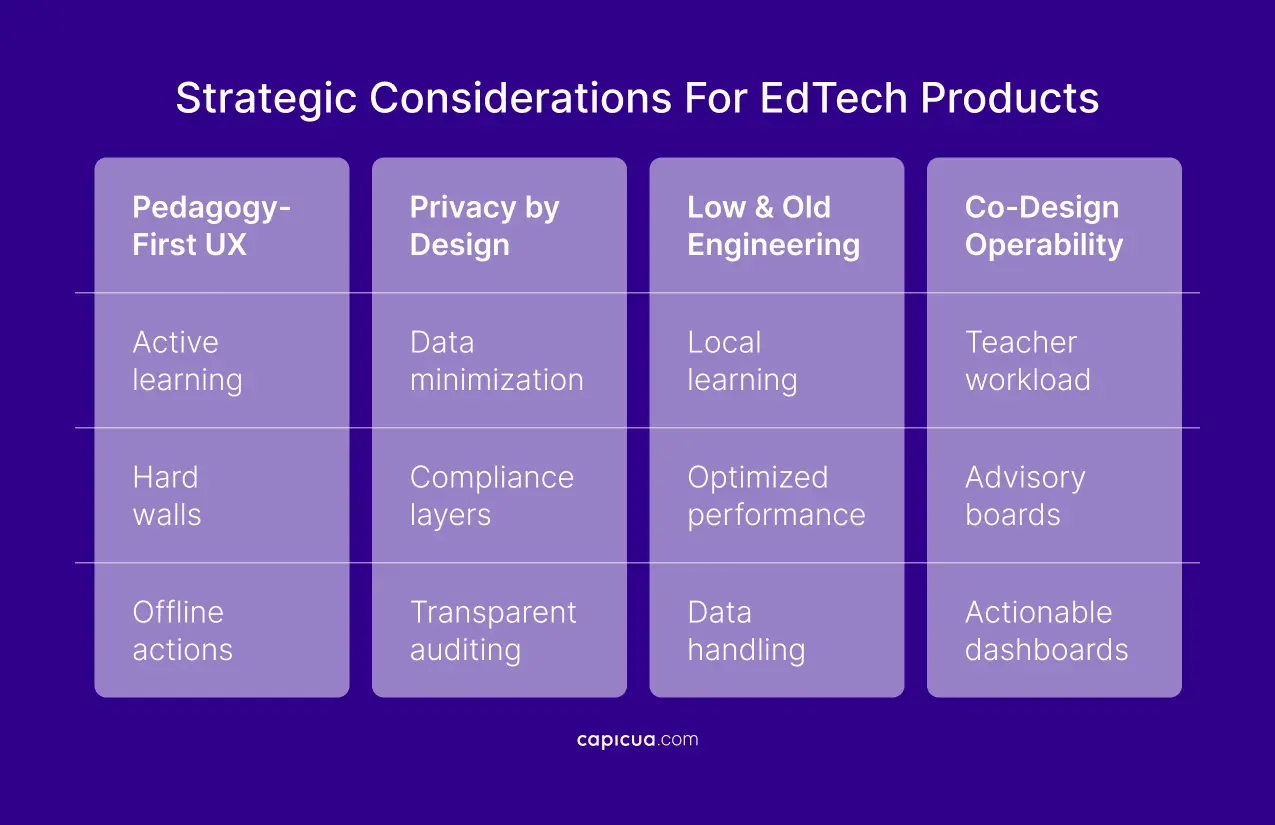
Strategic Considerations for EdTech Products
- Pedagogy-First UX: Instead of relying on addictive loops like endless scrolling or unneeded alerts, design clean workspaces that promote deep, focused thought.
- Active learning: Incorporate real-time problem-solving, microquizzes and interactive exercises to keep students as active participants.
- Hard walls: Design student interfaces to cleanly block out non-educational tabs, pop-ups, and notifications during a live lesson.
- Offline actions: Build products that prompt students to write on paper, conduct offline experiments, or talk directly with classmates, keeping software as a guide.
- Privacy by Design: Data collection should not be a monetization strategy, and security must be integrated directly into your software architecture from day one.
- Data minimization: Only gather the exact data required to run the learning module, deliberately ignoring personal student details you do not need.
- Compliance layers: Build systems that natively comply with strict global and regional regulations, such as Illinois SOPPA and NY Education Law 2-d.
- Transparent auditing: Give school administrators clear dashboards that show exactly where student data is held, encrypted, and automatically deleted.
- Low and Old Engineering: Assuming every student has a new tablet and fast Wi-Fi excludes the communities that need innovation the most.
- Local learning: Design your software to download lesson files locally and sync progress once they find a signal, so students' work doesn't depend on an active connection.
- Optimized performance: Keep code lightweight and highly responsive on budget hardware, Chromebooks, and older smartphones.
- Data consumption: Compress visual media and use text-based alternatives to prevent low-income students from draining expensive cellular data plans.
- Co-Design Interoperability: Software built without input from actual educators rarely lasts in a real classroom; partner with teachers to make the most out of your product.
- Teacher workload: Use universal integration standards such as LTI or OneRoster to feed data directly into tools the school already uses, such as Canvas or Classroom.
- Advisory boards: Include educators in early design loops to understand actual classroom constraints, such as short lesson times, audio issues, or poor connectivity.
- Actionable dashboards: Focus teacher screens on high-level trends that quickly pinpoint which students need help, rather than raw, unorganized data points.
21st Century Learning Systems and Digital Product Signal
The promise of 21st century learning systems is well documented, with critical thinking, collaboration, data literacy, and adaptive problem-solving among the competencies employers cite in every future-of-work survey.
Nonetheless, the implementation of gap is equally well documented, with several studies identifying teacher training, institutional support, and content quality as the most persistent blockers to technology integration, regardless of device access.
The "digital use divide" is more telling than the access divide. Students in under-resourced schools increasingly have devices, but the pedagogical depth of their use varies sharply along socioeconomic lines. A Brookings analysis warns that without deliberate equity design, AI tools may accelerate existing inequalities rather than reduce them.
Products that only perform well in well-resourced environments are capping their TAM and building fragility into their adoption story. On the other hand, the most compelling educational technology innovation is happening at the intersection of performance and accessibility: tools that adapt their intelligence without requiring high-bandwidth connections, sophisticated teacher training, or expensive hardware cycles.

The Future Education Technology
Global EdTech investment peaked at $16.7B in 2021, then fell below $3B by 2025, with the Rest of World reporting a structural collapse in K-12 startup funding as the post-pandemic tailwind evaporated. What survived were products with three traits: measurable outcomes, institutional adoption pathways, and clear unit economics.
The pressure on future education technology is toward accountability. School districts and enterprises are simultaneously cutting budgets and investing in tools that can demonstrate impact on retention rates, skill acquisition velocity, and assessment scores. As OpenFieldX frames it, the sector is in an "efficacy reckoning": products that cannot demonstrate causality between their interventions and learning outcomes are the first to be cut.
The innovation focused education products attracting investment in 2026 share a common architecture: AI-powered personalization tied to verifiable skill outcomes, B2B or institutional motion with predictable revenue, and equity design embedded in the product.

Technologies in Education: Where Product Meets Pedagogy
The most common failure mode for digital product teams entering education is treating pedagogy as a compliance layer, something to check with an advisory board and then move past. The product leaders who build lasting technologies in education treat pedagogy as the product constraint shaping every architectural decision.
This scope shows up in concrete tradeoffs. Should the system surface the answer or scaffold the thinking process? Should engagement metrics weight time-on-task or demonstrated comprehension? Should the AI intervene proactively or wait for the learner to signal confusion? These are pedagogical positions with downstream consequences for outcomes, retention, and institutional credibility.
The teams winning in this space invest in understanding the implementation context as thoroughly as the user needs. As MindK documents, the vendor-school reality gap is widening. Products built for sophisticated technical environments often do not align with where institutions actually are, and closing that gap is a product strategy problem.
Where the technical capability is present, the market is large, and the failure mode is not building the wrong product, but building without a grounded understanding of what the user actually needs to learn, Shaped Clarity™ does its best, turning signals into insights that keep teams building toward outcomes. Learn more about Shaped Clarity here!
Conclusion
Education and technology are converging toward a richer set of questions about what learning is for, who it serves, and how institutions, products, and individuals will share the work of making it real. The opportunity is to build adaptive, evidence-grounded, and equitable-by-design 21st century learning systems. Understand both the pedagogy and the product dynamics, and you'll write the most consequential chapters of the EdTech book.
If you're looking to leverage technology to lead the future of education, contact Capicua: get in touch | send us an email | schedule a call