What if the biggest driver of your SaaS revenue growth was how precisely you understand who your product is for? Founders and product leaders at scaling B2B SaaS often discover the hard way that pipelines can look healthy while revenue gets harder to sustain.
The root cause, more often than not, traces back to a blurry customer profile: a loosely defined picture of who the product serves, what they truly value, and why they stay. And this terrain is where retention is won or lost.
In this article, we explore what a customer profile really means in the context of SaaS product development, how it connects directly to your customer retention metrics, and what it takes to build a profile sharp enough to support sustainable, profitable growth.

What a Customer Profile Really Means for SaaS Retention
A customer profile is a structured, evidence-based representation of the customer segment most likely to derive lasting value from your product and, as a consequence, to remain a paying customer long enough to justify the cost of acquiring them.
In SaaS, this is often conflated with a persona: demographic attributes, job titles and company size. And yes, those matter, but they are just the starting point. A customer profile built for retention goes deeper, answering: what business problem does this customer need solved urgently enough to keep paying for a solution? What does success look like from their perspective? What does their behavior look like when they are getting value?

According to research cited by Bain & Company, a 5% increase in customer retention can boost profits by 25-95%. This is a wide range, but that's because the impact depends heavily on how well-aligned your retained customers are with your product's core value proposition.
Retain the wrong customers through discounts or support heroics, and you recover margin without building compounding growth. Retain the right customers—those whose success is structurally enabled by your product—and every retention gain compounds. The sharpness of your customer profile determines which side of that range you land on.
A customer profile built for retention goes beyond demographics: it maps the conditions under which customers derive sustained value from your product, and those conditions directly predict churn or loyalty.
How Customer Retention Metrics Reveal Profile Fit
Customer retention metrics are diagnostic tools, and each metric in your stack will tell you something specific about how well your customer profile is working—whether you are attracting the right accounts, activating them effectively, and delivering consistent value. The most critical customer retention metrics for SaaS organizations include:
- Net Revenue Retention (NRR) measures the percentage of recurring revenue retained from existing customers over a period, including expansion, contraction, and churn. An NRR above 100% means your existing customer base is growing on its own.
- Gross Revenue Retention (GRR) strips out expansion revenue to show pure retention. A declining GRR indicates that your core customer profile is churning, even if upsells are masking the problem.
- Customer Lifetime Value (CLV) quantifies the total revenue a customer generates across their relationship with your product. A healthy LTV:CAC ratio for B2B SaaS often sits at 3:1 or higher. Below that threshold, acquisition is outpacing the value being retained.
- Churn Rate remains the most immediate signal of profile misalignment. A monthly churn rate above 3.5% for B2B SaaS indicates that a meaningful portion of acquired customers are a poor fit for the product's current state.
Together, these metrics form a retention dashboard that reflects the quality of your customer profile as much as the quality of your product. The pattern matters: when NRR is strong, but GRR is soft, you are likely retaining revenue by expanding into a small cohort of ideal accounts while a larger cohort quietly churns. That is a profile concentration problem, not a growth success.
Customer retention metrics are profile diagnostics that reveal a different dimension of whether your product is reaching, activating, and sustaining those it was built for.
Why Misaligned Customer Profiles Drive Churn
At Series A post-PMF SaaS, growth seems strong, churn seems manageable, and teams feel confident. By Series B, however, churn has crept up, the support queue has grown, and the roadmap is fragmented, pulled in competing directions by conflicting needs. The customer profile that drove early traction has been diluted. In the urgency to grow, the sales motion has drifted outside the original profile, toward accounts that buy but do not stay.
Acquiring a new customer costs 5-25 times as much as retaining an existing one. When profile misalignment forces re-acquisition to compensate for churn, you are funding a structurally inefficient growth cycle. Companies with a defined and maintained ideal customer profile achieve 36% higher customer retention rates, 38% higher sales win rates, and a 208% increase in marketing revenue when sales and marketing are aligned around it.

The mechanics of profile drift are also predictable. Sales incentives reward new logos over fit quality, customer success is stretched thin across heterogeneous accounts, and decisions are pulled toward the loudest voices, which are rarely the most representative. And gradually, the product moves away from the value proposition that made it compelling to its best customers in the first place.
Addressing this requires a deliberate return to the signal. What do your longest-retaining, highest-expanding customers have in common? Those patterns are your customer profile. Building around them is the mechanism for sustainable growth.
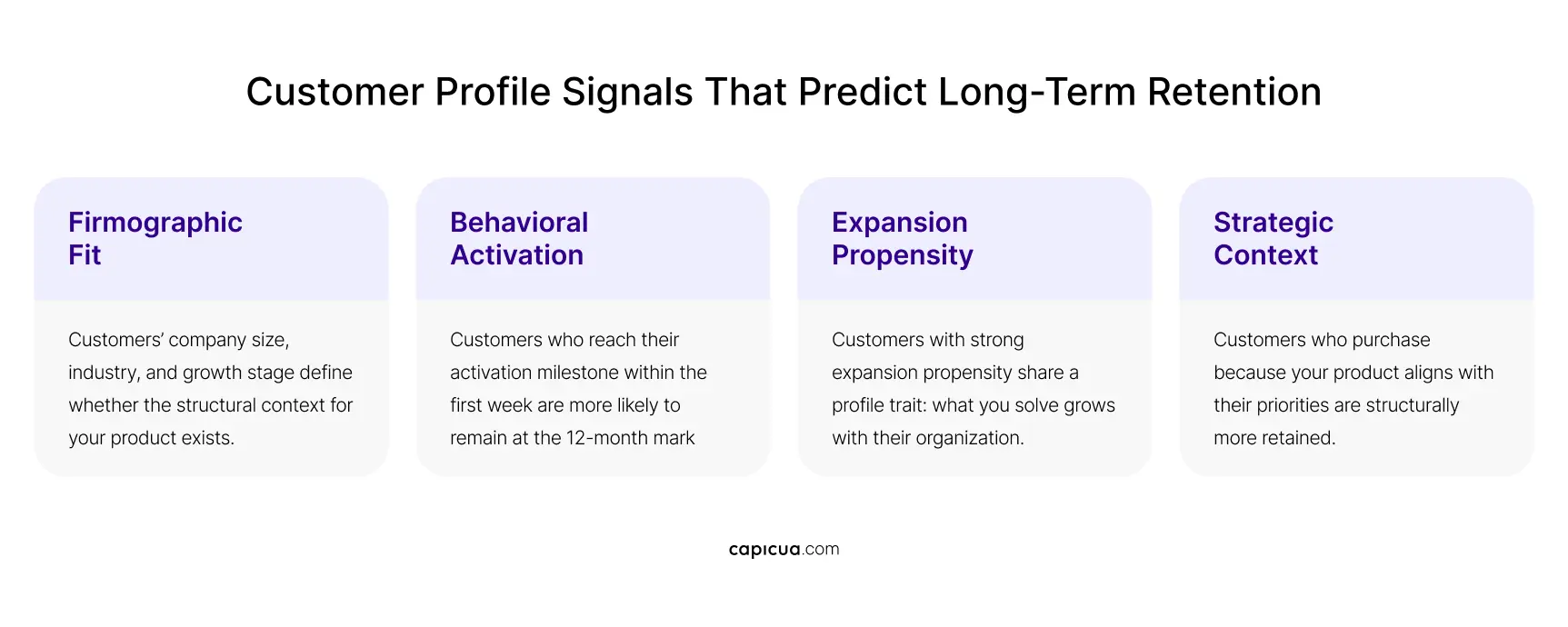
Customer Profile Attributes That Predict Long-Term Retention
Not all customer profile attributes carry equal predictive weight for retention. Understanding which signals matter most, and building them into your acquisition, onboarding, and success motions, is how product leaders translate profile clarity into measurable retention gains. The attributes that most reliably predict long-term SaaS retention fall into three categories:
- Firmographic fit: Company size, industry, and growth stage define whether the structural context for your product exists. According to research, enterprise SaaS experiences a monthly churn of 0.5-1%, while SMB/self-serve sees 3-7% monthly churn. This gap reflects the support resources, integration depth, and switching costs at each tier.
- Behavioral activation: The fastest predictor of retention is what they do in the first 30 days. Customers who reach their activation milestone within the first week are substantially more likely to remain at the 12-month mark, and a SaaS retention rate of 40% or higher is a reliable signal of product-market fit.
- Expansion propensity: Customers most likely to stay are also most likely to expand. In fact, expansion revenue now accounts for 40-50% of new ARR at high-performing SaaS companies. Customers with strong expansion propensity share a profile trait: the problem your product solves grows as their organization grows.
- Strategic context: Customers who purchase because your product aligns with a board-level or organizational priority are structurally more retained than customers who buy for convenience or curiosity. Strategic purchases survive budget cycles, leadership changes, and competitive pitches in ways that tactical purchases do not.
Building these attributes into your customer profile transforms it into a scoring system that sales can qualify against, success can use to prioritize, and product can use to make roadmap bets. Furthermore, leadership can use it to evaluate whether the growth motion is building toward sustainable revenue or diluting it.
The customer profile attributes that most predict retention are activation speed, firmographic fit, expansion propensity, and strategic context. Each maps directly to a measurable customer retention metric.
Build a Retention-Grade SaaS Customer Profile
The process of building a retention-grade customer profile starts with your existing customer base and works backward from the outcomes that matter: who stayed, who expanded, and who churned. Here is the framework for building a customer profile that supports sustainable SaaS growth:
- Customer base: Pull your full customer list and segment them by annual churn rate by cohort, CLV, CAC payback period, and NRR. The accounts that last the longest and grow fastest share common traits, and those traits are your profile.
- Behavioral signals: What did your best-retained customers do in their first 30 days that churned customers did not? Time-to-first-value, feature adoption sequences, and usage frequency at day 7, 14, and 30 are the signals that predict 12-month retention with the highest precision.
- Strategic context: Interview or survey your highest-CLV customers. What organizational priority does your product serve? Who championed the purchase internally? These answers reveal the contextual factors that enable your product to succeed.
- Incoming accounts: Turn the profile into a qualification rubric, weighting the attributes with the strongest predictive power, in sales qualification, onboarding triage, and customer success prioritization.
- Refresh profiles: A customer profile is not a static document, and four triggers warrant a profile refresh: churn rate deviation from the cohort baseline, win-rate compression, pricing tier mix shift, and category maturity change.
Companies allocating their product roadmap toward retention and expansion features—approximately 40% expansion, 30% retention, 30% acquisition—systematically outperform those that default to new-feature investment as the primary growth lever. Your customer profile is the input that makes that allocation possible: you can only prioritize retention features for the right customers when you know precisely who they are.

Customer profile clarity is an ongoing operating discipline that keeps product decisions, sales motions, and success investments calibrated around the customers most likely to generate sustainable value. Shaped Clarity™ helps teams act on growth signals without losing sight of who the product is genuinely built for. When clarity is present, retention becomes a leading indicator of product-market alignment.
Conclusion
Customer retention improves when the product consistently reaches customers for whom it was genuinely built, activates them quickly, and creates conditions for expansion. The customer retention metrics your board reviews each quarter will ultimately reflect the quality of your profile, and are achievable through the disciplined, signal-based work of knowing your customer well enough to build for them with confidence.
If you're looking to build the customer profile that drives measurable retention and sustainable growth, get in touch with Capicua: contact us | send us an email | book a call.