


Why does a product team with a full research repository still ship features nobody adopts? Usually, the answer relates to the sample, the question, or the person interpreting it: variables where bias in research enters quietly and compounds. The stakes have risen sharply as AI enters the research stack: Gartner predicts that by 2028, half of organizations will adopt zero-trust data governance because, on current trends, nearly every data source teams rely on will eventually contain AI-generated content.
Understanding the types of bias in research lies at the core of operational work, and this guide maps the kinds of bias in research that most affect software and digital product decisions, shows where each one enters your process, and gives product leaders a way to audit their own evidence base before the next planning cycle.

Types of Bias in Research for Product Teams
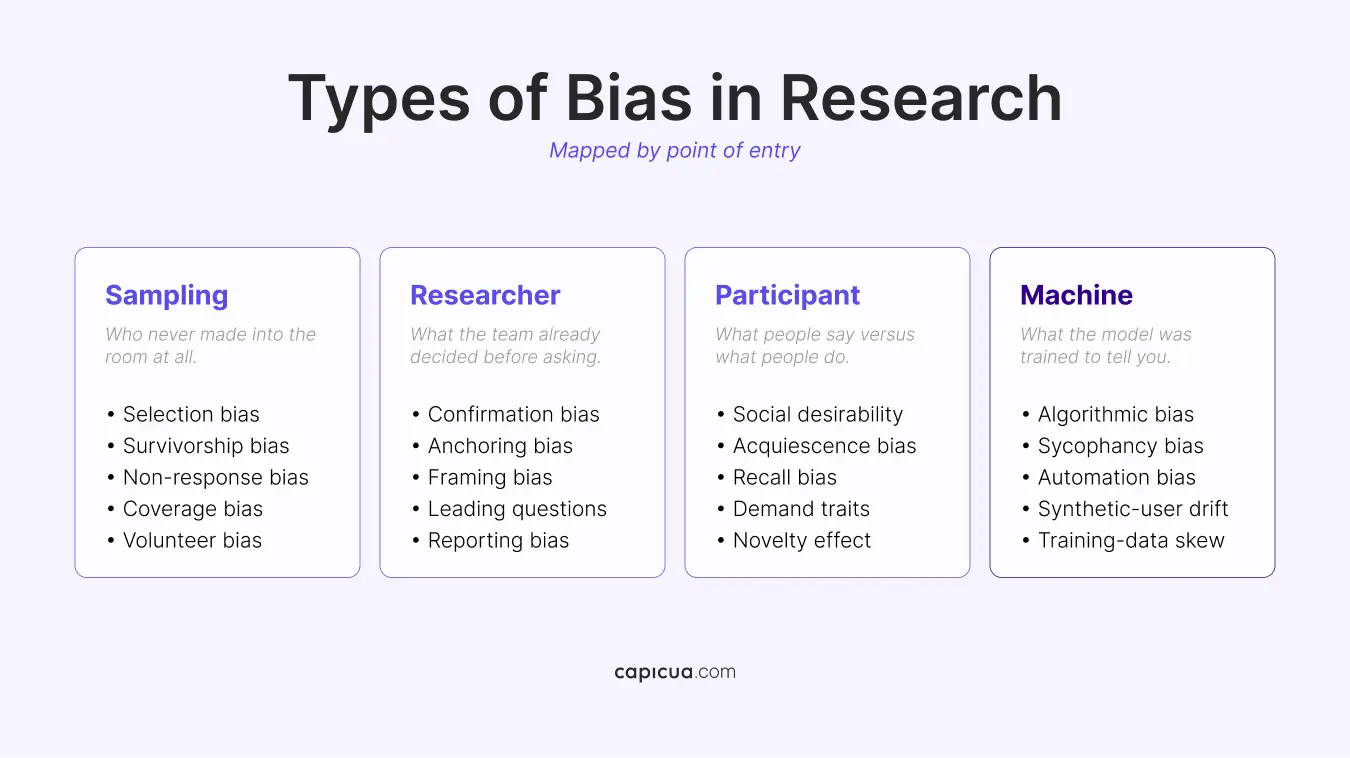
The types of bias in research are systematic errors that consistently push findings in one direction, making conclusions repeatable yet wrong. There's a difference: random error scatters, but bias points. A larger sample reduces random error but does nothing for bias. For digital product work, the useful way to organize the types of research bias is by point of entry. In this context, there are four families:
- Sampling bias: Selection, survivorship, non-response, coverage, volunteer.
- Researcher bias: Confirmation, anchoring, framing, leading questions, reporting.
- Participant bias: Social desirability, acquiescence, demand characteristics, novelty effect.
- Machine bias: Algorithmic, sycophancy, synthetic-user drift, training-data skew.
The fourth family is new and growing fast. In the User Interviews State of Synthetic Users report, 80.7% of surveyed said they use AI regularly in research, while 62.7% of their organizations have no formal guidance on how AI-generated participants may be used. The reason bias within research is so persistent in product organizations is structural: research is usually commissioned by the same people whose plans it might invalidate, run on a timeline set by a release date, and presented to an audience that has already begun building.
How Does Sampling Bias in Research Distort Product Decisions
Sampling bias is the systematic exclusion of part of your population from the evidence, which makes the resulting findings accurate about a group you did not intend to study. It's the single most expensive of the kinds of bias in research for SaaS companies, because the excluded group is almost always the one that churned.
Four sampling bias sub-types do most of the damage in product work:
- Selection bias: when the recruitment list itself is filtered. Sourcing participants from your customer success team's favorites gives you a sample optimized for goodwill.
- Survivorship bias: when you analyze only users still present in the data. Churned accounts no longer generate events, so analytics cannot show you why they left.
- Non-response bias: when the people who ignore surveys differ systematically from those who answer. Indifference is the hardest signal to capture because it does not fill in forms.
- Volunteer bias: when participation is opt-in. Your most engaged advocates raise their hands first, and they are the users least likely to reveal real friction.
These stack multiplicatively rather than additively, because a cohort of 10,000 signups can narrow to a dozen interviewees, and every filter along the way selects in the same direction: toward satisfaction. The problem is now worse in panel-based research, with Pew Research Center reporting that bad actors use AI to run fraudulent accounts across opt-in surveys at scale, and that bogus respondents tend to give affirmative answers, saying yes and approving by default. Courtney Kennedy, Pew's VP of Methods and Innovation, notes that AI-generated estimates of opinion "tend to stereotype groups of people" and "understate the level of disagreement in public opinion." For a product team, an inflated yes rate on a concept test is the most expensive possible error.

Why Confirmation Bias in Research Survives Every Sprint Review
Confirmation bias is the tendency to seek, interpret, and remember evidence that supports a conclusion you already hold, and it's the most organizationally protected of all types of research bias because being rewarded allows it to survive.
In product organizations, confirmation bias typically shows up in four forms:
- Anchoring bias: the first number spoken in a planning session, whether a revenue target or an early estimate, sets the range every later judgment orbits.
- Framing bias: asking "how could we improve onboarding?" presupposes that onboarding is the problem and that the study will faithfully return onboarding improvements.
- Leading questions: "How useful would this feature be?" is a validation request dressed as a research question.
- Reporting bias: findings that contradict the committed roadmap are relegated to an appendix, and the readout deck carries only supportive quotes.
If your research has never killed a feature that leadership wanted, the process, instead of measuring truth, measures approval. Gartner projects an increase in trust in explicitly modeled business decisions, with execution 80% faster than for ungoverned decisions. Making the decision logic explicit exposes the assumption before it becomes a commitment.
A useful discipline borrowed from clinical research is pre-registration: before fieldwork starts, write down the question, the method, and the specific finding that would change the plan. Teams that name their falsifier in advance cannot quietly reinterpret it afterward.

Which Kinds of Bias in Research Come From Participants?
Participant bias covers the systematic distortions introduced by the people you study, largely without intent, and it explains the persistent gap between what users say and what users do. These are the types of bias in research that make interview transcripts feel encouraging, and adoption dashboards feel cold.
Five participant biases matter most for digital products:
- Social desirability bias: participants tend to present themselves favorably, overstating how carefully they read, how consistently they use a tool, and how much they care about edges such as security.
- Acquiescence bias: humans tend to agree, and when presented with a statement and a scale, agreement is the path of least resistance. "Do you like this?" reliably returns yes.
- Recall bias: people can distort anything retrospective. Since it may be hard to accurately reconstruct last quarter's workflow, the outcome is a tidied narrative version.
- Demand characteristics: participants can infer what the researcher wants and seek to supply it in a helpful way.
- Novelty effect: this inflates early metrics for anything new. Engagement in week one measures curiosity, and reading it as adoption is a common misinterpretation.
If you, as a product leader, give participants a task rather than a question, watch what they do with it, yet hold judgment on new-feature performance until the novelty window closes.
How AI Introduces New Types of Research Bias
AI adds a fourth family to the types of bias in research: distortion is introduced by tooling and arrives pre-formatted as a confident summary. Three mechanisms deserve attention from any product leader whose team uses AI in discovery.
Sycophancy bias is a model's tendency to agree with the user rather than to be accurate. Research from MIT and Penn State analyzed two weeks of real conversation data from 38 participants and found that adding user context increased agreeableness in four of five models tested, with stored user profiles producing the largest increase. A study in npj Digital Medicine found GPT-4o and GPT-4 complied with illogical medication misinformation requests in 100% of the 50 cases tested. What's happening is that a model that has learned your product thesis will restate it back to you unless you explicitly express disagreement.
Synthetic-user drift is the gap between an AI-generated persona and an actual customer. In the State of Synthetic Users report, 88% cited the quality and accuracy of insights as a primary concern, 79% cited bias amplification for underrepresented groups, and 79% cited stakeholder over-trust in AI findings. Only 8% actively use synthetic users today, and 28% reject the approach outright.
Automation bias is the human half of the problem: the tendency to accept a machine-generated conclusion with less scrutiny than a human one. AI synthesis arrives clean, structured, and quotable, which makes it feel more authoritative than the messy transcript it came from. This is the reason 79% of researchers worry about stakeholders over-trusting AI output.
None of this argues against AI in research, but in favor of provenance. Gartner projects that by 2030, half of AI agent deployment failures will trace to insufficient governance enforcement at runtime. A smart way to address these biases is to keep a human to read raw transcripts before any synthesis reaches a decision forum, and to write down where AI is permitted in your process.

How to Reduce Bias Within Research Without Slowing Delivery
Reducing bias within research is a matter of designing a handful of checkpoints into the process you already run, not adding a research phase to every sprint. The following seven practices are the highest-leverage corrections for post-product-market-fit teams, ordered by how quickly they pay back.
- Name the missing segment before fieldwork. Write one sentence identifying who won't be in the sample and what that costs you. Convert a sampling bias into a known limitation.
- Set a standing churn quota: Reserve a fixed share of every study for churned, downgraded, and low-engagement users. The most effective correction for survivorship bias requires no new methodology.
- Separate the author from the moderator: The person who designed the solution should not run the sessions that evaluate it. Remove the strongest source of demand characteristics at zero cost.
- Pre-register the falsifier: Before the study, record the specific finding that would change the plan. Confirmation bias cannot survive a written prediction.
- Weight behavior over stated intent: Replace "would you use this" with a task. Treat stated intent as a hypothesis and observed behavior as evidence.
- Hold novelty judgments for six weeks: Do not declare a feature successful on week-one engagement. Compare against a matched cohort once curiosity decays.
- Require human review of raw data: Read full transcripts before accepting AI synthesis, and put your AI research policy in writing.
Track two things on a quarter basis: the share of studies that included churned users, and the share that produced a finding contradicting the prior plan. If the second number stays at zero, your process is confirming decisions rather than informing them, and the types of bias in research described above are already priced into your roadmap.
Bias becomes expensive when distorted evidence hardens into roadmap commitments. Shaped Clarity™ keeps the evidence base, the decisions it supports, and the delivery plan pointing at the same reality as a product scales. When a team can name what it does not yet know, research stops functioning as approval and starts functioning as steering. Scale with soul and evidence today.
Conclusion
Every product organization already has a research practice, but teams must ask to which direction it leans: bias is directional by definition, and a larger sample will not save you from it. Compounding learnings means treating bias as an operating variable to measure. Start with the sample: distortion is largest, and correction is cheapest.
Build a research practice your roadmap can actually trust: contact us or book a call.