


The SCAMPER method is a seven-prompt checklist that forces teams to question something it already owns: a feature, a pricing model, an onboarding flow, a product line. Each letter applies a different constraint, and constraints are what separate SCAMPER creative thinking from a whiteboard full of adjectives.
43% of failed startups cite poor product-market fit as a cause of death, according to CB Insights' "Why Startups Fail" analysis of shutdown post-mortems. For founders and product leaders running post-PMF companies, the SCAMPER technique produces options in an hour that a roadmap workshop rarely produces in a quarter.
This guide covers what the SCAMPER methodology is, how the seven prompts translate to software and digital products, how to run a session that ends in decisions, and where the SCAMPER framework stops being useful.

What is the SCAMPER Method in Product Development?
The SCAMPER method is a structured ideation framework that generates new product options by applying seven fixed prompts to something that already exists: Substitute, Combine, Adapt, Modify, Put to another use, Eliminate, and Reverse. The goal is to force teams to deform what they have until a better version appears systematically.
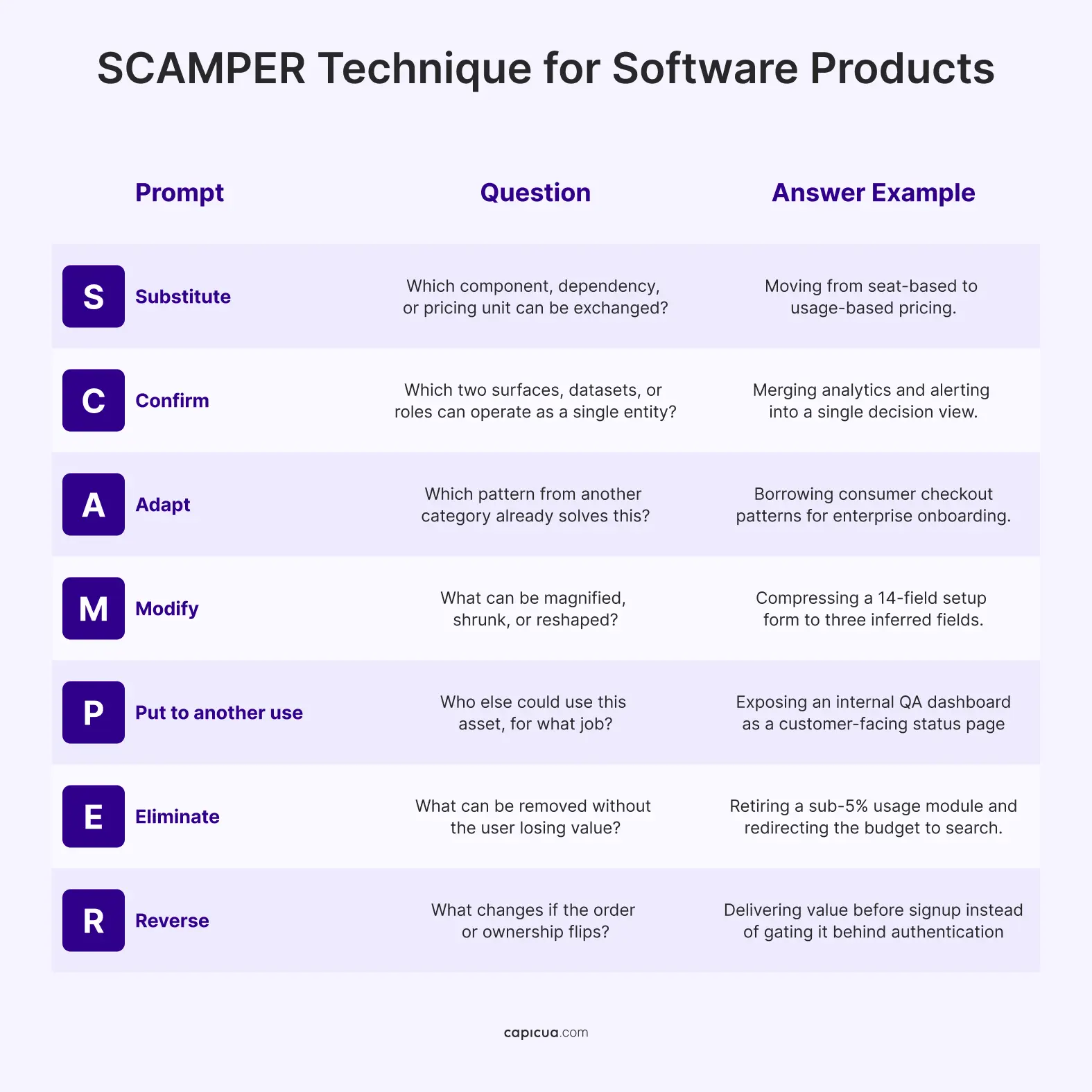
- S - Substitute: What component, step, rule, or assumption can be swapped out?
- C - Combine: What two features, teams, or datasets can merge into one surface?
- A - Adapt: What pattern from another category already solves this problem?
- M - Modify: What can be magnified, minimized, or reshaped?
- P - Put to another use: Who else could use this asset, and for what job?
- E - Eliminate: What can be removed without the user noticing a loss?
- R - Reverse: What happens if the sequence or the roles flip?
IMD traces the framework to Alex Osborn's 1953 book Applied Imagination, which introduced an early set of idea-spurring questions, and to Bob Eberle, who formalized the acronym in 1971. Because the method's mechanics are cognitive, and not technological, the SCAMPER framework has not substantially changed over its more than seventy years of use across industrial design, service design, and software.
SCAMPER brainstorming forces divergence on a specific object under a specific constraint, then converges on what survives contact with evidence. It sits upstream of prioritization and downstream of discovery. It doesn't tell teams what customers want: it tells them what their options actually are once they stop treating the current architecture as fixed.
Three properties make SCAMPER useful at scale:
- Object-bound: SCAMPER requires a subject. "Our product" produces noise, but "The first session after signup" produces decisions.
- Exhaustive by design: Its seven prompts, applied in order, cover addition, subtraction, recombination, and inversion.
- Legible to non-designers: Engineers, sales leads, and finance can all answer "what could we remove here?" without training.
How Does the SCAMPER Technique Work for Software Products?
The SCAMPER technique works for software by treating a digital product as a system of separable components, each of which can be swapped, merged, resized, repurposed, removed, or inverted. The objects prompts act on become flows, data models, pricing units, permissions, and integrations. Most published SCAMPER guidance still uses physical examples, which is why product teams dismiss it as a design-school artifact, yet the SCAMPER framework can also be operational for B2B roadmaps.
In mature products, Eliminate is the one most teams skip, because removing shipped functionality feels like admitting a mistake, and it's usually the prompt with the highest margin impact. On the other hand, Reverse produces category-level moves because inverting the sequence or ownership changes the business model rather than the interface. When run in order, the seven SCAMPER questions typically yield between 20 and 40 raw ideas on a single object in under an hour, widening the distribution of ideas with better tails.
SCAMPER Brainstorming vs Open Idea Sessions
SCAMPER brainstorming outperforms open-ended sessions because it removes the two failure modes that make free-form ideation unreliable: anchoring on the first plausible idea, and social convergence toward whoever speaks with the most confidence. A prompt sequence gives every participant the same starting constraint simultaneously.
In the 2026 Survey of the Product Management Profession, which polled 677 product professionals across 40 countries, 60% reported frequent firefighting and unplanned work, 71% said they do not spend enough time with customers, and only 25% of the working week goes to strategic activity. Harvard's David Ricketts makes the same argument in Harvard Online's analysis of why brainstorming fails: teams treat brainstorming as a standalone tool rather than one instrument inside a repeatable innovation process. SCAMPER creative thinking works because it's a small, closed loop with clear entry and exit conditions.
Three mechanisms explain the performance difference:
- Forced divergence: Each letter is a different search direction; a team cannot converge early without visibly skipping a prompt.
- Equal-footing participation: Constraints lower the cost of contributing, and quiet specialists answer a narrow question more readily than an open one.
- Built-in coverage audit: At the end of the session, the seven prompts work as a checklist, and gaps are visible, which is rarely the case with a free-form board.

How to Run a SCAMPER Workshop That Ends in Decisions
A SCAMPER template turns the framework into a meeting with an output. The run of show below fits in 90 minutes with a cross-functional group of five to eight people, and it ends with a ranked shortlist rather than a photograph of a wall.
- Name the object, precisely (5 minutes): One flow, one pricing model, one integration. If the subject needs a paragraph to describe, it's too big for one session.
- State the metric you own (5 minutes). Activation rate, expansion revenue, support ticket volume. Every idea is judged against this number, which prevents the session from drifting into matters of taste.
- Run each prompt for six minutes, silently first (45 minutes). Individual writing before group discussion. This is the single highest-leverage rule, because it stops the loudest voice from setting the frame.
- Score every idea on three axes (20 minutes). Impact on the stated metric, build effort, and evidence already in hand. Weight impact double. Ideas that score high on impact and low on evidence become research questions rather than backlog items.
- Cut to five and assign owners (15 minutes). Anything unowned at the end of the meeting will not survive the week.
There are two disciplines that separate teams that get value from this and teams that run it once and abandon it. The first discipline is separating generation from judgment. Scoring during generation immediately collapses the idea distribution; keep them in different phases with a visible break between them. The second discipline is routing the output correctly: a SCAMPER session produces candidates, and candidates need a prioritization pass. Capicua's guide to the MoSCoW method for product prioritization covers the handoff, and the ideas that score high on impact but thin on evidence belong in product and UX discovery before they consume engineering capacity.

How to Use the SCAMPER Framework With AI Tools
The SCAMPER framework pairs well with large language models because its prompts are already machine-legible instructions. Teams can feed a model their product description and ask it to run the SCAMPER methodology, and get raw coverage in seconds. However, the judgment about which options are real stays with the team.
The 2026 Product Focus survey found that 69% of product professionals use AI frequently or very frequently, and 97% report improved personal productivity. On the other hand, only 64% report improved product outcomes, and 85% say they validate AI output against their own expertise before acting on it. Productivity gains are arriving faster than outcome gains.
In a study published in Scientific Reports comparing roughly 100,000 human participants with leading language models, GPT-4 surpassed the average human on a divergent-thinking task, while no tested model exceeded the mean of the top half of human respondents. A model raises the floor of an ideation session, but teams' thinkers still define the ceiling.
McKinsey's 2026 assessment of responsible AI maturity, covering roughly 500 organizations, found that only about 30% reach a maturity level of 3 or higher in strategy and governance, and that organizations with explicit ownership of responsible AI score 2.6 on the maturity scale, compared with 1.8 for those without clear accountability. The pattern repeats in ideation; and structure and ownership are what convert model output into product decisions.
A workable division of labor looks like this:
- Model does breadth: Run all 7 prompts, generate 40 candidates and cluster duplicates.
- Team does depth: Apply domain constraints the model cannot see: contract terms, migration cost, support load, sales motion.
- Evidence does the deciding: Score against the metric named at the start of the session, using data you actually hold.
Where the SCAMPER Methodology Falls Short
The SCAMPER methodology has three real limits, and knowing them is what keeps it from becoming another ritual that consumes a morning.
- It requires an existing object: SCAMPER modifies, it doesn't originate. For a genuinely new category or a zero-to-one bet, the framework has nothing to act on, and a jobs-to-be-done or research-led approach fits better.
- It generates volume without validation: Seven prompts reliably produce 20 to 40 candidates, and volume creates the risk of mistaking a full board for progress. The binding constraint for most companies is evidence, not imagination.
- It's blind to strategic context: SCAMPER can generate a brilliant idea that contradicts your positioning. The Product Focus data is instructive here: 33% of product professionals report a weak or missing company strategy and 34% have no clear primary metric of accountability. Running an ideation framework inside that vacuum can multiply the drift.
Gartner predicts that by 2028, 90% of B2B buying will be intermediated by AI agents, pushing more than USD 15 trillion of spend through machine evaluation. Products optimized for human browsing will be evaluated on different terms; Reverse and Adapt become strategic prompts rather than creative exercises when the buyer stops being a person.
Ideation frameworks fail at the handoff between a good idea and a funded decision. Shaped Clarity™ is Capicua's operating framework for that handoff, connecting validation signals to prioritization so that the options a team generates are judged against evidence rather than enthusiasm. Discover more about Shaped Clarity here.
Conclusion
The SCAMPER method and its seven prompts have outlasted seventy years of methodology churn because it solves a problem that tooling does not touch: teams under delivery pressure stop searching before they have found their real options. Structure restores the search without adding process weight. Run the seven prompts on one precise object this quarter, score what comes out, and route the survivors. The alternative is to discover your options after a competitor has already shipped them.
Turn product ideas into decisions your team can fund and ship: contact us or book a call.