


The 6 Thinking Hats method helps product teams that fail in shaping the conversation that leads to product, strategic, and business decisions. When six people in a room are running six different kinds of thinking at once, and the loudest framing wins by default, the frame gives them one thinking direction at a time, so product decisions get examined from every angle instead of defended from six entrenched positions.
Frameworks such as the 6 Thinking Hats technique are more relevant than they were five years ago because the cost of a confidently wrong decision has gone up while the time available to make it has gone down. This guide covers what is Six Thinking Hats and how the 6 thinking hats technique maps onto the work of ideating, building, and scaling software.
What is Six Thinking Hats?
Six Thinking Hats is a structured thinking method in which a group deliberately adopts one mode of thinking at a time, signaled by six colored metaphorical hats, so that facts, emotions, risks, benefits, creativity, and process control are each given dedicated attention instead of competing simultaneously.
To answer what is 6 Thinking Hats, the method was developed by Dr. Edward de Bono, the cognitive scientist who also coined "lateral thinking," and his diagnosis of why group discussion goes wrong still describes most product meetings: "The main difficulty of thinking is confusion," de Bono wrote, "we try to do too much at once. Emotions, information, logic, hope, and creativity all crowd in on us. It is like juggling with too many balls."
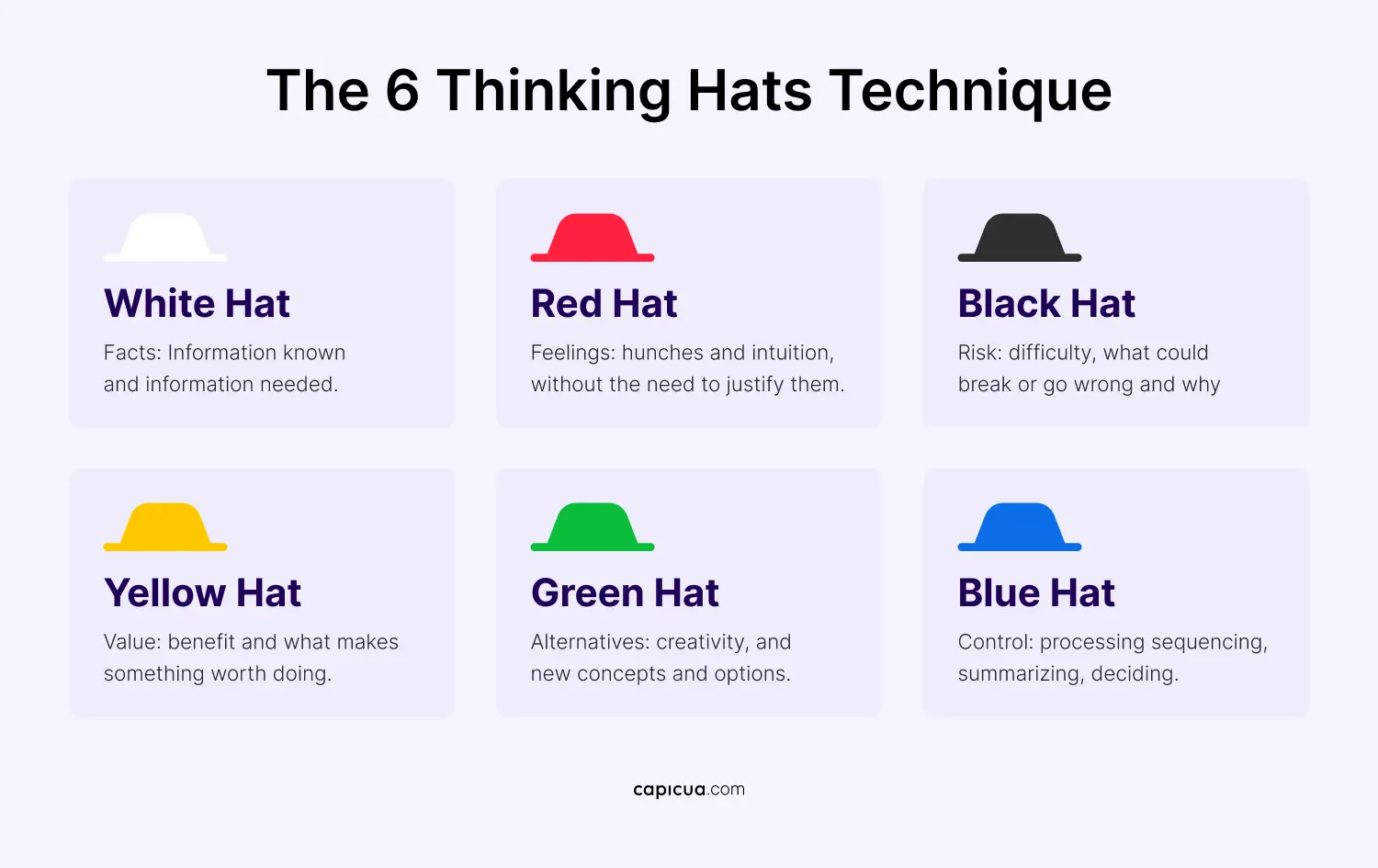
Each hat, as defined by the de Bono Group, carries a single assignment:
- White Hat: information known and information needed.
- Red Hat: feelings, hunches, and intuition, without any obligation to justify them.
- Yellow Hat: value and benefit; what makes something worth doing.
- Black Hat: risk, difficulty, and what might go wrong.
- Green Hat: creativity, alternatives, and new concepts.
- Blue Hat: control of the thinking process itself; sequencing, summarizing, deciding.
The mechanics of the 6 thinking hats technique rely on everyone wearing the same hat at the same moment. A skeptical engineer and an optimistic founder both argue the upside under the Yellow Hat, then both attack it under the Black Hat. Nobody owns a position, so nobody has to defend one. When MDS Sciex measured the impact of Six Hats training, it reported a 40% increase in the efficiency of its development process and an ROI of 2,648%, and ABB in Finland compressed multinational discussions that once took 30 days into two.

What is the 6 Thinking Hats Technique in Product Development?
In product development, the 6 thinking hats technique is a decision protocol that assigns each hat to a specific class of evidence, so a roadmap choice is tested against data, user sentiment, risk, business value, alternatives, and process discipline before it is committed.
The translation from de Bono's general framework to product work is where the method earns its place next to scoring frameworks like RICE. A RICE score tells you how initiatives rank against each other; a six-hat session tells you whether the inputs to that score are trustworthy. One is arithmetic, the other is scrutiny, and scaling teams need both.
Mapped onto product artifacts, the hats look like this:
- White hat: cohort retention, support volume, cycle time, change failure rate.
- Red hat: team confidence, user frustration, founder instinct, sales-floor sentiment.
- Black hat: technical debt, dependency risk, compliance exposure, churn scenarios
- Yellow hat: retention lift, expansion revenue, deal velocity, reusable platform value
- Green hat: alternative solutions, smaller tests, configuration instead of code, removal
- Blue hat: decision ownership, success metrics, review dates, rollback plans.
McKinsey's State of Organizations 2026, a survey of more than 10,000 senior executives across 15 countries and 16 industries, finds that technology infusion, economic disruption, and shifting workforce models increase organizational complexity in a way that raises the value of any mechanism that makes a decision legible to everyone in the room. MIT Sloan Management Review also documents how black hat workshops let teams model competitive responses before committing to a move. Same principle: isolate adversarial thinking, give it a formal slot, and it stops leaking into every other conversation as background cynicism.

Example of 6 Thinking Hats in Product Ideation
In ideation, an example of 6 thinking hats in practice weights the White (facts) and Green (alternatives) hats most heavily, because the risk at this stage is building something nobody wants and the cheapest correction is a wider set of options tested against real signal.
Let's see the six thinking hats in action: A Series B analytics platform is considering a self-serve trial to reduce reliance on sales-led onboarding. To run structured ideation for product teams, a 45-minute Six Thinking Hats session looks like this:
- Blue Hat (open): State the decision in one sentence; confirm everyone reads it the same way; name the scribe and the timebox.
- White Hat: What does activation data actually show for sales-assisted accounts? Which numbers are measured and which are estimated? The discipline here is only to report.
- Yellow Hat: Which segment benefits most, and what specifically improves: activation rate, sales cycle length, or expansion revenue?
- Black Hat: What has to be true for a self-serve trial to convert? Which enterprise buyers will read a trial as a downgrade in service? What is the cheapest way to be wrong?
- Red Hat: Does this feel like our product, or like a competitor's roadmap?
- Green Hat: What are three other ways to shorten time-to-value? What would this look like as a two-week test rather than a two-quarter build?
- Blue Hat (close): What is the smallest experiment that separates signal from opinion, who owns it, and when do we revisit?
The Green Hat slot is where the volume gain shows up. Channel 4 in the UK reported generating more ideas in two days of de Bono training than in the previous six months; separating generation from criticism stops promising options from being killed in their first thirty seconds. The method has also proven structured enough for machines to run. A 2025 study introduced a Parallel Thinking-based Facilitation Agent that uses large language models to perform all six hat roles during online consensus building. A framework legible enough to automate is a framework specific enough to teach.

6 Thinking Hats Examples in Product Building
During the build stage, the most useful 6 thinking hats examples shift weight toward the Black (risk) and Blue (control) hats, because AI-assisted development has raised delivery throughput and delivery instability at the same time, making structured verification a competitive requirement rather than a process nicety.
DORA's State of AI-assisted Software Development 2025 found that AI functions primarily as an amplifier, magnifying the strengths of high-performing organizations and the dysfunctions of struggling ones. Its follow-up analysis of 1,110 Google engineers reports that 90% of technology professionals now use AI at work and over 80% believe it raised their productivity, while 30% report little to no trust in the code AI generates. Higher AI adoption is associated with rising software delivery throughput and rising software delivery instability.
DORA names the cost as a verification tax, where time saved writing is re-spent auditing, and one engineer puts it plainly: "I spend more time babysitting the AI and reviewing what it’s trying to do." A six thinking hats session at the build stage puts that tax on the table before it becomes a release incident:
- White Hat: What are our current cycle time, change failure rate, and rework rate on this surface? What does existing telemetry say about how this area is used?
- Black Hat: Where does scope quietly expand once we start? What technical debt does this create, who pays it down, and when? If AI-generated code sits in this path, what is the verification plan before it ships?
- Red Hat: Does this scope feel achievable in the window? Is anyone building something they do not believe in?
- Green Hat: What could we cut and still deliver the core outcome? Could this ship behind a flag?
- Yellow Hat: What does shipping this well do for velocity on the next three things?
- Blue Hat: What are the acceptance criteria, the post-release metric, the rollback plan, and who calls it?
The verification question (black hat) is the one teams skip, and it maps directly to DORA's recommendation to work in small batches and shift AI-generated review feedback to the author rather than the reviewer. Structured critique is how a team holds calibrated speed instead of trading stability for throughput without noticing.

Six Thinking Hats Examples in Product Scaling
At scale, six thinking hats examples give the Black Hat (risk) equal billing with the Blue Hat (control), because the blast radius of a wrong decision now includes paying customers, contractual commitments, and the trust that growth depends on.
The arithmetic of a mistake changes once a product is live at volume. A broken feature that taught you something useful at 100 users churns enterprise accounts at 100,000, and this is the stage where teams most often keep the vocabulary of early-stage speed while operating in a context that no longer rewards it.
Consider a scaling decision: a workflow SaaS product is deciding whether to build a heavily requested custom-reporting module. The hats surface different classes of evidence:
- White Hat: Which cohorts are asking, and what do their retention and expansion curves look like? What is the current blast radius in users, revenue, and contractual exposure?
- Yellow Hat: Which existing accounts get measurably better? Does this strengthen the moat, or just the feature list?
- Black Hat: What breaks at ten times current load? Which compliance obligations does this touch? What is the churn scenario if it goes wrong on large accounts?
- Red Hat: Are we doing this because a customer asked loudly, or because it matters? What would we regret in six months?
- Green Hat: Could configuration, a partnership, or a removal solve this instead of a build? What feature could we retire to make room?
- Blue Hat: Which part of this decision is reversible, and which is a one-way door? What staged rollout applies, and what signal stops it?
That Green Hat (alternatives) question about removal is the one scaling teams rarely ask unprompted, and it's frequently the highest-leverage option on the table. Growth-stage roadmaps accumulate surface area faster than they retire it, and a formal creative slot is what makes subtraction a legitimate answer rather than an admission of failure. McKinsey's finding that leaders are shifting emphasis toward sustained performance and long-term value creation describes this change in posture, and a 6 thinking hats method session is one way to operationalize it inside a single meeting.
How to Run a 6 Thinking Hats Session
To run a 6 thinking hats method session well, a facilitator sequences the hats deliberately, timeboxes each one, requires the whole group to occupy the same hat simultaneously, and closes with a written decision, owner, metric, and review date.
Blue (control), White (facts), Yellow (value), Black (risk), Red (feelings), Green (alternatives), Blue (control) because opening and closing with process is what separates a session from a conversation. As a rule of thumb, three de Bono Six Thinking Hats rules do most of the work:
- Timebox every hat and publish the clock: Sessions collapse when the Black Hat expands to fill available time, which it will if permitted.
- Collect silent written input before opening the floor: In groups of six or more, sixty seconds of individual writing per hat prevents the first speaker from setting the frame for everyone else.
- Never let one person be assigned a hat: Appointing someone "the Black Hat" recreates the positional argument the method exists to dissolve.
The honest limitations of the 6 thinking hats method matter just as much, and three are worth naming:
- It cannot manufacture information: The White Hat (facts) surfaces what a team knows, and a session run on thin evidence produces a well-structured guess. Six hats sharpen judgment; they do not substitute for product validation or research.
- It's vulnerable to facilitation quality: Research on automating parallel thinking identifies unresolved challenges in optimizing scheduling and managing behavior during the divergent phase, a precise description of what inexperienced facilitators also get wrong.
- It does not survive as theater: A session that ends without a named owner and a review date has produced a feeling of rigor rather than rigor itself. The Blue Hat (control) close is the only part of the method that is genuinely non-negotiable.
One broader risk is worth flagging for teams leaning hard on AI. DORA notes that AI usage patterns can deliver breakthrough productivity while blocking skill development, limiting the hands-on problem-solving that builds real expertise. A framework that structures human critique is a reasonable countermeasure, provided the humans still do the critique.
Recurring product debates are a symptom of a team operating without a shared picture of what is known, what is risky, and what has already been decided. Shaped Clarity™ fills that gap by turning scattered signals into one operating reality so that structured sessions like the six hats have real evidence to work with instead of competing assumptions. Used together, Six Thinking Hats provides the discipline and Shaped Clarity provides the substance. Discover how to scale without losing soul with Shaped Clarity.
Conclusion
The Six Thinking Hats method has outlasted four decades of management frameworks because it addresses a problem that has not changed: human groups are bad at doing several kinds of thinking at once, and product teams are asked to do exactly that under time pressure. With AI raising both the volume of code shipped and the instability of what reaches production, the constraint is not generation but judgment. The Six Hats product decision-making framework is a cheap, portable way to schedule judgment. For teams tired of rebuilding what they just launched, that is a reasonable place to start.
Make product decisions your team can defend and revisit with confidence: contact us or book a call.