


You may know the feeling of every quarter feeling like starting from scratch. And for many scaling teams, the answer lies upstream of the roadmap, in a product vision framework that was never built or was written once and quietly shelved. According to the Product-Led Alliance State of Product Management report, 57.8% of product teams cite leadership direction and internal priorities as a top influence on their product strategy.
For a founder or product leader in a post-product-market-fit Series A to C SaaS company, that gap shows up as rework, features nobody adopts, and the strange feeling of rebuilding a product you just launched. A clear product vision is the difference between a team that compounds and a team that keeps resetting.
This guide walks through what a product vision framework is in the context of software products; a practical framework for creating a product vision and strategy; a product vision statement framework; and how to keep the whole thing alive as you scale.

What is a Product Vision Framework in Software Products
A product vision framework is a structured method for defining where a product should go over the next two to five years and translating that direction into a strategy the team can act on. The timeframe of a product vision for software, as noted by Product School, aims to find a horizon and remain stable even as the strategy and roadmap shift beneath it.
The clearest way to hold the pieces together is a simple hierarchy. The product vision is the destination, the long-term change you want to create for users; the product strategy is the route you choose to reach it; and the product roadmap is the map of what you build and when. While vision stays steady, strategy and roadmap adapt as you learn. However, if each product team invents its own vision, everyone ends up picking a different star from the sky, and that's exactly how alignment erodes.
A product vision framework turns an abstract aspiration into a repeatable practice, and names who the product is for, the need it serves, the differentiators that make it worth choosing, and the business outcomes it should produce. Those inputs later feed prioritization: a strong vision quietly does work for you every time the roadmap is questioned.
Why Can Product Vision Fail to Guide Product Strategy
Most teams have something they call a vision, but the problem is that it rarely reaches the work. The Product-Led Alliance found that product teams score 3 out of 5 on average for how confident they are that non-product teams even understand the vision and strategy, and the same 3/5 for how effectively strategy is communicated across departments.
The same research shows that 72.2% of product managers spend around a quarter of their time on strategy, meaning the vision is set once. When alignment breaks down, teams cite resource and capacity constraints (49.2%) and shifting priorities away from short-term commitments (47.5%) as the top causes.
As a result, speed becomes the default setting regardless of stage, which works in ideation and backfires at scale. We have written about how roadmaps quietly fracture under growth in How To Build a SaaS Roadmap That Survives Scaling: the underlying issue is clarity, and most teams never name it. A vision that does not touch prioritization is decoration.

The Framework for Creating a Product Vision
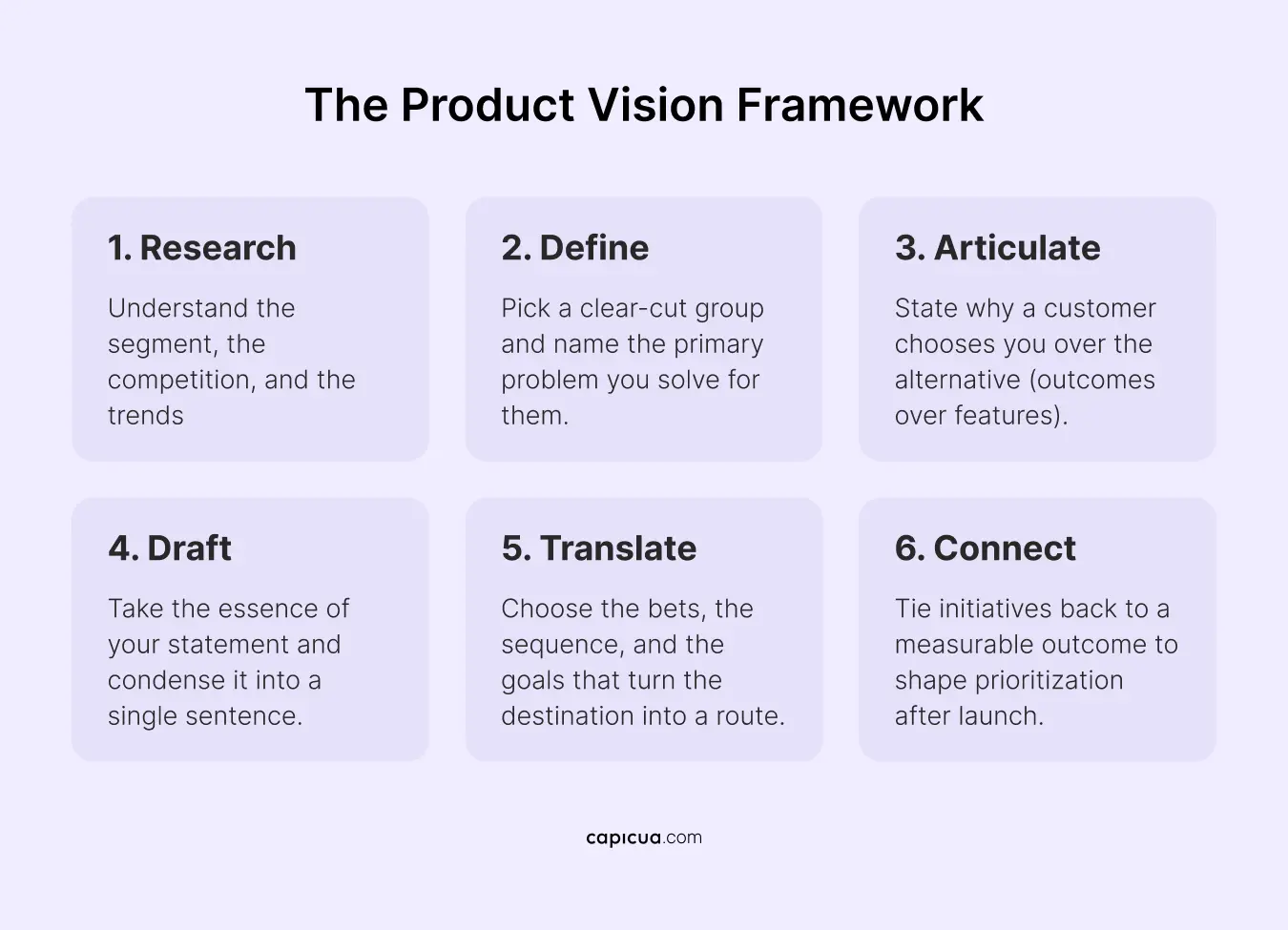
A reliable framework for creating a product vision and strategy moves from research to a stable statement to an executable plan. The sequence below combines Product School's six-step approach with Roman Pichler's Product Vision Board, which organizes strategy into target group, needs, product, and business goals beneath the vision.
- Research: Understand the segment, the competition, and the trends that make this window real. A vision grounded in evidence stays feasible, not just aspirational.
- Define: Pick a clear-cut group and name the primary problem you solve for them.
- Articulate: State why a customer chooses you over the alternative, in terms of outcomes rather than features.
- Draft: Condense the direction into a single inspiring sentence.
- Translate: Choose the bets, the sequence, and the goals that turn the destination into a route.
- Connect: Tie every initiative back to a measurable outcome so the vision continues to shape prioritization after launch.
The discipline in this framework for creating a product vision and strategy is the handoff between steps four and five. A vision with no strategy is a poster; a strategy with no vision is a backlog. Keeping both in a single artifact lets a team validate assumptions early, which Pichler frames as attacking your biggest risk first.
How to Write a Product Vision Statement Framework
A product vision statement framework distills the whole direction into a single sentence that names the target customer, the change you create for them, and what makes your approach different. A useful template can be "For [target customer], [product] will [deliver this change] by [key differentiator]." The product vision statement framework only earns its place if it's inspiring enough to make a candidate want to join, which Marty Cagan describes as the difference between a team of missionaries and a team of mercenaries.
One caution: a product vision addresses the needs of the product itself, its users, and the technology trends you will ride to serve them. Keep the statement free of feature lists so it survives the next three roadmap revisions.

How to Keep Your Product Vision Framework Alive at Scale
Writing the vision is the easy part; keeping it alive is what separates the top performers. Product-Led Alliance found that fully product-led organizations average 4 out of 5 on both strategy and roadmap alignment, the highest of any group, while teams still transitioning actually dip before they improve.
Three rituals keep a product vision framework connected to the work:
- Tie every roadmap initiative explicitly to the vision and company OKRs; if an item cannot be traced back, it belongs on the backlog.
- Review assumptions on a cadence, asking whether the last bet produced the outcome it promised rather than just reporting status.
- Make the vision visible in the rituals teams already run, so a new hire can read the roadmap and understand what was decided and why.
As the gap between product decisions and user reality widens, discovery must be built into the process rather than bolted on at launch. That is the throughline of building a roadmap that survives scaling: goals define what the business wants, signals identify leading indicators, and metrics track progress. With that structure, alignment becomes a byproduct of shared understanding instead of a meeting.
High scaling with a drifting vision, high feature output with flat retention, and high effort with slow progress are almost always a clarity problem. Shaped Clarity™ exists for these situations, turning product signals into decisive business direction and giving teams the structure to adapt without losing coherence. Learn more about Shaped Clarity here!
Conclusion
A product vision is the stable destination that makes every strategic choice and roadmap trade-off legible, and the teams that treat it that way move with purpose, while others reset each quarter. Build the framework, write the statement, validate the assumptions, and then do the harder work of keeping it visible as you grow. The vision that survives contact with real users, real OKRs, and real scale is the one that compounds.
Turn a fuzzy vision into a framework your team can execute: contact us or book a call.