


All founders have felt the same: the demo works, and the pilot impresses the board, but the production exposes costs, latency, and failure modes that nobody priced in. The root, more often than not, traces back to the chosen agentic design patterns, and why: a structural decision made early but rarely revisited.
The stakes now are commercial, with McKinsey's 2026 State of AI finding that 40% of organizations with more than $1B in revenue are scaling AI agents (up from 27% a year earlier), while smaller organizations remain flat at 22%, and Gartner estimating that $234B in enterprise application spend (around 20% of the category) is exposed to agentic disruption by 2030. For Series A to C SaaS companies, agentic AI architecture has become a product strategy question directly tied to retention, margin, and competitive position. This guide breaks down the patterns, the tradeoffs, and how to choose the right AI agent architecture for your product.
What Are Agentic Design Patterns in AI Systems?
Agentic design patterns are reusable structural blueprints that define how AI agents reason, use tools, coordinate with other agents, and hand control back to humans. This shared set of decisions about who plans, who acts, who checks the work, and when the system stops becomes the architectural vocabulary of agentic system design. An agent architecture, by contrast, is the concrete implementation of those decisions inside a product. In practical terms, every AI agent architecture combines five building blocks:
- Model: the reasoning engine, usually an LLM, that interprets goals and decides on next steps.
- Tools: APIs, databases, and services the agent can call to read data or take action.
- Memory and context: what the agent knows about the user, the task, and prior steps.
- Orchestration: the logic that sequences agents, routes tasks, and resolves conflicts.
- Guardrails: permissions, evaluations, and human approval points that keep the system inside acceptable risk.
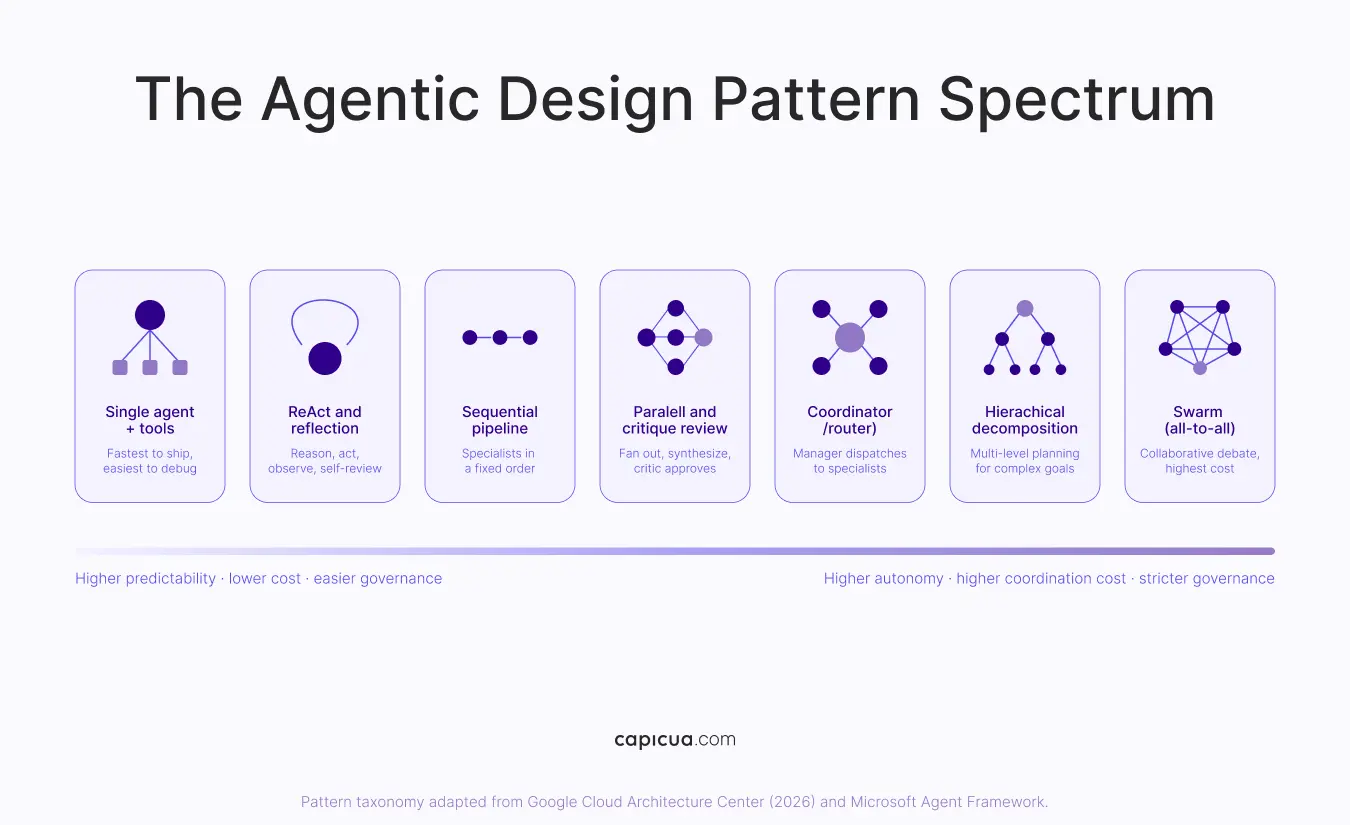
Google Cloud's Architecture Center documents twelve distinct agentic AI design patterns, from a single agent with tools to swarms where agents debate all-to-all. Microsoft's Agent Framework ships five built-in orchestration patterns: sequential, concurrent, handoff, group chat, and a manager-led "magentic" mode. The pattern you choose determines how these blocks connect, and the convergence across vendors means agent architecture in AI has matured into a discipline with known tradeoffs, and teams can stop improvising.

Agentic AI Design Patterns for Product Teams
The core agentic AI design patterns fall into three families: single-agent patterns, multi-agent workflow patterns, and control patterns that govern autonomy. Most production systems combine one pattern from each family.
Single-Agent Patterns
- Tool use (single agent with tools): one model, a defined toolset, and a system prompt. It's the fastest pattern to ship and the easiest to debug, which makes it the right default for most first releases.
- ReAct (reason and act): the agent cycles through thought, action, and observation until it concludes. Google Cloud recommends it for tasks that need continuous planning and adaptation, with the tradeoff of higher latency.
- Reflection: the agent reviews its own output against criteria before returning it, trading extra tokens for quality.

Multi-Agent Workflow Patterns
- Sequential pipeline: specialized agents run in a fixed order, each feeding the next. It suits predictable, repeatable processes such as document intake or onboarding flows.
- Parallel (concurrent): several agents work simultaneously, and a final step synthesizes results, reducing latency for research and analysis tasks.
- Review and critique: a generator agent produces output, and a critic agent approves or requests revisions; one of the most cost-effective ways to raise multi-agent reliability.
- Coordinator (router or manager): a central agent decomposes requests and dispatches sub-tasks to specialists, powering most customer-facing assistants across domains.
- Hierarchical decomposition and swarm: multi-level planning or all-to-all collaboration for open-ended problems with the highest coordination cost and the hardest debugging.
Control Patterns
- Human-in-the-loop: execution pauses at defined checkpoints for human approval. Microsoft's Agent Framework implements it through approval-required tools that halt a workflow until a person signs off.
- Custom logic: code-based orchestration with explicit branching, used when business rules must be deterministic.
Each step up in autonomy multiplies the surface area for failure, and a multi-agent system can outperform a single agent on complex work. Yet, every handoff adds tokens, latency and another place where context can drift.
How to Choose the Right Agent Architecture in AI
Choosing an agent architecture in AI starts with the task, then error tolerance and only then the technology. Google Cloud's guidance frames the first question as: does your application need fast, interactive responses at the cost of some accuracy, or can it tolerate delay to reach a more thorough result? Product leaders can turn it into a repeatable decision process:
- Define the job to be done: Write the user outcome in one sentence. If you cannot, the problem belongs in discovery before it reaches architecture.
- Rate task predictability: Repeatable, well-bounded tasks fit sequential or single-agent patterns. Open-ended tasks justify coordinator or ReAct patterns.
- Set the latency and cost budget: Each additional agent call has a per-interaction cost. Model it against your unit economics before you commit.
- Classify the risk of action: Gartner recommends four autonomy levels, which are observe, advise, act with approval, and act autonomously. Match governance rigor to each level, so every agent gets controls proportionate to its scope.
- Pick the simplest pattern that passes steps 2 to 4: Add complexity only when evaluation data shows the simpler pattern cannot hit the quality bar.
- Design the evaluation loop: Decide how you will measure correctness, cost per task and escalation rate before launch.
This sequence keeps AI system architecture tied to business outcomes. Also, it protects roadmaps from the common trap of adopting a sophisticated multi-agent architecture because it looks impressive in a pitch, then spending two quarters reworking it.

Agentic AI Architecture Mistakes That Cause Rework
The most expensive agentic AI architecture mistakes come from treating agents as isolated features, disconnected from the surrounding system. Four failure patterns show up repeatedly across scaling teams:
- Uniform governance: Over-restricting simple agents slows delivery; under-restricting autonomous ones invites incidents. Governance must match the level of autonomy. Gartner predicts that by 2027, 40% of enterprises will demote or decommission autonomous AI agents because of governance gaps discovered after production.
- Scaling before foundation: Only one in five companies has a mature governance model for autonomous agents, according to Deloitte's State of AI in the Enterprise. And while two-thirds of organizations have experimented with agents, McKinsey reports that fewer than 10% have scaled them to tangible value.
- Outsourcing architecture: Per Gartner, 70% of enterprises will abandon agentic AI built by vendor forward-deployed engineering by 2028, as costs escalate and internal teams cannot evolve what was built. When those who understand the agent architecture leave, the product loses its ability to adapt.
- Automating old workflows: Nearly three-quarters of AI high performers fundamentally redesigned workflows, compared with about a quarter of everyone else, according to McKinsey's The State of AI. Agents layered on top of a broken process inherit its friction and add new failure modes.

Agentic System Design as a Product Strategy Decision
Agentic system design belongs on the product leadership agenda because it fixes the cost structure, the user experience and the speed of future iteration. Three principles help founders and leaders make decisions with confidence.
- Design the human role first: Every agentic design pattern implies approver, supervisor, editor or escalation point roles and defining those roles early shapes the interface, the trust signals users see and the human-in-the-loop checkpoints the system needs.
- Build on open interoperability standards: The Model Context Protocol (MCP) and the Agent2Agent (A2A) protocol now sit under the Linux Foundation's Agentic AI Foundation. Building on shared standards lowers switching costs between model providers and keeps your AI system architecture portable.
- Treat evaluation as a metric: Track task success rate, cost per completed task, escalation rate and user trust signals with the same rigor you apply to activation and retention, to know when to graduate an agent to a higher autonomy level and when to pull it back.
Choosing agentic design patterns under pressure, without a shared view of the user outcome, the risk tolerance and the cost model, is how teams end up rebuilding systems they just launched. Shaped Clarity™ gives product, design and engineering a common lens to align on those decisions before code is written, so your agentic AI architecture can adapt to change and support sustained growth. Discover Shaped Clarity.
Conclusion
Agentic design patterns have moved from research vocabulary to board-level product decisions, and the data is consistent across McKinsey, Gartner and Deloitte: adoption is accelerating faster than the discipline to manage it. The next wave of competitive advantage will belong to teams that design agentic systems with the same clarity they apply to their core product. Clear patterns, deliberate autonomy and real user evidence turn agents from impressive demos into durable value.
To design an agentic AI architecture that scales without rework, contact us or book a call.