

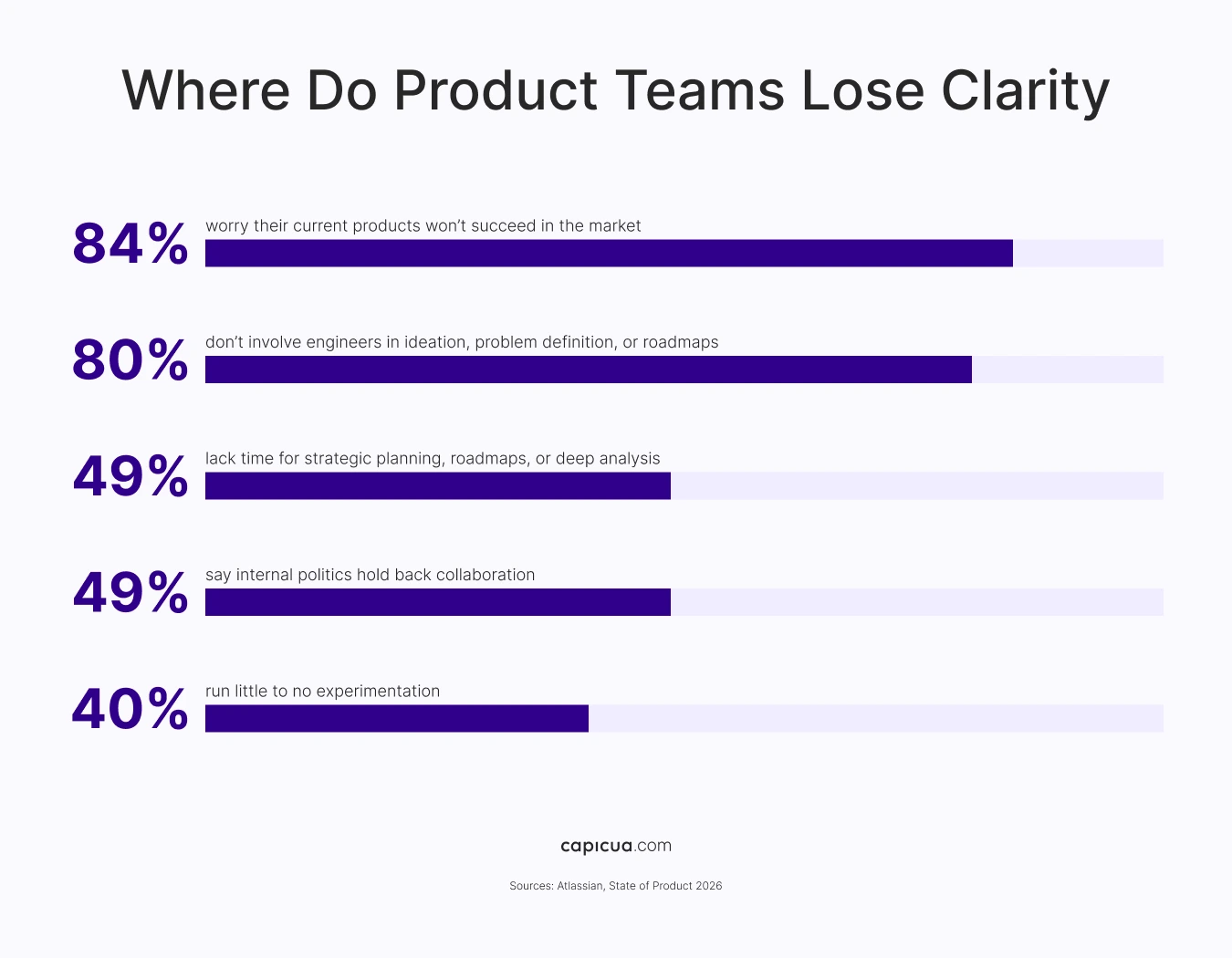
In Atlassian's State of Product 2026, 84% of product teams said they worry their current products won't succeed in the market, even though 85% say they have a seat at the strategic table. Roadmap items get approved on conviction, engineering starts, and three sprints later the team realizes the problem was framed wrong; and influence without evidence is an expensive combination.
A discovery session, the cheapest place to close that gap, is the structured moment where product, design, engineering and go-to-market leaders test the assumptions behind a bet before funding it. This guide answers "what is a discovery session?" while also explaining how an agile discovery session, a UX discovery session and a brand discovery session differ and how each can end with a decision the whole team can act on.
What is a Discovery Session in Software Development?
A discovery session is a facilitated, time-boxed working session in which a cross-functional team defines the problem worth solving, makes the assumptions behind a product bet explicit, and agrees on the evidence required before committing build capacity. The output is a decision, backed by a shared understanding of users, goals and technical constraints.
Every discovery session exists to reduce product risk, with Silicon Valley Product Group (SVPG)'s Marty Cagan describing discovery as prototyping work to test value, usability, feasibility and viability risks before building a commercial-quality product. A good session answers four questions: Will customers want this? Can they use it? Can we build and run it? Does it work for the business? Product leaders who treat discovery as risk reduction tend to get decisions, and decisions protect a roadmap from drift.
Why Discovery Sessions Matter for Scaling SaaS Teams
Discovery sessions move the most expensive decisions (what to build and why) to the point where changes are still cheap; yet post-PMF teams usually stall when a growing organization keeps shipping against assumptions nobody has tested since the early days. Atlassian research found that 80% of teams still don't involve engineers during ideation, problem definition or roadmap creation; and 49% report insufficient time for strategic planning, roadmap development or deep analysis. Another 49% say internal politics hold back collaboration, and 40% of teams run little or no experimentation.
What's more, AI coding tools have sped up shipping, which also raises the cost of shipping the wrong thing. SVPG's Cagan argues that, because delivery costs have dropped so sharply, building the feature is "no longer the bottleneck", which is also why more and more feature factory-driven teams are "capable of producing more bad products, faster."
In the context of faster digital product creation, skipped product discovery shows up as sprints that feel like resets, features with lower adoption, and rebuildings of products that launched months ago. Capicua's research on the hidden costs of product uncertainty traces how that uncertainty compounds into rework, slower releases and eroding team confidence. A half-day discovery session costs a fraction of one misdirected sprint.
Agile, UX, Brand and Technical Discovery Sessions
The right discovery session depends on which risk is largest. Value risk calls for an agile discovery session, usability risk for a UX discovery session, positioning risk for a brand discovery session, and feasibility risk for a technical discovery session. Mature teams run all four over a product's life, but rarely in the same week.
Agile Discovery Session
An Agile discovery session is a short, recurring discovery session embedded in the delivery cadence, usually ahead of quarterly or release planning, that converts business goals into testable hypotheses and a prioritized backlog of experiments. Inputs to an Agile session include OKRs, product analytics, customer feedback and the current backlog; its outputs are a hypothesis backlog, success metrics and clear owners.
With Digital.ai's 18th annual State of Agile Report stating that 73% of respondents want stronger leadership support and clearer alignment between delivery work and business goals, while only 29% are accountable for connecting agile work to business outcomes, an Agile discovery session can close the loop every cycle.
UX Discovery Session
A UX discovery session focuses on user behavior: who struggles, at which step of the journey, and why. Typical activities include synthesizing interviews, mapping the current-state journey, framing jobs to be done and reviewing usability evidence. Capicua's guide to product and UX discovery covers the research methods in depth.
User research is gaining strategic weight, and the share of Maze's Future of User Research Report 2026 respondents who say research is essential to all levels of strategy rose from 8% to 22% in one year, with 41% saying research informs product and strategic decisions. Product managers are also the largest group of non-researchers running research, at 39%, which makes a structured UX discovery session the easiest way to keep that research rigorous. For method selection, see Capicua's customer experience research methods.

Brand Discovery Session
A brand discovery session defines what a company stands for, who it serves and why buyers should choose it, so positioning, messaging and product decisions reinforce one another. For B2B SaaS, it becomes urgent when entering a new segment, launching a second product, repositioning after a pivot, or merging teams after an acquisition.
The Kantar BrandZ Most Valuable Global Brands 2026 ranking puts the combined value of the Top 100 at a record $13.1 trillion, up 22% on the previous year. The argument is that, as AI systems surface and weigh content, being meaningful and different matters more for brands, and the fastest growers focus on removing friction and delivering value. A roadmap that ignores positioning tends to dilute the very differentiation it was meant to build.
Technical Discovery Session
A technical discovery session is a discovery session led by engineering that surfaces architecture options, integration limits, data requirements, scalability and security constraints before scope is fixed. With 80% of teams leaving engineers out of problem definition, this is the session most often skipped and most often regretted.

How to Run a Discovery Session: A Six-Step Framework
To run a discovery session, frame one decision, bring the right cross-functional people together, make assumptions explicit, ground them in user evidence, rank the risks, and close with a documented decision. The following sequence can help product teams:
- Frame the decision: Write the bet as a question with a deadline, such as "Should we build self-serve onboarding for mid-market accounts this half?"
- Assemble a cross-functional group: Include the decision-maker, the product manager, a design lead, a tech lead and one voice from sales or customer success.
- Run an evidence audit: Before the session, collect analytics, support themes, interview notes and win/loss data. Label each claim as known, believed or unknown.
- Map assumptions: Use assumption mapping to plot every belief behind the bet by importance and by strength of evidence.
- Rank experiments: For each critical assumption, define the cheapest test that would change the decision: a prototype, customer calls, a fake-door test, or a technical spike.
- Decide and document: End with go, pivot or stop. Record the rationale, owners, success metrics and the date the decision will be revisited.
A clear product vision makes every step faster, because the team can test options against a shared destination. Capicua's product vision framework for scaling teams is a useful pre-read before any discovery workshop.

Discovery Session Questions for Product Leaders
The best discovery session questions expose what the team believes without evidence. Use them as prompts during the evidence audit and assumption mapping steps.
Business and outcome questions:
- What business outcome will change if this works, and by how much?
- What happens if we don't build this in the next two quarters?
- Which competitor move or market shift makes this urgent now?
User and problem questions:
- Who experiences this problem most acutely, and how do they solve it today?
- Where in the journey does the friction appear, and what does it cost the user?
- What have we observed directly, and what are we inferring from dashboards?
Product and technical questions:
- What is the smallest version that would prove the core value?
- Which integration, data or security constraint could break the plan?
- What will this add to our maintenance and operational load at scale?
Brand and market questions:
- Does this strengthen the reason buyers choose us over alternatives?
- Would sales, marketing and product describe the ideal buyer the same way?
- How will we explain this in one sentence on a pricing or product page?

Discovery Session FAQs
These are the questions founders and product leaders ask Capicua most often before a first discovery session.
How long does a discovery session take?
A single discovery session usually takes two to four hours, a full discovery workshop runs one to three days, and a discovery phase for a new product or major platform change typically spans two to six weeks.
Who should facilitate a discovery session?
A neutral facilitator works best, either an experienced product leader without a stake in the outcome or an external partner. Neutrality keeps the session focused on evidence rather than internal politics.
What is the difference between a discovery session and a design sprint?
A discovery session decides which problem is worth solving and what evidence is needed, and a design sprint takes a defined problem and moves quickly to a tested prototype. Discovery usually comes first.
How often should post-PMF teams run discovery sessions?
Run an agile discovery session before each planning cycle, a UX discovery session or brand discovery session whenever you enter a new segment or launch a significant capability, and a technical discovery session before any major architectural commitment.
Can AI run a discovery session?
AI can accelerate preparation, from summarizing interviews to clustering feedback, and 69% of research practitioners now use it. Framing the decision, reading nuance and making the final call remain human responsibilities.
The gaps a discovery session exposes, from unframed problems to silent assumptions, are clarity gaps, and they compound with every sprint. Shaped Clarity™ is Capicua's lens for closing them: it turns discovery signals into shared decisions so products adapt to change, learn from users and grow market share without drifting from intent. Seen through Shaped Clarity™, a discovery session becomes the operating rhythm that keeps strategy and delivery pointed at the same outcome. Discover more about Shaped Clarity.
Conclusion
A discovery session earns its place by making the next six months of delivery more predictable. The teams that scale cleanly treat discovery as a decision system, choosing the agile, UX, brand or technical format that fits the risk in front of them and closing every session with evidence, owners and a clear call.
To turn your next roadmap bet into an evidence-backed decision, contact us or book a call.