

Figma's 2026 AI Report found that 90% of designers, developers, and product managers say design is at least as important as it was before, with nearly six in ten stating that it now matters more. AI has made building cheap, and a product manager can stand up a working prototype in an afternoon. The constraint has moved upstream, to when a team decides which problem to solve and which of many possible solutions deserves the next sprint. This moment is brainstorming, and most product teams still run it like a status meeting.
Brainstorming in UX design has become the cheapest leverage point in the product life cycle. An idea that dies on a sticky note costs minutes, but an idea that dies in production costs a quarter. This guide covers the brainstorm meaning for product teams, where design thinking brainstorming fits, the brainstorm techniques that hold up in cross-functional teams, how to brainstorm with AI without collapsing your idea pool, and the best way to facilitate a brainstorming session that ends in a sustainable decision.
What is Brainstorming? The Brainstorm Meaning for Product Teams
Brainstorming is a structured idea-generation method in which a group produces as many solutions to a clearly defined problem as it can, while deferring judgment to a separate evaluation step. The method traces back to Alex Osborn's 1953 book Applied Imagination, which built brainstorming on two principles: welcome wild ideas and hold back judgment so the group can maximize creative output.
For software and digital products, the brainstorm meaning is narrower and more useful. Brainstorming in design is the divergent step of the product process in which a cross-functional team (product, design, engineering and, often, a customer-facing role) explores the solution space for one well-framed user problem before converging on the bets worth prototyping. The output is a short list of options with clear reasons for choosing between them, rather than a single favorite chosen by the most senior voice in the room.
Three traits separate product brainstorming from a generic creative session:
- It starts from evidence: Research insights, product analytics, support themes or win/loss data define the problem before anyone suggests a feature.
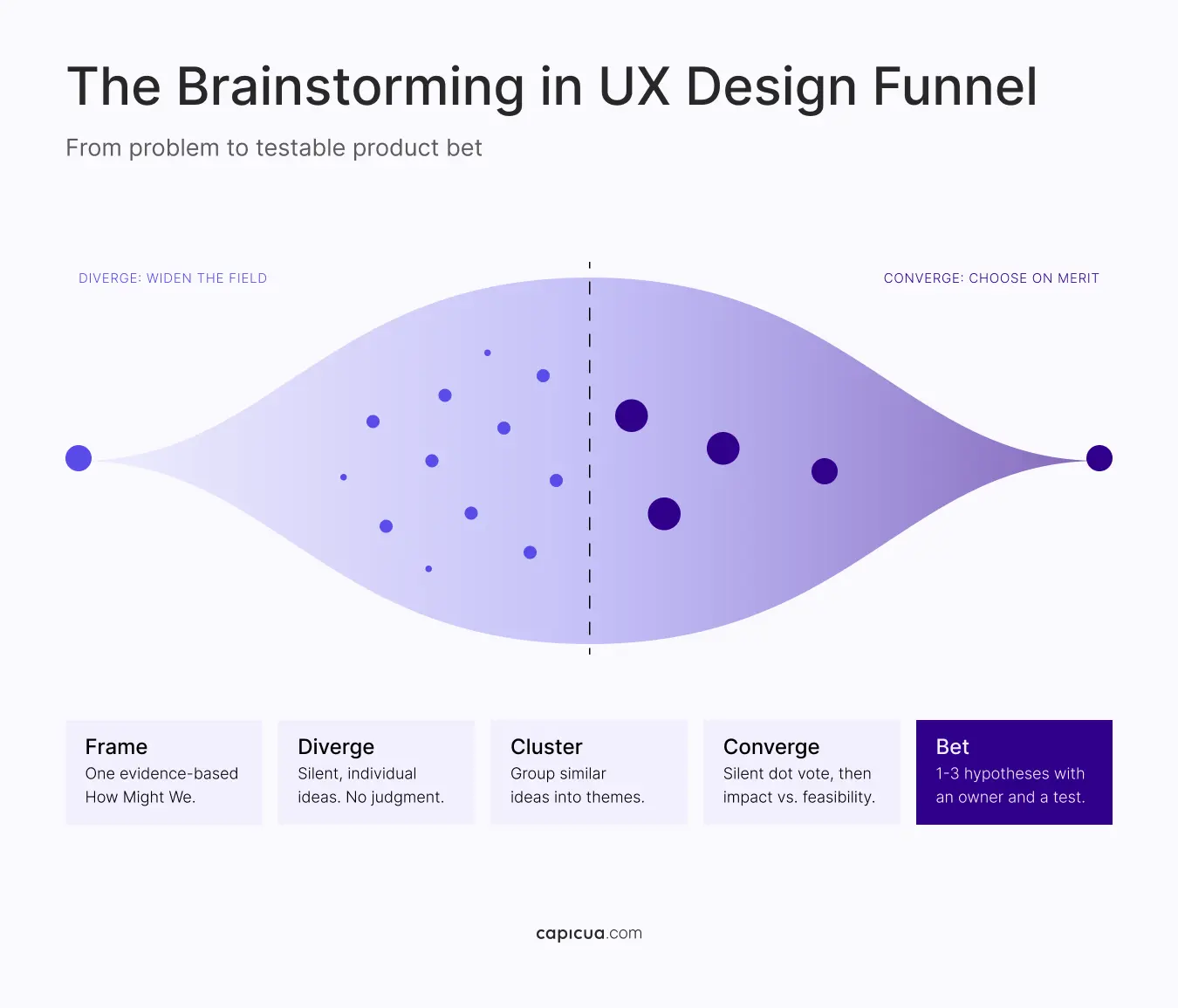
- It separates generation from selection: The group widens the field first and judges later, so early favorites cannot crowd out stronger options.
- It ends in a testable bet: The session closes with a hypothesis, an owner and the cheapest test that could change the decision.
In new product development, success depends on the quality of the best idea rather than the average one, and Wharton research shows that the best idea improves with the total number of ideas, their average quality and their variance. A brainstorm that produces five similar ideas gives a team far fewer chances at a breakthrough than one that produces forty different ones.
Why Brainstorming in UX Design Decides What Gets Built
Brainstorming in UX design decides what gets built because, once AI commoditizes execution, the scarcest resource on a product team is judgment about which solution deserves to exist. An August 2026 Harvard Business Review analysis of an AI-enabled innovation challenge observed that teams created the most value during problem definition and solution design, where diverse perspectives challenged assumptions, and argued that competitive advantage increasingly comes from deciding what is worth building and why.
The AI in Design Report 2026, published by Designer Fund and Foundation Capital, found that working prototypes are now an expected design output for 43% of respondents, and 40% say their PMs and engineers are doing more design work. Respondents also flagged that the cost of speed compresses the open-ended exploration phase where strong ideas incubate. Meanwhile, Figma's 2026 AI report shows designers participating in development doubled to 41% in a year, while developers doing design work rose from 44% to 60%.
For a post-PMF SaaS company, this changes the economics of a skipped brainstorm. When a prototype takes two weeks, a weak idea usually gets caught in review. When it takes two hours, a weak idea can reach customers before anyone questions it, and the cost shows up later as low adoption, rework and roadmap churn. A well-run brainstorm UX design session is the checkpoint where a team compares several directions before committing engineering capacity.

Design Thinking Brainstorming: Where Ideation Fits
Design thinking brainstorming happens in the ideate stage, after a team has built empathy with users and defined the problem, and before it prototypes and tests. That position matters, because brainstorming that runs before problem definition produces confident solutions to unvalidated problems.
The working model behind it is divergent and convergent thinking. In the divergent half, the group generates widely and defers critique. In the convergent half, it clusters, evaluates and selects. Mixing both in one conversation, where each idea gets debated the moment it appears, is the most common reason sessions end with few options and strong opinions.
A How Might We question turns a research insight into an open prompt that names the user, the action and the outcome, and Capicua's How Might We template breaks down how to calibrate it. The payoff of good framing showed up clearly in a June 2026 buildathon run by Miro with NYU Stern: 33 MBA students in eight teams had six hours to build AI-assisted solutions, judges explicitly prioritized problem definition and solution design over speed, and the winning teams stood out by framing their problem differently rather than through engineering sophistication.
In a scaling product organization, design thinking brainstorming sits inside a five-step loop:
- Discovery: Run an evidence audit and frame the problem.
- Ideation: Diverge against one to three How Might We questions.
- Convergence: Cluster ideas, vote silently and weigh impact against feasibility.
- Prototyping: Build the top two or three options as fast, often AI-assisted, prototypes.
- Testing: Let real users decide which bet earns roadmap space.

Brainstorm Techniques for UX/UI Design Teams
The most effective brainstorm techniques for UX/UI teams separate individual idea generation from group discussion, because the sequence protects quieter experts and prevents early convergence on the first plausible idea.
In a field experiment published in Organization Science in 2026, R&D specialists working without AI leaned toward technical solutions and commercial specialists toward commercial ones; AI-assisted participants produced more balanced proposals regardless of background. Whichever technique you pick, the room needs more than one function.
- Brainwriting: Each participant writes ideas independently for a fixed time, then passes or posts them so others can build on them. It's the default for mixed-seniority and remote teams because it gives every function an equal voice.
- Crazy 8s: Crazy 8s gives each person eight minutes to sketch eight distinct ideas, one per minute. It works best for screens, flows and interactions, where comparing sketches beats debating descriptions.

- How Might We + Round-Robin: The group drafts How Might We questions from research insights, votes on the strongest two or three, and then takes turns adding ideas to each. It suits ambiguous problems where the framing is still in play.
- Reverse Brainstorming: Reverse brainstorming asks how to cause the problem, such as "How might we make onboarding fail for a first-time admin?", and then inverts each answer into a fix. It is useful for underperforming features, churn drivers and risk reviews.
- SCAMPER: SCAMPER prompts the team to Substitute, Combine, Adapt, Modify, Put to other use, Eliminate or Reverse parts of an existing feature. It turns vague improvement goals into concrete variations.

- Starbursting: Starbursting generates who, what, where, when, why and how questions before anyone proposes a solution. It fits features with unclear scope, where the real gaps sit in the questions nobody has asked.
- AI-assisted pooling: AI-assisted pooling uses one or more AI models to expand the idea set after the human round, seeded with the pain points the team identified. It adds volume fast, as long as the process protects diversity (covered in the next section).
As a quick guide on how to brainstorm by situation: use How Might We with Brainwriting for new, ambiguous problems; Crazy 8s for screens and flows; Reverse Brainstorming or SCAMPER for existing features; Starbursting for unclear scope; and AI-assisted pooling when you need volume quickly.
How to Brainstorm With AI Without Losing Idea Diversity
To brainstorm with AI without losing idea diversity, let humans define the problems and pain points, use AI to generate solutions at volume and inject deliberate variety through personas, constraints and multiple models. AI tends to raise the quality of individual ideas while narrowing their range, so the process has to counteract that pull.
The clearest evidence comes from a study by Christian Terwiesch, Lennart Meincke, Karan Girotra, Ethan Mollick, Gideon Nave and Karl Ulrich, accepted in Production and Operations Management in July 2026. AI-generated product ideas were seven times more likely than human ideas to land in the top 10% by purchase intent. Yet AI idea sets were consistently less diverse across every study the authors reanalyzed. Their interventions show what works:
- Pooling ideas across models from different vendors brings diversity close to human levels.
- User personas and functional design constraints restore most of the lost diversity.
- Letting humans pick the pain point and AI propose the solutions ranks among the strongest strategies.
- Repeatedly asking AI to make ideas bolder reduces diversity, because ideas converge on the same "novel" features.
- Generating one idea per separate AI session produces the least diverse pool.
The P&G experiment in Organization Science points to the same division of labor: AI mainly lifted the quality of generated ideas, while human judgment kept its value in selecting among them. The AI in Design Report 2026 captures the cultural shift underneath, with one agency designer describing how the team's ritual moved from blank-slate brainstorming to validating AI-proposed explorations.
Six rules keep AI brainstorming wide:
- Frame with humans: The team names the problem and pain points; AI proposes solutions.
- Brainwrite before you prompt: Capture human ideas first so the AI output cannot anchor them.
- Vary the inputs: Rotate personas, constraints and models instead of re-running one prompt.
- Ask for difference explicitly: Request ideas that are deliberately distinct from each other and from the ones already on the board.
- Generate wide, select human: Use AI for volume, then cluster and vote as a team.
- Count the clusters: If forty ideas collapse into four themes, the pool is narrower than it looks.
How to Facilitate a Brainstorming Session
The best way to facilitate a brainstorming session is to frame one evidence-based problem, generate ideas individually before discussing them, separate divergence from convergence on the clock, and close with a documented bet. A neutral facilitator owns the process so that the most senior person in the room does not own the outcome.
The HBR analysis recommends that managers protect time for defining problems and build teams around complementary perspectives rather than technical specialties, and both principles shape the agenda below.
Use this eight-step format for a 60- to 90-minute session:
- Pick one decision: Write the problem as a single How Might We question tied to evidence.
- Invite people across functions: Include product, design, engineering and one customer-facing voice.
- Send a pre-read: Share a one-page evidence summary at least a day ahead.
- Set the rules out loud: Defer judgment, aim for quantity, build on others' ideas and keep one conversation at a time.
- Diverge individually: Run 8 to 12 minutes of brainwriting or Crazy 8s in silence.
- Share without pitching: Each person posts ideas and explains them briefly, with no selling or defending.
- Converge in silence first: Cluster ideas, run a silent dot vote, then weigh impact against feasibility and confidence.
- Decide and document: Leave with one to three bets, each with a hypothesis, an owner, the cheapest test and a review date.
For remote and hybrid teams, collect ideas asynchronously for 24-48 hours on a shared canvas, then use the live session only for clustering and decisions. Figma's 2026 data shows 76% of product builders already do at least half their work on the canvas, which makes this format easy to adopt.
Every brainstorm surfaces the same underlying question: does the team share a clear picture of the problem, the user and the decision before it starts generating? Shaped Clarity™ gives product teams that shared picture, so brainstorming turns evidence into bets instead of opinions, and those bets adapt as users and markets change. With clarity upstream, every idea a team generates has a fair chance to become the right product. Discover Shaped Clarity.
Conclusion
Brainstorming in UX design has become a decision system. As AI lowers the cost of building, the advantage shifts to teams that compare many different options, choose with evidence and test before they commit. The structure around different techniques matters: framing from research, silent generation, deliberate variety when AI joins the room and a documented decision at the end.
To turn your next brainstorming session into validated bets, contact us or book a call.