


Every product team loves to call itself data-driven, yet 84% worry the products they are building right now won't succeed in the market, according to Atlassian's State of Product. Today, teams have more dashboards, more feedback, and more AI tooling than ever, but also have less confidence in what to build next.
The path from data to trust is where product insights live, and the quality of your product development insights decides whether next quarter compounds what customers value or adds another feature nobody opens. This guide covers what product insights are, where they come from, how insight product development works, how AI is reshaping the insights products teams rely on, and how to measure whether any of it is paying off.
What Are Product Insights in Software Development?
Product insights are validated, decision-ready explanations of why users behave the way they do and what that behavior means for the business. A strong product insight links an observation (what happened) to a cause (why it happened) and a consequence (what the team should do next).
Data points, feedback tickets and dashboards are raw material. A product insight is what remains after you triangulate, challenge and tie that material to a commercial outcome such as retention, expansion or activation. This logic is why two companies with identical product analytics stacks can make very different roadmap calls.
- Product data describes what happened, e.g., a drop in weekly active seats inside mid-market accounts.
- Customer feedback captures what users say, e.g., repeated requests for a bulk-edit feature.
- Stakeholder opinions reflect what people inside the company believe, often shaped by the loudest account or the most recent escalation.
- Product insights explain why the behavior happens and what to do about it, with enough evidence to defend the decision in a board meeting.
The strongest product development insights sit at the intersection of user behavior, business value and technical feasibility. Insights that skip one of these tend to produce features that are adopted but unprofitable, profitable but hard to use, or desirable but expensive to maintain. An insight-driven product strategy treats all three as part of the same evidence.
Why Product Insights Decide Which Bets Pay Off
Product insights decide which bets pay off because most shipped software goes unused, and insight filters features customers adopt from features that only add maintenance cost. Roughly 80% of built features fail to reach meaningful adoption, and just 6.4% of features generate 80% of all user clicks. That pattern adds up to quarters of capacity spent on code that raises complexity without raising value and compounds into the cost of rework in software development: features get rebuilt, repositioned or quietly removed after launch, and each reversal resets the roadmap.
Confidence is eroding inside product teams, too. Atlassian's State of Product 2026 found that nearly 40% of respondents name feature prioritization as their biggest challenge, and 40% of product teams run limited or no experimentation. Without insight, prioritization becomes a negotiation between opinions, and the most senior opinion usually wins.
Forrester's 2026 CX Index found that only 26% of North American brands achieved statistically significant improvements in experience quality, while 68% stayed flat. In crowded SaaS categories, that stagnation leaves room for any competitor that understands customers well enough to act faster.
The cost of building without product insights can be classified into five categories:
- Wasted engineering capacity on features that never reach meaningful feature adoption.
- Rework cycles that reset the roadmap every few sprints and erode team trust.
- Slower expansion revenue, because accounts don't grow into features they never needed, which shows up in net revenue retention.
- Cross-functional misalignment, since every function argues from its own anecdote.
- Hidden uncertainty costs that rarely appear on a P&L, explored in the cost of product uncertainty.

Where Do Product Development Insights Come From?
Product development insights come from triangulating at least three signal types: what users do (product analytics), what users say (user research and feedback) and what the market rewards (commercial and competitive data). A single source rarely survives scrutiny; patterns that repeat across sources usually do. The six core sources of product insight are:
- Product analytics: funnels, cohort retention, feature adoption and time-to-value, which reveal where users stall.
- User research: interviews, usability tests and contextual inquiry, which explain why users stall.
- Voice of the customer (VoC): support tickets, NPS verbatims, sales call notes and community threads, which show what users ask for in their own words.
- Commercial data: win/loss analysis, churn reasons, expansion patterns and pricing objections, which connect behavior to revenue.
- Market and competitive research: category shifts, analyst coverage and competitor positioning, covered in market research techniques for software.
- Delivery signals: engineering effort, defect patterns and tech debt hot spots, which change the cost side of every bet.
Maze's Future of User Research Report found that the share of organizations where research is essential to all levels of strategy nearly tripled in a single year, from 8% in 2025 to 22% in 2026. Two in three respondents (66%) report rising demand for research, and product managers now run studies themselves in 39% of organizations.
In Atlassian's survey, 30% of product teams said they cannot spend enough time on customer research and interviews, and 49% lack time for data analysis and metric tracking. When research time shrinks, teams default to the loudest voice in the room.
Structured discovery sessions help close that gap by putting product, design, engineering and commercial leaders in front of the same customer insights before roadmap commitments are made.
How Insight Product Development Works: A Six-Step Loop
Insight product development is an operating model in which every roadmap decision starts from a validated insight, is framed as a testable bet and feeds new learning back into the system. It turns product discovery from a one-time phase into a continuous loop that runs alongside delivery.
- Frame the decision: Start with the business question the insight must answer, such as "Why do mid-market accounts stall after onboarding?" Research without an attached decision rarely makes it to the roadmap.
- Collect signals across sources: Pull quantitative and qualitative evidence in parallel so neither one dominates the conversation.
- Synthesize and triangulate: Cluster findings into themes, then test each theme against at least one independent source.
- Write the insight statement: Use a consistent format: "We observed [behavior] among [segment] because [cause], which affects [metric]. We trust [change] will move it by [range]."
- Turn the insight into a bet: Size the opportunity, define success metrics upfront and agree on the result that would end the bet.
- Close the loop: Measure outcomes, share them with the people who supplied the signal and store the learning where future teams can find it.
Most organizations stall at steps five and six. In Productboard's 2026 analysis of product workflows, 66% of product leaders named measuring success their biggest unresolved challenge, and more than half said improving feedback loops is the next problem they want to solve. Elena Levi, Director of Product at Payoneer, describes the stakes in the same piece: "When teams see that feedback is actually leading to action and that they're being heard of, they'll continue to provide it."
G2's September 2026 feedback analytics research shows the same pattern from the vendor side. In it, Pat Osorio, co-founder of Birdie, notes that most feedback platforms stop at aggregation and surface themes without closing the loop back to the roadmap. Treating that loop as a product in its own right is what separates insight-led teams.

How AI Is Changing Insights Products and User Research
AI is changing insights products by compressing the time between raw signal and synthesized theme, while people still handle interpretation, prioritization and judgment. Insights products are the platforms teams use to capture and analyze product signals, including product analytics tools, feedback management systems, research repositories and voice of the customer suites.
Maze reports that 69% of research practitioners use AI in at least some projects, citing faster turnaround (63%) and improved team efficiency (60%) as the top benefits. In G2's feedback analytics research, two of the vendors surveyed report time-to-insight reductions of more than 70% for their customers.
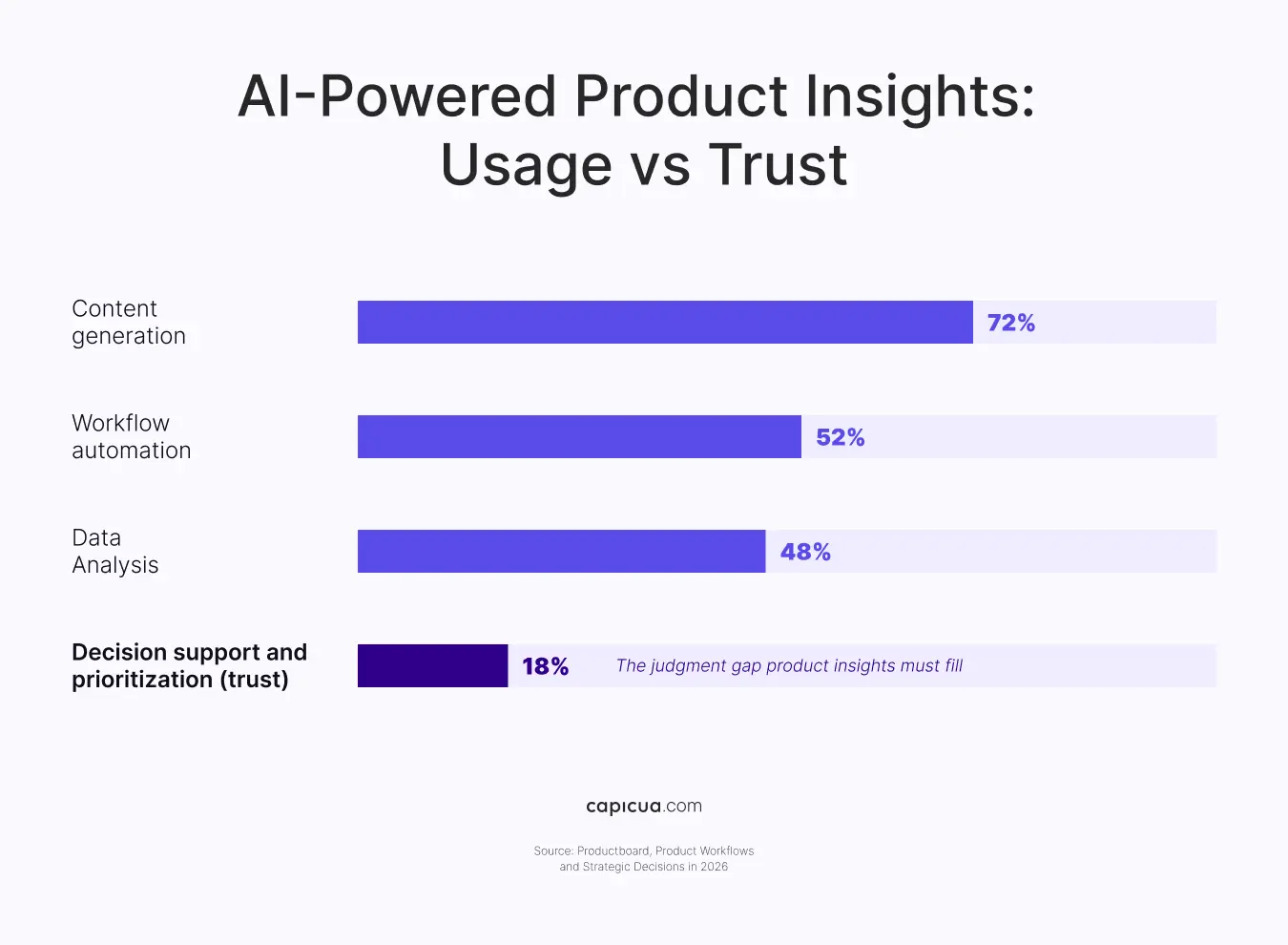
Productboard found that 72% of product leaders use AI for content generation and 48% for data analysis, yet only 18% trust it for decision support or prioritization. Researchers draw the same line: in Maze's study, 82% say human judgment remains essential for interpreting nuance and emotion, and 76% say the same for framing the right questions.
There are edges where AI-powered insights can help, and edges where leaders stay hands-on:
- Use AI for: transcribing and tagging interviews, clustering voice of the customer data at scale, flagging anomalies in product analytics, and drafting first-pass synthesis for human review.
- Keep people on: choosing which questions matter, interpreting context and emotion, weighing tradeoffs against strategy and deciding what to build.
- Fix the inputs first: With AI, "garbage in, garbage out" can do far more damage than a single wrong decision, which is why her team invests in event tracking, cataloging and schema definitions before adding automation.
For teams already running AI agents across product work, Capicua's guide to AI agent orchestration covers how to keep those systems accountable to human decision-makers.
How to Measure the Impact of Product Insights
Measure the impact of product insights by how quickly they change decisions and how often those decisions move business metrics. Product leaders should track a small set of indicators that connect insight work to outcomes the board already cares about.
- Insight-to-decision time: days between a validated insight and a committed decision.
- Bet hit rate: share of shipped bets that reach their predefined success metric.
- Feature adoption rate: share of target users who use a new feature repeatedly within 30 to 90 days of launch.
- Rework ratio: share of engineering capacity spent rebuilding or reversing recent work.
- Retention and expansion: gross and net revenue retention for the segments an insight targeted.
- Evidence coverage: share of roadmap items backed by at least two independent signal sources.
Keep the system light, and remember that Atlassian found that only 3% of product professionals feel they have enough time for every part of their role, so any measurement model has to survive a busy quarter. Two or three of these metrics, reviewed monthly in the same forum where roadmap decisions are made, will do more than a dashboard nobody opens. Pairing them with clear measures of speed and success keeps velocity honest.

Most scaling teams already hold more signal than they can use; what they lack is a shared way to turn it into decisions everyone trusts. Shaped Clarity™ is Capicua's lens for that work, aligning founders, product, design and engineering around validated customer insights, so products adapt to change, learn from real behavior and grow market share without the drift and rework that follow assumption-led roadmaps. Discover Shaped Clarity here.
Conclusion
Product insights are as much a leadership discipline as a research output. The companies that compound value over the next few years will shorten the distance between what users do, what teams learn and what gets built and keep human judgment at the center as AI takes over the mechanical parts of synthesis.
To turn scattered signals into actionable product insights, contact us or book a call.