


Every product leader eventually hits the sprint where a two-day feature takes three weeks. This gap between planned and actual velocity is the interest payment on technical debt, and in most companies it compounds quietly until it surfaces as a missed roadmap commitment.
Deloitte's 2026 analysis puts technical debt at 21%-40% of an organization's IT spending, and IBM Institute for Business Value research shows that enterprises pricing debt into their AI business cases project 29% higher ROI than those that leave it out.
This guide covers how to manage technical debt from a founder's seat: what to measure, how to prioritize, and which technical debt management strategies hold up as the company scales and AI-generated code enters the stack.
What is Technical Debt Management?
Technical debt management is the ongoing practice of identifying, measuring, prioritizing, and paying down the shortcuts embedded in a software product so they stop taxing delivery speed, quality, and strategic options. Technical debt itself is the future cost of rework created when a team chooses an expedient solution over a sustainable one. Like financial debt, it carries principal (the work required to fix it) and interest (the drag it adds to every change that touches it).
Gartner formalized the category with its Magic Quadrant for Technical Debt Management Tools, published in May 2026, which opens with a blunt observation: "Rapidly accumulating technical debt reduces quality, predictability, and delivery speed." Today, product leaders mostly inherit one or more of the following five types of technical debt:
- Code debt: duplicated logic, missing tests, and shortcuts that slow every change.
- Architectural debt: coupling and platform decisions that block scaling or integrations.
- Experience debt: inconsistent UX patterns and unused features that raise release costs.
- Data debt: fragmented schemas and unclear ownership that undermine readiness.
- AI technical debt: plausible-looking code produced faster than review, test, or ownership.
Some debt can be seen as a smart bet. Think of a deliberate shortcut taken to validate a market hypothesis with a known payback plan. Trouble starts when debt is invisible, unpriced, and nobody owns it. We see this pattern repeatedly in companies that crossed product-market fit on a codebase built for an earlier stage, a dynamic we unpack in Digital Products and The Broken Window Effect.
Why Tech Debt Management is a Board-Level Decision
Tech debt management belongs on the board agenda because debt now determines whether AI and growth investments return their projected value. IBM's research found that 81% of executives say technical debt is already constraining AI success, and 69% believe it will make some AI initiatives financially untenable. Leaving debt out of the business case erodes projected ROI by 18% to 29%.
InformationWeek's coverage of the IBM study also reports that project timelines stretch by up to 22% when debt is ignored, and cites Forrester research in which 75% of technology decision-makers expect their technical debt to reach a severe level in 2026. For a Series A to C company, those numbers translate into three recurring board conversations:
- Roadmap credibility: commitments slip because estimates ignore the interest owed on legacy modules.
- AI strategy: copilots and agents stall when they sit on top of brittle integrations and inconsistent data.
- Diligence exposure: debt leadership cannot describe it, and it becomes a discount when an investor or acquirer finds it first.
The leaders who handle this well talk about debt-adjusted ROI: every business case for a new capability carries the cost of the debt it depends on. Product teams face the same math with unvalidated assumptions, which we cover in State of Digital Products: Uncertainty Costs. Unpriced risk always lands somewhere, usually in next quarter's velocity.
How AI-Generated Code Changes Managing Technical Debt
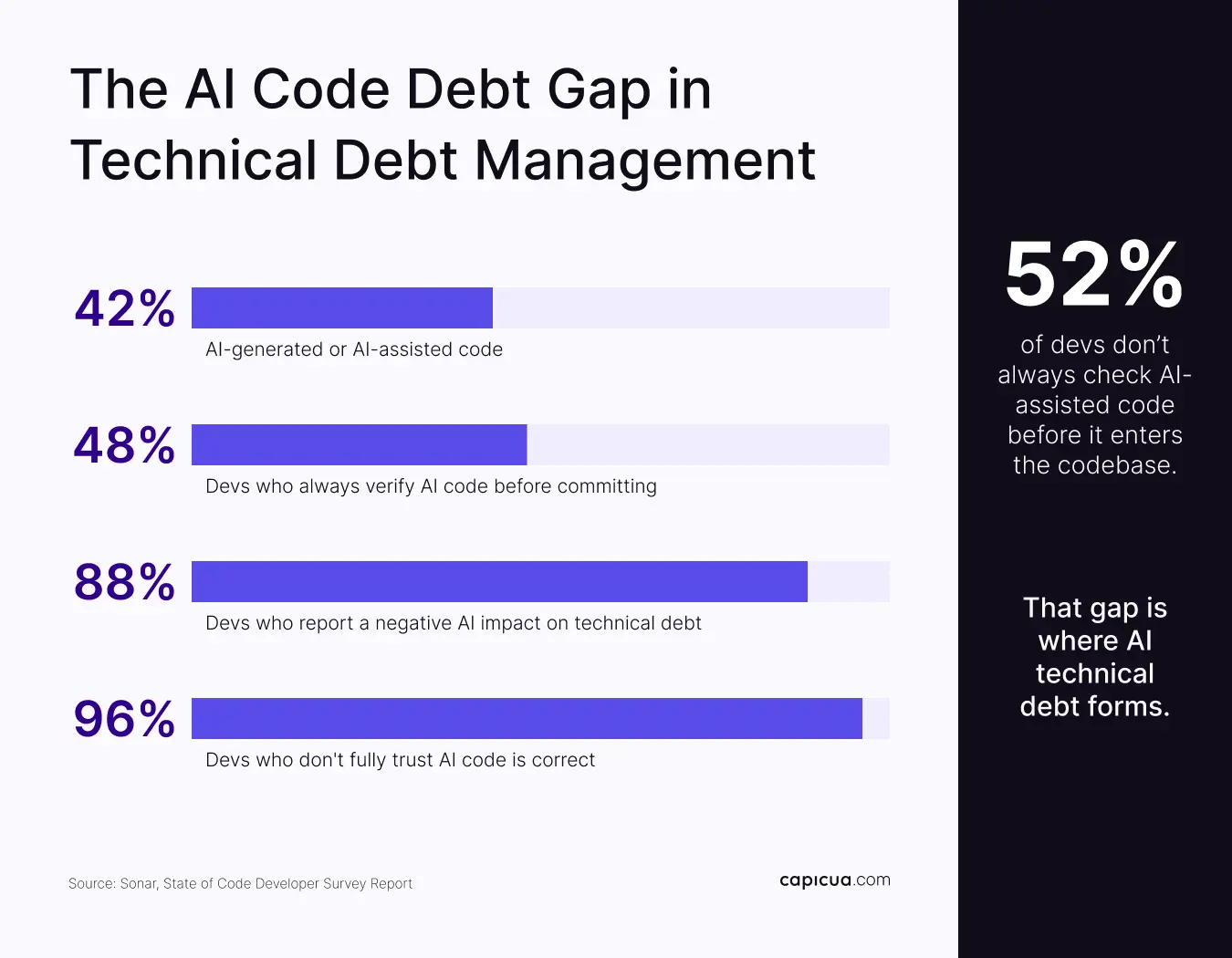
Managing technical debt now means managing how quickly AI tools create it. Sonar's State of Code Developer Survey, based on 1,149 professional developers, found that 42% of code is already AI-generated or AI-assisted, a share developers expect to reach 65% by 2027. Yet 96% don't fully trust AI-generated code to be functionally correct, and only 48% always check it before committing.
The outcome is a distinct category of AI technical debt: code that compiles, passes a quick review, and becomes expensive months later. In the same survey, 88% of developers report at least one negative AI impact on technical debt, most often code that looks correct but is unreliable (53%). Developers still spend 24% of their work week on toil, a figure that barely moves whether they use AI often or rarely. For leaders, this data has three implications:
- Throughput metrics overstate progress: Lines and pull requests shipped no longer approximate value delivered.
- Review capacity becomes the constraint: 38% of developers say reviewing AI code takes more effort than reviewing human code.
- Quality gates must apply to AI output by default: Static analysis, tests, and architectural rules need to run on every commit, whatever its origin.
IBM notes that "the same technology that can exacerbate technical debt is a powerful tool for resolving it," and 93% of developers report at least one positive AI impact on debt, led by better documentation. Teams that govern agents with clear roles and checkpoints turn AI into a refactoring accelerant.

How to Manage Technical Debt: A Six-Step Framework
How to manage technical debt comes down to six repeatable steps that turn a recurring engineering complaint into a governed portfolio. Capicua applies this sequence with product teams scaling past their first architecture.
- Make debt visible with a debt register: Log each item with its location, owner, affected product area, and the symptom it causes, such as slow releases or blocked features.
- Classify by type and intent: Separate deliberate debt, a known shortcut with a payback plan, from accidental debt caused by decay, drift, or outdated dependencies.
- Price interest alongside the principal: Estimate the engineering hours each item costs per sprint in workarounds, incidents, and slower delivery.
- Prioritize by business exposure: Score each item by interest rate and proximity to revenue-critical work. High-interest debt in the path of next quarter's bets goes first.
- Protect a capacity budget for paydown: Reserve a fixed share of each sprint or quarter for debt reduction and review it alongside feature commitments.
- Prevent new debt with guardrails: Extend the definition of done to include tests, documentation, architecture decision records, and automated quality checks for human and AI-generated code alike.
Most companies stall at steps three and four. Engineers know where the debt lives, and product leaders know what the roadmap needs. Technical debt prioritization works when both views sit in the same artifact and the same meeting. The payoff is less rework.

Technical Debt Management Strategies That Scale
The technical debt management strategies that hold up past Series B share one trait: they tie every debt decision to a business outcome the leadership team already tracks.
- Fund paydown through business cases: Every new initiative budget includes the cost of the debt it depends on. Because debt-aware AI business cases project 29% higher ROI, this change reframes paydown as an investment with a measurable return, not overhead.
- Modernize incrementally instead of rewriting: Replace legacy components piece by piece behind stable interfaces, following the strangler fig pattern, and avoid big-bang rewrites that freeze the roadmap for quarters. Legacy modernization compounds over time: infrastructure modernization can reduce technical debt by 10% in year one.
- Treat refactoring as product work: Tie refactoring to a roadmap outcome, such as a faster onboarding flow or a new integration, to prioritize it. Frame every paydown as a capability unlock, name the feature it enables, and put a date on it.
- Govern AI-generated code explicitly: Assign ownership, review standards, and static analysis rules to AI output. Forrester suggests that "if someone creates an agent, perhaps it should go into a repository for vetting before it's deployed," The same logic applies to generated code.
- Connect debt decisions to discovery: Much architectural debt starts as product uncertainty: code written for a use case nobody validated. Structured discovery sessions shrink the volume of speculative code that later becomes debt.
How to Measure Technical Debt: Metrics Product Leaders Should Track
Measuring technical debt works best with a small set of indicators that connect code health to business performance. Quantification is the hard part for most organizations: Gartner reports that infrastructure and operations leaders "struggle with capturing the magnitude and impact of technical debt in their environments."
Six metrics give founders and product leaders a usable dashboard:
- Capacity share on unplanned work: the percentage of each sprint lost to incidents, workarounds, and hotfixes.
- Interest per roadmap item: the estimated extra hours debt adds to each planned initiative.
- Change failure rate and lead time for changes: delivery signals that degrade first when debt rises.
- Technical debt ratio: remediation cost relative to development cost, most useful as a trend line.
- AI-code verification rate: the share of AI-assisted commits that pass review, tests, and static analysis before merge.
- Rework rate: capacity spent redoing work shipped in the previous two quarters.
Report these quarterly next to retention and expansion revenue. When the board sees debt interest beside churn, paydown earns a stable place on the roadmap. Our guide to scaling a business explains why operational foundations decide whether growth compounds or stalls.

Most technical debt traces back to decisions made without a shared picture of what the product needs to become. Shaped Clarity™ gives founders, product, and engineering one lens for those decisions, so every shortcut becomes a conscious bet with a payback plan, and every paydown connects to a product outcome. Start leveraging Shaped Clarity.
Conclusion
Technical debt management depends on who controls the roadmap: the team's intentions or the codebase's accumulated shortcuts. The companies that scale cleanly make debt visible, price its interest in the same currency as features, and govern AI-generated code before it compounds. Measurable debt becomes a lever, and ignored debt quietly taxes every bet.
To turn technical debt into a governed, roadmap-ready plan, contact us or book a call.