


Every product team that shipped an AI feature in the last two years has met the same wall: the model writes beautiful prose and then returns a JSON blob your parser chokes on. You add retries, a validator, a fallback prompt, and a human reviewer; and the feature works, sort of, yet it costs more per call than the decision it replaced.
Meanwhile, McKinsey's 2026 global survey found that 37% of organizations attribute any EBIT impact to AI, essentially flat year over year, while 80% of individuals say it made them personally more productive, and that's where most scaling companies are currently losing money. That was until TypeSafe AI proposed a different shape for the problem. Its first model, Jev, does not generate text at all: you hand it a block of state and a set of typed questions, and it returns typed decisions with probabilities and a calibrated confidence score that your code can branch on directly. TypeSafe calls it the System One model, and it launched alongside a US$40 million seed round led by DCVC.
For founders and product leaders, the interesting part is that the System One model can reframe what an AI call is inside a product: a function call with a contract, rather than a conversation you hope goes well. The reframing has real consequences for AI inference cost, latency budgets, and the rework that follows every unreliable integration.
What Is Jev TypeSafe AI System One Model?
Jev is a proprietary AI model from TypeSafe AI that returns typed values with probability estimates and confidence scores instead of natural language, designed to be consumed by software rather than read by a person. It's the first model in a class TypeSafe calls System One models, and was released in limited early access on September 15, 2026.
The name comes from two places. First, Jev honors nineteenth-century economist William Stanley Jevons, whose paradox holds that falling costs increase total consumption rather than reducing it. Second, System One borrows Daniel Kahneman's distinction between fast, intuitive System 1 thinking and slow, deliberate System 2 reasoning within the psychology of judgment and decision-making. The bet embedded in the name is that once a unit of machine judgment costs a rounding error, teams will put judgment in ten times more places.
The TypeSafe documentation describes a request as one block of state plus one or more typed questions, evaluated in parallel and in isolation. There are three question types:
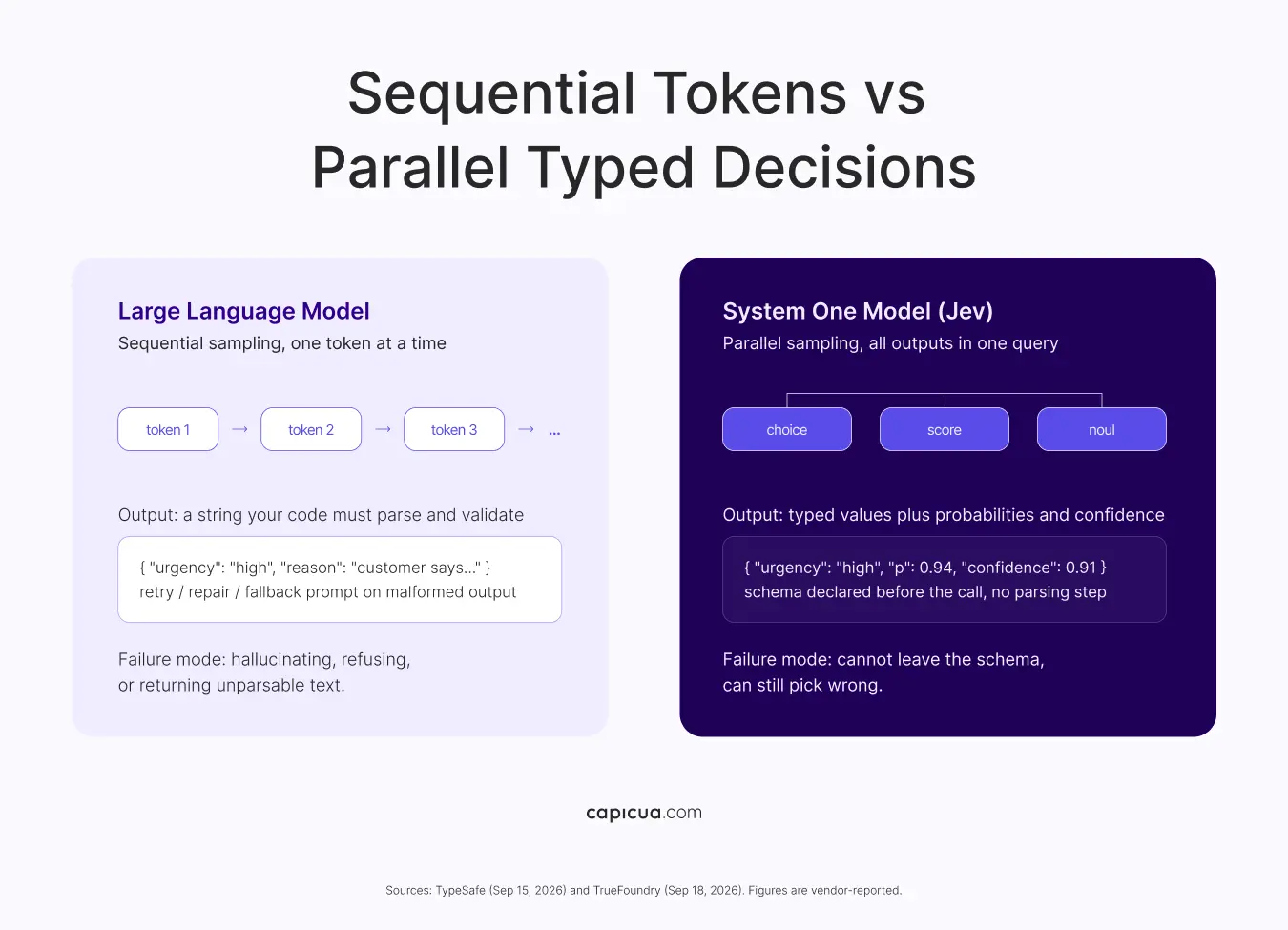
- Choice selects one option from a defined set and returns the selection, a probability per option, and a confidence score.
- Score rates the state against ordered levels and returns a score, the underlying distribution, and a confidence value.
- Noul evaluates whether a statement is true and returns a probability between 0 and 1.
Because the answer space is declared before the call, the model cannot return a value outside the schema, which TypeSafe frames as eliminating type errors and hallucinated fields by construction. The company has not published Jev's architecture, weights, or a technical paper, describing the model only as transformer-based and trained exclusively on synthetic data using Reinforcement Learning for Calibrated Decisions (RLCD).
System One Model vs Large Language Model LLM
A System One model differs from an LLM in three structural ways: it samples in parallel rather than autoregressively, it returns schema-bound values rather than strings, and it attaches calibrated confidence to every field rather than expressing certainty in prose.
This sampling difference drives the performance claims: while an LLM generates one token at a time, each conditioned on the last, Jev uses what TypeSafe describes as a parallel sampler that produces all outputs in a single query. Adding a second or third question to a request barely moves response time, because each question is evaluated independently against the same state, which also means there is no context rot across questions.

The training difference matters more for product decisions. Reinforcement Learning from Human Feedback (RLHF) optimizes for responses human raters prefer, which is why modern LLMs are superb conversational partners and inconsistent decision-makers. On the other hand, RLCD optimizes probabilities against outcomes instead of rater preference, making calibration a property of the model, not something you prompt for.
Lastly, and not least importantly, Jev generates no text whatsoever, whether it be summaries, explanations, or rationale; while also capping choice cardinality at 255 options, above which TypeSafe uses a slower two-stage approach that scores candidates independently before making an explicit choice. LangChain's engineering team put the boundary plainly: Jev is not a drop-in replacement for an LLM, and the sensible pattern is an LLM for open-ended reasoning with a System One model handling the fast structured decisions along the way.
What Does Jev Cost, and How Fast Is It?
At the time of writing this article (Sep 2026), Jev is priced at $0.042 per million input tokens with output tokens free, and reports end-to-end response times of 70 to 500 milliseconds. TypeSafe's comparison against frontier models is 193.6x faster and 444.6x cheaper.
The more useful numbers sit in the underlying evaluation. Across four workflows covering security incident response, agent trace observability, invoice processing, and customer service, DataCamp published this comparison:
Jev ties the mid-tier frontier model on accuracy at roughly one seventy-sixth of the cost per case and twenty-five times the speed. In contrast, the larger models keep a genuine five- to six-point accuracy advantage. The shape favors high-volume decisions where a small accuracy delta is tolerable and an unbounded cost curve is not.
However, AI interference is already a live constraint: McKinsey found that one in five organizations is limiting AI use because of operating costs, and that high performers hit cost ceilings on coding agents about three times as often as everyone else. At roughly $0.0004 per case, scoring fifty million product reviews for sentiment and policy violations lands near $20 rather than several thousand. Decisions now happen in the request path.
The strategic unlock of a System One model lives in the judgment calls that were never worth an LLM call in the first place, which is a scope change.
System One Models and Product Architecture
A System One model belongs at the high-volume decision layer of a product: classification, routing, scoring, extraction, and verification, with escalation to an LLM or a human when confidence is low. This is the placement that both TypeSafe and its early integration partners converge on. LangChain shipped a langchain-typesafe package with two patterns worth studying even if you never call Jev:
- Model routing: Jev reads the latest user message against natural-language criteria and picks which model handles the run, keeping probabilities and confidence in agent state.
- Tool risk gating: Jev screens tool calls for risky actions and blocks them before execution, a pattern previously locked inside closed-source coding harnesses.
Both are governance patterns in engineering clothes, which Forrester describes as a "trust tax" on agentic systems, where every autonomous action has to be logged and defensible to an auditor. The journal also notes that roughly three-quarters of enterprise leaders say they are adopting agentic AI while only a small minority run it in meaningful production. A cheap, fast, calibrated confidence signal on every action is one of the few things that makes that tax affordable.
Four actions shape the fit:
- Smart conditionals that replace brittle hand-written rules with classification, routing, and branching.
- Map-reduce over large datasets that turn unstructured records into features at row-level cost.
- Real-time interactions where a 100-millisecond budget rules out a frontier model entirely.
- Verification layers that score, judge, and guardrail the outputs of the LLMs already in your stack.
If your team is already thinking in terms of orchestration, this maps cleanly onto the design questions covered in Capicua's guide to autonomous agents and multiagent systems and the decision-rights framing in AI governance for digital products.

What Should Product Leaders Consider Before Betting on Jev
Before committing roadmap to Jev, verify four things: the benchmark provenance, the interpretability gap, the access model, and the calibration claim that nobody outside TypeSafe has tested.
TrueFoundry's audit discovered that the 193.6x and 444.6x figures come from workflow evaluations TypeSafe invented, built by its own model capabilities team, scored against reference answers averaged from GPT-6 Astra and Fable 5.1, with competing models wrapped in TypeSafe's own adapter. TypeSafe itself flags all three biases and says real-world gains will land below the headline. Credit where due for the candor, and skepticism where due for the number.
"Cannot hallucinate" is narrower than it sounds. A model that emits no free text cannot invent a citation or a tool name, and schema conformance is genuinely guaranteed. A model constrained to three categories can still confidently pick the wrong one. It eliminates malformed answers, not mistaken judgment, and the 0% error rate on structured output comes from construction rather than measurement in the wild.
There's also no rationale to audit. Jev returns a probability, not an explanation, which, in regulated domains, is a real constraint on debugging and on audit trails, and the workaround is architectural: keep the System One model at the routing layer and escalate flagged cases to a model that can explain itself.
Last but not least, access is narrow as of this writing. Jev is proprietary, hosted behind a single API, waitlisted, with no published weights and no on-premises option. TypeSafe is also open that it cannot prove current pricing is unsubsidized, though it expects prices to fall.

How To Pilot a System One Model Without Rework
Pilot a System One model by isolating one high-volume decision you already measure, running it in shadow mode against your current approach, and promoting it only when calibration holds on your data. The sequence matters more than the tooling.
- Pick a decision you can already score: Support ticket urgency, refund eligibility, lead qualification, content policy flags. If you cannot measure today's accuracy, you cannot evaluate a replacement.
- Decompose it into single-judgment questions: TypeSafe's own guidance is that each question should be a gut check a knowledgeable person could make in seconds. Market size, feasibility, and differentiation as separate questions, recombined in your own code.
- Run it in shadow: Log Jev's decision and confidence next to the production decision without acting on it, and remember you're testing calibration beyond accuracy.
- Set thresholds: Act autonomously above a confidence line, escalate below it, which is where the cheap confidence signal earns its keep.
- Instrument escalation rate: A rising escalation rate is the earliest signal that your state has drifted away from what the questions assume.
- Only then move a decision into the request path: Latency gains are also the point where a wrong call becomes visible to a customer.
New model classes are easy to adopt and expensive to adopt badly, because each one quietly changes which decisions your product makes automatically and which ones a person still owns. Shaped Clarity™ keeps that map explicit as the tech underneath it shifts, so that models can enter your architecture as a deliberate bet with a threshold and an owner. Discover more about Shaped Clarity.
Conclusion
Machine judgment is becoming a typed, cheap, callable primitive, and that changes the economics of every decision your product currently hard-codes, batches overnight, or routes to a person by default. Whether TypeSafe's specific numbers hold up under independent testing is a question for the next two quarters of evaluation, and the architectural question is already live regardless of the answer. Product leaders who map their decision layer now will be ready to swap in whichever model wins, while those waiting for the benchmarks to settle will spend that time rebuilding prompts.
To design a decision layer your product can evolve without rework, get in touch with Capicua: contact us or book a call.