


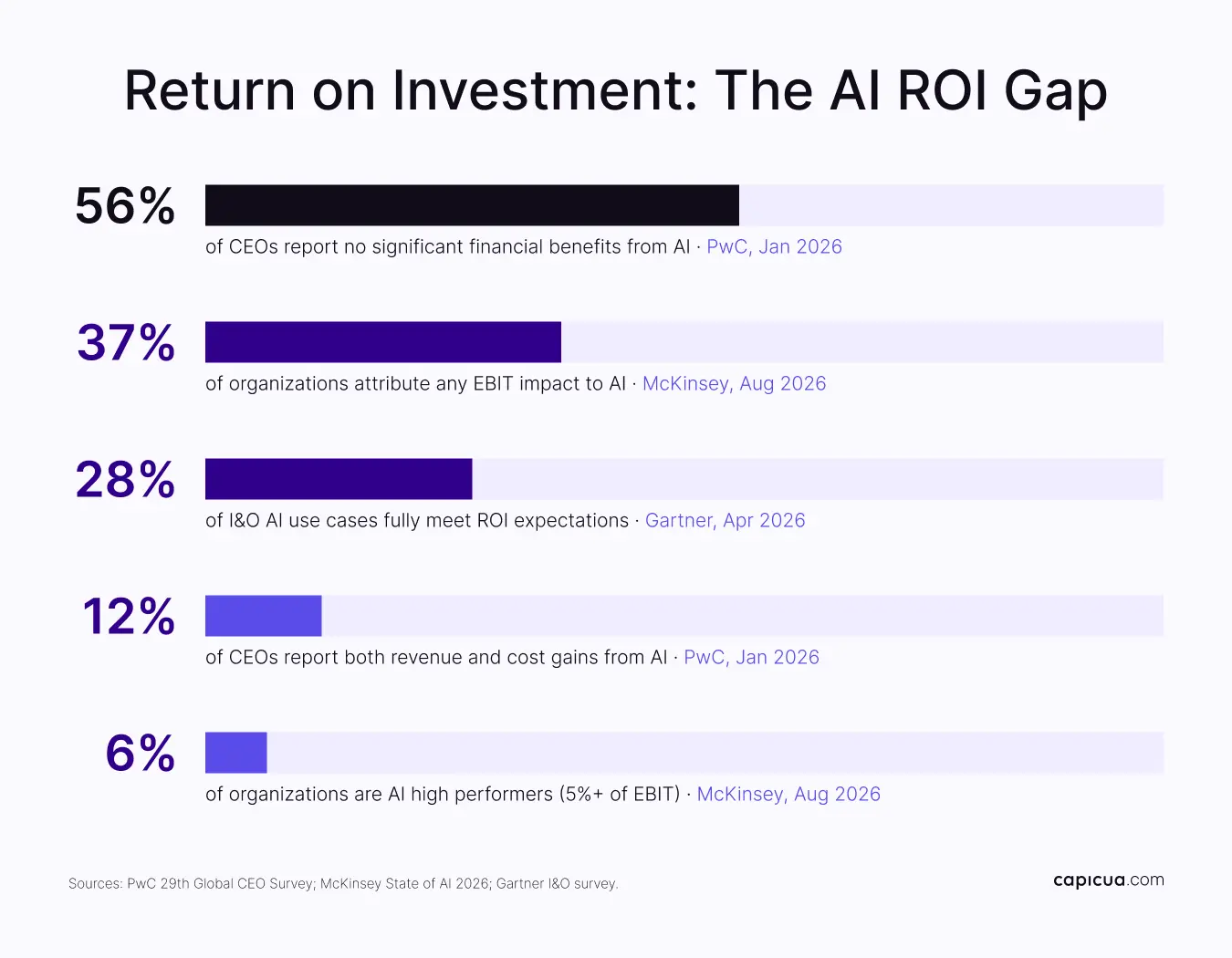
Corporate AI budgets are on track to double this year, from roughly 0.8% to about 1.7% of revenue, according to BCG's AI Radar 2026, but returns have not kept pace. In PwC's Global CEO Survey, 56% of 4,454 CEOs said AI had delivered no significant financial benefit to date, and only 12% reported gains in both revenue and cost.
For founders and leaders at scaling companies, that gap now lives in the board deck, in the P&L's inference line, and in the question every CFO eventually asks about the AI roadmap: what did we get back? AI return on investment has become the metric that decides which AI bets keep funding, and teams that pass tend to win on operating discipline, with model choice a distant second. In practice, Artificial intelligence ROI is a management problem.
This guide covers how to define AI ROI for a software product, why returns stall after the pilot, how to calculate return on AI agent investment with fully loaded costs, how the ROI of generative AI differs from agentic systems, and what AI ROI operations look like when returns compound quarter after quarter.
What Is AI Return on Investment for Software Companies?
AI return on investment is the net financial value an AI initiative produces, measured against its fully loaded cost over a defined period and compared with what would have happened without it. In software, that value shows up in four places: lower operating costs, higher revenue, shorter cycle times, and reduced risk.
Two parts of that definition carry most of the weight. The first is fully loaded AI cost, including inference, evaluation, human review, governance, and the rework AI output creates downstream. The second is the baseline your team would have reached anyway with existing tools and headcount. Most AI business cases skip both, so projected returns rarely survive a finance review.
Data shows how wide the gap between adoption and AI value realization has become:
- Artificial intelligence ROI remains concentrated: McKinsey's State of AI in 2026 found that 37% of respondents attribute any EBIT impact to AI, about the same share as last year, and only around 6% qualify as high performers attributing 5% or more of EBIT to it.
- Individual gains rarely reach the P&L: The McKinsey survey found that 80% of respondents say AI has improved their individual productivity, more than double the share reporting any EBIT impact.
- Disciplined organizations are pulling ahead: KPMG's Q3 2026 AI Pulse Survey found that nearly 6 in 10 leaders at $1B+ organizations report measurable business value, with 37% citing stronger financial performance.
For a post-PMF SaaS company, a narrower definition is most useful: AI ROI is the change in unit economics, gross margin, retention, or delivery speed that you can attribute to a specific AI capability and defend in a board meeting. When AI features are meant to drive expansion, tie them to the same retention math covered in Capicua's guide to net revenue retention.
Why Does Artificial Intelligence ROI Stall?
Artificial Intelligence ROI stalls after the pilot because AI lands in workflows that were never redesigned to use it, while costs that were invisible in the demo arrive at scale. The model usually performs as advertised, yet the surrounding system caps its output.
A Gartner survey of infrastructure and operations leaders quantifies the pattern: only 28% of AI use cases fully succeed and meet ROI expectations, while 20% fail outright. Leaders who reported a failure most often said they expected too much, too fast, and 38% named poor data quality or limited data availability as a direct cause.
Three failure modes account for most stalled returns in product organizations:
- Bolt-on deployment: AI gets inserted into an unchanged process, so the old process sets the ceiling. McKinsey found that nearly three-quarters of AI high performers redesigned workflows because of AI, compared with about a quarter of everyone else.
- Invisible run costs: About one in five McKinsey respondents say AI operating costs, including tokens, have already constrained their AI use. Usage-based costs that seem trivial in a pilot compound as adoption grows.
- Commitment without measurement: BCG reports that more than 90% of organizations plan to keep investing at current or higher levels even if AI does not pay off in the next year. Conviction keeps budgets alive and removes the forcing function that would expose a weak business case early.
Debt is another dimension that ROI models rarely capture. AI-generated code and content that ships without enough review accumulates cost later, a pattern covered in Capicua's playbook on technical debt management. Every hour of rework that follows an AI rollout belongs on the cost side of the ledger.

How to Calculate Return on AI Agent Investment
To calculate return on AI agent investment, subtract the agent's fully loaded cost from the net value it creates over 12 months, then divide by that fully loaded cost, after discounting value for real adoption, review time, and error rates.
Four things belong in fully loaded AI cost:
- Build cost: engineering, integration, data preparation, and the evaluation harness.
- Run cost: inference and token spend, platform fees, storage, and monitoring.
- Oversight cost: human review time per task, evaluation runs, and governance overhead.
- Correction cost: rework on wrong outputs, escalations, and customer-facing incidents.
How to Calculate AI agent ROI in Six Steps
- Baseline the current work: Measure task volume, minutes per task, error rate, and loaded hourly cost before the agent exists. Without a baseline, every projection is an estimate against memory.
- Estimate realistic coverage: Define the share of tasks the agent can complete end to end, then apply an adoption rate. Coverage on a curated test set overstates coverage on production traffic.
- Subtract review time: Every task an agent touches still costs human minutes for approval or spot checks. Net time saved equals baseline minutes minus review minutes.
- Price the errors: Multiply handled tasks by the error rate, and by the minutes it takes to fix each mistake. This is the line most AI business cases omit.
- Add run and oversight cost: Include monthly inference, platform fees, and the hours your team spends evaluating and governing the agent.
- Compare against the counterfactual: Credit the agent only with value your team couldn't reach through existing tools, a process fix, or simpler automation.
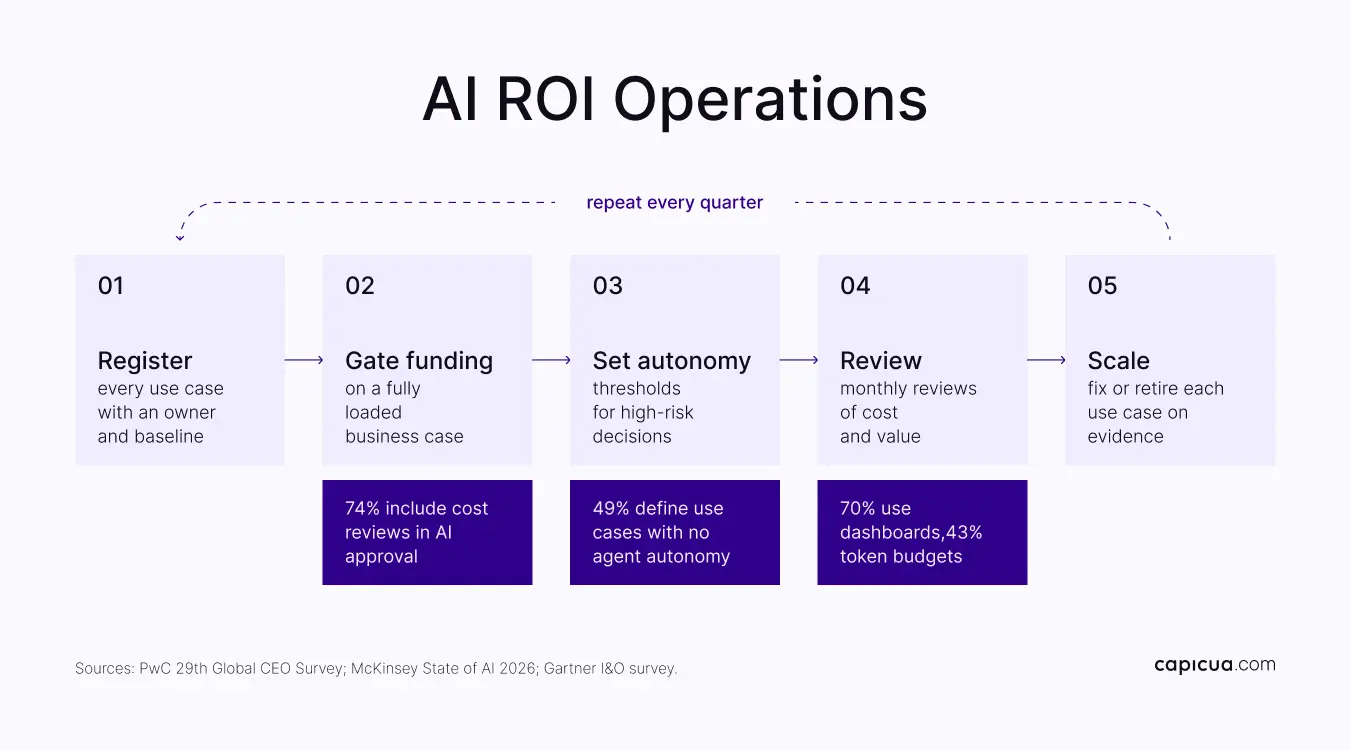
Disciplined teams are instrumenting these inputs. In KPMG's Q3 2026 survey, 74% of teams include cost reviews in AI approval processes, up from 61% the previous quarter; 70% use AI monitoring dashboards; and 43% have implemented usage or token budgets.

What Is the ROI of Generative AI Compared With AI Agents?
The ROI of generative AI comes mostly from individual productivity, faster drafting, coding, and research, while AI agent ROI comes from completing multi-step workflows with limited human involvement. Generative AI returns are easy to capture and hard to prove; agent returns are easier to prove and harder to capture safely.
Generative assistants spread quickly because the unit of value is a person, which is why McKinsey's 80% individual productivity figure is so high. The hard part is conversion: saved minutes scatter across calendars unless someone redesigns the work to bank them as capacity, shorten cycle times, or eliminate work the company no longer needs to do.
Agents change the unit of value from a person to a process. BCG's AI Radar found that 15% of CEOs direct more than half of their 2026 AI investment to agents and are about twice as likely as cautious peers to deploy them end to end across a workstream. 40% of organizations with revenue above $1B now scale AI agents, up from 27% a year earlier.
Agentic AI ROI carries a different risk profile, and Gartner predicts that by the end of 2027, 40% of agentic AI projects will be canceled because of escalating costs, unclear business value, or inadequate risk controls, while arguing that agents earn autonomy by proving reliability first. In practice, agents pay back fastest where several outcomes are acceptable, and errors are contained, then expand scope as reliability is demonstrated. Capicua's guide to agentic design patterns maps patterns to autonomy levels, and our breakdown of AI agent orchestration covers coordinating agents without multiplying cost.
- Generative AI fits work drafted for a human to finish. Measure its ROI through cycle time and throughput per person.
- AI agents fit processes with clear inputs, bounded outcomes, and a measurable cost per transaction. Measure ROI per completed workflow.
- Hybrid systems fit cases where an agent routes and executes while a generative model explains, summarizes, or drafts for review.
How Do AI ROI Operations Keep Returns Compounding?
AI ROI operations is the discipline of managing AI initiatives as a product portfolio, with shared scoring, AI cost governance, and regular decisions to scale, fix, or retire each use case. It turns a one-time business case into a recurring management loop.
The case for a portfolio approach is well documented, and Gartner recommends managing AI use cases as a product to avoid duplication, with a shared scoring model that ranks each one on feasibility, risk, cost, and expected business impact. PwC also found that CEOs whose organizations built strong AI foundations are three times more likely to report meaningful financial returns. AI ROI operations have five main moves:
- Register every AI use case in one portfolio, with an owner, a baseline, and a target metric.
- Gate funding on a fully loaded business case that includes run, oversight, and correction costs.
- Set autonomy thresholds: KPMG found that 49% of leaders have defined high-risk use cases where agents may not make autonomous decisions.
- Review cost and value monthly with token budgets and dashboards, so drift shows up before the quarter closes.
- Scale, fix, or retire: Promote use cases that clear their hurdle, redesign the workflow around those that nearly do, and sunset the rest.
Gartner's October 2026 analysis estimates that more than $3.5 trillion of AI infrastructure spending could be impaired by the end of 2030 because AI revenue is forecast to fall short of what planned capital spending requires, which can be read as vendor economics adding urgency. Leaders can read that as a reason to stress-test every business case against higher future inference prices, since providers under return pressure have every incentive to reprice. For the accountability side of the loop, Capicua's guide to AI governance for digital products covers decision rights and ownership.
Which AI ROI Metrics Should Product Leaders Report?
The AI ROI metrics that belong in a board report connect leading signals, such as cycle time and capacity, to lagging financial outcomes, such as gross margin and retention. Reporting only lagging metrics leaves AI looking unproven for quarters, and reporting only leading metrics invites the fair question of whether any of it reached the P&L.
Gartner's "Achieving AI Agent ROI: What Leading Product Teams Measure First" notes that the best product teams track speed, life cycle effectiveness, and capacity first as proof of AI impact, a sequence that mirrors how value matures inside a product organization.
Leading indicators for the first two quarters:
- Cycle time from request to shipped outcome for AI-assisted workflows.
- Capacity released, measured as hours redeployed to roadmap work.
- Adoption depth, the share of eligible tasks actually routed through the AI capability.
- Escalation and error rate, the earliest warning that coverage or quality is drifting.
Lagging indicators from quarter three onward:
- Cost per transaction for workflows the AI handles end to end.
- Gross margin impact after inference, oversight, and correction costs.
- Revenue and retention effects for customer-facing AI features, tracked through expansion and churn.
- Fully loaded ROI per use case, compared against the funding hurdle rate.
Every AI metric on a board slide should have a named owner who can explain how it was calculated and what would change it. For a wider view of how AI is reshaping what customers count as value, see Capicua's analysis of product value in the AI era.

Most stalled AI returns trace back to capability being funded before the decision it was meant to improve was clearly defined, measured, and owned. Shaped Clarity™ gives product teams that definition first, aligning the workflow, the user outcome, and the business metric before an agent or model enters the picture. The result? Products that can swap models, absorb new cost structures, and keep compounding returns without constant rebuilding. Learn more about Shaped Clarity.
Conclusion
Organizations that convert AI spend into a financial return baseline before they build count the costs demos hide and manage AI as a portfolio with owners, thresholds, and the willingness to retire what doesn't clear the bar. This discipline separates the 12% of CEOs reporting both revenue and cost gains from everyone else.
To turn AI spend into returns your board can verify, contact us or book a call.