

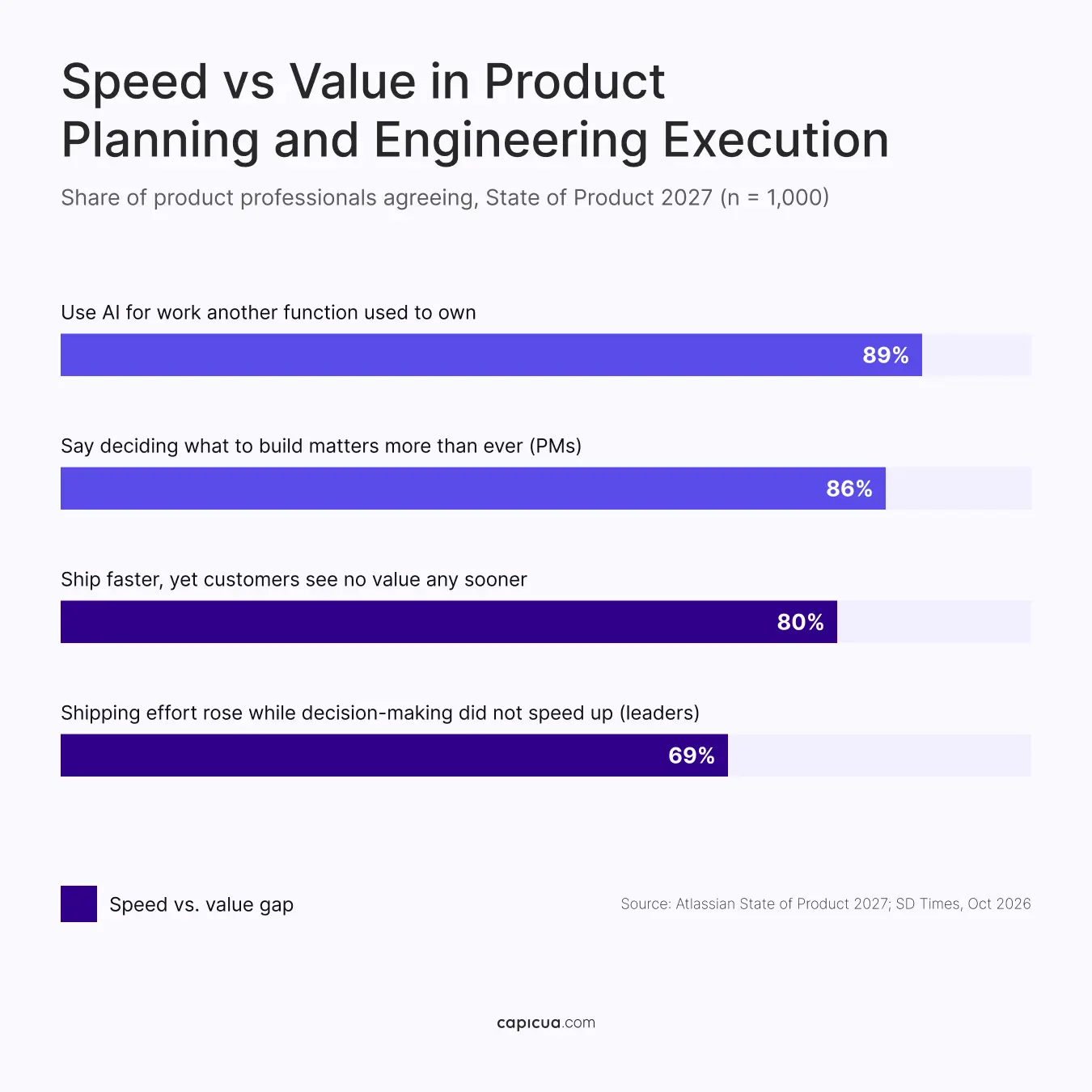
80% of product professional teams say they're shipping faster, but customers aren't seeing the benefits any sooner, according to Atlassian's State of Product 2027 survey of 1,000 product professionals. The same research found that 69% of product leaders agree they've put in more effort to ship faster while decision-making hasn't sped up, even with AI.
That gap sits between the roadmap the board approved and the work engineering actually delivers. For founders and leaders, being able to align product planning and engineering execution is how to close the gap, so every sprint spends capacity on a bet the business still believes in. As AI compresses build time, product and engineering alignment has become the main constraint on growth, and common mistakes aligning product and engineering cost more because they compound faster.
This guide covers what alignment means in an AI-assisted software development model, why it breaks down after product-market fit, the mistakes that keep repeating, a six-step operating rhythm, and the metrics that prove it is working.
What Does It Mean to Align Product Planning and Engineering Execution?
To align product planning and engineering execution means that the decisions made in planning (which problems to solve, for whom, in what order, and at what cost) remain the same decisions engineering is executing against at any point in the quarter, with a shared understanding of tradeoffs and a fast path to change them when evidence shifts.
In practice, product and engineering alignment has three layers:
- Intent alignment: Product, design, and engineering agree on the outcome a bet should move and why it matters now.
- Capacity alignment: The product roadmap reflects the real engineering capacity left after maintenance, technical debt, and incident load, measured against actual availability rather than theoretical headcount.
- Decision alignment: Everyone knows who owns which call, how scope changes get made, and how long a blocked decision can wait.
Most teams invest heavily in intent alignment and very little in decision alignment. The LeadDev Engineering Team Performance Report 2026 found that 68% of interviewed engineering professionals say aligning priorities across teams is a challenge, 57% point to ownership and accountability, and 52% cite a lack of information or visibility. These decision-layer failures are not fixable with a better roadmap template.
Alignment also changes shape once a company is past product-market fit. Early on, the founder holds the plan and the code in one head; at Series A to C, the plan lives in a roadmap tool, execution lives in a ticketing system, and the reasoning that connects them often lives nowhere. Capicua's work on the product vision framework and leadership clarity in product teams starts from the same premise: alignment depends on how decisions travel, and that path needs to be designed.
Why Product and Engineering Alignment Breaks Down as AI Speeds Delivery
Product and engineering alignment breaks down under AI because engineering execution now outruns the decisions that should guide it. When code becomes cheap, every unclear requirement, unowned decision, and stale roadmap assumption gets built faster and at greater volume.
In the LeadDev Engineering Team Performance Report 2026, 52% of respondents say the biggest delivery bottleneck is now code review and validation, 22% say it has shifted to product specification and requirements, and only 7% say it is still writing code. Upstream, 86% of product managers agree that deciding what to build matters more than ever.
Roles are blurring at the same time, with 89% of product teams now using AI for work previously handled by another function, and 67% agreeing it's hard to define their role now, per SD Times. Overlapping roles help by shortening handoffs, but they get expensive when nobody knows which function owns a tradeoff.
The human cost lands on the leaders translating plans into delivery: the LeadDev Engineering Leadership Report 2026 found that 54% of surveyed CTOs feel emotionally drained by their work at least once a week, up from 24% in 2025. The organizations getting real value from AI respond by redesigning the work itself: McKinsey's State of AI 2026 reports that nearly three-quarters of AI high performers fundamentally redesigned workflows because of AI, compared with about one-quarter of other respondents.
Three forces pull planning and execution apart:
- Throughput inflation: More code ships per sprint, so a misaligned bet produces more rework before anyone notices.
- Specification debt: Thin requirements were tolerable when engineering time forced a conversation. With AI agents, a vague ticket becomes a finished feature.
- Role drift: As product, design, and engineering overlap, decision rights that were once implicit need to be written down.
Common Mistakes Aligning Product and Engineering
The common mistakes aligning product and engineering share one root cause: alignment gets treated as a quarterly event, such as a planning offsite or roadmap review, while the decisions it covers keep changing every week.
Seven mistakes show up repeatedly in post-PMF SaaS companies:
- Planning features with no outcome attached: A feature list tells engineering what to build and nothing about what success looks like, so every scope trade-off becomes a negotiation. An outcome-based roadmap gives engineers the context to make good calls without escalating each one.
- Bringing engineering in after the decision: When engineers first see a bet at handoff, feasibility risk surfaces in sprint three instead of week one. 79% of tech leaders flag ownership and accountability as a collaboration problem, well above the 57% average.
- Planning against headcount with no capacity model: Roadmaps that ignore maintenance, incidents, and debt promise work that cannot fit. Technical debt and maintenance is a priority for 48% of engineering organizations over the next 12 months, capacity that rarely appears on a product roadmap.
- Leaving decision rights implicit: Who can cut scope? Who decides when a date moves? When nobody knows, decisions wait for the next meeting, and AI-accelerated teams keep building in the meantime.
- Measuring output and calling it progress: Velocity, tickets closed, and pull request counts are easy to inflate with AI. Only 44% of engineering professionals believe their current metrics reflect the value their team delivers.
- Writing specs that only humans can interpret: With 22% of teams naming product specification as their new bottleneck, vague requirements turn into confident, wrong code. Specs need explicit acceptance criteria, constraints, and the reason the work exists.
- Freezing the roadmap after approval: A plan that can only change at the next quarterly review forces teams to choose between executing a stale bet and improvising without authority. Both erode trust between product and engineering.
Each of these mistakes is cheap to make and expensive to discover. Capicua's breakdown of the cost of rework in software development covers how small planning misses compound once they reach production.

How to Align Product Planning and Engineering Execution: A Six-Step Operating Rhythm
Align product planning and engineering execution by replacing quarterly handoffs with a standing operating rhythm that connects outcomes, capacity, decisions, and evidence.
The six steps below work for most Series A to C SaaS organizations without adding a new framework.
- Anchor every bet to one outcome and one owner: Write each roadmap item as a problem, the customer it affects, the metric it should move, and the single person accountable for the tradeoff, so that engineering can reason about the product roadmap.
- Plan with the product trio from day one: Product, design, and engineering shape the bet together during discovery sessions, so value, usability, and feasibility risks are tested before commitment.
- Build an honest capacity model: Subtract maintenance, incident load, platform work, and debt paydown before allocating roadmap work. Publish the reserved share, so capacity planning is visible to leadership and the board.
- Write a decision-rights map: List the recurring calls (scope cuts, date changes, architecture choices, quality bars) and name who decides, who is consulted, and the maximum time a decision can wait. Atlassian's session with Forrester urges leaders to revisit which decisions each team owns as their responsibilities evolve.
- Write specs for humans and agents: Every ticket that reaches an AI-assisted team should state the outcome, acceptance criteria, constraints, and non-goals. Clear specs reduce the review load that now dominates delivery.
- Run a weekly alignment review on evidence: Fifteen minutes; product and engineering leads review what shipped, what moved, what changed in capacity, and which decisions are waiting. Small weekly adjustments keep the quarterly review a confirmation, not a reset.
Before changing the rhythm, map how a bet actually travels from idea to production. A value stream map exposes the waiting time between decisions, where alignment is usually lost. If your organization is moving toward a product operating model, this rhythm is the practical layer that holds under delivery pressure.

Which Metrics Show Product and Engineering Alignment is Working?
The metrics that show product and engineering alignment is working measure whether shipped work changes outcomes and how quickly the organization makes and revises decisions. Activity metrics alone answer neither question.
In LeadDev's 2026 performance data, 68% of respondents avoid lines of code as a metric and 32% avoid pull request counts, citing gaming and metrics that reward activity over outcomes, and only 31% of organizations currently measure the impact of AI-powered developer tools. The pressure to prove value is real: 84% of engineering leaders say engineering productivity is a top management concern.
Five measures carry most of the signal:
- Outcome hit rate: The share of shipped bets that moved their target metric within the agreed window.
- Decision latency: The median time from a blocked decision being raised to it being made. Long latency is the clearest symptom of unclear decision rights.
- Planned vs. unplanned capacity: The share of engineering time spent on roadmap work compared with unplanned work, rework, and incidents.
- Rework ratio: The share of capacity spent revisiting work shipped in the last two quarters.
- Time to customer value: The time from release to first meaningful use by the target segment; the gap between shipping faster and customers benefiting sooner.
Among LeadDev respondents aware of DORA metrics, 50% now rate them effective or very effective, up from 41% in 2025. DORA tells you whether delivery is healthy, and the five alignment measures tell you whether healthy delivery is aimed at the right outcomes. Capicua's guide to product insights covers how to turn signals into the next round of bets.

Most misalignment between planning and execution traces back to decisions that travel without their reasoning attached. Shaped Clarity™ is the lens Capicua uses to keep outcomes, capacity, and decision rights visible to product, design, and engineering at the same time, so a roadmap can change direction without triggering a rebuild. Teams that work this way spend AI-accelerated capacity on bets the business still believes in, and adapt as users and markets move. Discover Shaped Clarity.
Conclusion
AI has made engineering execution abundant and decision quality scarce; hence, growing requires planning that keeps pace with the delivery: outcome-owned bets, honest capacity, explicit decision rights, and a weekly rhythm that lets evidence change the plan.
To align product planning and engineering execution without slowing your teams down, contact us or book a call.