


PwC's April 2026 survey found that 73% of SaaS leadership teams picked one or more of the same top three strategic actions since early 2025: increased AI investment, stronger risk management, and adjusted trade strategy. When every competitor makes identical moves, those moves become the price of staying in the game, and advantage shifts to the teams that can see further and choose better: a capability known as strategic thinking.
Russell Reynolds Associates surveyed more than 2,700 leaders and found strategic thinking to be the leadership capability rated most important today, yet the same pressure that makes it so valuable also crowds it out of the calendar. Founders and product leaders at post-PMF SaaS companies see the cost in roadmaps that reset every quarter, features nobody adopts, and strategic planning cycles that produce documents instead of decisions.
This guide covers how to define strategic thinking, how strategic thinking vs tactical thinking plays out inside a product organization, which strategic thinking skills matter in the AI era, and how a leadership development strategic thinking process turns the capability into a team habit.
How Do You Define Strategic Thinking for Software Products?
Strategic thinking connects today's decisions to a company's long-term position by reading patterns across markets, customers, and capabilities, then choosing where to commit scarce resources. In a software company, it means deciding which problems the product should own, which bets deserve the next two quarters of engineering capacity, and which opportunities the team will deliberately decline.
Russell Reynolds frames it in terms most product leaders will recognize: lifting focus above immediate execution, spotting patterns across functions and stakeholders, and understanding how a trade-off in one area changes performance in another. Their research found that 58% of leaders identify strategic thinking as the most critical skill for navigating threats to organizational health.
To define strategic thinking precisely for a product organization, it helps to separate it from its two closest neighbors:
- Strategic thinking generates and tests options. It asks what should be true in 18 to 36 months, and why.
- Strategic planning converts the chosen option into commitments: goals, sequencing, budgets, owners, and review points.
- Strategic execution delivers against those commitments, sprint by sprint.
In practice, three traits mark a strategic thinker inside a SaaS company:
- Pattern recognition across product usage, sales conversations, churn signals, and competitor moves.
- Second-order reasoning about what a decision triggers downstream, including pricing, architecture, and team structure.
- Deliberate trade-offs, where saying no to a segment or a feature is a planned outcome of the strategy.
The pressure to get this right is rising, with 63% of leaders naming technological change as the top factor affecting organizational health over the next 12 to 18 months (preparedness for it reached only 51%) in the Global Leadership Monitor H1 2026.
Strategic Thinking vs Tactical Thinking: What Is the Difference?
Strategic thinking vs tactical thinking comes down to the question each one answers: strategic thinking decides what to pursue and why, while tactical thinking decides how to deliver it well within a given window. Product organizations need both, and most failures happen when one is mistaken for the other.
Five dimensions separate strategic thinking and tactical thinking:
- Time horizon: Strategic thinking spans 12 to 36 months; tactical thinking spans sprints and quarters.
- Unit of decision: Strategy chooses markets, segments, and capabilities; tactics choose features, tasks, and sequences.
- Reversibility: Strategic choices are expensive to undo, so they deserve slower, evidence-heavy debate. Tactical choices are cheap to reverse and should move fast.
- Success signal: Strategy is measured by position: retention, net revenue retention, and differentiation. Tactics are measured by delivery: velocity, quality, and cycle time.
- Information: Strategy tolerates ambiguity and incomplete data; tactics need clear requirements to move.
The most common failure in scaling SaaS is tactical motion presented as strategy. PwC found that when a major external disruption hits, 98% of executives select at least one defensive response, such as preserving cash, compared with 76% who select an offensive move like accelerating innovation. Defense is often necessary, but a roadmap built only from defensive reactions is a list of tactics with no direction behind it, and it's the fastest route to feeling like every sprint is a reset.
The reverse failure is just as costly: a strategy deck nobody can translate into work. The same PwC survey reports that 68% of executives struggle to translate uncertainty into business decisions. Teams that close this gap make every tactical decision traceable to a strategic choice, the same discipline that reduces the cost of rework in software development.

How Does Strategic Thinking Shape Strategic Planning?
Strategic thinking shapes strategic planning by supplying the choices the plan commits to; without it, planning becomes budgeting with a timeline attached. A plan is only as good as the options considered and the assumptions tested before anyone writes a roadmap.
BCG's 2026 study of 175 chief strategy officers shows more than three-quarters saying balancing short-term pressure with long-term value is a major part of their job, yet half stated they weren't confident they could manage it. Only 2% of companies handle that trade-off well across growth and profitability in good times and bad, yet 94% rated continuous reinvention as critical, with only 12% feeling well prepared.
For a post-PMF software company, that gap shows up in four predictable places:
- Annual plans that ignore new evidence, so the roadmap defends last year's assumptions.
- Quarterly plans with no long horizon, so every quarter optimizes for the next meeting.
- Separate streams for core and new bets; exploration gets cut first when targets slip.
- Plans without kill criteria, so failing initiatives keep consuming capacity for quarters.
A product strategy planning rhythm that holds up under pressure combines three cadences:
- An annual strategic frame that names target segments, the problems the product will own, and the two or three bets that define the year. It anchors the product vision framework the whole team works from.
- A quarterly strategic review that re-tests the assumptions behind each bet against fresh signals from usage data, discovery sessions, and product insights, then reallocates capacity when the evidence changes.
- A monthly tactical checkpoint that keeps delivery honest without reopening strategy every week.
BCG recommends dual-horizon planning, where investments in today's business and tomorrow's are evaluated together, and pre-mortems that assume a strategy has already failed and work backward to the reasons. Both translate directly to SaaS roadmaps: review core and new bets in the same session, and run a pre-mortem on any bet that will consume more than a quarter of a team's capacity.

Which Strategic Thinking Skills Do Product Leaders Need?
The strategic thinking skills product leaders need most are systems thinking, counterfactual thinking, integrative thinking, and critical thinking, because analysis is becoming abundant while judgment stays scarce. BCG's 2026 research argues that AI is commoditizing the analytical work that once defined the strategy function, which shifts the strategist's value toward choosing the right mode of thinking for each problem.
Each of these strategic skills maps to a recurring product decision:
- Systems thinking maps how variables reshape each other. When revenue drops, a systems thinker traces the loop: reduced investment in product updates leads to weaker reviews, lower revenue, and further budget cuts. In SaaS, the same lens connects onboarding friction to support load, churn, and net revenue retention.
- Counterfactual thinking asks what the company would build if it started from scratch. It is how leaders notice when an existing product line, pricing model, or architecture is protecting the past.
- Integrative thinking challenges either/or framings such as growth versus margin or platform versus features, and looks for a design that serves both. It sits behind most durable decisions about scaling a business.
- Critical thinking tests evidence before it becomes commitment, including AI-generated analysis. Nearly six in ten strategists in the BCG survey said AI's effects are now central to their role, and three-quarters said they need to develop their capabilities here.
Underneath all four sit the foundational strategic skills every product leader is expected to show at board level: framing the right problem, reading weak signals, telling a narrative the team can act on, and making trade-offs explicit. Leaders often keep their strategic reasoning private and assume others will connect the dots, which makes storytelling a core part of strategic decision-making.
How is AI Changing Strategic Thinking and Strategic Planning?
AI is changing strategic thinking by raising the cognitive ceiling on how many options a team can generate, model, and stress-test, shifting human value toward framing questions and making the final call. Felipe Csaszar argues in Harvard Business Review that AI can generate and evaluate thousands of strategic options, keep views of markets and competitors continually updated, and stress-test plans through structured debate that internal politics cannot sway. This shift changes three habits in strategic planning:
- Wider search before narrowing: Planning cycles that used to surface a dozen ideas and keep three can now map a far larger option space before choosing.
- Living models over static decks: Market and competitor views can update continuously instead of freezing on the day of the offsite.
- Routine challenge: AI-assisted red-teaming can become a standard step before any major commitment.
Csaszar's point about advantage matters most for SaaS leaders because, since every company can access the same models, lasting advantage goes to those that pair them with proprietary data, integrated workflows, and faster execution. In product terms, this means first-party usage data, research insights, and a decision process that turns AI output into commitments faster than competitors can.
BCG warns that as computation becomes abundant, human judgment can erode, and recommends assumption audits, red-team rotations, and explicit rules for when human judgment overrides algorithmic output. Capicua's analysis of AI return on investment and strategic technology development points to the same pattern: AI amplifies the clarity of the process it plugs into.
What is a Leadership Development Strategic Thinking Process?
A leadership development strategic thinking process is a repeatable system of habits, practices, and feedback that builds strategic capability across a leadership team over time, so the company does not depend on a few naturally strategic individuals. Russell Reynolds' advisors describe strategic thinking as "a muscle that grows with intentional practice," including in leaders who began their careers as highly tactical operators.
Demand for strategic thinking training is high, with Together's Enterprise L&D in 2026 report finding that 56% of HR and L&D (Learning and Development) leaders rank strategic and critical thinking as the top skill need, ahead of digital fluency at 44% and leadership skills at 42%, and 77% say formal mentorship will be critical for employee development. Classroom courses alone rarely change behavior, because strategic judgment develops through real decisions, context, and feedback.
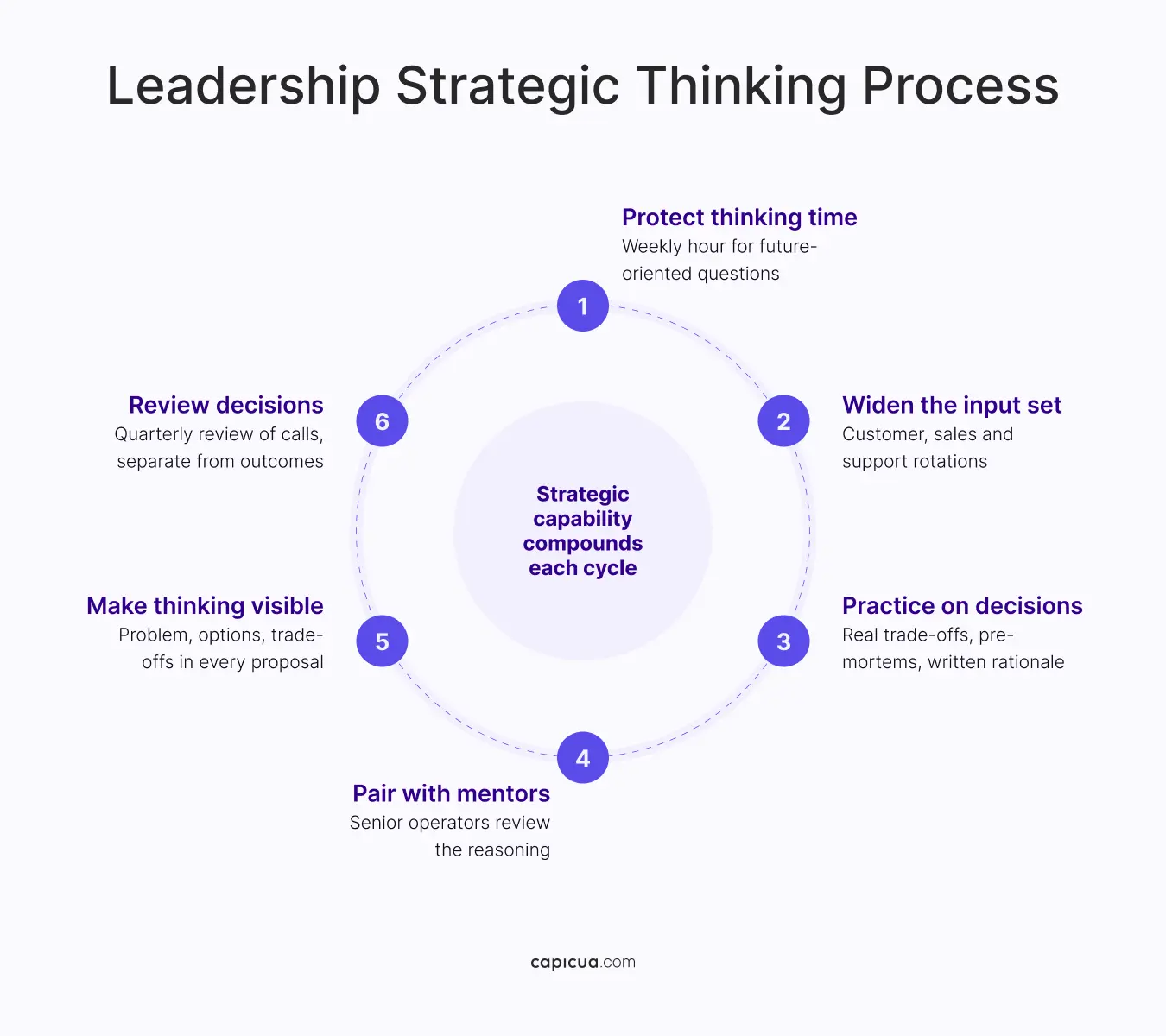
A six-step process product organizations can run:
- Protect thinking time: Block a recurring weekly hour for future-oriented questions, such as which current assumptions about growth or behavior would hurt most if proved wrong.
- Widen the input set: Rotate leaders through customer calls, sales reviews, and support queues so patterns surface from outside their own function.
- Practice on live decisions: Use real roadmap trade-offs as training material, with a pre-mortem and a written rationale for each major bet.
- Pair with mentors: Match emerging leaders with senior operators who review their reasoning, which reflects the social learning model most L&D leaders now favor.
- Make thinking visible: Require a short narrative for every strategic proposal that states the problem, the options considered, and the trade-offs accepted.
- Review decisions as well as outcomes: Revisit major calls each quarter to separate a sound decision with a bad outcome from a lucky one.
This process connects directly to how leadership shapes clarity across product teams and to the product operating model that defines who owns which decisions.
Most product teams already have the raw material for strong strategic thinking: usage data, customer conversations, and capable leaders. What usually goes missing is a shared structure that connects those signals to roadmap choices. Shaped Clarity™ gives founders and product leaders that structure, so strategic choices stay traceable, trade-offs stay explicit, and the product adapts to change without a rebuild every quarter. Discover Shaped Clarity.
Conclusion
Strategic thinking is becoming the scarce resource in software companies because analysis is getting cheaper and the standard playbook is now shared by everyone. Pulling ahead will require defining strategic thinking clearly, keeping it distinct from tactical execution, and anchoring strategic planning in tested assumptions. Pick one bet, run it through a pre-mortem, and see how much clearer the roadmap becomes when every tactical decision traces back to a strategic one.
To turn strategic thinking into product decisions your team can execute, contact us or book a call.