


A 2026 State of B2B Monetization survey of more than 230 SaaS and AI companies stated that three in four software companies changed their pricing or packaging in the last year, and the largest vendors are now making the most changes. This trend is making B2B SaaS pricing models shift from a set-and-forget decision into an operating discipline, with the model most teams chose at product-market fit being calibrated to a world where every unit of value arrived through a human login.
AI agents complete work without occupying seats, AI features carry real marginal costs, and buyers are rewriting what they consider a fair bill. The result is a SaaS pricing landscape where hybrid structures, credits, and capacity commitments sit alongside the classic per-seat plan, and where the wrong SaaS pricing model surfaces later as flat expansion revenue, eroding margins, or a competitive pilot at renewal. This guide breaks down the main SaaS pricing models, the SaaS pricing strategies that hold up under AI economics, and how product leaders can change pricing without damaging customer trust.
What are B2B SaaS Pricing Models?
B2B SaaS pricing models are the structures a software company uses to turn the value customers get from its product into recurring revenue, defined by what is charged for (the value metric) and how that charge is packaged. Every model answers two questions: which unit of value the customer pays for, and how predictable that payment is for both sides.
Seven models cover most of the B2B market today:
- Flat-rate pricing charges one fixed price for a defined product scope. It is simple to buy and sell, and it caps expansion at the next contract.
- Tiered pricing packages features into good, better, and best editions, so customers upgrade as their needs mature.
- Per-seat pricing charges for each named user. It scales with customer headcount and has been the default SaaS pricing model for two decades.
- Usage-based pricing charges for measurable consumption such as API calls, records processed, or tokens, so revenue grows with customer activity.
- Capacity-based pricing sells a committed block of usage, usually as credits, with overages above the commitment and no refund below it.
- Hybrid pricing combines two or more models, most often a seat or platform fee plus a usage or credit meter for AI features.
- Outcome-based pricing charges only when a defined business result occurs, such as a resolved support ticket.
The market has already moved toward the middle of that list, with 37% of companies reporting a hybrid pricing model as their primary structure, up from 25% among the same respondents a year earlier. Companies under $5M ARR still lean on flat fees, while vendors above $150M ARR hold onto per-seat pricing at 29% adoption.
Why is Per-Seat SaaS Pricing Losing Ground?
Per-seat pricing is losing ground because AI agents decouple the value software delivers from the number of people who log in, which weakens the link between customer headcount and vendor revenue. When one agent completes work that once required several users, a seat-based contract either undercharges for the value created or shrinks at renewal.
Gartner has quantified the exposure: up to $234 billion of enterprise application spending is exposed to agentic arbitrage through 2030, roughly 20% of enterprise application SaaS spend, as agents complete tasks across systems and reduce direct use of traditional interfaces. Deloitte's TMT Predictions go further, expecting at least 40% of enterprise SaaS spend to shift toward usage-, agent-, or outcome-based pricing by 2030.
G2's 2026 AI Agents Insight Report found that only 9% of buyers consider per-seat pricing the fairest way to price agent services. Preference for pay-as-you-go models rose from 38% to 57% in a year, with 74% of buyers open to piloting or switching to an alternative vendor at renewal.

Is AI Seat Compression Already Hitting Revenue?
AI seat compression is real, and its timing is uneven. The Revenera Monetization Monitor found only 7% of software producers reporting seat loss due to AI, while nearly half reported downward pricing pressure linked to AI. Respondents named insufficient expansion revenue as their biggest monetization challenge, most acutely among companies on flat-fee or seat-based plans. For most post-PMF companies, the near-term threat shows up as price compression and stalled expansion, the same line that drives net revenue retention, well before seat churn appears in the data.
Which B2B SaaS Pricing Models Fit the AI Era?
The B2B SaaS pricing models that fit the AI era are hybrid structures that keep a predictable base and add a meter matched to how AI creates value: effort for broad platforms, output for focused use cases, and outcomes only where results are observable and attributable. The meter a company picks matters more than the label on its pricing page.
Three meters often get grouped under usage-based pricing:
- Effort-based pricing charges for the resources AI consumes, such as tokens, compute, or agent hours. It suits broad AI portfolios and infrastructure products because one currency spans many use cases.
- Output-based pricing charges for what AI produces, such as generated drafts or updated records. It suits focused use cases where customers can see the work delivered.
- Outcome-based pricing charges for a business result, such as an issue resolved or revenue collected, and shifts the quality risk to the vendor.
Among companies adding a hybrid AI meter, roughly 35% rely on effort, 55% on output, and only about 10% on outcomes. Outcome-based pricing has found a durable home mainly in customer support, where a resolved conversation can be observed, attributed, and written into a contract.
Capacity-based pricing is becoming the default because it gives CFOs a budgetable commitment while preserving recurring revenue for the vendor. About four in five vendors introducing AI pricing choose capacity models, where customers commit to a block of credits and receive no refund for unused capacity; 29% of companies already use AI credits, and another 33% plan to introduce them within six to twelve months.
How Do You Choose a Value Metric for a SaaS Pricing Model?
Choose a value metric by finding a unit that rises as customers get more value, that buyers can understand and forecast, and that your product can measure reliably. A strong value metric aligns price with delivered value, keeps expansion natural, and holds up as AI changes how work gets done.
Five tests separate a durable value metric from a convenient one:
- Value correlation: The metric grows when the customer's results grow. Seats pass this test only when human users drive the value.
- Buyer legibility: A CFO can read the invoice, explain it internally, and budget for next quarter.
- Measurability: The product meters it accurately and auditably, account by account.
- Cost alignment: The metric scales with your cost to serve, which matters once inference sits inside your gross margin.
- Adoption safety: The metric never penalizes the behavior you need, such as broad use of a feature you want customers to adopt.
Among buyers who name pricing as a top purchase criterion, per-seat pricing ranked last for core software at 12.6%, behind consumption at 28.9% and outcomes at 22.2%. For separately billed AI functionality, the ranking flipped: per-seat came first at 42.3%, ahead of consumption at 36.6% and outcomes at 21.1%. Buyers want flexibility on familiar spend and a ceiling on unfamiliar spend.
The practical implication for SaaS pricing strategies is to separate the two conversations: meter the core platform on the unit that tracks value, and give AI features a capped or budgetable structure until customers build usage history. Before committing to a metric, pressure-test it against real behavior. Capicua's guide to product insights covers how to turn usage signals into evidence, and our overview of market research techniques covers willingness-to-pay methods.

SaaS Pricing Strategies To Protect Margin and Predictability
The SaaS pricing strategies that protect margin price AI against its real cost to serve, give customers spending controls before variable charges go live, and design packaging so power users pay for the value they consume. Margin and predictability work best as design constraints set in the first version of a pricing model.
AI changes the cost structure underneath every model, with internal costs and margins being the most important inputs when pricing AI capabilities (cited by 54% of respondents), and the median target gross margin for AI products being about 50%, well below the 70% to 80% typical of SaaS. Only 12% target SaaS-like margins of 80% or more on AI.
Buyers feel the same pressure: 46% of AI agent buyers report higher-than-expected operating costs, and buyers ranked the controls they want before accepting variable spend: real-time usage dashboards, monthly spend caps, cost-per-outcome reporting, routing to lower-cost models, and forecasting before deployment. Gartner's September 2026 guidance predicts consumption-based pricing will account for over 35% of net new corporate legal technology spend with major vendors by 2028.
Five strategies hold up under these conditions:
- Set a margin floor for every AI feature before choosing its meter, so heavy usage cannot turn a popular feature into a loss.
- Ship guardrails with the meter: Include usage dashboards, spend caps, and alerts in the first release of any variable pricing.
- Price the power-user tail: Poyar observes that the top 10% of AI power users often drive 70% or more of token consumption, so limits should target that tail rather than the median user.
- Use premium editions and add-ons for expansion: A premium edition priced roughly 50% to 100% above the base, plus add-ons a minority of customers value highly, restores expansion without repricing everyone.
- Right-size commitments with customers: Forrester's August 2026 analysis warns CIOs that usage set during deployment becomes the renewal baseline; vendors that help buyers forecast honestly earn trust that survives that conversation.
The economics behind these choices mirror Capicua's breakdown of AI return on investment: fully loaded cost changes the business case for vendors and buyers alike.
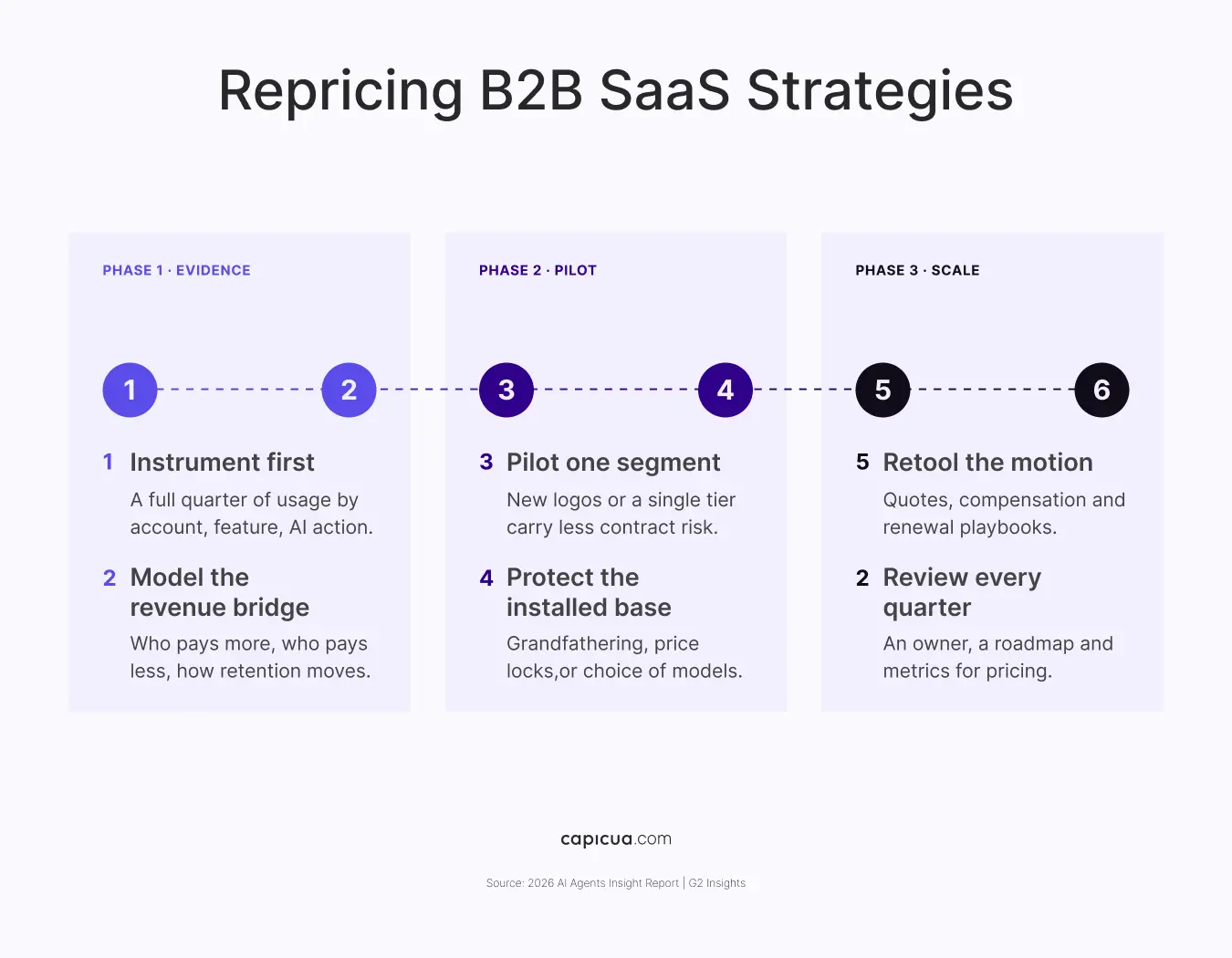
Changing a B2B SaaS pricing model without losing trust means sequencing the move: instrument usage first, test the new model on a defined segment, protect existing customers through the transition, and prepare sales and customer success to sell value instead of access. Most pricing changes fail in execution, not design.
- Instrument before you reprice: Capture usage by account, feature, and AI action for at least a full quarter. Recommendations include having transparent, auditable value metrics live in the platform before changing commercial terms.
- Model the revenue bridge: Run every existing account through the proposed model to see who pays more, who pays less, and how retention moves.
- Pilot with new customers or one segment: New logos and a single tier carry less contractual risk than the installed base.
- Protect the installed base: Grandfathering windows, price locks, or a choice between old and new models can keep a pricing change from triggering churn.
- Retool the commercial motion: Quotes, sales compensation, and renewal playbooks must reward the new metric. With 74% of agent buyers open to a competitive pilot at renewal, renewals deserve new-deal preparation.
- Review pricing every quarter: Give pricing an owner, a roadmap, and success metrics, the same way you manage any core product surface.
Pricing changes also carry an uncertainty cost that compounds when teams skip validation, a pattern Capicua explores in our playbook for scaling a business.
Pricing drift usually starts as product drift: features ship faster than the team's shared understanding of where value lives, and the pricing page ends up describing access instead of results. Shaped Clarity™ helps founders and leaders make value explicit, connecting what users actually do, what the business needs to earn, and what the product can measure. With clarity, a SaaS pricing model can evolve with the market instead of being rebuilt under renewal pressure. Discover Shaped Clarity.
Conclusion
The shift underway in SaaS pricing moves the industry from charging for access toward charging for the work software and AI deliver together. Most B2B companies will make that move through hybrids, credits, and capacity commitments rather than a single leap. The companies that come out ahead will know their value metric, protect their AI margins and give buyers the predictability they are asking for.
To design a B2B SaaS pricing model that can grow with your product, team, and customers, contact us or book a call.