


According to HG Insights, 79% of software buyers had already heard of the product before they started researching. Most purchase decisions take shape before a sales team knows a deal exists, so brand identity does much of the selling, even when no one from the company is in the room, which raises the bar for what branding has to carry.
Forrester's State of Business Buying states that a typical B2B purchase now involves 13 internal stakeholders and nine external influencers, but many first encounter your product through an AI answer engine that summarizes your category in three sentences, which means that both audiences test the brand far beyond the logo.
Digital product branding lives in the onboarding flow, the interface, the microcopy, the pricing page, and the way large language models describe what you do. This guide covers what is branding in a software context, how branding and identity connect to growth, and a practical framework for branding digital products so they stay coherent.
What is Branding, and What is Brand Identity in Software?
Branding is the ongoing work of shaping how a market perceives a company, and brand identity is the set of deliberate, repeatable signals a company controls to earn that perception: its positioning, voice, visual system, product experience, and proof. In software, branding goes further than in most industries because customers spend more time inside the product than with any campaign.
While related, branding and identity are distinct. Brand is the reputation that lives in customers' heads, and identity is what the company decides and encodes into every surface so that reputation forms in the intended direction. When the two drift apart, customers notice first and leadership notices last.
Gartner predicts that by 2028, over 80% of companies will make significant identity changes, including mission, brand, and culture, to keep pace with AI's impact on markets. For software companies, AI is also changing the product category itself, so identity work and product strategy now move together.
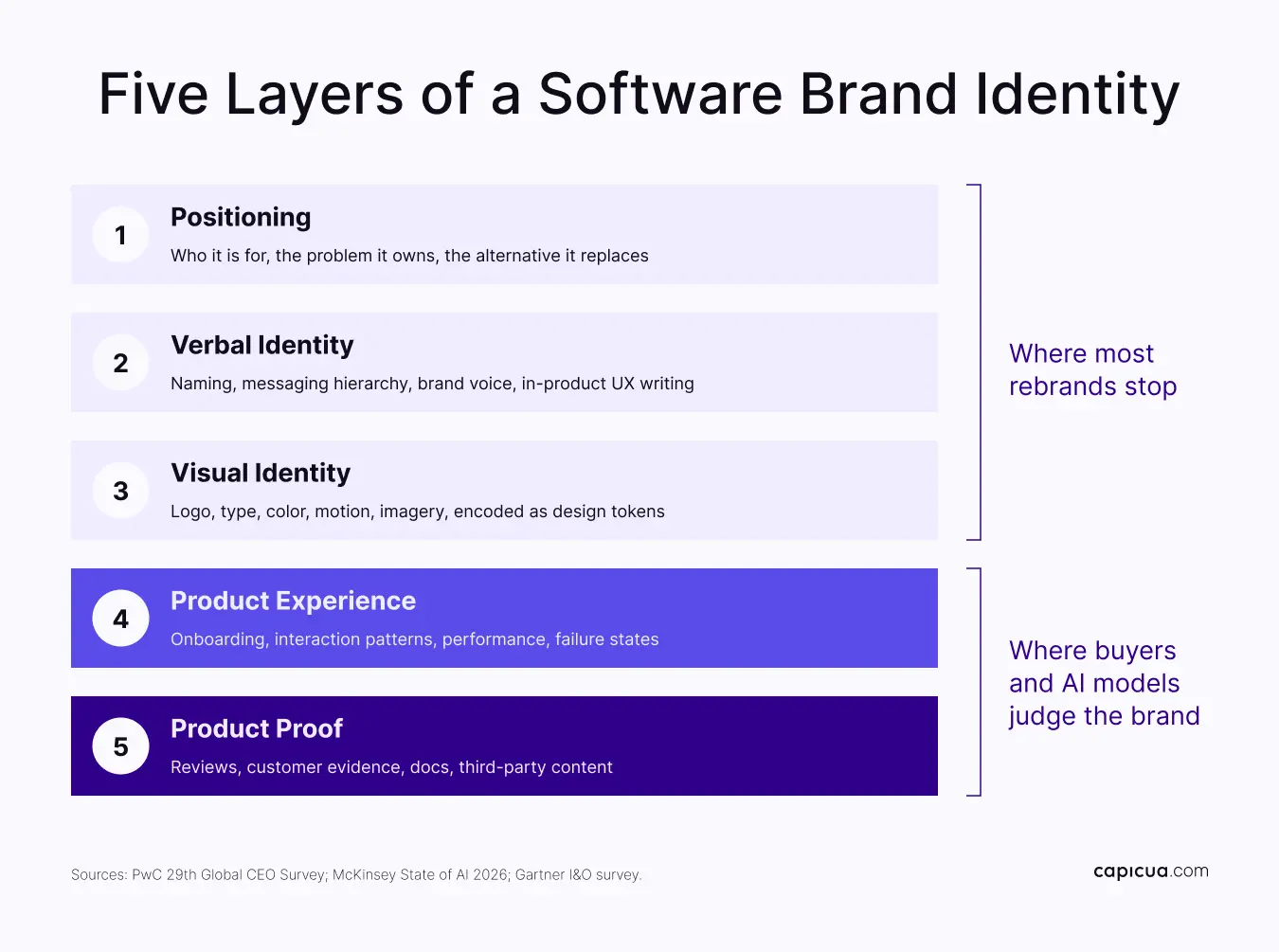
A software brand identity has five main layers:
- Brand strategy and positioning: who the product is for, the problem it owns, and the alternative it replaces.
- Verbal identity: naming, messaging hierarchy, brand voice, and in-product UX writing.
- Visual identity: logo, typography, color, iconography, motion, and imagery, encoded as design tokens.
- Product experience: onboarding, interaction patterns, performance, and how the product behaves when something fails.
- Product proof: customer evidence, reviews, documentation, and third-party content that validates every claim above.
Most rebrands stop at layer three, but the strongest identities treat layers four and five as brand work because that is where buyers form their judgment.
Why Does Brand Identity Drive Growth for Software Companies?
Brand identity drives growth because it determines whether a product makes the shortlist before sales gets involved, and whether buyers trust it enough to choose it. A Gartner survey of 426 senior marketing leaders found that companies with a strong brand strategy are 2x more likely to exceed their growth goals. The TrustRadius 2026 report found that 83% of technology buyers shortlisted three or fewer products, and HG Insights' analysis adds that 67% ended up buying their first-choice product. A buyer who doesn't recognize your name or cannot repeat what you do rarely gives you a second chance to make the case.
However, product-led companies face issues, too. Gartner found that 84% of companies are stuck in a "brand doom loop," where they underinvest in brand measurement, lack confidence in the results, and attract even less funding. Product-led SaaS companies have their own version of this: they treat brand as a marketing deliverable, product teams ship features named and designed on their own terms, and identity quietly fragments across the app, website, and sales deck.
How is Digital Product Branding Different From Traditional Branding?
In digital product branding, the product is the brand's primary touchpoint: customers form their judgment inside the interface every working day, long after the campaign that brought them in has ended. In a digital product company, a product manager naming a feature, a designer choosing an empty-state illustration, and an engineer deciding how an error message reads are all making branding decisions, whether or not anyone calls them that.
The contrast with traditional branding shows up in four places:
- Frequency: a campaign reaches a buyer a few times a quarter, while the product reaches a user dozens of times a day.
- Evidence: traditional brands make promises, and digital products prove or break them in real time through speed, reliability, and clarity.
- Ownership: brand teams own campaigns, while product, design, and engineering jointly own the in-product experience.
- Infrastructure: traditional brands rely on guidelines, and branding for digital products relies on design tokens, components, and content patterns that ship with the code.
On average, utility is the most effective way for a brand to become globally relevant. Still, for software, utility is the product experience itself, so you can't plan product experience and brand identity separately. Design has also gained weight as AI lowers the cost of building: Figma's 2026 AI report found that 90% of respondents say design is at least as important as it was before AI, and nearly six in ten say it matters more. A design system becomes brand infrastructure, and UX writing becomes the brand voice users hear. Capicua's work on product experience strategy treats both as positioning levers from the first sprint.

How Are AI Answer Engines Changing Branding for Digital Products?
AI answer engines change branding for digital products by placing a summarizer between the brand and the buyer. Models extract claims, compress nuance, and describe your product in their own words before a prospect ever visits your site.
Gartner research already shows that 47% of consumers and 60% of B2B buyers say they consulted GenAI tools or chatbots for a recent purchase decision. Gartner also warns that AI systems detect differentiation and flatten vague or overly clever content into something average, and recommends proprietary terms, structured claims, and schema, so models have fewer generic words to swap in.
Buyers are also checking what the machines tell them: 63% of buyers used AI during their purchase journey, 94% fact-check its answers at least some of the time, and 74% use reviews to inform their decisions. A Gartner survey found that 69% prefer to validate AI-generated insights with sales reps, and Forrester adds that more than 60% of business buyers now use a trial to evaluate solutions, putting the product experience back at the center of the brand promise.

What does Generative Engine Optimization mean for brand identity? Generative Engine Optimization (GEO) is the practice of making a brand's claims easy for AI models to find, understand, and repeat accurately. For brand identity, GEO rewards four habits:
- One category claim, stated the same way everywhere: on the homepage, in the product, in documentation, and in review profiles.
- Proprietary terms used consistently: a named framework or method gives models a specific term to cite instead of a generic paraphrase.
- Structured, verifiable claims: numbers, comparisons, and use cases written so a model can extract them cleanly.
- Earned proof that models can reach: Lead with earned validation and make those proof points discoverable in LLM-driven search.
How to Build a Brand Identity for Digital Products: A Six-Step Framework
Building a brand identity for a digital product starts with a positioning decision, runs through the product experience, and ends with governance. Each step constrains the next.
- Make the positioning bet explicit: Write down who the product is for, the problem it owns, and the alternative it replaces, in one sentence a buyer could repeat to a colleague. If leadership cannot agree on that sentence, every asset will encode the disagreement.
- Audit every touchpoint the buyer sees: Include the website, the product, documentation, the sales deck, review profiles, and AI answers. Ask ChatGPT, Claude, Gemini, and Perplexity how they describe your product and your category, and compare the answers with your positioning sentence.
- Codify the verbal identity: Build a messaging hierarchy, a short glossary of proprietary terms, and voice guidelines that apply inside the product, from onboarding to error states.
- Encode the visual identity as tokens: Translate color, type, spacing, and motion into design tokens and components so every team ships on-brand by default. This is the work of UX style guides and a governed design system.
- Align product moments with the promise: Review onboarding, empty states, pricing, upgrade prompts, and failure states against the positioning. A product that promises clarity and greets new users with twelve settings breaks its own brand. Our guide on improving user interface design covers the interface side.
- Assign ownership and measure: Assign ownership and measure. Name an owner for brand coherence across product and marketing, set a quarterly review, and report brand health in business terms. Gartner recommends regularly measuring brand health, tying it to business outcomes, and telling a clear story about how brand contributes to growth.
How Do You Measure Brand Identity Strength in SaaS?
Brand identity strength in SaaS is measured by how often the product is known, shortlisted, described accurately, and chosen. Awareness alone says little about any of those outcomes. Gartner found that more than 50% of C-suite executives want their CMO to clarify the relationship between brand and business strategy, and 43% want a clear, simple story about brand health and business performance. Six metrics give leaders that story:
- Pre-research familiarity: the share of new opportunities that already knew your name at first contact, captured in discovery calls and win-loss interviews.
- Shortlist rate: how often you make the final two or three, which matters when 83% of buyers shortlist three or fewer products.
- AI answer accuracy: a fixed set of category prompts run monthly across major AI assistants, scored for whether each describes your product correctly and names you.
- Message consistency score: the share of audited touchpoints that state your category claim and proprietary terms the same way.
- Earned validation: review volume, recency, and the language customers use, since 74% of buyers use reviews to inform decisions.
- First-choice win rate: how often the product a buyer favored at the start is the one they buy, put at 67% across buyers.
These signals connect brand to the same pipeline and retention conversations leadership already has. Capicua's guides on product insights and market research techniques cover how to collect the qualitative evidence behind them.
Brand drift starts small: a feature named one way in the app and another on the pricing page, an onboarding flow that contradicts the sales promise, an AI summary that describes a product you stopped selling two years ago. Shaped Clarity™ is the lens Capicua uses to keep positioning, product experience, and proof aligned as teams and channels multiply, so the brand customers experience is the one leadership chose, and products adapt to market change without needing a rebrand every time the roadmap moves. Discover Shaped Clarity.
Conclusion
The strongest software brands share one trait: their identity reads the same in a sales deck, an onboarding flow, an error message, and an AI-generated summary. Coherence is what earns a place on a three-product shortlist, survives a buying committee's fact-checking, and turns first preference into a signed contract. As AI answer engines and larger buying groups add more interpreters between a company and its customers, brand identity becomes an operating system for decisions across product, marketing, and sales. To build a brand identity your product, teams, and AI answer engines all express the same way, contact us or book a call.