


According to Gartner, people are roughly three times more likely to use third-party GenAI tools than company-provided chatbots to resolve a service issue, and that company chatbot usage has been statistically flat since 2022. At the same time, McKinsey's State of AI in 2026 reports that chatbots are the most widely scaled AI tool, with 47% of respondents saying their organizations are scaling them across the enterprise.
That distance between deployment and use is a conversational AI design problem. The models behind most assistants are capable enough; adoption depends on how the conversation is scoped, grounded, recovered, and handed off to people; all edges that fall under the wing of conversational AI design.
This guide covers what conversational AI design means for software products, the best practices in conversational AI design that move resolution and trust, how to create conversational AI in seven steps, and how to measure it, including the new reality where customers ask other AI assistants about your product before they ever open yours.
What is Conversational AI Design in Software Products?
Conversational AI design is the discipline of shaping how an AI system understands user intent, responds in natural language, takes action, and hands off to people, so that each conversation ends in a resolved task. It combines conversation design, interaction design, content strategy, and AI behavior specification into a single product surface.
In a B2B SaaS product, a conversational interface sits on top of your data model, permissions, billing logic, and support operations, so every design decision inherits constraints from the rest of the product. Six layers do most of the work:
- Intent model: the ranked set of jobs users bring, sorted by volume, value, and risk.
- Conversation and voice: flows, clarifying turns, failure paths, and tone for each state.
- Knowledge grounding: curated, current sources the AI answers from and can cite.
- Actions and guardrails: the tools the AI may call, with confirmation and undo for consequential steps.
- Human handoff: a visible path to a person that carries the full conversation context.
- Governance and measurement: named owners, evaluations, and outcome metrics per intent.
Conversational AI design moved past classic chatbot scripting: rule-based bots guide users down linear flows, and LLM-based assistants interpret open-ended language and increasingly act through agentic AI capabilities. Yet Nielsen Norman Group's research on site AI chatbots found that participants rarely used them, often failed to notice them, and struggled to see what they offered beyond search, filters, or general-purpose assistants. The technology advanced faster than the design discipline around it, and Capicua's guide to the natural user interface covers the broader shift toward intent-based input that conversational interfaces belong to.
Why Conversational AI Design Decides AI ROI
Conversational AI design decides AI return on investment because customers judge assistants on resolution, task completion, and access to people, and those qualities come from design decisions far more than from model selection. Per Gartner research, service and support leaders invested a median 12% of their 2025 budget in AI, the highest share of any business function, and the disappointing impact of customer-facing GenAI is attributed to misalignment with customer expectations, not to technology limits.
What customers expect is now measurable:
- They expect action: 58% of customers who use GenAI have used it to complete a task on their behalf, rising to 74% in B2B environments.
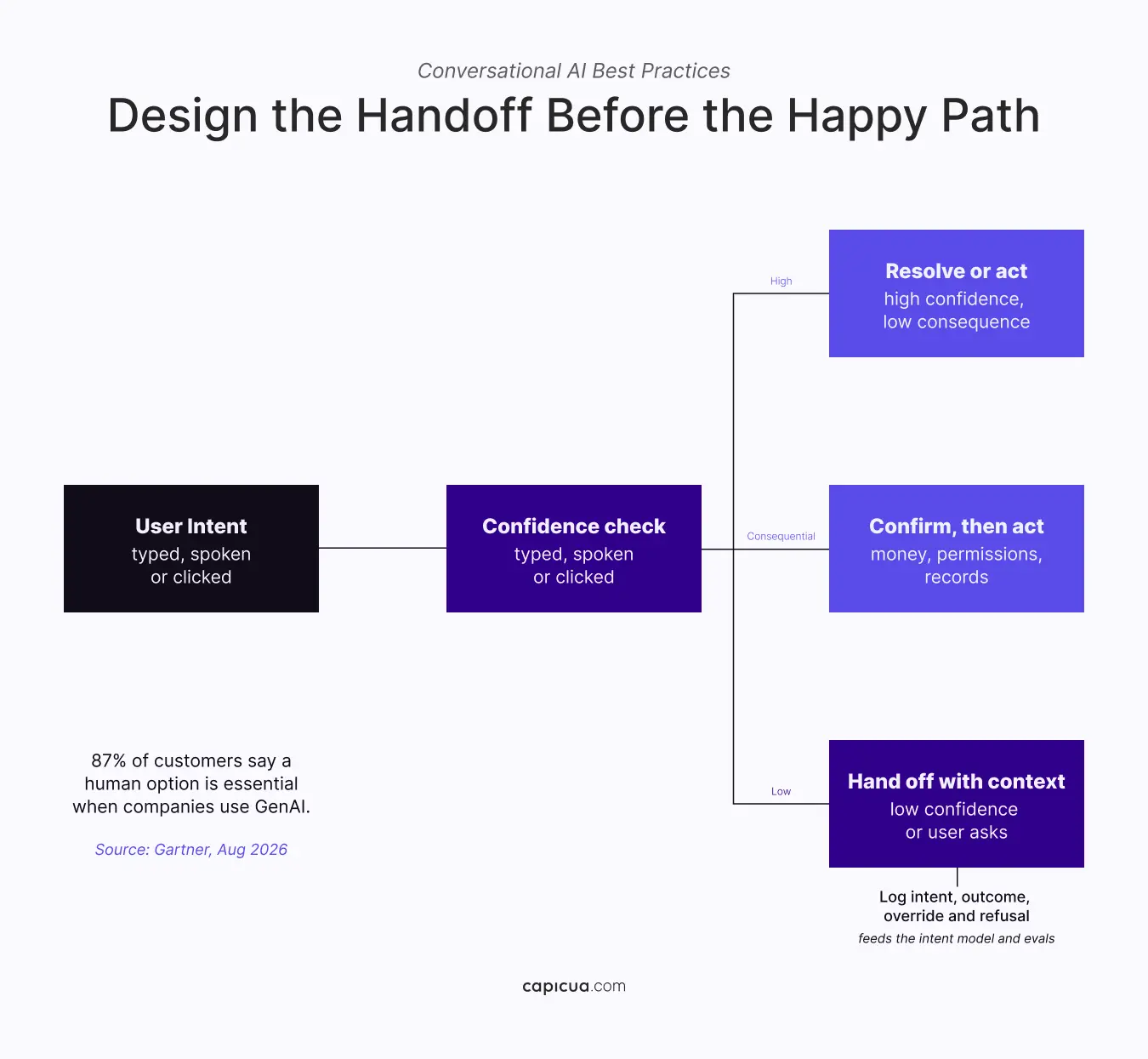
- They expect a person within reach: 87% of customers say access to a human agent is essential when companies use GenAI; 50% say GenAI makes their interactions easier.
- They rarely give a second chance: Only 27% of customers would try a chatbot again after a negative experience, especially when the bot misunderstood them, gave generic information, or made a person harder to reach.
37% of respondents attribute any EBIT impact to AI, and nearly three-quarters of AI high performers fundamentally redesigned workflows around AI, compared with one-quarter of other respondents. With the cost per resolution of GenAI expected to exceed $3 by 2030, higher than that of many B2C offshore human agents, every failed conversation becomes more expensive.

Best Practices in Conversational AI Design
Best practices in conversational AI design include stating scope clearly, answering briefly, grounding every answer in owned knowledge, designing actions with confirmation, keeping human handoff visible, admitting uncertainty, and writing tone for each state. Each one removes a specific reason users abandon assistants.
- State what the assistant can and cannot do: The first message should clearly describe the assistant's capabilities, offer relevant prompts, and signal what the user is looking at.
- Consolidate into one entry point: An AI chatbot should not compete with existing chat channels. One conversational entry point, available on every page of a multi-step process, keeps users from guessing which assistant to trust.
- Answer first, expand on request: Participants tend to approach chatbots like search bars, typing as little as possible and preferring answers they can scan. Concise responses with lists and expandable detail outperform chatty ones.
- Ground answers in curated, owned knowledge: An assistant can only be as accurate as the content it retrieves. Assign an owner to every knowledge source, version it, and retire conflicting or stale pages before launch.
- Design actions with confirmation and undo: Since most GenAI users now expect task completion, define which actions the AI may take on its own, which require explicit confirmation (money, permissions, customer records), and how each one can be reversed.
- Keep human handoff visible and context-rich: The five qualities of site chatbots place handoff willingness first, alongside flexibility, proactivity, emotional responsiveness, and transparency. A handoff should pass along the information already collected, and GenAI should never be a mandatory first step for every issue.
- Admit uncertainty and route low-confidence cases: GenAI is the most helpful when it attempts resolution only when confidence is high. Clarifying questions and an honest limit statement protect trust better than a fluent, wrong answer.
- Disclose that users are talking to AI: Transparency is one of NN/g's five chatbot qualities, and regulation is moving the same way. By 2028, AI regulation is predicted to increase assisted service volume by 30% as customers exercise their right to reach a human.
- Write voice and tone for every state: Errors, refusals, billing questions, and handoffs carry the most risk, so they deserve written tone guidance. Our guide to UX writing covers how to document voice per state and assign ownership of product words.
How to Create Conversational AI in 7 Steps
To create conversational AI that holds up in production, start from a ranked intent map, audit the knowledge it will answer from, define action boundaries, design failure paths before happy paths, test with real users, instrument evaluations, and launch narrow before you expand. This is the sequence for conversational interfaces inside scaling products.
- Map and rank intents: Pull intents from support tickets, in-product search logs, sales call notes, and session data. Rank them by volume, business value, and risk, then pick two or three high-volume, reversible intents for the first release.
- Audit the knowledge layer: List every source the AI will answer from, assign owners, and fix contradictions. Most hallucination complaints trace back to outdated content.
- Define action boundaries and autonomy levels: For each intent, decide whether the AI answers, acts with confirmation, or routes to a person. Agentic design patterns map these choices to autonomy levels.
- Design failure paths: Write the clarifying turns, refusals, low-confidence responses, and handoff messages first, because these moments decide whether a frustrated user stays.
- Prototype and test with real users: Run moderated sessions with five to eight participants per key intent, using realistic data and accounts. Test the opening message, the first failure, and the handoff, since those three turns shape trust.
- Instrument evaluations: Build an evaluation set from real transcripts, track resolution per intent, and review a sample of conversations every week, with regressions in tone or accuracy as defects.
- Launch narrow, then expand: Release to a limited audience, keep a fixed interface fallback, and add intents or autonomy only where the data shows reliable resolution.
Conversation design work also has to fit the rest of the interface. Capicua's guide on how to create a user interface explains how to choose a design-first, system-first, or AI-first method per surface, which applies directly to the screens that surround an assistant.

How to Measure Conversational AI Design Success
Conversational AI design success is measured by outcomes per intent, starting with resolution, handoff quality, recontact rate, and cost per resolution. Containment alone misleads, because a user who gives up and leaves also counts as contained. The metrics that belong on a product leader's dashboard are:
- Resolution rate per intent: the share of conversations that end with the job done, verified by a downstream event such as a completed update or a closed ticket.
- Handoff quality: the share of escalations that arrive with full context, and the time agents spend re-asking for information.
- Recontact rate: how often users return through another channel for the same issue within a set window.
- Time to resolution: including generation latency and any wait for a human.
- Cost per resolution: inference, oversight, and correction costs, compared with the human baseline.
- Refusal and override rates: how often the AI declines, and how often users abandon the conversational path for a fixed interface.
- Retry after failure: whether users who had a failed conversation come back to the assistant at all.
Average responsible AI maturity rose to 2.3 from 2.0, while only about a third of organizations reach level three or higher in strategy, governance, and agentic AI controls. For assistants that assemble responses or interfaces on the fly, A solid generative UI strategy makes intents, refusals, and overrides better units of analysis than screens.
Conversational AI Best Practices for GEO and Third-Party Assistants
Conversational AI best practices now extend beyond your own interface, because many customers start with ChatGPT, Claude, or Gemini before they reach you. Your content must be structured so generative engines describe your product accurately, and your own assistant must own the transactional, account-specific work those tools cannot do.
Gartner states that customers may begin service journeys with third-party GenAI, but they still come to the company when they need to transact, access account information, or resolve complex issues, which gives product leaders new areas of interest:
- Make your public knowledge legible to generative engines: Publish help content, pricing logic, and product documentation with definition-first answers, consistent terminology, and clear structure. This Generative Engine Optimization (GEO) applied to support content shapes what third-party assistants say about you.
- Make your own assistant the place where work gets done: Concentrate your conversational interface on authenticated tasks such as changing plans, updating records, or diagnosing an account, where context and permissions give you an advantage no general assistant has.
- Prepare for agents as users: As more customers delegate tasks to AI agents, expose key capabilities through well-documented APIs and agent-ready interfaces so an external agent can complete a job without scraping your screens.

Which intent matters? What is the assistant allowed to do? When should a person take over? Shaped Clarity™ gives product teams a shared definition first, so the conversation layer adapts as users and markets change, learns from every resolved and failed intent, and keeps earning its place in the product. Discover Shaped Clarity, Capicua's proprietary lens.
Conclusion
Conversational AI design has become the deciding factor in whether AI investment reaches customers, and the advantage belongs to teams that rank the intents worth serving, design the failure and handoff paths first, and measure outcomes per intent. As customers split their journeys between third-party assistants and your product, the assistant that wins is the one that finishes the job and makes a person easy to reach.
To design conversational AI your customers trust and your team can scale, contact us or book a call.