


Sometimes, after a sprint review, the roadmap looks the same, but the work underneath it has quietly doubled. A "small" request from a key account, a stakeholder idea that skipped the queue, a feature an AI agent built because the ticket never said where to stop: none of these feels like a decision, yet together they decide where your engineering capacity goes.
Scope creep is getting more expensive: PMI's Pulse of the Profession 2026 found that 81% of project professionals say their projects have become more complex. Nearly one-third of complex projects fail to deliver the full scope of their intended benefits, more than twice the rate for projects overall. With every unclear boundary now getting built faster, this guide covers the scope creep meaning, the causes of scope creep in software development, how AI changes scope creep in software engineering, what it costs, and how to manage scope creep without freezing the roadmap.
What is Scope Creep? The Scope Creep Meaning for Software Products
Scope creep is the gradual, uncontrolled expansion of a project's or product's agreed scope, through new features, requirements or deliverables, without matching changes to time, budget, capacity or the outcome the work is meant to achieve. Scope that changes through an explicit decision is change management, while scope that changes through accumulation is scope creep.
In software, the scope creep meaning is broader: since products have no finish line, creep shows up as a product roadmap that keeps absorbing work nobody traded off, a growing surface area that customers barely use, and teams that feel busy while the outcome metric stays flat. Atlassian's State of Product 2027 research reports that 86% of product managers agree deciding what to build matters more than ever, which is another way of saying that unmanaged additions now carry a higher price.
Common scope creep examples in B2B SaaS include:
- A sales-led promise to a large prospect becomes a "quick" custom integration inside the current release.
- A stakeholder adds a dashboard view during sprint review, and it lands in the sprint without anything leaving.
- Engineers gold plate a feature with extra settings and edge-case handling that no customer asked for.
- A design refresh expands from one flow to the whole navigation because "we're already in there."
- An AI coding agent implements every interpretation of a vague ticket, and the team ships all of them.
There's also a difference between scope creep vs feature creep vs requirements creep. These terms overlap, and the difference matters when you diagnose the problem:
- Scope creep is the umbrella term for any uncontrolled growth in what a team has committed to deliver.
- Feature creep is scope creep at the product level: new features keep piling into the product until it loses focus and simplicity.
- Requirements creep happens inside a feature: its requirements keep expanding or shifting after work has started.
- Gold plating is self-inflicted creep: the team adds polish or capability beyond what was agreed, usually with good intentions.
PMI's 2026 research on project success found that teams willing to flex time, cost or scope in service of value achieve stronger outcomes. The goal of scope management is to make every change deliberate, priced and owned, so the product can adapt without drifting.
What Causes Scope Creep in Software Development?
Scope creep in software development is caused by unclear outcomes, unclear decision rights and invisible capacity, which together let new work enter without anyone pricing what it displaces. Most teams blame demanding stakeholders, yet the root causes can also sit in the operating model.
In the LeadDev Engineering Team Performance Report 2026, 68% of engineering professionals say aligning priorities across teams is a challenge, and 57% point to ownership and accountability. PMI's Pulse of the Profession 2026 shows that high performers on complex projects are more likely to align sponsors at initiation, establishing a shared view of success before execution begins (39% of high performers versus 30% of low performers).
The most frequent causes of scope creep in post-PMF SaaS companies are:
- Outcome-free roadmaps: Roadmap items describe features instead of the problem and metric they target, so there is no test for whether a new request belongs.
- Implicit decision rights: Nobody knows who can say no, so every request becomes a negotiation and the loudest voice wins.
- Thin specifications: Tickets without acceptance criteria and non-goals invite interpretation, and interpretation expands.
- Revenue pressure without guardrails: Deal-driven commitments enter the current release instead of a visible queue.
- No scope baseline: Without a recorded starting point, a team cannot see how much scope has grown, so growth goes unchallenged.
- Capacity planned against headcount: Plans that ignore maintenance, incidents and debt leave no honest view of what fits.
Atlassian's State of Developer Experience 2026 ranks unclear requirements among the top five friction points for developers, alongside finding information, meetings, context switching and technical debt. Each of those friction points is also an entry door for creep.

How AI Changes Scope Creep in Software Engineering
AI changes scope creep in software engineering by removing the natural friction that used to slow it down: when code is cheap, every unclear requirement and unvetted idea gets built at full speed and volume. In AI-assisted software development, the cost of saying "yes" has dropped at the keyboard and risen everywhere else.
The LeadDev Engineering Team Performance Report 2026 found that 52% of respondents now see code review and validation as the biggest delivery bottleneck, and another 22% point to product specification and requirements, with only 7% saying writing code is still the constraint. Atlassian's State of Developer Experience 2026 adds that 87% of developers say AI helps them ship faster, while 72% experience the same or more friction than before, and 65% regularly spend time correcting AI output.
Three AI-era patterns turn small ambiguities into large scope creep:
- Specification inflation: An agent given a vague ticket builds the broad version, and reviewers approve it because it works.
- Throughput illusion: Teams measure output volume, so extra scope looks like productivity. Atlassian's State of Teams 2026 found that 89% of executives say AI increases speed, but only 6% have clear examples of organization-wide AI ROI.
- Review overload: More generated work competes for the same review capacity, so unplanned additions slip through because nobody has time to challenge them.
In the Stack Overflow Developer Survey 2026, developers named project goals and requirements (85%) as the most trusted source of context for AI tools. Clear scope is now the input that makes AI useful, a theme Capicua also covers in aligning product planning and engineering execution.
What Does Scope Creep Cost a Software Company?
Scope creep costs a software company more than budget: it consumes roadmap capacity, delays time to value, erodes strategic focus, wears down the team and compounds with complexity. The direct cost is engineering time spent on work nobody committed to, but the indirect cost is the bet that never got built.
According to PMI's Pulse of the Profession 2026, roughly one-third of complex projects fail, nearly double the 13% failure rate for projects overall, and four out of five complex projects experience negative fallout such as strategic drift, delivery disruption and lower morale. On the coordination side, Atlassian's State of Teams 2026 estimates that a "fragmentation tax" from uncoordinated AI work costs Fortune 500 companies $161 billion each year.
For a Series A to C company, these costs show up in four places:
- Roadmap capacity: Every unplanned addition pushes a committed bet into the next quarter. Use the calculator above to estimate how many roadmap weeks your team loses.
- Time to value: Larger releases ship later and teach less, so the market signal you need arrives after the next decision is made.
- Rework and debt: Rushed additions are the work most likely to be revisited, which is why the cost of rework in software development rises with every creeping release.
- Credibility: When commitments slip repeatedly, boards and customers start discounting the roadmap, and teams lose conviction in it.
The 7-Step Framework To Manage Scope Creep
To manage scope creep, give every change request a single path: tie it to an outcome, price the trade-off, let a named owner decide, and update the scope baseline so the whole team sees what changed. The playbook below works in agile and hybrid teams without adding heavy ceremony, and it answers both how to manage scope creep and how to prevent scope creep from returning.
- Anchor every bet to one outcome: Write each roadmap item as a problem, a target customer and the metric it should move.
- Record a scope baseline: Capture what is in, what is out and the non-goals for every bet. Without a baseline, scope growth is invisible.
- Map decision rights: Name who can add, cut or swap scope for each bet, who is consulted, and how long a decision can wait.
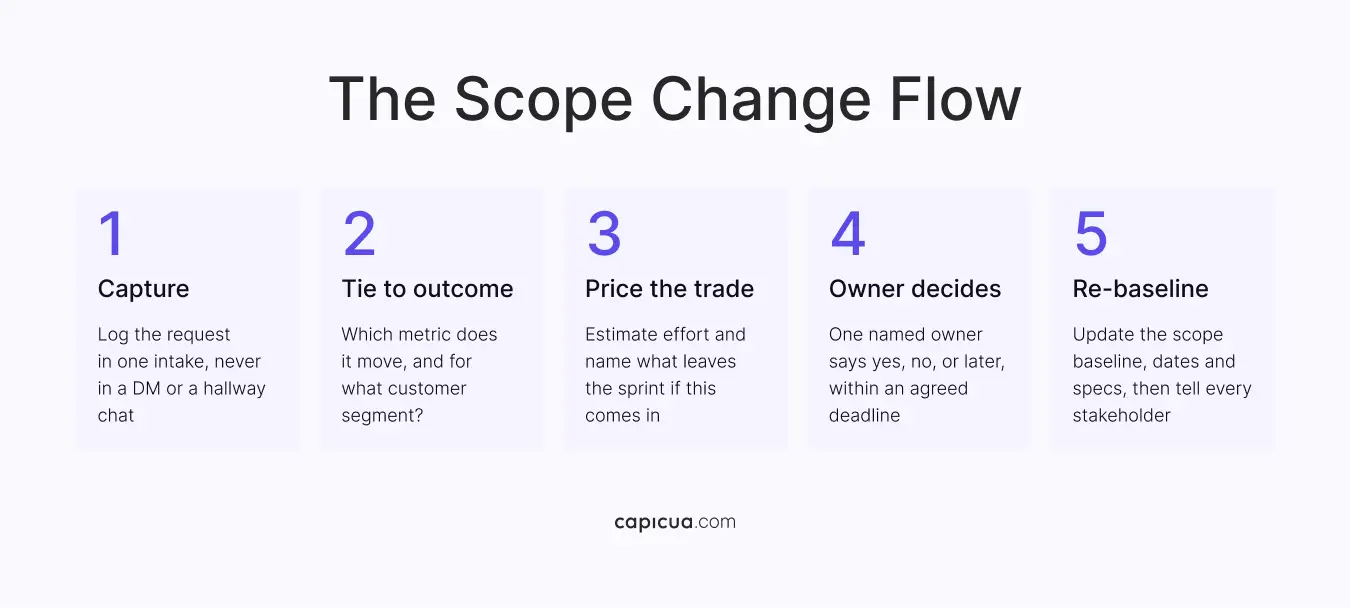
- Run a lightweight change control process: Capture, tie to outcome, price the trade, decide, re-baseline. The triage flow above shows the five steps.
- Trade every addition: Every accepted addition names what leaves the sprint or release. Scope creep in agile teams happens when new stories join without anything moving out.
- Write specs for people and agents: Every ticket states the outcome, acceptance criteria, constraints and non-goals, so AI-assisted work stays inside the agreed boundary.
- Review scope in every sprint: Compare delivered scope with the baseline, and log approved changes with their trade-offs for stakeholders.

Which Metrics Detect Scope Creep Early?
Metrics that detect scope creep early compare what a team committed to with what it actually spent capacity on, and track how quickly scope decisions are made. Activity metrics such as tickets closed or pull requests merged hide creep, because extra scope inflates them.
Trust in current metrics is low, with only 44% of engineering professionals believing their metrics reflect the value their team delivers, and 68% actively avoiding lines of code as a measure. PMI's project success research links stronger outcomes to defining success criteria upfront and measuring progress toward outcomes throughout the work.
Six indicators give founders and product leaders an early warning system:
- Scope growth rate: The percentage change between the original scope baseline and the current scope of each bet.
- Planned versus unplanned capacity: The share of each sprint spent on work that was not in the plan when the sprint started.
- Change request volume and approval rate: How many requests arrive per cycle, and how many enter without a recorded trade-off.
- Decision latency: The median time from a scope question being raised to an owner deciding it.
- Outcome hit rate: The share of shipped bets that moved their target metric, which shows whether added scope is creating value.
- Rework ratio: The share of capacity spent revisiting work shipped in the last two quarters.
Review these alongside retention and expansion revenue, so the leadership team reads scope creep as a business signal alongside revenue data.
Scope creep thrives where decisions travel without their reasoning: the outcome a bet serves, the capacity it costs, and the owner who can trade it. Shaped Clarity™ is the lens Capicua uses to keep the outcome a bet serves, the capacity it costs, and the owner who can trade it visible to product, design and engineering at once, so a roadmap can absorb new signals and change direction without drifting into scope nobody chose. Discover Shaped Clarity.
Conclusion
Scope creep signals that change is entering a product faster than the speed at which decisions about it are being made. The cost of building has dropped, but the cost of building the wrong thing has not. Those who scale cleanly define outcomes before features, record a scope baseline, name who decides, and price every addition weeks before it enters a sprint.
Keep your roadmap focused and turn scope changes into deliberate product decisions: contact us or book a call.