

Gartner predicts that by 2029, 30% of employees laid off due to AI replacement will need to be rehired, often at a significantly higher cost. At the same time, S&P Global's 2026 labor research found that only 22% of AI projects target a fully autonomous end state, meaning most organizations are building something between full automation and a simple assistant.
The question shows up in the roadmap, the pricing page, and the board deck: should the AI feature do the work, or help the user do the work better? AI augmentation vs automation is the choice between those two answers. Most teams make it implicitly, one feature at a time, and the sum of those choices quietly defines what the product becomes. This guide covers what separates the two models, why automation-first roadmaps stall, a practical test for augment vs automate, and how to design and measure both inside a digital product.
What is the Difference Between Automation vs Augmentation?
Automation vs augmentation is the difference between AI that completes a task on its own and AI that improves how a person completes it. AI automation removes the human from the execution loop, while AI augmentation keeps the human in the decision loop and makes their judgment faster, better informed, or more consistent; some researchers even call this latter model augmented intelligence.
The Anthropic Economic Index offers one of the most precise working definitions available. It classifies directive interactions, where a user hands over a task and the model completes it with minimal back-and-forth, and feedback loops as automation, while learning, task iteration, and validation count as augmentation. This framing describes interaction patterns that can be designed, rather than abstract intentions.
In software and digital products, the distinction plays out across three dimensions:
- Who decides: In automation, the system decides and acts. In augmentation, the system recommends and a person decides.
- Where accountability sits: Automation moves accountability into the product, its guardrails, and its owners. Augmentation keeps it with the user, supported by the product.
- What compounds: Automation compounds throughput and unit cost. Augmentation compounds expertise, decision quality, and the insight that comes from people.
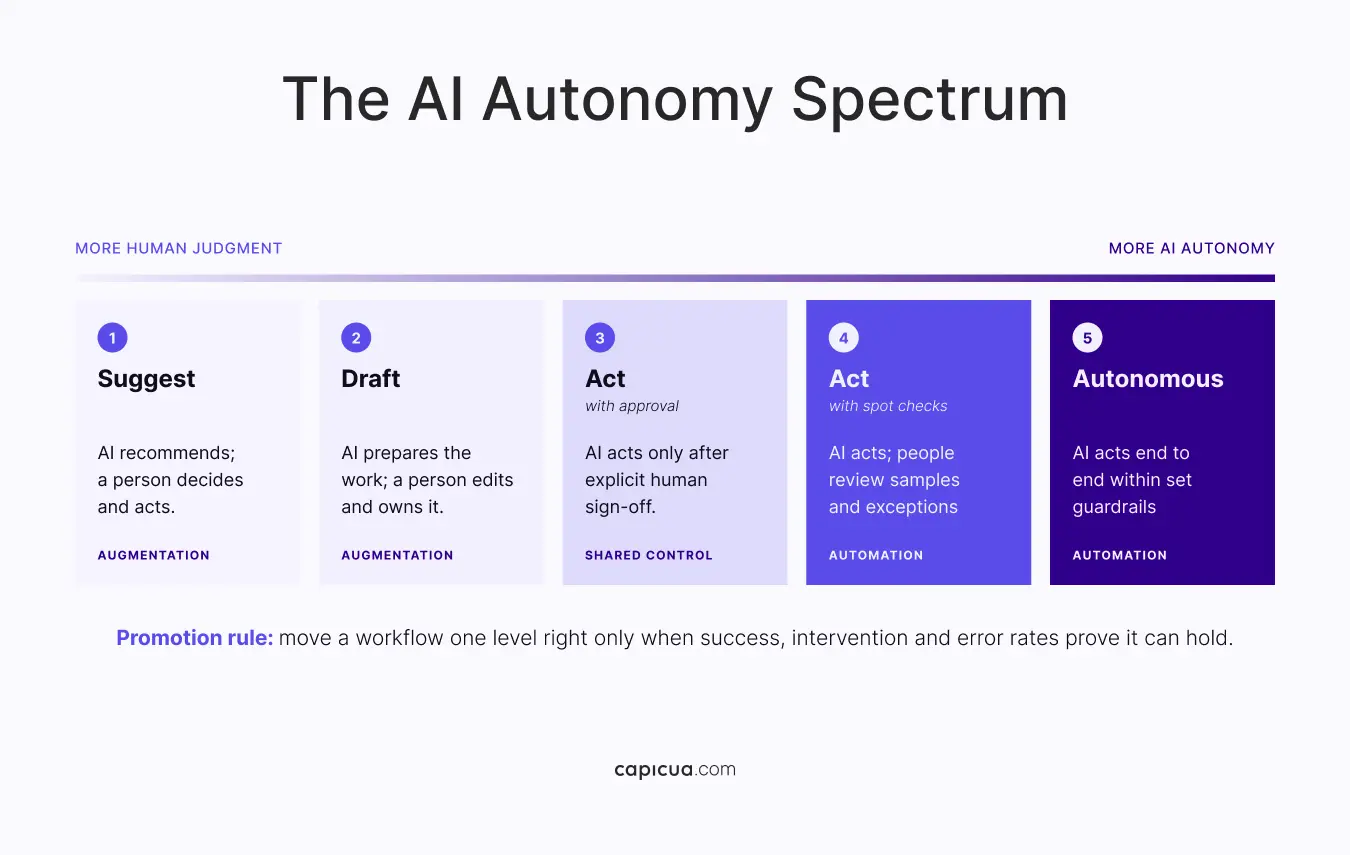
The comparison of AI augmentation vs AI automation also has a wide middle ground, with most production systems sitting on a spectrum of AI autonomy levels: suggesting, drafting, acting with approval, acting with spot checks, and acting autonomously. Gartner recommends proportional governance that classifies AI agents across distinct autonomy levels, because each level represents a different trust boundary. Treating the decision as binary leads teams to over-restrict simple features and under-restrict powerful ones, a pattern we explore in our guide to AI governance for digital products.
What Does the Data Say About AI Augmentation vs AI Automation?
The data shows that augmentation remains the dominant way people use AI for complex, open-ended work, while automation concentrates in programmatic, high-volume workflows. Usage patterns, deployment targets, and success rates all point in the same direction.
On the consumer side, Anthropic's January 2026 report found that augmented use on Claude.ai rose to 52% of conversations while automated use fell to 45%, after automation briefly overtook augmentation in August 2025. Within enterprise API traffic, about three-quarters of those interactions were classified as automation, reflecting workflows built for delegation, such as document processing, email handling, and scheduling.
Regarding reliability, tasks on Claude.ai succeeded 67% of the time compared with 49% for API traffic, and success rates on Claude.ai declined far more slowly as tasks got longer. The authors connect the gap to multi-turn conversation, where users can clarify, correct course, and iterate toward a solution. This is the operating logic of AI augmentation: every human turn works as a correction loop.
Anthropic's March 2026 report found that, in terms of experience, users with six months or more of tenure iterate with Claude more, delegate less, and see higher success rates. This association held after controlling for the tasks they bring. This finding pushes back against their earlier hypothesis that automation signals sophistication.
Enterprise deployment data points the same way:
- Autonomy is the exception: Only 22% of AI projects target a fully autonomous end state, while summarization, translation, and data management lead adoption.
- Trust is falling: Only 16% of organizations fully trust third-party AI models, down from 24% in 2023, making autonomous deployment harder to justify outside low-risk use.
- Decisions are where users feel value: McKinsey's State of AI in 2026 reports that 50% of respondents say AI helps them make better decisions, alongside the 80% who report individual productivity gains.
The AI automation vs AI augmentation decision is, in practice, a reliability decision. Automation pays off where tasks are bounded and repeatable, and augmentation pays off where tasks are long, ambiguous, or expensive to get wrong.
Why Automation-First AI Strategies Stall in Software Products
Automation-first AI strategies stall because they optimize for cost before reliability, trust, and workflow design are in place. Early savings then turn into governance incidents, rework, and lost expertise.
On value, McKinsey's 2026 survey found that 80% of respondents report AI has improved their individual productivity, but only 37% attribute any EBIT impact to AI, and just 6% qualify as high performers. High performers pursue growth and innovation alongside efficiency, and nearly three-quarters of them report fundamentally redesigning workflows, compared with about one-quarter of everyone else.
Moving to governance, Gartner predicts that by 2027, 40% of enterprises will demote or decommission autonomous AI agents because of governance gaps identified only after production incidents. And, focusing on returns, S&P Global found that just 46% of AI initiatives launched in the past year are on track to reach ROI within 12 months, and only 37% are live and delivering value.
The human side carries its own cost. In Harvard Business Review, researchers from Oxford, Stanford, and BetterUp argue that automation strategies tend to show earlier gains while augmentation strategies tend to win over time, because long-term success depends on how people feel about their work, whether they engage with new tools, and whether talent stays.
Three failure modes account for most stalled automation programs in product organizations:
- Automating an unredesigned workflow: An agent layered on a broken process inherits every handoff, exception, and approval that process already carried. Capicua's guide to agentic design patterns covers how architecture choices lock in those costs early.
- Skipping the trust ladder: Autonomy granted before reliability is proven turns small error rates into customer-facing incidents. Each step up the autonomy spectrum should be earned with evaluation data.
- Hollowing out expertise: When agents absorb the entry-level work through which people learn, today's productivity gain can become tomorrow's judgment gap, a risk McKinsey highlights as organizations reshape roles around agents.

Augment vs Automate: A Decision Framework for Product Leaders
The augment vs automate decision should be made per workflow, with a six-step framework with unified criteria to predict whether a task can run safely without human judgment: reversibility, input variance, volume, verifiability, context density, and learning value. Scoring each workflow against the same criteria turns a debate about AI ambition into a comparable, defensible product decision.
The Six-Criteria Augment vs Automate Test comprises:
- Reversibility: How expensive is a wrong output, and can it be undone? Reversible, low-cost errors favor automation. Errors that reach customers, money, or compliance favor augmentation or approval gates.
- Input variance: How different is each case from the last? Standardized inputs favor automation. Long-tail, ambiguous inputs favor augmentation.
- Volume and frequency: How often does the task run? High-volume work multiplies the savings of automation and the cost of its mistakes.
- Verifiability: Can a person or a test check the output quickly and cheaply? Cheap verification makes sampling-based automation viable. Expensive verification keeps a human in the loop.
- Context density: How much unwritten context, relationship history, or strategic intent does the task require? Dense context favors augmentation.
- Learning value: Does doing the task build expertise or insight your team needs? When the human work is how your team learns what users need, automating it removes the signal.
After the six criteria, teams can move to read the results:
- Automate: High volume, low variance, cheap to verify, and reversible. Examples include data enrichment, ticket routing, and invoice matching.
- Automate with oversight: High volume but costly errors. Use approval gates, confidence thresholds, or sampled review, and track intervention rates.
- Augment: Ambiguous, high-stakes, context-dense, or learning-rich work, such as pricing decisions, roadmap trade-offs, customer escalations, and research synthesis.

How to Design AI Augmentation Into Digital Products
Designing AI augmentation into a digital product means making the human decision easier, faster, and better informed, with an interface that shows what the AI did, how confident it is, and how to change it. Good augmentation design treats the user as the accountable owner and the AI as a fast, visible collaborator.
Six design patterns separate augmentation that users trust from assistance they ignore:
- Editable drafts over finished outputs: Present AI work as a starting point the user can shape, so ownership stays with the person who signs off.
- Visible confidence and sources: Show why a recommendation exists and how certain the system is, so users know where to look harder.
- Approval gates scaled to risk: Ask for confirmation only where the cost of error is high. Approval fatigue erodes the oversight it was meant to provide.
- Earned autonomy: Let teams promote a workflow from "suggest" to "act with spot checks" as accuracy proves out, and demote it just as easily.
- Undo and audit trails: Make every AI action reversible and reconstructable, which lowers the stakes of trying new automation.
- Corrections as signal: Capture every edit and override as product data that improves the model, the workflow, and the roadmap.
Organizations that design this way also reshape the teams around the product. McKinsey describes one product development function in which traditional pods of eight to ten people became hybrid teams of four to six, supported by agents, with an orchestration chart showing where human judgment and accountability matter most.
PwC's analyst relations team reaches a similar conclusion, noting that real value comes from designing AI to support decision-making rather than replacing it. Capicua's breakdown of AI agent orchestration for product teams covers how to route each step to an agent, an automation, or a person.
How to Measure the ROI of AI Augmentation vs Automation
Measure AI automation by cost per completed task, exception rate, and throughput, and measure AI augmentation by decision quality, cycle time, and rework, always against a baseline recorded before the AI arrived. Using a single metric for both models can make one look like a failure.
Metrics for AI automation:
- Cost per successful run, including inference, retries, and human review time.
- Exception and intervention rate, the share of runs that need a person to step in.
- Throughput and cycle time for the end-to-end workflow, not individual steps.
Metrics for AI augmentation:
- Decision quality, measured through outcome hit rates, forecast accuracy, or win rates.
- Time to decision for the work the AI supports.
- Rework rate, the share of output revisited after release.
- Adoption depth, the share of eligible decisions where users actually engage the AI.
When Anthropic discounted raw speedups by task success rates, the implied boost to annual US labor productivity growth fell from 1.8 to roughly 1.0 to 1.2 percentage points, a reminder that unverified speed overstates value. How you use the gains matters too: Gartner predicts that by 2027, 75% of organizations that prioritize capturing AI productivity gains as cost savings will be eclipsed by competitors that reinvest those gains into innovation, modernization, and upskilling. For the full cost model, Capicua's guide to AI return on investment walks through fully loaded costs and baselines.

Most automation vs augmentation mistakes start as clarity gaps: teams automate a workflow nobody mapped, or augment a decision nobody owns. Shaped Clarity™ helps product, design, and engineering agree on the decision each AI feature serves, who holds it, and what evidence would earn the system more autonomy, before the build starts. Products shaped this way adapt as models improve, learn from every correction users make, and keep growing their share of the market. Discover Shaped Clarity.
Conclusion
The strongest AI products of the next few years will deliberately mix augmentation and automation models: augmenting the judgment-heavy work that defines their value and automating the repeatable work that slows their users down. Teams that treat automation vs augmentation as a product decision, measured and revisited, will spend less time rebuilding and more time compounding.
To decide where your product should augment vs automate with evidence instead of guesswork, contact us or book a call.