


Product leaders have never had more customer feedback, or less agreement on what it means. A 2026 State of Customer Experience Report found that 66% of CX practitioners believe experiences improved last year; however, only 17% of consumers agree. The same report found that 30% to 40% of departments take no action after receiving customer insight. The distance between what companies collect and what customers actually experience is where voice of customer work earns or loses its budget.
Voice of customer research has become a leadership question: which signals deserve a roadmap slot, which belong in the backlog and which should change positioning, pricing or onboarding. This article covers what is voice of the customer in software, why the customer voice decides which product bets pay off, how to run voice of customer research and voice of customer analysis without drowning in data, and how to close the customer feedback loop so the program proves its value.
What is Voice of the Customer in Software Products?
Voice of the customer (VoC) is the continuous practice of capturing, analyzing and acting on what customers say, do and feel about a product, so that product, design, engineering and go-to-market decisions rest on customer evidence. In software, a voice of customer program connects three signal types into one view of the account and the user:
- Direct signals: what customers tell you when asked, through interviews, surveys, NPS verbatims, usability sessions and advisory boards.
- Indirect signals: what customers say when nobody asked, in support tickets, sales call recordings, community threads, reviews and churn notes.
- Inferred signals: what customers do, visible in feature adoption, time-to-value, drop-off points, seat expansion and renewal behavior.
Most teams over-index on direct signals, with a 2026 Gartner session on why surveys aren't working framing improving customer experience as leaders' top priority for the year and warning that generic surveys keep producing data that lacks actionability. Survey response rates have declined year over year, and more than half of consumers believe companies should infer satisfaction from behavior and signals rather than surveys alone. The recommendation is to augment targeted surveys with indirect analytics.
Voice of customer differs from UX research and product analytics in scope and cadence. UX research goes deep on a sample to explain why users behave as they do, and product analytics measures what happens at scale. VoC sits across both, giving leaders a continuous, cross-functional read of the customer voice that can be tied to revenue. As detailed in our guide to customer experience research methods, Capicua treats these as one evidence set.
Why Customer Voice Decides Product Bets
Customer voice decides which product bets pay off because buying, adoption, and renewal decisions happen in places your team cannot see, and a structured VoC program brings those decisions back into view.
Gartner found that buyers used an average of seven information sources during a recent purchase and that 45% used GenAI along the way. 67% prefer a rep-free experience, and 70% prefer a completely digital, self-service path. Today, your product is evaluated, adopted and judged in sessions no seller or customer success manager attends.
Experience quality is also largely flat, which rewards the companies that listen with more precision. Per Forrester's 2026 CX Index, 26% of North American brands posted statistically significant gains, 7% declined, and 68% remained unchanged. Loyalty is thin, too: only 22% of consumers feel very loyal, and 40% recently switched brands. Atlassian's State of Product 2026 found that 84% fear their products will fail.
Weak customer signal is usually the cause, and it carries four predictable costs:
- Roadmaps negotiated by the loudest account instead of by evidence across segments.
- Features that never reach adoption, which compound into rebuilds and rework.
- Churn reasons discovered at renewal, when the account is already gone.
- Positioning that drifts from buyer language, which slows every sales cycle. Our guide to win/loss analysis covers how to recover that language directly from buyers.
Strong VoC data is also the raw material for the product insights that decide which bets get funded in the first place.

How to Run Voice of Customer Research
Run voice of customer research by starting with a decision, combining direct and indirect sources, sampling across the full customer base (including churned and low-engagement accounts), and running the work at a steady cadence instead of as an annual project.
- Name the decisions the program must inform: Start with business questions such as "Why do mid-market accounts stall after onboarding?" Research without an attached decision becomes a report nobody reopens.
- Map your signal inventory: List every place the customer voice already lives: CRM notes, support tickets, call recordings, NPS verbatim, community threads, product analytics and win/loss interviews. Most teams already own more VoC data than they use.
- Sample for variation: Include power users, new accounts, downgraded and churned customers, and every role in the buying group. Satisfied advocates volunteer first, which is why sampling distortion is among the costliest types of bias in research.
- Set a continuous cadence: Short weekly or biweekly customer conversations surface drift earlier than a heavyweight annual survey. This rhythm is the core of continuous discovery, keeping product discovery running alongside delivery.
- Use one interview guide and one coding scheme: Ask about specific past moments instead of hypothetical features and tag every input with the same taxonomy: problem, segment, journey stage and revenue at stake.
- Give the program an owner and a forum: VoC needs a home, usually product operations, plus a monthly review where product, design, engineering, sales and customer success read the same themes together.
Maze's Future of User Research Report 2026 found that 66% of respondents report growing demand for research, up from roughly 55% a year earlier, and that product managers now run research in 39% of organizations. The share of organizations where research is essential to all levels of strategy nearly tripled in one year, from 8% to 22%. As voice of customer research spreads beyond research teams, shared standards matter more than headcount.
How to Do Voice of Customer Analysis
Voice of customer analysis is the process of turning raw feedback into ranked, evidence-backed themes by coding every input against a shared taxonomy, triangulating across signal types and weighting themes by business impact instead of request volume.
A five-part voice of customer analysis framework includes:
- Normalize the inputs: Pull tickets, transcripts, survey verbatim and call notes into one repository with the same metadata: account, segment, ARR, lifecycle stage and source.
- Code against a stable taxonomy: Tag each input by problem, job to be done, journey stage and sentiment so that themes can be compared quarter over quarter.
- Triangulate before you trust: A theme earns roadmap attention when it appears in at least two independent sources, such as interviews and product analytics.
- Weight by impact: Ten requests from accounts that represent 40% of ARR outweigh a hundred requests from trial users. Rank themes by revenue at risk, expansion potential and strategic fit.
- Write insight statements: "We observed [behavior] among [segment] because [cause], which affects [metric]." A consistent statement makes every theme comparable and debatable.

How AI Changes Voice of Customer Analysis
AI is now the fastest way to transcribe, tag and cluster VoC data at scale, and product leaders are drawing a clear line around it. Productboard's 2026 Product Workflow survey found that 72% of product leaders use AI for content generation and 48% for data analysis, but only 18% trust it for decision support or prioritization. Maze reports that 69% of research practitioners use AI in at least some projects, while 82% say human judgment remains essential for interpreting nuance and emotion.
The practical split for a voice of customer program looks like this:
- Use AI for transcription, tagging, clustering and first-pass synthesis across thousands of inputs.
- Keep people on interpretation, prioritization, trade-offs against strategy and the final call on what to build.
- Fix the inputs first, since AI amplifies whatever foundation it receives, and messy data produces confident noise.
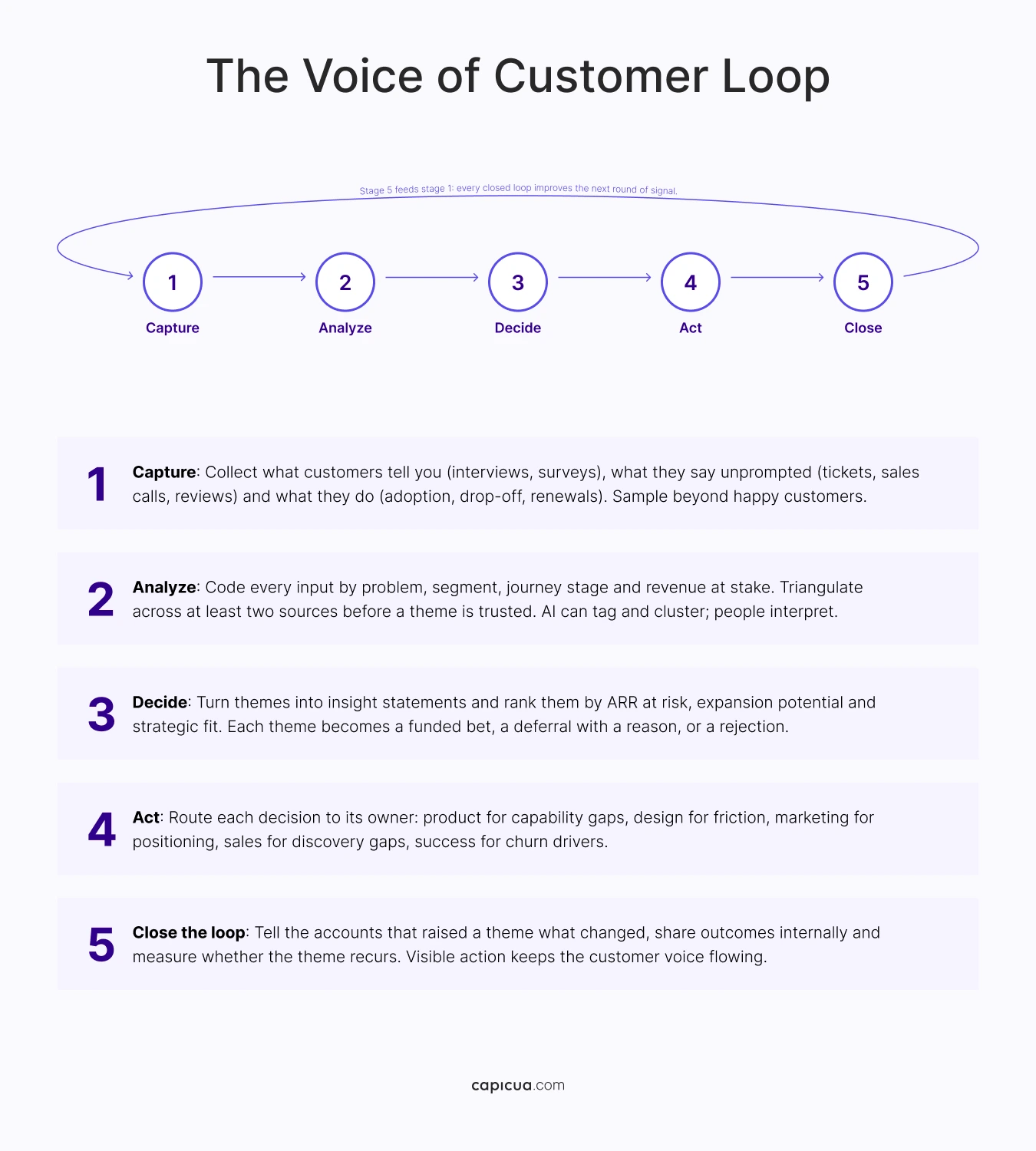
How to Close the Customer Feedback Loop and Prove VoC ROI
Close the customer feedback loop by routing every validated theme to an accountable owner, tying it to a roadmap decision, measuring the outcome and telling customers and internal teams what changed.
66% of respondents named measuring success as their biggest unresolved challenge, closely followed by managing product feedback loops, and more than half said improving feedback loops is the problem they most want to solve next. Furthermore, 78% of CX practitioners plan to adopt new metrics or approaches in 2026, and teams drawing on a wider range of data sources are significantly more likely to prove ROI.
Who Owns Each Voice of Customer Theme
- Product: capability gaps, integration blockers and adoption problems.
- Design and UX: friction in onboarding, workflows and self-service paths.
- Marketing: messaging that misses, pricing confusion and missing proof points.
- Sales: discovery gaps, missed stakeholders and procurement friction.
- Customer success: churn and contraction drivers, plus expansion blockers.
- Leadership: segment fit, pricing strategy and competitive bets.
Metrics That Prove a Voice of Customer Program Works
- Insight-to-decision time: days between a validated theme and a committed decision.
- Theme recurrence: whether a top complaint declines after a related change ships.
- Adoption of VoC-driven releases: share of target users who use the change repeatedly within 30 to 90 days.
- Retention and expansion: gross and net revenue retention in the segments a theme targeted.
- Evidence coverage: share of roadmap items backed by at least two independent VoC sources.
Most scaling teams already hear more from customers than they can use, and drift starts when that customer voice never reaches the decisions that shape the roadmap. Shaped Clarity™ aligns founders, product, design and engineering around validated customer evidence so products adapt to change, learn from real users and grow market share without the rework that follows assumption-led bets. Discover Shaped Clarity.
Conclusion
Voice of customer has moved from a CX metric to a product leadership discipline. When buyers evaluate on their own, users adopt in silence and churn surfaces only at renewal, the advantage goes to those who capture every signal, analyze it with rigor and act on it visibly. A voice of customer program built on decisions, ownership and closed loops is how that distance shrinks quarter after quarter.
To turn your customer voice into product decisions your team can defend, contact us or book a call.