


According to Atlassian, 86% of product managers agree that deciding what to build matters more than ever. And, according to Harvard Business Review, as AI commoditizes execution, teams create the most value during problem definition and solution design. The pressure lands on one short artifact most teams either skip or write too loosely: a design statement.
A design statement is the sentence that tells product, design and engineering what the next design must achieve, for whom, and how the team will judge success. This guide covers the design statement definition, the real difference between a problem statement vs design statement, where the design thinking point of view statement fits between them, a step-by-step method, and the mistakes that quietly turn problem framing into rework.
What is a Design Statement? Design Statement Definition
A design statement is a concise, solution-open sentence that defines who a team is designing for, what change the design must create for them, why that change matters to the business, and which constraints and success criteria the work must respect. In short, the design statement definition describes a commitment: it converts research and problem framing into a direction the whole product trio can build against.
In the design thinking process, the define stage turns observation into direction. The Nielsen Norman Group notes that teams use several names for these artifacts, including user need statements, problem statements and point of view statements, and advises organizations to pick one vocabulary and use it consistently.
A strong design statement carries five parts:
- Design intent: An action verb that frames the work, such as "Design a first-week experience that helps..."
- Specific user: A segment, role and context drawn from research, never "users" in general.
- Outcome: The change for the user and the business result it supports.
- Success signal: A measurable indicator the team agrees on before ideation starts.
- Guardrail: What must not get worse while the team pursues the outcome.
A design statement sits closer to a design brief than a problem statement does, yet it's shorter, with one or two sentences a team can read aloud at sprint kickoff and return to in the retrospective. A well-crafted need statement doubles as a benchmark for success, because the success signal gives every later review a fixed reference point.
Problem Statement vs Design Statement
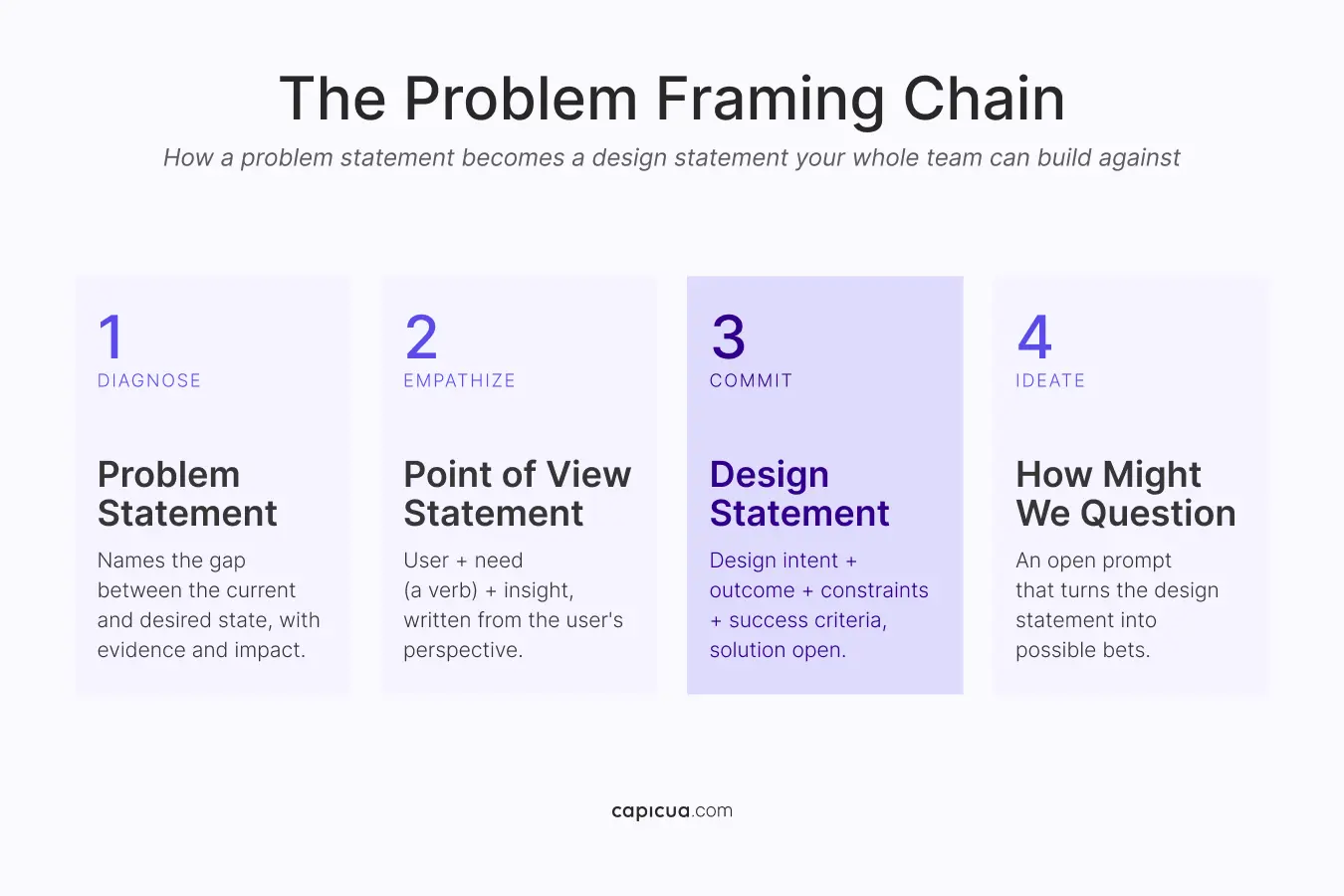
The difference in problem statement vs design statement comes down to direction. A problem statement decides: it describes the gap between the current state and the desired state. A design statement directs: it commits the team to the change its design must produce and the evidence that will prove it.
In practice, a problem and a design statement are divided by four dimensions:
- Purpose: The problem statement explains what is broken and why it matters. The design statement defines what the next design must accomplish.
- Perspective: Problem statements often start from the business or the system. Design statements merge the user's perspective from the POV statement with a business outcome.
- Timing: The problem statement opens product discovery. The design statement closes the define stage and opens ideation.
- Testability: A problem statement can be accurate and still give a team nothing to act on. A design statement must carry a success signal and a guardrail, so it can be judged later.
In a B2B SaaS setting, the statements would be:
- Problem statement: New workspace admins stall before inviting their team, delaying activation past the trial window and weakening first-year renewals.
- Design statement: Design a first-week setup experience that helps new workspace admins validate one real workflow in under 30 minutes, so more trial accounts reach team invites. We will know it works when the share of trials with three or more invited teammates by day seven rises, with no increase in onboarding support tickets.
The LeadDev Engineering Team Performance Report 2026 found that 22% say AI has moved their biggest delivery bottleneck to product specification and requirements, and 68% say aligning priorities across teams is a challenge. A problem statement handed straight to engineering leaves every tradeoff open to negotiation, while a design statement settles the target before the first ticket exists.
What is a Design Thinking Point of View Statement?
A design thinking point of view statement, or POV statement, is an actionable sentence that combines a specific user, a need written as a verb, and an insight that explains why that need matters, all from the user's perspective. The Nielsen Norman Group's guide to user need statements treats need statements, problem statements and point of view statements as one tool for the define stage, built from a user, a need and a goal.
A simple template keeps the structure honest: [Specific user] needs to [action] because [insight].
The POV statement and the design statement work as a pair. The POV statement captures who struggles and why; and the design statement adds what the business needs from solving it, how success will be measured and what must stay protected. Without the POV statement, a design statement drifts toward business-only targets; without the design statement, a strong insight stays on a sticky note nobody owns.
Point of View Statement Design Thinking Examples for B2B SaaS
If you came looking for point of view statement design thinking examples, these three show the structure applied to B2B software:
- Fintech compliance: Compliance leads at regional banks need to explain every automated risk flag to auditors, because a single unexplained flag can stall a quarterly review.
- HR software: Hiring managers at 200-person companies need to compare final candidates in one sitting, because scheduling a second debrief often means losing the candidate to a faster offer.
- Developer platforms: Platform engineers inheriting a legacy service need to understand its dependencies before changing it, because an unexpected outage damages their credibility with product teams.
Turned into a design statement, the HR example becomes: Design a debrief experience that helps hiring managers at 200-person companies reach a final decision in one session, so that time from final interview to offer shrinks. We will know it works when median days from final interview to offer drop, with no fall in hiring manager satisfaction scores.

How to Write a Design Statement for Software Products
To write a design statement, start from validated research, draft the POV statement first, then add the business outcome, a measurable success signal and a guardrail, and finally check that the sentence launches ideation without naming a solution. Steps include:
- Gather the evidence: Pull interview notes, product analytics, support themes and win/loss findings into one place. Capicua's guide to product insights covers how to turn those signals into bets, and discovery sessions are the natural setting for this step.
- Name one user segment: Choose the segment whose behavior the evidence describes best. A statement that serves three personas serves none of them well.
- Write the need as a verb: Describe what the user is trying to accomplish and remove every mention of a screen, feature or component.
- Capture the insight: Explain why the need matters to the user, emotionally or operationally. The insight is usually what surprised the team in research.
- Attach the outcome and success signal: Connect the user change to a business result, then agree on the indicator that will show progress, such as activation, adoption, time to value or retention.
- Set a guardrail: Name the metric or experience that must not degrade, such as support volume, performance or accessibility.
- Stress-test and convert: Read the statement with product, design and engineering together. If it produces a How Might We question that generates many different ideas, it is ready. Capicua's How Might We template and its guide to brainstorming in UX design pick up from here.
A reusable design statement template looks like this: Design [an experience or workflow] that helps [specific user] [need, as a verb] so that [outcome]. We will know it works when [success signal], without [guardrail].
NN/g distinguishes broad, umbrella need statements that align a long-term roadmap from narrow ones that a team can satisfy within one or two releases. Most product organizations benefit from both: one parent design statement per strategic bet and several child statements per sprint, each traceable to the parent. In a June 2026 buildathon that Miro ran with NYU Stern, 33 MBA students had six hours to build AI-assisted products, and judges explicitly ranked problem definition and solution design above speed. The winning teams stood out by framing their problems differently, and none of them won on engineering sophistication.
Why Design Statements Matter More as AI Speeds Up Delivery
Design statements matter as AI speeds up delivery because execution has become abundant while clarity about what to build has stayed scarce. A vague requirement used to stall in review, but today it can become a finished feature within days and reach customers before anyone questions it.
According to Figma's 2026 AI Report, 90% of designers, developers and product managers say design is at least as important as it was before. Still, the same report also shows roles blurring fast. Designers participating in development doubled to 41% in a year, and developers doing design work rose from 44% to 60%. When more people can build, a shared statement of what the build must achieve becomes the main thing keeping them aligned.
Designers say the same about their own work, with 91% stating that clear goals and expectations help them do their best work, while 87% say creative autonomy does, per Figma's State of the Designer 2026. A well-written design statement delivers both at once: a fixed goal and an open solution space.
Engineering feels the pressure downstream: 52% of LeadDev 2026 respondents say code review and validation is now their biggest bottleneck. Reviewers can only judge whether generated work is correct if someone defined what correct means, and the success signal and guardrail in a design statement give them that yardstick. Capicua's guide on how to align product planning and engineering execution covers how to carry the same intent into specs that both humans and AI agents can follow.

Common Design Statement Mistakes and How to Measure Them
The most common design statement mistakes are embedding a solution, writing for users in general, skipping the success signal and treating the statement as a one-time workshop output. Each one surfaces later as rework, roadmap churn or features nobody adopts.
- Naming the solution: "Design an AI assistant for onboarding" decides the answer before ideation. Rewrite it around the action the admin is trying to complete.
- Writing for everyone: "Users need a faster workflow" hides which segment matters most and why.
- Dropping the insight: Without the "because," the team has no way to choose between two solutions that both meet the need.
- Missing the success signal: If nobody agreed on a measure before building, every launch gets declared a success.
- Ignoring guardrails: Growth targets without guardrails trade one problem for another, such as activation gains that double support load.
- Freezing the statement: New evidence should update the statement. A design statement that never changes is usually one the team stopped reading.
Measuring framing quality keeps the practice honest, and four signals cover most of the ground:
- Outcome hit rate: The share of shipped bets that moved the success signal named in their design statement.
- Rework share: The portion of capacity spent revisiting recently shipped work, which falls when framing improves.
- Retro traceability: Whether retrospectives start from the original design statement and score delivery against it.
- Reversal rate: How often new evidence changes a statement or stops a bet. A rate of zero usually means the team is ignoring inconvenient findings.
Capicua's analysis of the design thinking process in engineering design and its guide to strategic thinking and strategic planning show how these measures connect day-to-day framing to the bets leadership funds.

Teams move from evidence to execution without a shared, testable picture of what it is trying to change. Shaped Clarity™ ensures that problem statements, POV statements and design statements stay connected to real signals and keep the product adapting as users and markets shift. With clarity upstream, every sprint builds toward an outcome the whole team already agreed to measure. Discover Shaped Clarity.
Conclusion
A design statement is small enough to fit on a sticky note and strong enough to decide what a team builds for a quarter; what matters is the discipline behind it: diagnose with a problem statement, empathize with a POV statement, commit with a design statement, and open ideation with a How Might We question.
To frame the right problems before your next build, contact us or book a call.