
Go Back

Strategic Feature Prioritization

Strategy
Updated:
12/9/25
Published:
12/9/25
Build With Clarity
Summarize
Share

https://capicua-new-251e906af1e8cfeac8386f6bba8.webflow.io/blogs/

Most product teams have more ideas than resources to build them. As Marty Cagan highlights in "Inspired," the challenge is mostly related to deciding what to do. 

To reinstall a balance between effort and outcomes, feature prioritization becomes a strategic ally for teams and leaders alike. This article provides a comprehensive overview of feature prioritization, from concept to frameworks. Let's go!

What is Feature Prioritization?

Feature prioritization is a strategic approach to making intentional trade-offs when building a digital product. This systematic approach focuses on listing possible ideas and features for teams to analyze what to build and in what order. 

As a result, a disorganized backlog of ideas can be recast into strategic product roadmaps. Effective prioritization aligns business objectives, user needs and Return on Investment.

Related
Disadvantages of the Lean Framework

What is a Feature Prioritization Matrix?

A feature prioritization matrix visually plots potential features against variables, often presented as a 2x2 grid. Its four quadrants help categorize work and guide decision-making. 

In most cases, the matrix relies on value and effort variables. Nonetheless, these can adapt to specific needs. Examples include " satisfaction vs cost" or "urgency vs relevance." The power of a prioritization matrix lies in its simplicity for strategic conversation.

How Does Feature Prioritization Work?

Feature prioritization is a continuous cycle that starts by putting all product features, ideas and requests on the table. Usually handled within the backlog, it includes input from sources such as direct feedback, user research and data analytics.

After collecting ideas, teams select a framework that fits their context and collaborate to define the criteria. What constitutes "value"? How will "effort" be measured? Each feature is then systematically assessed against these criteria. For a matrix, this means plotting it on the grid; for RICE, it means calculating the score. This prioritized list informs the product roadmap, dictating the sequence of steps for upcoming sprints or cycles.

Related
Business Technology Consulting Services

Feature Prioritization Frameworks

Value vs Effort Matrix

As mentioned, one of the most intuitive frameworks is the Value vs Effort matrix, which helps make quick decisions with a simple 2x2 grid. The vertical axis represents the value a feature delivers, considering both customer and business value. Think of enhancing user experiences and also increasing market share.

On the other hand, the horizontal axis shows the effort required to build it, encompassing all resources, such as development time and costs. Plotting ideas onto this feature prioritization matrix reveals four distinct quadrants:

  1. Quick Wins. Top priorities that offer substantial benefit with minimal investment and should be addressed immediately.
  2. Major Projects. Strategic initiatives that demand meticulous planning, yet are vital for product sustainability.
  3. Fill-Ins. Tasks that can be completed in the case of schedule gaps without taking over more impactful work.
  4. Time Sinks. Features that should be deprioritized as they consume significant resources for little to no return.
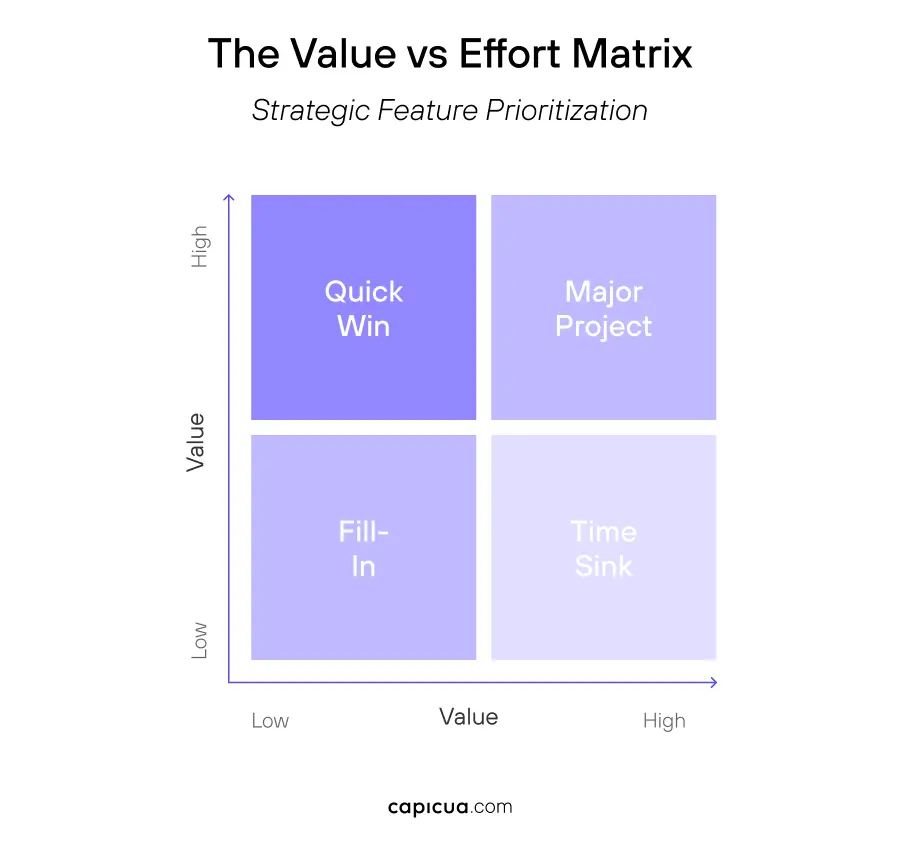
Value vs Effort Matrix. Capicua Product Growth Partner, Creator or Shaped Clarity

The MoSCoW Method

The MoSCoW matrix categorizes features by necessity, helping stakeholders agree on what is important for a specific release or timeframe. MoSCoW stands for: 

  • Must-Have (M). Non-negotiable features that would lead to failure if left out. 
  • Should-Have (S). Important features yet not vital for the current release. 
  • Could-Have (C). Desirable features that would improve the experience but whose absence doesn't break the product.
  • Won't-Have (W). Features explicitly acknowledged as out of scope for the current timeframe.

The RICE Framework

For a more data-driven approach, the RICE framework ranks features with a scoring system. This reduces subjectivity by dividing prioritization into four specific factors. The final score is calculated as: (Reach × Impact × Confidence) / Effort, providing a single, comparable number for each feature.

  • Reach. Focuses on quantifying audiences. Answers: How many users will this feature affect within a specific time period? 
  • Impact. Measures impact on a 0.5 (low) - 3 (massive) scale. Answers: How much will this feature impact individual users? 
  • Confidence. Analyzes trust in percentages. Answers: How confident are you in your estimates for reach and impact?
  • Effort. Typically estimated in "person-months" or a similar unit. Answers: What is the total time required from all team members to build this?
Related
Software Maturity Modelsk

The Weighted Shortest Job First (WSJF)

For teams using the Scaled Agile Framework (SAFe), the Weighted Shortest Job First (WSJF) model helps prioritize tasks. To do so, it considers the economics of development, prioritizing what delivers the most value in the shortest amount of time.

WSJF can be more complex, but, as it measures the financial impact of delays, it's useful for larger companies. This approach relies on the costs of delay and the job duration

While the cost of delay combines value with risk reduction or enablement, the job duration serves as a proxy for effort. The formula divides the cost of delay by the job duration.

Let's say an e-commerce platform has two projects. Project A is to fix high-value cart abandonment, and Project B is a new "Wishlist" social sharing feature. Using WSJF, we calculate Cost of Delay (CoD) / Job Duration and see the following:

Project A has an extremely high CoD as it damages trust and has high urgency. Yet, the engineering team estimates a 3-day fix, so it has a low duration. The WSJF Score for Project A would be: 100 (CoD) / 3 (JD) = ~33

Project B may improve rates in the long term, but it doesn't stop active revenue loss, so it has a medium CoD. What's more, it demands new interface design and backend work, and it can take up to a month. The WSJF Score for Project B would be: 30 (CoD) / 15 (JD) = 2.

As you may have guessed, with a WSJF score of 33 vs. 2, cart abandonment is over 16x more important to do first.

Related
Business Growth Strategies

What is MVP Feature Prioritization?

In the context of Minimum Viable Products, MVP feature prioritization applies this discipline with the sole goal of learning. In MVPs, the goal is to launch just enough features to test an idea and collect feedback. This objective makes feature prioritization a core exercise. 

Narrowing down the key problem the product aims to solve allows building only essential features aligned with the value proposition. The MoSCoW framework can be particularly useful here, as the focus is almost exclusively on identifying the "Must-Haves." Anything that falls into the "Should-Have" or "Could-Have" categories is aggressively deferred to a future version. MVP feature prioritization helps the team work more quickly, reduces initial costs and shapes the product roadmap with real feedback.

How To Select a Feature Prioritization Framework

No framework is universally best; the choice depends on context and maturity. For new products or teams seeking alignment, the Value vs Effort matrix is a simple starting point. When the focus relies on clearly communicating and aligning stakeholders' expectations, the MoSCoW method helps create clearer work categories.

For mature products with quantitative data, the RICE framework provides a robust scoring system. The result is a clear, detailed comparison between features. Choose a tool catered to your product's current stage, timeline, milestones and objectives.

The Business Advantage of Feature Prioritization

A formal feature prioritization process ensures the benefits of successful products extend far beyond an organized backlog. For founders and leaders, it maximizes the value teams deliver by focusing on high-impact features. Leads can ensure constrained resources yield the maximum possible return.

Following that realm, feature prioritization supports grounded strategic direction. By aligning what is being built and why, companies can reduce wasted cycles. This disciplined prioritization directly enhances customer satisfaction. As teams consistently ship features that solve real problems, companies build trust and loyalty.

Conclusion

Feature prioritization is key to guaranteeing every invested resource delivers its maximum possible value. This careful approach is what sets apart products that just work from those that lead markets and please users.

At Capicua, the Product Growth Partner, we bring clarity and action to replace guesswork with meaning. Ready to build what matters most? Reach out today!

About
We turn costly guesswork into signal-based direction for visionary leaders to regain control losing value.

With Shaped Clarity™, we anchor decisions to purpose for sustainable and rewarding growth.
Shaped Clarity
discover
Shaped
Clarity™
Shaped Clarity
discover
Shaped
Clarity™

Scalable Product Evolution

The Palindrome - Capicua's Blog
Make The Difference
This image showcasts different concepts related with the article topic.
Summarize:
Summarize with ChatGPTSummarize with PerplexitySummarize with Claude

Most product teams have more ideas than resources to build them. As Marty Cagan highlights in "Inspired," the challenge is mostly related to deciding what to do. 

To reinstall a balance between effort and outcomes, feature prioritization becomes a strategic ally for teams and leaders alike. This article provides a comprehensive overview of feature prioritization, from concept to frameworks. Let's go!

What is Feature Prioritization?

Feature prioritization is a strategic approach to making intentional trade-offs when building a digital product. This systematic approach focuses on listing possible ideas and features for teams to analyze what to build and in what order. 

As a result, a disorganized backlog of ideas can be recast into strategic product roadmaps. Effective prioritization aligns business objectives, user needs and Return on Investment.

Related
Disadvantages of the Lean Framework

What is a Feature Prioritization Matrix?

A feature prioritization matrix visually plots potential features against variables, often presented as a 2x2 grid. Its four quadrants help categorize work and guide decision-making. 

In most cases, the matrix relies on value and effort variables. Nonetheless, these can adapt to specific needs. Examples include " satisfaction vs cost" or "urgency vs relevance." The power of a prioritization matrix lies in its simplicity for strategic conversation.

How Does Feature Prioritization Work?

Feature prioritization is a continuous cycle that starts by putting all product features, ideas and requests on the table. Usually handled within the backlog, it includes input from sources such as direct feedback, user research and data analytics.

After collecting ideas, teams select a framework that fits their context and collaborate to define the criteria. What constitutes "value"? How will "effort" be measured? Each feature is then systematically assessed against these criteria. For a matrix, this means plotting it on the grid; for RICE, it means calculating the score. This prioritized list informs the product roadmap, dictating the sequence of steps for upcoming sprints or cycles.

Related
Business Technology Consulting Services

Feature Prioritization Frameworks

Value vs Effort Matrix

As mentioned, one of the most intuitive frameworks is the Value vs Effort matrix, which helps make quick decisions with a simple 2x2 grid. The vertical axis represents the value a feature delivers, considering both customer and business value. Think of enhancing user experiences and also increasing market share.

On the other hand, the horizontal axis shows the effort required to build it, encompassing all resources, such as development time and costs. Plotting ideas onto this feature prioritization matrix reveals four distinct quadrants:

  1. Quick Wins. Top priorities that offer substantial benefit with minimal investment and should be addressed immediately.
  2. Major Projects. Strategic initiatives that demand meticulous planning, yet are vital for product sustainability.
  3. Fill-Ins. Tasks that can be completed in the case of schedule gaps without taking over more impactful work.
  4. Time Sinks. Features that should be deprioritized as they consume significant resources for little to no return.
Value vs Effort Matrix. Capicua Product Growth Partner, Creator or Shaped Clarity

The MoSCoW Method

The MoSCoW matrix categorizes features by necessity, helping stakeholders agree on what is important for a specific release or timeframe. MoSCoW stands for: 

  • Must-Have (M). Non-negotiable features that would lead to failure if left out. 
  • Should-Have (S). Important features yet not vital for the current release. 
  • Could-Have (C). Desirable features that would improve the experience but whose absence doesn't break the product.
  • Won't-Have (W). Features explicitly acknowledged as out of scope for the current timeframe.

The RICE Framework

For a more data-driven approach, the RICE framework ranks features with a scoring system. This reduces subjectivity by dividing prioritization into four specific factors. The final score is calculated as: (Reach × Impact × Confidence) / Effort, providing a single, comparable number for each feature.

  • Reach. Focuses on quantifying audiences. Answers: How many users will this feature affect within a specific time period? 
  • Impact. Measures impact on a 0.5 (low) - 3 (massive) scale. Answers: How much will this feature impact individual users? 
  • Confidence. Analyzes trust in percentages. Answers: How confident are you in your estimates for reach and impact?
  • Effort. Typically estimated in "person-months" or a similar unit. Answers: What is the total time required from all team members to build this?
Related
Software Maturity Modelsk

The Weighted Shortest Job First (WSJF)

For teams using the Scaled Agile Framework (SAFe), the Weighted Shortest Job First (WSJF) model helps prioritize tasks. To do so, it considers the economics of development, prioritizing what delivers the most value in the shortest amount of time.

WSJF can be more complex, but, as it measures the financial impact of delays, it's useful for larger companies. This approach relies on the costs of delay and the job duration

While the cost of delay combines value with risk reduction or enablement, the job duration serves as a proxy for effort. The formula divides the cost of delay by the job duration.

Let's say an e-commerce platform has two projects. Project A is to fix high-value cart abandonment, and Project B is a new "Wishlist" social sharing feature. Using WSJF, we calculate Cost of Delay (CoD) / Job Duration and see the following:

Project A has an extremely high CoD as it damages trust and has high urgency. Yet, the engineering team estimates a 3-day fix, so it has a low duration. The WSJF Score for Project A would be: 100 (CoD) / 3 (JD) = ~33

Project B may improve rates in the long term, but it doesn't stop active revenue loss, so it has a medium CoD. What's more, it demands new interface design and backend work, and it can take up to a month. The WSJF Score for Project B would be: 30 (CoD) / 15 (JD) = 2.

As you may have guessed, with a WSJF score of 33 vs. 2, cart abandonment is over 16x more important to do first.

Related
Business Growth Strategies

What is MVP Feature Prioritization?

In the context of Minimum Viable Products, MVP feature prioritization applies this discipline with the sole goal of learning. In MVPs, the goal is to launch just enough features to test an idea and collect feedback. This objective makes feature prioritization a core exercise. 

Narrowing down the key problem the product aims to solve allows building only essential features aligned with the value proposition. The MoSCoW framework can be particularly useful here, as the focus is almost exclusively on identifying the "Must-Haves." Anything that falls into the "Should-Have" or "Could-Have" categories is aggressively deferred to a future version. MVP feature prioritization helps the team work more quickly, reduces initial costs and shapes the product roadmap with real feedback.

How To Select a Feature Prioritization Framework

No framework is universally best; the choice depends on context and maturity. For new products or teams seeking alignment, the Value vs Effort matrix is a simple starting point. When the focus relies on clearly communicating and aligning stakeholders' expectations, the MoSCoW method helps create clearer work categories.

For mature products with quantitative data, the RICE framework provides a robust scoring system. The result is a clear, detailed comparison between features. Choose a tool catered to your product's current stage, timeline, milestones and objectives.

The Business Advantage of Feature Prioritization

A formal feature prioritization process ensures the benefits of successful products extend far beyond an organized backlog. For founders and leaders, it maximizes the value teams deliver by focusing on high-impact features. Leads can ensure constrained resources yield the maximum possible return.

Following that realm, feature prioritization supports grounded strategic direction. By aligning what is being built and why, companies can reduce wasted cycles. This disciplined prioritization directly enhances customer satisfaction. As teams consistently ship features that solve real problems, companies build trust and loyalty.

Conclusion

Feature prioritization is key to guaranteeing every invested resource delivers its maximum possible value. This careful approach is what sets apart products that just work from those that lead markets and please users.

At Capicua, the Product Growth Partner, we bring clarity and action to replace guesswork with meaning. Ready to build what matters most? Reach out today!