


Every point of gross revenue retention compounds into valuation, runway and the freedom to fund the next bet, but that number is moving in the wrong direction. Median GRR across B2B SaaS fell from 88% to 84%, and Net Revenue Retention (NRR) has been flat since 2024.
In this context, customer retention strategies are the deliberate product, pricing, service and operating decisions that keep customers reaching value long enough to renew and expand. This guide breaks down the best customer retention strategies for software and digital products in the AI era, the customer retention techniques that work beyond the product, and how founders and product leaders can tell whether any of it is working.
What are Customer Retention Strategies for SaaS?
Customer retention strategies are the systems a software company uses to keep customers active, renewing and expanding after their first purchase. SaaS Customer retention manages Gross Revenue Retention (GRR), the share of starting revenue you keep after churn and contraction, and Net Revenue Retention, which adds expansion revenue back in.
B2B SaaS companies have a median NRR of 103% and a median GRR of 91% for bootstrapped companies with $3M to $20M in ARR, and the 75th-percentile GRR is slipping from 95% to 91%, which shows that even strong performers are losing ground. Retention is the lagging proof that customers keep reaching value.

Why is Customer Retention Harder in the AI Era?
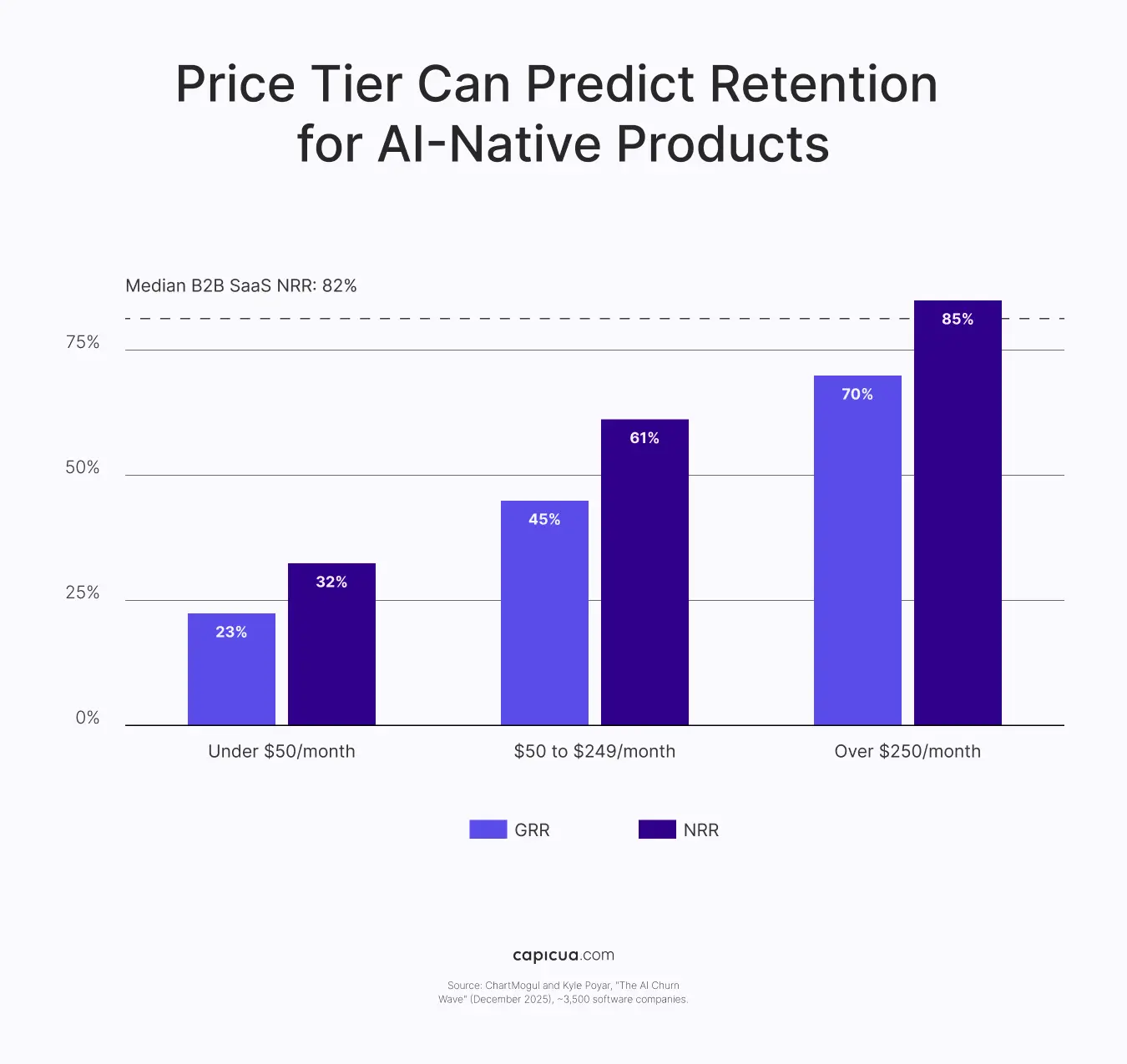
Customer retention is harder because both buying and leaving software got easier. AI-native products posted a GRR of 40% and an NRR of 48%, against a median NRR of 82% for B2B SaaS: lower commitment means lower switching costs, and lower switching costs turn customer churn into a monthly decision instead of an annual one.
AI-native products priced above $250 per month retained 70% GRR and 85% NRR, close to B2B SaaS norms. In comparison, products under $50 per month kept only 23% GRR, and AI-native GRR climbed from 27% in January to 40% in September 2025, suggesting durability responds to design, packaging and go-to-market choices.
However, investment is drifting away from the installed base, with Gartner reporting that spending on customer loyalty and retention fell 29% between 2024 and 2026, to less than 15% of total media spend. In this context, the teams that understand AI best are doubling down on customer retention.
Customer Retention Strategies That Start in the Product
The most durable customer retention strategies start inside the product, because it's where customers decide whether value is real.
Time-to-Value Onboarding Design
Time-to-value is the time between purchase and the first moment a customer gets the outcome they paid for. Across software companies, customers can be up to 10 times more receptive in their first 30 days than in months four through eleven, and seat upgrades fall from 0.83% in month one to 0.19% by month four. Onboarding is the first retention and the first expansion moment, so treat it as a surface with an owner, a metric and a roadmap.

Workflow Depth and Product Adoption
Product adoption measures how many core workflows a team runs through your product, and how many people rely on it. One-week retention can be as low as 5.0% in North America, and retention data reflects both organizational integration and product quality. Map the two or three actions that signal your product is embedded in an account, and design features, prompts and integrations that move accounts toward them.
Behavior-Based Customer Health Score
A customer health score turns usage, support and commercial signals into an early warning system, with the strongest scores weighting behavior over sentiment: shrinking active seats, abandoned core workflows and unresolved tickets. Pair the score with context from voice of customer research and route each risk pattern to the team that can fix it, whether that is product, design, engineering or customer success.
Customer Retention Techniques Beyond the Product
Effective customer retention techniques extend into pricing, service and the way a company responds when customers leave.
Pricing and Packaging Aligned With Value
Research found an NRR of 108% for usage-based pricing compared with 98% for seat-based pricing, and annual plans carry a median NRR 10-20 points higher than monthly plans. Make annual the default where value supports it, align packages with the outcomes customers buy, and review pricing against retention cohorts.

AI Support With a Clear Path to a Human
87% of B2B and B2C customers consider access to a human agent essential when companies use GenAI in customer service, and only 27% of users would try a chatbot again after a negative experience. Let AI resolve high-confidence issues, hand off with full context, and track resolution quality as a churn reduction metric.
Churn Reasons Into Product Bets
Cancellation data and churn interviews are some of the most honest research a company owns. Categorize the reasons, quantify the revenue behind each one, and assign product owners. Win/loss analysis applies the same discipline to churned accounts, and product insights turn those patterns into bets the roadmap can test.
Segmented Win-Back Campaigns
More than 5% of churned customers return within three months, and that number climbs to almost 10% for AI-native products. A win-back sequence that shows former customers what changed since they left, tied to the reason they cited, recovers revenue at a fraction of the cost of acquisition.
How to Measure and Improve Customer Retention Strategies
To measure and improve customer retention strategies, report GRR and NRR side by side, segment both by cohort, and connect leading indicators such as time-to-value to the lagging revenue outcomes the board sees. Half of interviewed customer success and revenue leaders have no consistent way to measure AI's impact, only 21% connect measurement to revenue outcomes, and 65% of the most AI-mature teams reported NRR of 100% or higher.
A practical retention scorecard for product leaders includes these retention metrics:
- Gross revenue retention: the clearest read on churn and contraction.
- Net revenue retention: retention plus expansion revenue, reported next to GRR so growth cannot hide leakage.
- Logo churn rate by segment: separates small-account noise from strategic losses.
- Cohort retention curves: show whether recent product changes help new customers stick.
- Time-to-value and activation rate: leading indicators that move months before renewals do.
- Customer lifetime value: links retention to the economics of acquisition.
Review the scorecard monthly with product, design, engineering and customer success in the same room. Retention metrics change outcomes when they change decisions about what gets built, priced and supported next.

Customer Retention Best Practices for Product Leaders
Customer retention best practices come down to ownership and rhythm: retention suffers when it lives inside a single department, because the causes of churn are spread across onboarding, roadmap, pricing and support.
- Make retention a leadership metric with one accountable owner and cross-functional contributors.
- Define activation as a value moment for each segment, then design onboarding toward it.
- Route churn signals into a shared insight backlog with owners and follow-up dates.
- Reserve roadmap capacity for retention work, so fixes for existing customers compete fairly with new features.
- Revisit pricing and packaging at least once a year against retention cohorts.
- Measure AI in support and success by resolution quality and renewal impact.
Shaped Clarity™ gives product, design and engineering a shared lens to connect retention signals with product decisions, so onboarding, roadmap and pricing evolve with how customers work. The result is a product that learns from its users, adapts to change and earns a growing share of every account. Learn about Shaped Clarity.
Conclusion
To hold value through the AI era, treat retention as a strategy: design for time-to-value, price for commitment, give AI a human safety net, and turn every churned account into a lesson the roadmap can use. The best customer retention strategies this year will spend next year growing accounts instead of replacing them.
Build customer retention strategies that keep accounts growing: contact us or book a call.