


How many of your last quarter's releases did real users try before your team committed engineering time to them? To be honest, for most scaling companies, fewer users try the product than most roadmaps suggest, and without UX testing, the cost surfaces later as rework, churn, and non-adopted features.
To further establish this issue, Atlassian's State of Product found that more than 85% of PMs affirm that, with AI-assisted shipping not bringing customer value sooner, knowing what to build matters more than it did before. Meanwhile, Maze reports that demand for research rose to 66% of organizations, with PMs running research in almost 40% of them.
Given this context, this guide covers the types of UX testing, when concept testing UX work pays off, how to run a UX writing test, where A/B testing UX decisions belong, and the UX testing questions product leaders should ask before any study begins. Let's test it out.
What is UX Testing for Software and Digital Products?
UX testing observes real users as they interact with a concept, prototype, or live product to measure whether they can understand it, use it, and, most importantly, get value from it. This type of testing answers behavioral questions (e.g., whether users can complete a task) and attitudinal questions (e.g., whether users trust the product and understand its language).
An important clarification is that, while often treated as one activity, UI and UX testing are separate activities that overlap. UI testing, in the design sense, evaluates the visual hierarchy, labels, controls, and states of the interface layer. UX testing, on the other hand, evaluates the experience around screens, including workflows, mental models, and whether the product does the job the customer chose or bought it for. The ideal scenario is to run UX and UI testing together: a usable screen inside a broken flow and a smooth flow with unusable interfaces both still produce churn.
The value of UX testing lies in the decisions it protects. Every untested assumption is a bet on engineering hours, so testing turns them into evidence before the cost compounds into rework, support tickets, and slow retention loss.
What are the Main Types of UX Testing?
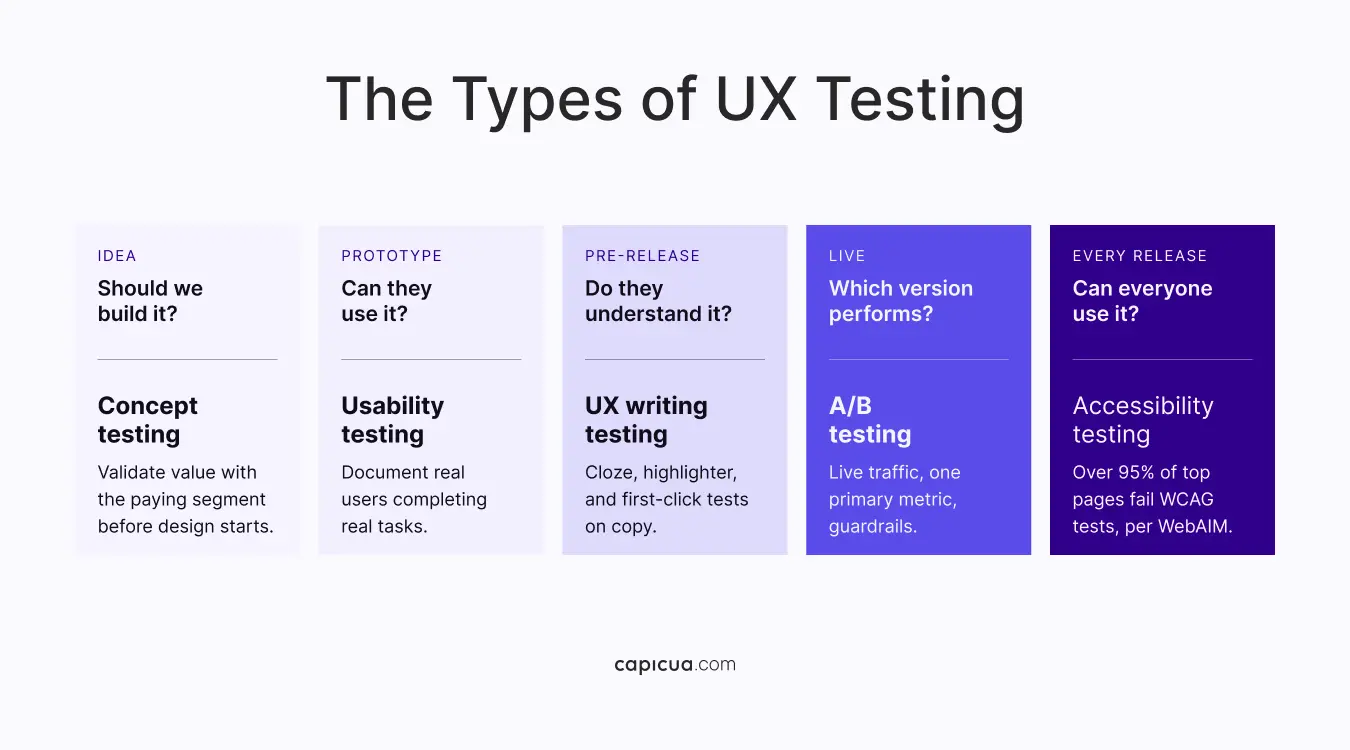
The main types of UX testing are concept testing, moderated and unmoderated usability testing, prototype testing, information architecture testing, UX writing and content testing, preference and first-click testing, A/B testing, and accessibility testing. Each answers a different question, so the right choice follows the decision at stake.
- Concept testing validates whether an idea solves a meaningful problem before design and engineering invest in it.
- Moderated usability testing is a facilitator who watches participants complete realistic tasks and probes the reasons behind their behavior.
- Unmoderated usability testing trades depth for speed and sample size, with participants completing recorded tasks on their own.
- Prototype testing evaluates interactive prototypes before development, with AI prototyping tools making it more practical to test complex interfaces.
- Information architecture testing leverages card sorting and tree testing to reveal whether navigation and labels match how users group and look for things.
- UX writing and content testing measures whether copy is understood and acted on.
- Preference and first-click testing compares design directions and checks where users expect to start a task.
- A/B testing compares live variants with real traffic and statistical confidence.
- Accessibility testing confirms people using assistive technology can complete core tasks.
A Human Factors review found that performance measures (19%), the NASA-TLX questionnaire (12%), and eye fixations (11%) were the most common ways usability studies captured cognitive load. However, common UX testing failures include lacking task randomization, analyzing transcripts while ignoring on-screen behavior, or blurring interviews and usability tests into a single study that does neither well.

How To Run Concept Testing in UX
Concept testing UX research presents an idea, value proposition, or low-fidelity representation to target users to learn whether it solves a real problem before design and engineering commit; since nothing has been built yet, it's the cheapest point in the product lifecycle to discover whether a feature is unwanted.
Concept tests protect expansion bets, such as new modules, pricing tiers, AI capabilities, or a move upmarket. In this context, a clear design statement gives the test something specific to validate, and discovery sessions supply the problem context.
Running a concept test is a 6-step process:
- Name the decision and the kill criteria: Agree in advance what result would stop, reshape, or greenlight the idea.
- Use the lowest fidelity that conveys value: A one-page narrative, a storyboard, or a clickable flow is usually enough.
- Recruit from the segment that will pay: Friendly power users and internal teams inflate enthusiasm.
- Ask about current behavior before reactions: How people solve the problem today predicts adoption better than how they rate a hypothetical.
- Compare concepts deliberately: Show each participant one concept for clean reactions, or several in rotated order for direct comparison.
- Decide and document: Record what you learned and the call you made so the next quarter doesn't relitigate it.
A key thing to notice here is how AI has changed both sides of concept testing. For builders, a polished AI prototype can still hide weak patterns and confusing hierarchies, so a designer still needs to review it before reaching users. For participants, synthetic users promise instant feedback, yet in an NN/g comparison study, humans gave more than 50 distinct answers while the synthetic respondents collapsed onto about a dozen. Synthetic data can be the groundwork for hypotheses, but human participants are still the evidence.
UX Writing Test Methods That Work
A UX writing test measures comprehension and action by evaluating whether interface copy, including labels, error messages, onboarding text, empty states, and AI responses, helps users understand what to do next. According to NN/g, users read only about 20% to 28% of the text on a page, so the words that do get read carry disproportionate weight.
Consider these actions to run a successful UX writing test:
- Cloze test: remove every few words from a passage and ask participants to fill the gaps; if the text is comprehensible to that audience, they can complete it accurately.
- Highlighter test: participants mark phrases that build confidence in one color and phrases that create doubt in another to quickly expose jargon and risky promises.
- First-click test with copy variants: keep the layout fixed, change only the labels, and see which wording sends users to the right place.
- Comprehension check after a task: ask participants to explain, in their own words, what a setting or message means.
- Content preference and tone interviews: compare voice options with real users, especially for sensitive moments such as billing errors or AI uncertainty.

A/B Testing Checklist for Product Leaders
A/B testing UX decisions means splitting live traffic between two or more variants and measuring which one moves a predefined metric with statistical confidence. It fits when a product has enough traffic, a measurable outcome, and a hypothesis grounded in earlier qualitative evidence.
Wingify's (VWO) Experimentation Benchmark, covering 193,000 experiments and 270,000 variations across 38,000 websites in 17 industries, shows that CTA copy, the most-tested tactic, wins about 10% of the time, and click-through rate experiments land near 10% as well. Most winning campaigns deliver steady, modest gains, while large lifts are rare.
Many B2B products lack the traffic to show significant gains from small UI changes, so A/B testing works best on high-volume surfaces such as signup, onboarding, pricing pages, and in-app upgrade prompts. Furthermore, an A/B test reveals which variant won, and qualitative UX testing explains why, which helps inform the next hypothesis.
The A/B testing checklist includes:
- Tie the hypothesis to evidence from usability sessions, support tickets, or analytics.
- Define one primary metric and the guardrail metrics that must not drop.
- Calculate sample size and minimum duration before launch.
- Avoid stopping early on a promising trend.
- Segment results by meaningful cohorts, such as new versus existing accounts or plan tier.
- Agree on the decision rule in advance: ship, iterate, or archive the learning.

Which UX Testing Questions Should Product Leaders Ask?
The most useful UX testing questions come in two sets: the questions leaders ask before approving a study, and the questions moderators ask participants during it. The first set protects the decision; the second protects the data.
Questions to Ask Before A UX Testing Study
- What decision will this test inform?
- What result would change our plan?
- Which risk are we retiring: value, usability, comprehension, accessibility, or performance?
- Who exactly must participate, and who must we exclude?
- What evidence threshold counts as a pass?
- Who owns acting on the findings, and by when?
UX Testing Questions to Ask Participants
- Context: "Walk me through the last time you handled [task]. What tools did you use?"
- Prompt: "You need to [goal]. Show me how you would do that here." Phrase tasks as goals, without the interface's own labels.
- Expectation: "Before you click, what do you expect to happen?"
- Post-task: "How easy or difficult was that, and what made it so?"
- Comprehension: "In your own words, what does this message mean for your account?"
- Value: "What, if anything, would stop you from using this at work next week?"
- Wrap-up: "How would you describe this product to a colleague?"
Replace leading prompts such as "Do you like this feature?" with neutral ones such as "How would this change the way you handle [task] today?" Capicua's breakdown of types of bias in research explains how question wording skews results.
How to Build a UI and UX Testing Cadence That Scales
The share of organizations calling research essential to all levels of strategy rose from 8% to 22% in a year, and 82% of respondents said human judgment remains essential for interpreting nuance, even as 69% now use AI in research. A practical cadence for a Series A to C team looks like this:
- Concept testing at every quarterly planning cycle for the largest bets.
- UI UX testing sessions with five to eight users every sprint or two on in-flight work.
- UX writing tests before any release that changes onboarding, billing, permissions, or AI responses.
- A/B testing on high-traffic surfaces, informed by qualitative findings.
- Accessibility checks on every release, with assistive-technology users on major launches.
- A shared repository where findings, decisions, and ideas from sessions such as UX brainstorming stay searchable.
Shaped Clarity™ starts with what the next decision requires to align product, design, and engineering, and ensures every test, session, and experiment across UX testing feeds a product that learns as the market moves. Learn more about Shaped Clarity.
Conclusion
UX testing has never been cheaper to run or easier to fake; the benefit comes from treating testing as a decision system: concept testing before commitment, usability and UX writing tests before release, A/B testing where traffic allows, and accessibility checks on every ship. Start with the next decision on your roadmap and ask what it would take for a real user to prove it right or wrong.
Turn roadmap bets into evidence with a UX testing practice built for scale: contact us or book a call.