


Your team adopted AI coding agents a year ago: output went up, pull requests multiplied, and the roadmap looked faster on paper. Yet, against all odds, rework started: features that technically worked but missed the business intent, reviews that took longer than the build, and senior engineers pulled into firefighting instead of architecture. The agents did exactly what they were told, but nobody told them clearly enough.
As AI now writes or assists 65% of the code developers commit, the scarce resource in software teams has shifted from typing speed to clarity of intent. This guide will explain what is spec-driven development, how a strong spec definition works, and how founders and product leaders can adopt spec-driven AI development without slowing their teams down or reinventing waterfall.
What is Spec-Driven Development (SDD)?
Spec driven development (SDD) is a software development approach in which the primary source of truth is a written, version-controlled specification, and code is generated, checked, and updated against it. In spec-driven dev, humans define what the product must do, why, and under which constraints; and AI coding agents plan, break down, and implement the work with the spec anchoring every decision.
Of course, spec driven dev is older than generative AI, but it has gained new urgency once agents started producing most of the code, with an arXiv practitioner paper describing the three levels of spec-driven development teams can choose from:
- Spec-first: the spec is written before implementation to guide the agent, then may drift once code ships.
- Spec-anchored: the spec is maintained alongside the code and updated whenever behavior changes.
- Spec-as-source: humans edit only the spec, and code is treated as a generated artifact.
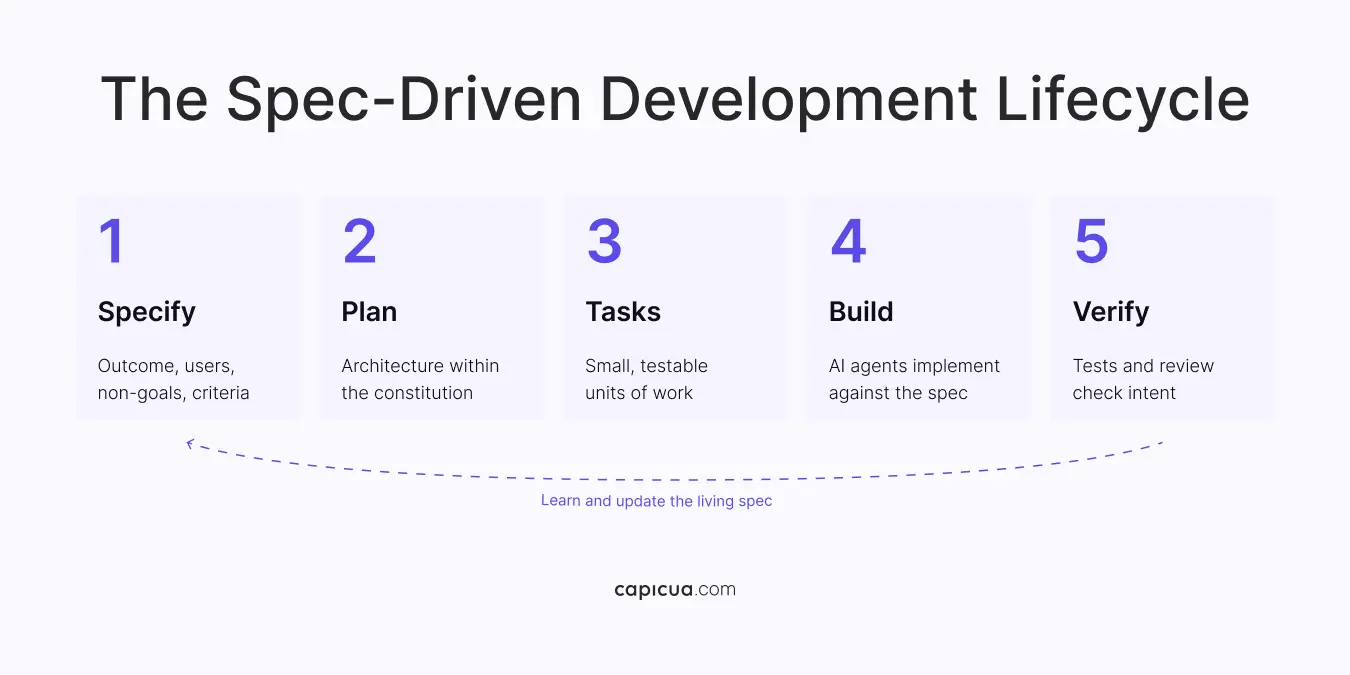
Tooling has matured quickly around these levels, with GitHub's open-source Spec Kit reporting more than 130,000 GitHub stars and 38 agent integrations, and structuring work as specify, plan, tasks, and implement. The Thoughtworks Technology Radar also noted that spec-driven development featured prominently in its discussions and that several of its teams use GitHub Spec Kit on existing, brownfield systems.
Spec-Driven AI Development Matters for Scaling Teams
Spec-driven AI development matters because AI has shifted the bottleneck from writing code to verifying it, and you can't verify without a clear statement of what "correct" means.
Today, 76% of developers and engineering managers agree they generate AI code faster than they can verify it, and 53% now spend more time reviewing code than creating it. Still, only 6.6% of developers trust AI output for important decisions. Moreover, per New Relic research, 94% of technology leaders rated AI-generated code as higher quality at review, yet 78% reported more incidents after deployment and 74% said at least a quarter of AI code needed significant rework.
Explicit expectations change outcomes, which is the economic case for spec development: the spec becomes the yardstick that makes fast review possible. However, with Gartner expecting that, by 2028, more than half of enterprises will stop buying assistive AI tools, outcome-focused AI needs written-down outcomes, which is what a specification provides.

What Makes a Strong Spec Definition?
A strong spec definition is a concise, testable description of the outcome a feature must create, the constraints it must respect, and the evidence that will prove it works. It reads like a contract between product intent and engineering execution, written so that both people and AI coding agents can act on it without improvising.
In practice, the specs that hold up under agentic workflows share six components:
- Problem and outcome: the user or business problem, and the measurable result that signals success.
- Users and context: who the feature serves, in which workflow, and with which prior knowledge.
- Scope and non-goals: what is in, and what is explicitly out, so the agent does not fill gaps with assumptions.
- Constraints: architecture patterns, technology versions, security and compliance rules, performance budgets.
- Acceptance criteria: concrete, testable conditions, ideally expressed as scenarios that can become automated tests.
- Open questions and decisions: a short log of tradeoffs made, so the next contributor understands the reasoning.
There is a project-level rulebook above individual projects, called a "constitution" by Spec Kit, which, when used properly, captures project scope, domain context, technology versions, coding standards, and repository structure. A constitution also carries the risk of instruction bloat and lengthy markdown that becomes hard to review, so the best spec definition is the shortest one that still removes ambiguity. A sharp design statement frames the problem to solve, and clear boundaries are the first defense against scope creep.
How to Adopt Spec-Driven Dev Without Recreating Waterfall
The safest way to adopt spec-driven dev is to do it incrementally: start with one high-impact workflow, keep specs small, and treat them as living documents that evolve with releases.
Heavy upfront documentation recreates the waterfall problems agile teams escaped; lightweight, versioned specs keep the speed while adding direction. A practical adoption sequence looks like this:
- Pick a contained, valuable workflow: Choose a feature area with recurring rework or high review load, where clarity gains will be visible within one or two cycles.
- Write the constitution first: Capture architecture decisions, standards, and domain language once, so every spec inherits them.
- Spec only the change: For existing systems, express changes as deltas against a persistent source-of-truth spec.
- Run the loop: a "spec, plan, tasks, code, review" lifecycle can surface issues earlier, where rework had previously stemmed from unclear intent and hidden assumptions.
- Turn acceptance criteria into automated checks: Specs guide agents, but tests enforce them. Executable verification turns a document into a contract.
- Update when reality changes: When users, data, or strategy shift, edit the spec first and regenerate the plan, keeping the spec anchored to the product as it actually exists.
Product defines outcomes and acceptance criteria, design contributes user context and interaction intent, and engineering owns constraints and the constitution. This shared artifact is what Capicua described in aligning product planning and engineering execution: one source of truth that every function can read and challenge.
Spec Development vs Vibe Coding: When to Use Each
Spec development fits work that must be maintained, audited, or scaled, while vibe coding (prompting an agent conversationally with minimal structure) fits disposable prototypes and quick experiments. The choice of vibe coding vs spec-driven development depends on how long the code will live and how costly a misunderstanding would be:
- Choose vibe coding for throwaway prototypes, spikes, internal demos, and hypothesis tests where learning speed matters more than durability.
- Choose spec-first for new features on an established product, where intent must be clear, but the spec can be retired after release.
- Choose spec-anchored for core workflows, integrations, regulated areas, and anything multiple teams or agents will touch over time.
- Consider spec-as-source only where the domain is stable and well understood, and the team has the testing maturity to regenerate code safely.
Experienced engineers with strong clean code and architecture habits get the most value from these workflows, which means spec-driven development amplifies the discipline a team already has. The takeaway is portfolio thinking: prototype freely to learn, then graduate validated ideas into specs before they become part of the product customers depend on.

Shaped Clarity™ is Capicua's lens for turning user signals, business goals, and technical constraints into decisions teams can build on, which is exactly the input a living specification needs. Applied to spec-driven AI development, it keeps specs grounded in validated user evidence, so products adapt to change, learn from users, and grow market share instead of accumulating AI-generated rework. Learn more about Shaped Clarity.
Conclusion
Spec-driven development reframes product leadership in the agentic era. When AI agents can produce working code in minutes, the decisive advantage moves to the teams that can state, precisely and briefly, what should exist and why. The spec becomes the place where strategy, design, and engineering meet, and the yardstick that enables fast verification.
To turn AI speed into products your users trust, contact us or book a call with Capicua.